

 08/22/2026
  Steve Bearden
79% of consumers actively engage with the mail they receive, yet many marketing teams still treat their budgets as moving targets. With the July 12, 2026, USPS rate increase pushing domestic postcards to 65 cents and metered letters to 78 cents, a generic direct mail quote is no longer sufficient for sophisticated, high-volume operations. You likely recognize that physical mail drives a 4.4% response rate, far outperforming digital channels. However, the difficulty of coordinating disparate print and fulfillment vendors often erodes those gains through hidden fees and production delays.
It’s time to move beyond transactional pricing and toward a strategic partnership that prioritizes industrial precision. This guide will show you how to navigate the technical factors influencing direct mail costs in 2026, from leveraging Variable Data Printing for hyper-personalization to utilizing automation for maximum postage savings. We’ll explore how a centralized production-to-mailbox workflow provides the predictability you need to secure a quote that maximizes your marketing ROI and scales alongside your business goals.
Key Takeaways
- A professional direct mail quote serves as a strategic blueprint that integrates production, data management, and logistics into a unified project estimate.
- Technical factors like mail piece dimensions and Variable Data Printing workflows are primary drivers that dictate the complexity and cost of your campaign.
- Postage remains the largest variable in any mailing budget, often representing over half of the total investment required for high-volume outreach.
- Securing an accurate estimate depends on a detailed preparation checklist that covers everything from paper stock weight to specific delivery timelines.
- Centralizing your project within an integrated, technology-first facility ensures a predictable workflow and higher ROI through streamlined execution.
Beyond the Unit Price: What a Comprehensive Direct Mail Quote Includes
A professional direct mail quote is far more than a single line item on a spreadsheet. It represents a multi-layered estimate that coordinates production, data processing, and complex logistics into a unified project plan. When you evaluate an estimate, you’re looking at the cost of precision. Production expenses involve specific choices in paper stock, ink coverage, and specialized binding or finishing options that define the tactile experience of your brand. Direct mail as a channel relies on these physical details to command attention, but a strategic quote must also account for the invisible work behind the scenes.
Data processing fees are a critical component of any reliable estimate. These include essential list hygiene services, National Change of Address (NCOA) updates, and deduplication to ensure you aren’t paying to mail to the same person twice. Additionally, fulfillment and kitting costs cover the manual or automated labor required for complex assembly, such as multi-piece inserts or personalized tipping. These elements ensure that your message reaches the right mailbox in the exact format intended, protecting your budget from avoidable waste.
The Three Pillars of Mailing Estimates
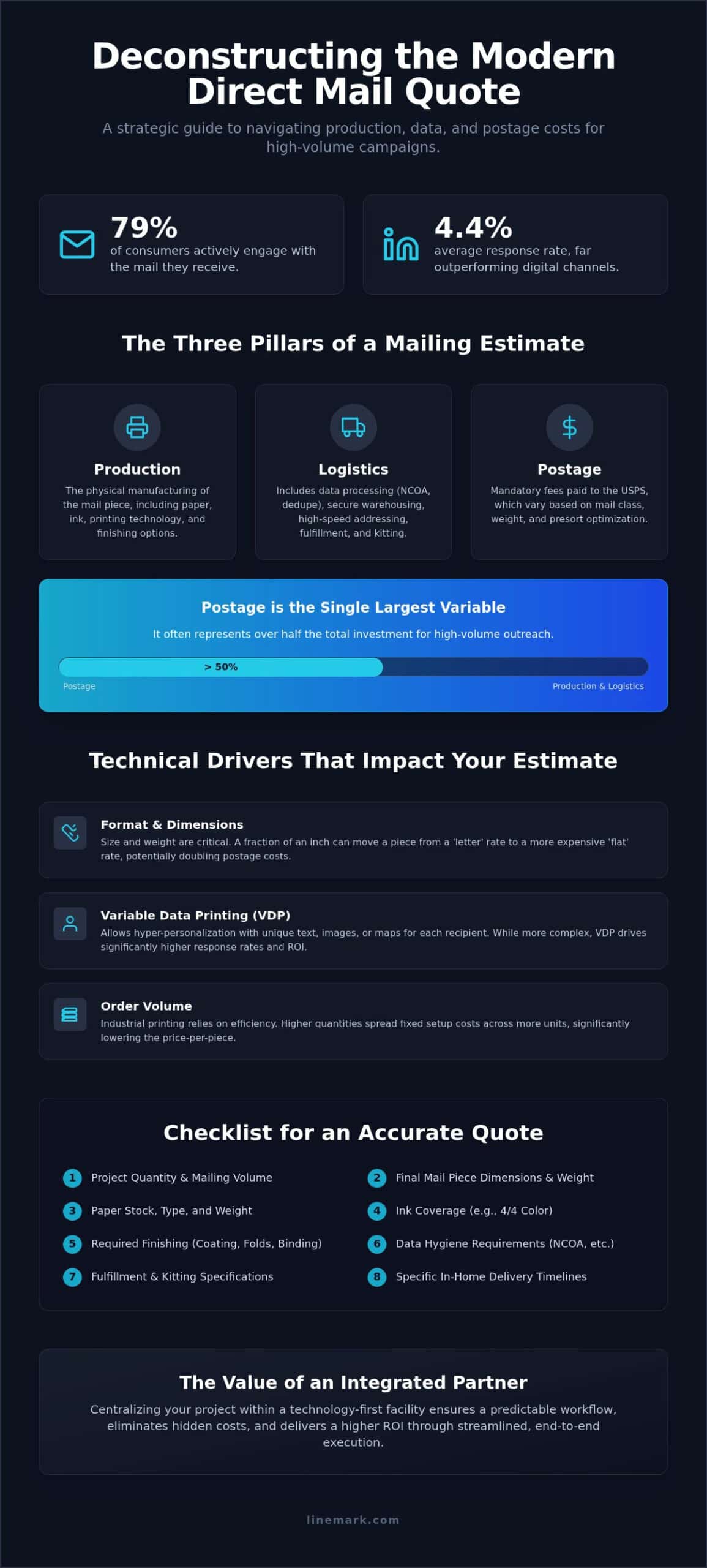
We view every project through three distinct lenses to ensure operational excellence and cost transparency. A comprehensive estimate will clearly break down these areas:
- Production: The physical manufacturing of the mail piece using digital or offset technology tailored to your specific volume and quality requirements.
- Logistics: The secure warehousing, high-speed addressing, and movement of materials to the optimized postal entry point.
- Postage: The mandatory fees paid to the USPS, which vary based on mail class, weight, and presort optimization.
Why “Cheap” Quotes Often Lead to Hidden Costs
Low-cost estimates often hide risks that can derail a high-volume campaign. If a quote excludes data verification, you’ll likely pay more in undeliverable mail than you saved on the initial processing fee. Poor-quality paper stock is another common pitfall; thin or inconsistent materials often lead to postal machine rejects, causing significant delays and surcharges. A comprehensive direct mail quote should proactively address these technical details to prevent budget creep.
Choosing integrated direct mail services reduces these risks by keeping production and mailing under one roof. This centralized approach eliminates vendor miscommunication and ensures that every technical specification aligns with postal regulations from day one. It’s a proactive way to maintain a predictable workflow and protect your marketing ROI through every stage of the production cycle.
Technical Drivers: How Format and Personalization Impact Your Estimate
The physical specifications of your campaign are the most direct influences on a direct mail quote. Dimensions and weight don’t just dictate paper costs; they determine your eligibility for specific postage tiers. A shift of just a fraction of an inch can move a piece from a “letter” rate to a “flat” rate, potentially doubling your mailing costs. Beyond size, the choice of substrate and finish adds both aesthetic value and durability. Options like UV coating or soft-touch matte finishes protect the piece during high-speed sorting, ensuring it arrives in pristine condition. Order volume also plays a massive role. Industrial printing relies on setup efficiencies. As your quantity increases, the fixed costs of machine calibration and plate making are spread across more units, significantly lowering the price-per-piece.
The Role of Variable Data Printing (VDP)
Personalization is no longer a luxury; it’s a performance requirement. Variable Data Printing (VDP) allows for the seamless integration of personalized images, maps, and text for every unique recipient in your database. While this requires a more sophisticated digital workflow than static printing, the investment often pays for itself through higher response rates. A VDP-enabled direct mail quote accounts for the specialized software and data processing needed to sync your mailing list with the creative assets. Our technology-first approach ensures that these complex datasets are handled with industrial precision, maintaining the integrity of your brand across thousands of unique impressions. High-ROI teams use this technology to move beyond simple name-merging, creating 1:1 marketing pieces that speak directly to the recipient’s past behavior or geographic location.
Selecting the Right Format for Your Goals
Different campaign objectives require different physical formats. Postcards are often the most cost-effective entry point, especially when utilizing programs like Every Door Direct Mail for local saturation. For example, a service-based business like Yardworx Lawn & Landscape can leverage these tools to reach specific residential routes with seasonal offers. However, if your message requires more space or privacy, self-mailers or envelope packages might be necessary. A letter-sized piece must meet specific aspect ratios to qualify for automated sorting. Deviating from these standards can lead to manual handling surcharges that significantly inflate your final costs. It’s also worth exploring how techniques from large format graphics can be adapted for high-impact dimensional mailers that stand out in a crowded mailbox. If you’re unsure which format aligns with your budget and goals, you can consult with a technical expert to optimize your design for the best possible rates.
Postage is the silent giant of marketing logistics. It typically accounts for 50% or more of your total campaign investment, yet many organizations view it as a fixed, unchangeable tax. A sophisticated direct mail quote should treat these costs as a variable that can be optimized through technical precision and industrial scale. By aligning your design, data, and distribution strategy with current postal regulations, you can capture significant savings that directly impact your bottom line.
Understanding Mail Classes
The choice of mail class is a balance between speed and budget. Your quote should clearly distinguish between these options to help you make an informed decision:
- First-Class Mail: This is the gold standard for time-sensitive materials. It offers guaranteed delivery windows and includes return service for undeliverable pieces, making it ideal for financial notices or urgent offers.
- Marketing Mail: This is the most common choice for high-volume acquisition. It provides substantial discounts for campaigns where delivery speed is secondary to reach and frequency.
- Non-Profit Rates: Organizations with 501(c)(3) status can access even deeper discounts. We assist in managing the required documentation to ensure your campaign qualifies for these specialized tiers.
Postage Optimization Strategies
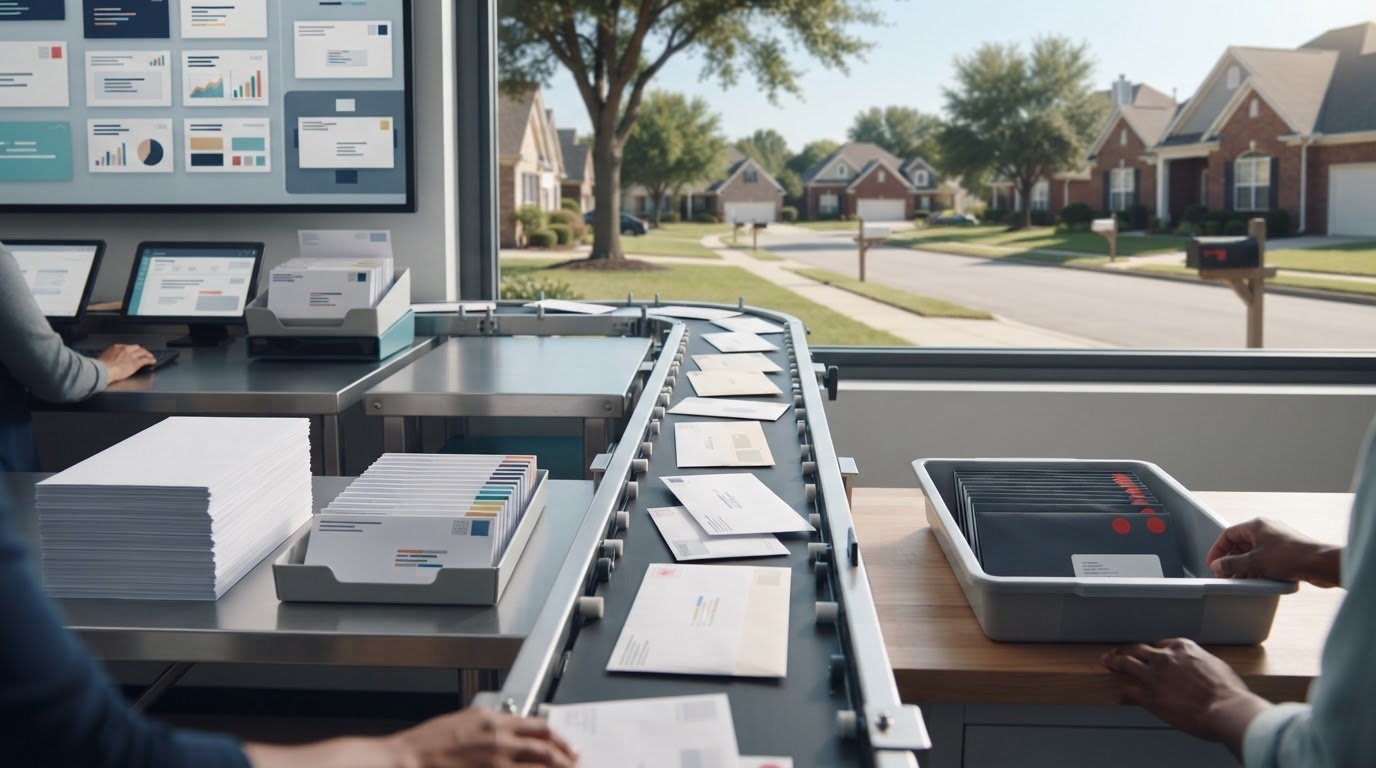
Efficiency in mailing is achieved through a combination of data hygiene and logistical expertise. We utilize advanced address list cleaning tools, such as NCOA and CASS, to prevent you from paying postage on undeliverable mail. This process ensures your data is accurate and compliant with the latest postal standards before the first piece is ever printed.
Beyond data, we leverage our nationwide distribution infrastructure to implement drop-shipping strategies. For national campaigns, we transport your mail directly to regional postal hubs. This bypasses multiple layers of the postal network, which often results in faster delivery and lower overall costs. When you review your direct mail quote, these logistical efficiencies should be evident, reflecting a partnership that values operational excellence as much as creative impact. Small design adjustments, such as modifying the aspect ratio to qualify for automation discounts, are also part of this holistic optimization process.
Preparation Checklist: Information Needed for an Accurate Production Quote
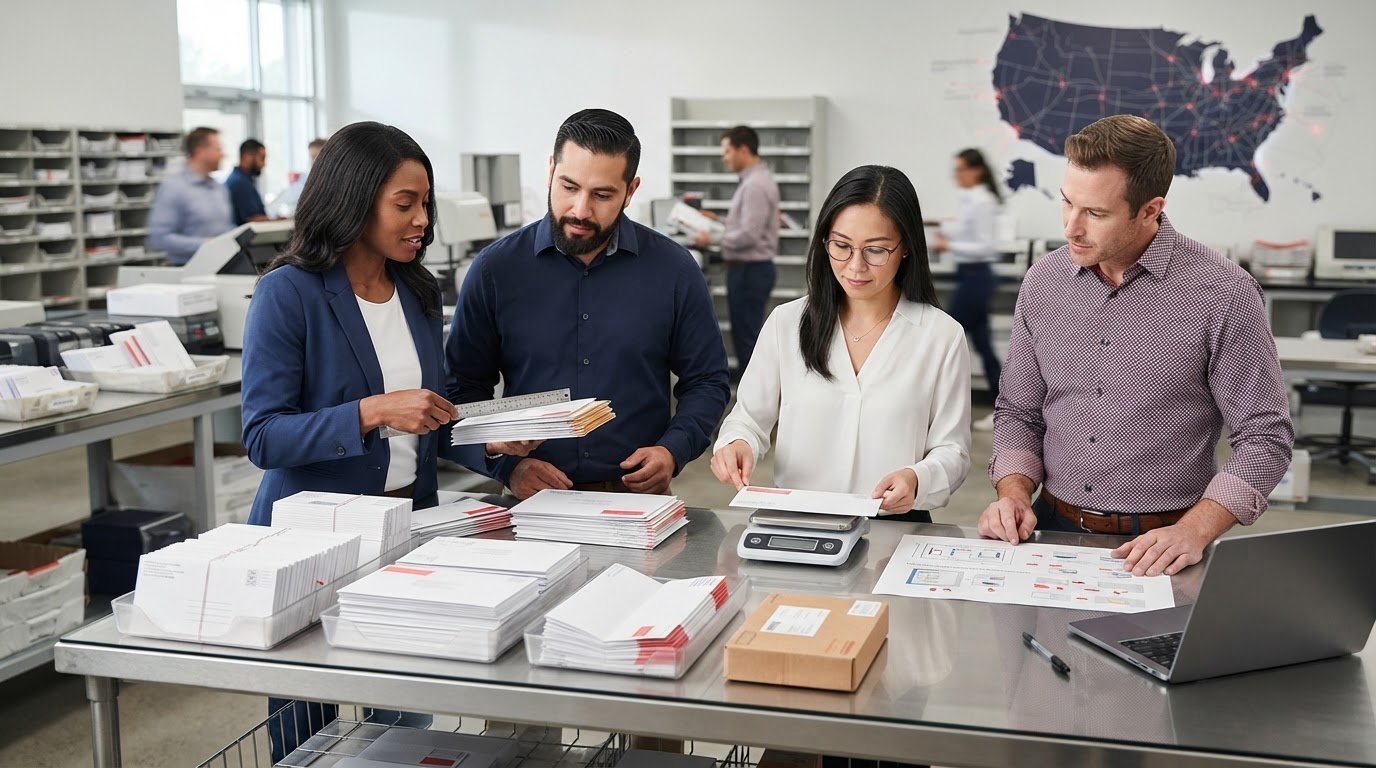
Precision begins with documentation. To receive a high-fidelity direct mail quote, you must provide a granular breakdown of your campaign’s technical requirements. Vague estimates often lead to budget overruns or production delays. Start with clearly defined objectives and your targeted in-mailbox date. This allows our production team to work backward, identifying the most efficient equipment and labor schedules to meet your timeline without sacrificing the industrial quality your brand demands.
Physical specifications are the bedrock of the estimate. We need to know the exact dimensions, weight, and paper stock weight, typically measured in GSM or point size. These details dictate whether your project is best suited for high-volume offset printing or our advanced digital presses for shorter, more targeted runs. Quantity estimates are equally vital; higher volumes unlock setup efficiencies that lower your per-unit cost. Additionally, specify the source of your data. Let us know if you’ll provide a cleaned mailing list or if you require us to source targeted data to meet your acquisition goals.
File Preparation and Design Specs
Successful production relies on files that are ready for the press. Your design must include standard bleeds and strictly adhere to postal clear-zone requirements to avoid manual sorting surcharges. If your project requires sophisticated binding & finishing, such as wafer sealing, gate-folding, or specialized scoring, these must be noted in the initial request. Finally, clarify whether you need our team to handle only the production or if you require creative assistance to optimize the layout for postal compliance.
Logistics and Fulfillment Requirements
A comprehensive estimate accounts for the journey after the ink is dry. If your campaign involves multiple personalized components, specify your kitting needs. This might include inserting a personalized letter and a brochure into a window envelope with matched-mail precision. For recurring programs, determine if you require long-term storage or inventory management within our facility. Clearly define your distribution scope, whether it’s a single national drop or a multi-phase rollout designed to align with your internal sales capacity. To get started on your next high-volume project, request a customized direct mail quote from our technical team today.
Scaling with Linemark: Integrating Production, Data, and Nationwide Fulfillment
Scaling a campaign requires more than just a printer; it demands a strategic ally capable of handling high-volume complexity with industrial authority. We eliminate the friction of managing separate print, data, and fulfillment vendors by providing a unified partnership model that prioritizes your end goals. When you request a direct mail quote from us, you aren’t just receiving a price for paper and ink. You’re accessing over 30 years of industrial communications expertise and a technology-first approach to data integration. This foundation ensures that even the most complex 1:1 personalized campaigns are executed with the precision of a boutique shop and the power of a large-scale operation.
The Efficiency of a Centralized Facility
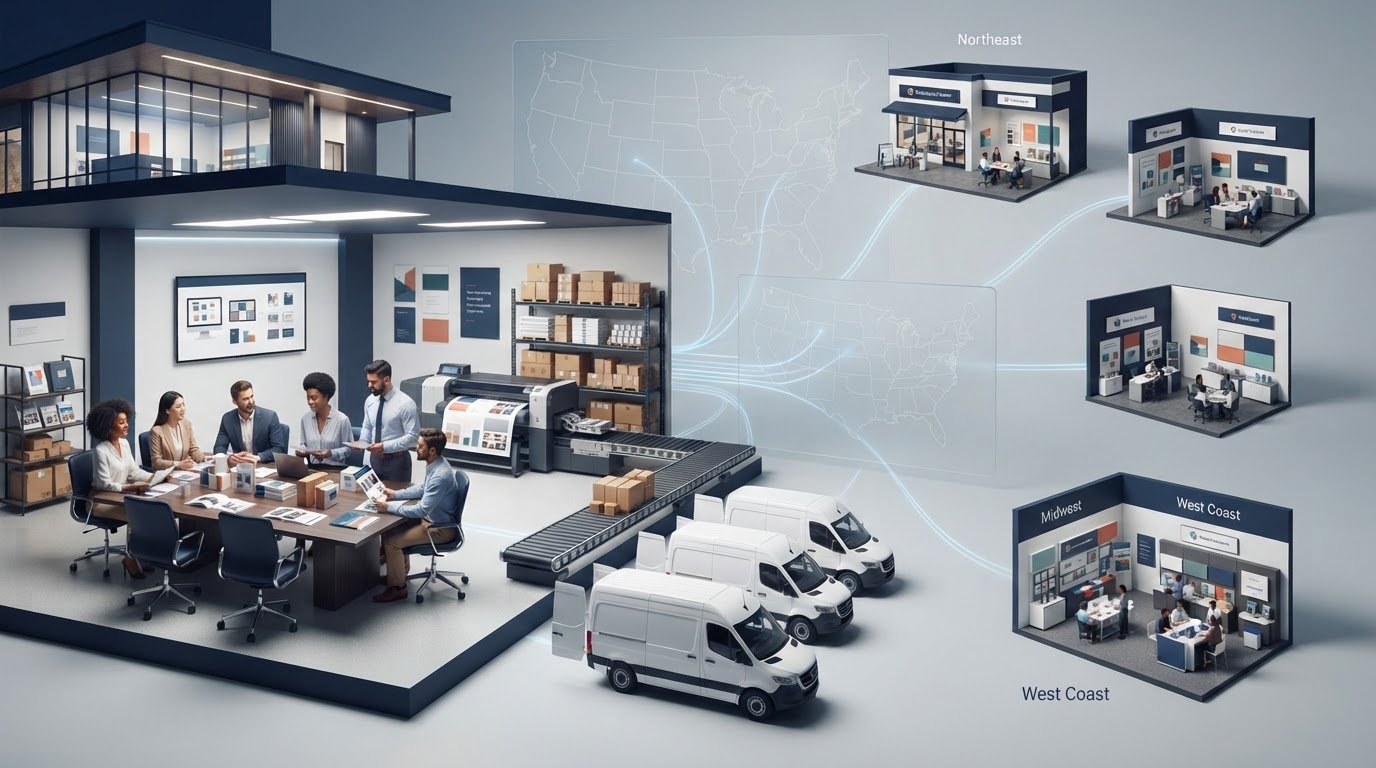
Our 90,000-square-foot integrated production facility is engineered specifically for operational excellence and integrated workflows. Having production and fulfillment in one location significantly reduces lead times by removing the need to transport materials between different service providers. This centralized approach also allows for more competitive pricing across both high-volume offset runs and smaller, agile digital print projects. From this single hub, we leverage a robust nationwide distribution and storage infrastructure. This allows us to handle national rollouts with ease, maintaining a steady and confident rhythm from the initial press check to the final postal drop. The result is a well-oiled machine that handles any scale of work without sacrificing the quality your brand expects.
MarCom On-Demand: Managing Recurring Direct Mail
For organizations managing recurring mailing needs across various regions or departments, our marcom on-demand portal serves as a centralized destination for distributed marketing. This platform allows your team to automate ordering processes while maintaining absolute brand consistency across every piece of collateral. Partners gain access to real-time tracking and comprehensive inventory reporting, providing the security of knowing exactly where their materials are at any given moment. This level of visibility is a catalyst for client growth, as it allows for more precise budget management and faster response times to market changes. Incorporating these technological advancements into your direct mail quote transforms a transactional exchange into a premium, holistic journey that supports long-term growth and predictable campaign costs.
Optimizing Your 2026 Direct Mail Strategy
A successful campaign in 2026 requires more than just a competitive price. It demands a technical partnership that integrates data precision with industrial scale. By focusing on postage optimization and leveraging advanced Variable Data Printing, you can transform a standard mailing into a high-performance marketing asset. Prioritizing format choices and list hygiene directly impacts your bottom line, making the thorough preparation of your specifications a vital step in the process.
Linemark provides the infrastructure to turn these strategic goals into reality. Our 90,000-square-foot high-capacity production facility and over 30 years of industrial printing expertise ensure your project is handled with meticulous detail. We utilize advanced VDP and automated fulfillment technology to streamline your workflow from the initial press check to the mailbox. When you’re ready to move beyond transactional estimates, Request a Strategic Direct Mail Quote from Linemark. We’re here to help you navigate the nuances of modern logistics and achieve the predictable, high-ROI results your organization requires. It’s time to build a mailing program that scales with your ambition.
Frequently Asked Questions
How long does it take to receive a direct mail quote?
Standard requests typically receive a response within 24 to 48 business hours. Complex projects involving custom kitting or high-volume variable data integration may require additional time for a thorough technical review. Providing a complete specifications sheet during your initial inquiry ensures our team can generate a precise estimate quickly. This allows us to allocate the appropriate equipment and labor within our integrated facility to meet your specific delivery deadlines while maintaining the highest standards of quality.
Is postage included in the initial print estimate?
Postage is a pass-through cost and is typically quoted as a separate line item from production and fulfillment fees. Because postage rates are paid directly to the United States Postal Service, they aren’t subject to the same markups as manufacturing. We provide a detailed estimate of these costs based on your mail class and weight. This transparency helps you manage your total marketing budget without encountering unexpected financial surprises during the final distribution phase.
What is the minimum quantity for a commercial direct mail run?
We specialize in high-capacity production, but our advanced digital printing capabilities allow for agile, shorter runs starting around 500 pieces. For maximum cost efficiency on traditional offset equipment, quantities of 5,000 or more are often recommended to spread setup costs. The ideal volume for your direct mail quote depends on your specific goals and the level of personalization required. We scale our operations to handle millions of pieces with industrial precision and meticulous attention to detail.
Can I use my own mailing list, and does it affect the quote?
You can certainly provide your own mailing list, and this choice directly influences the data processing portion of your estimate. When you supply a list, we perform essential hygiene services like deduplication and address standardization to ensure deliverability. If you require a rented or targeted list, those procurement costs will be factored into the quote. Using a clean, provided list often reduces the initial investment while protecting your overall campaign ROI and long-term growth potential.
How does variable data printing (VDP) change the cost of a campaign?
Variable Data Printing introduces a digital processing component to your estimate, reflecting the specialized software and workflows required for 1:1 personalization. While the per-piece production cost may be slightly higher than static printing, the significant increase in response rates often yields a much higher return on investment. Our technology-first approach ensures that these complex datasets are integrated seamlessly, allowing you to speak directly to each recipient’s unique needs or past behaviors with industrial-grade precision.
What is the difference between First-Class and Marketing Mail pricing?
First-Class Mail is optimized for speed and guaranteed delivery windows, making it more expensive than bulk options. Marketing Mail, formerly known as Standard Mail, offers substantial savings for high-volume acquisition campaigns where delivery timing is more flexible. Your choice between these classes depends on your campaign’s urgency and budget constraints. We analyze your distribution goals to recommend the most cost-effective mail class that aligns with your specific communication strategy and your organization’s financial objectives.
Does the quote include the cost of address verification and NCOA?
Yes, a comprehensive estimate from our team includes essential data hygiene services like NCOA and CASS certification. These processes are mandatory for securing automation discounts and ensuring your mail reaches the intended recipient. By including address verification in the initial direct mail quote, we protect you from paying postage on undeliverable pieces. This proactive approach to data management is a cornerstone of our commitment to operational excellence and campaign cost predictability for our strategic partners.
Can Linemark handle the storage and fulfillment of my mailers?
We operate a 90,000-square-foot facility designed to manage long-term storage and complex fulfillment needs for our partners. Our infrastructure supports everything from simple inventory management to intricate kitting and nationwide distribution. This centralized model eliminates the logistical friction of moving materials between separate vendors, reducing lead times and overall costs. You can rely on our industrial capacity to handle recurring mailing programs or large-scale national rollouts with the steady, controlled pace of a seasoned expert.