

 08/21/2026
  Steve Bearden
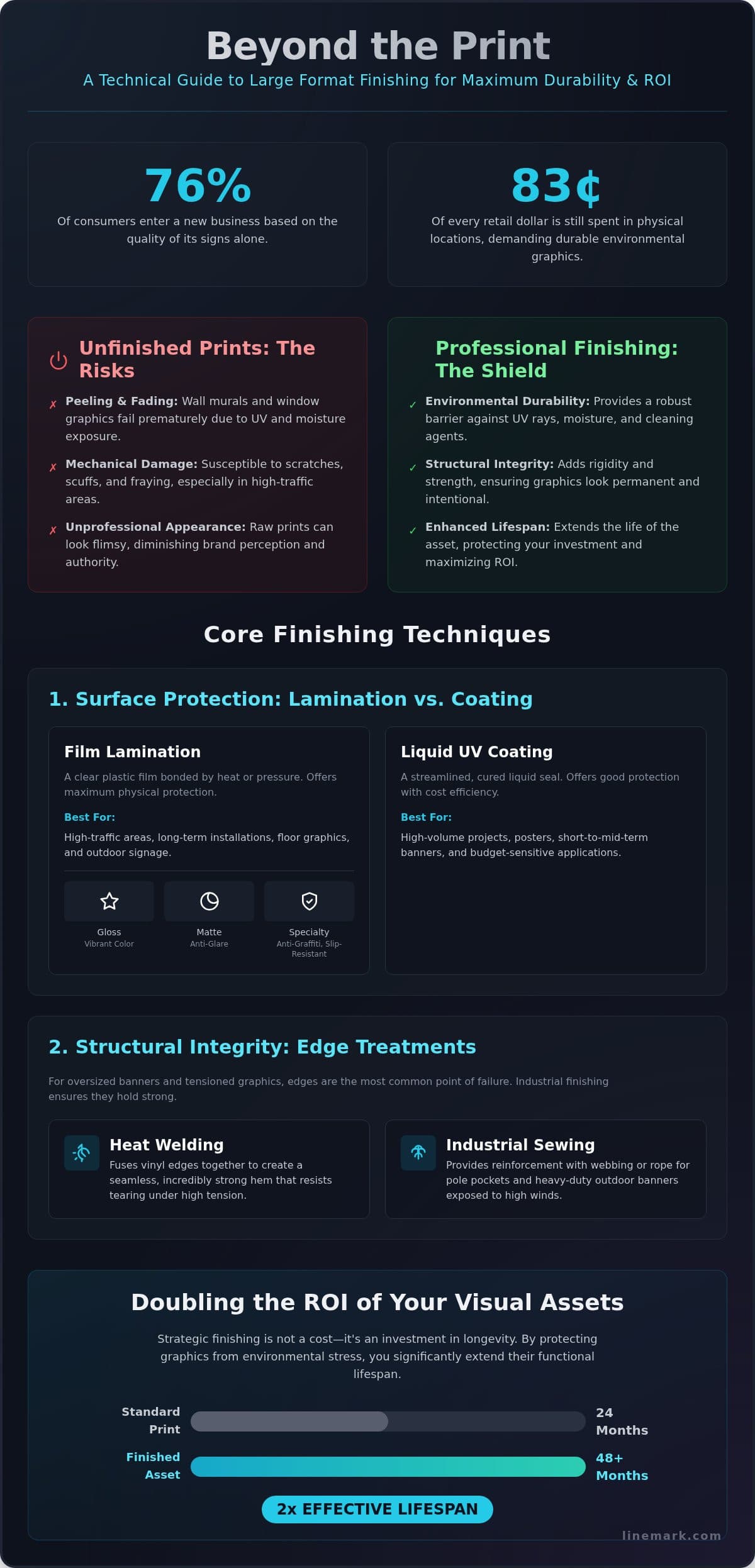
Did you know that 76% of consumers report entering a business for the first time based solely on the quality of its signs? While a striking design catches the eye, the true lifespan and ROI of your project depend on professional large format printing finishing. In a market where over 83 cents of every retail dollar is still spent in physical locations, your environmental graphics must do more than just look good on day one; they must endure.
You likely recognize the frustration of seeing a premium wall mural peel at the seams or watching window graphics lose their luster due to UV exposure. It’s a costly setback that often stems from a mismatch between material and environment. We understand that your brand’s reputation is tied to the precision of these large-scale assets, and you need solutions that guarantee consistency across every installation.
This guide provides a technical roadmap for post-print fabrication. You’ll learn how to select finishing techniques that match the specific environmental demands of your site, ensuring your graphics remain durable and high-impact. We will cover everything from material compatibility to advanced mounting options, helping you transform digital images into permanent, functional brand assets.
Key Takeaways
- Learn how finishing acts as the critical bridge between digital production and long-term environmental durability.
- Master the technical nuances of large format printing finishing, including when to choose film lamination over cost-effective liquid coatings.
- Discover how precision edge treatments like heat welding and industrial sewing provide the structural integrity required for oversized signage.
- Identify the specific environmental factors, from UV exposure to humidity, that should dictate your choice of substrate and finish.
- Understand the efficiency gains of partnering with a high-capacity facility that integrates production, finishing, and nationwide distribution.
The Role of Finishing in Large Format Production
Large format printing finishing is the essential post-print fabrication phase where a raw digital output transforms into a functional, durable environmental asset. While Wide-format printers excel at reproducing high-resolution imagery with precision, the resulting print is often vulnerable to the elements and mechanical stress. Finishing bridges the gap between a visual concept and a tangible product that can withstand the rigors of its intended environment. This stage involves specialized processes like lamination, precision cutting, and structural reinforcement that define the graphic’s final utility.
Beyond the Ink: Why Finishing Defines the Final Product
A raw print lacks the polished professional edge required for high-stakes branding and environmental signage. Without proper finishing, even the most vibrant graphics can appear unfinished or flimsy when mounted in a commercial space. Finishing adds the necessary texture, sheen, and rigidity that elevate brand perception and instill confidence in the viewer. It’s the phase where we establish structural integrity, ensuring that a wall mural or floor graphic doesn’t just look impressive but feels permanent and intentional. By adding protective layers or rigid backings, we turn a flexible substrate into a sturdy piece of communication hardware that commands attention.
Protecting Your Investment: Durability and Longevity Standards
High-capacity production requires a relentless focus on operational durability. Professional finishing prevents mechanical damage, such as surface scratches from heavy foot traffic on floor graphics or edge fraying on outdoor banners. It also provides a critical chemical barrier against common cleaning agents, environmental pollutants, and industrial grime that would otherwise degrade the ink over time. Without these safeguards, the lifespan of your graphics is severely truncated, leading to premature replacement costs and wasted budget. Professional large format printing finishing serves as the primary defense against environmental stress, ensuring oversized graphics retain their structural integrity regardless of the installation site.
Ultimately, the choice of finishing impacts the total cost of ownership for any large-scale project. While it represents an initial investment, it significantly extends the graphic’s lifecycle and maintains visual consistency across your assets. A well-finished asset can maintain its impact for a full 48-month cycle rather than a standard 24-month span, effectively doubling the ROI. By integrating these fabrication steps early in the planning process, you ensure that your brand message remains clear, consistent, and resilient across its entire operational lifespan, transforming a simple print into a strategic communication tool.
Core Surface Finishing: Lamination, Coating, and Mounting
Surface finishing is the phase where your graphic gains its physical character and environmental resistance. In professional large format printing finishing, we primarily use lamination and liquid coatings to shield the ink from external stressors. Film lamination involves heat or pressure-bonding a clear plastic layer to the print surface. This provides a robust barrier against moisture, fingerprints, and physical abrasions. For high-volume projects where budget efficiency is paramount, liquid UV coatings offer a streamlined alternative. These coatings provide a thin, protective seal that’s ideal for posters and banners that don’t require the heavy mechanical protection of a film.
Understanding these large format finishing techniques allows you to align your production choices with the specific demands of the installation site.
Lamination Options: Gloss, Matte, and Specialty Overlaminates
Choosing between gloss and matte is more than an aesthetic decision; it’s a functional one. Gloss laminates enhance color saturation and contrast, making them perfect for high-impact displays in low-glare environments. However, in brightly lit retail spaces or trade shows, matte finishes are often superior because they diffuse light and ensure readability from all angles. Beyond standard finishes, specialty overlaminates provide targeted protection. Anti-graffiti films allow for the removal of spray paint without damaging the underlying graphic, while slip-resistant laminates are a safety requirement for any floor graphics. These layers also provide essential UV protection, acting as a sunscreen for your ink to prevent premature fading.
Mounting Substrates: Choosing the Right Rigid Base
Mounting is a critical component of large format printing finishing that involves adhering a flexible print to a rigid substrate to create a self-standing or wall-mounted sign. This requires a deep understanding of material compatibility between adhesives and base surfaces to prevent delamination or bubbling over time. Common choices like Foamcore are excellent for lightweight, short-term indoor displays. For projects requiring more durability, Gatorboard provides a tougher wood-fiber veneer that resists warping. When the environment demands industrial strength, Dibond (an aluminum composite) is the standard for exterior signage. You can find a detailed breakdown of these materials in our Ultimate Guide to Large Format Graphics.
The weight and rigidity of these bases must match the installation hardware and wind-load requirements of the site. If you’re looking for a partner to manage these complex technical requirements, our team specializes in creating durable environmental graphics that maintain brand consistency across any substrate.
Structural Finishing and Industrial Edge Treatments
While surface treatments protect the visual layer, structural finishing provides the physical integrity required for installation. This phase of large format printing finishing involves transforming flexible or rigid materials into precise geometric shapes and load-bearing assets. Without industrial-grade edge treatments, even the highest quality print can suffer from fraying, structural failure, or misalignment during assembly. We utilize advanced fabrication technology to ensure that every asset meets exact dimensional specifications, whether it’s a stand-alone 3D display or a grand-format banner spanning an entire building facade.
Navigating the complex wide-format finishing landscape requires an understanding of how physical fabrication impacts the final installation’s success. It’s the difference between a graphic that merely fits and one that’s engineered for its environment.
Precision Trimming and CNC Routing for Custom Shapes
Standard rectangular prints are often insufficient for modern environmental graphics. CNC routing technology allows us to cut complex, non-rectangular shapes with microscopic accuracy. This is critical for interlocking retail displays and dimensional lettering where every piece must fit perfectly into a larger assembly. Industrial routers handle high-volume production without sacrificing the precision required for custom fabrication. By automating the cutting process, we eliminate the human error associated with manual trimming. This ensures brand consistency across hundreds of identical assets, regardless of their complexity.
Hemming, Seaming, and Grommeting for Large-Scale Displays
Oversized banners face significant physical stress from wind loads and their own weight. Hemming reinforces the edges of vinyl substrates by folding and bonding the material, creating a double-layered perimeter that prevents tearing at stress points. For grand-format murals that exceed the width of a single roll, we use heat welding or industrial sewing to seam multiple panels together. These seams are engineered to be nearly invisible while maintaining the tensile strength of the original material. It’s a precise balance of heat, pressure, and speed.
Grommeting and pole pockets are the final step in securing these displays. Strategic grommet placement is essential for distributing tension evenly across the banner. If grommets are spaced too far apart, the material will sag; too close, and the structural integrity of the hem may be compromised. We also utilize pole pockets for a cleaner, more architectural look in indoor environments. These structural details ensure that your graphics don’t just look professional on day one but remain secure and taut throughout their entire deployment.
Selecting the Right Finish for Environmental Graphics
Selecting the right large format printing finishing requires a strategic assessment of the installation environment. It’s not enough to produce a high-quality print; you must engineer it to survive its surroundings. Environmental factors like humidity, extreme temperature fluctuations, and direct sunlight can cause unprotected graphics to warp, fade, or delaminate within months. By establishing a clear selection framework, you protect your budget and ensure brand consistency across every asset.
Interior environments present their own challenges. In high-traffic corridors, graphics face constant physical contact and harsh cleaning chemicals. Heavy-duty, scuff-resistant laminates are essential in these spaces to maintain visual clarity. Safety is another non-negotiable factor. For floor graphics, you must use UL-listed, slip-resistant laminates to meet safety regulations and mitigate liability. Conversely, low-traffic areas might prioritize aesthetic depth over mechanical protection, allowing for more delicate textured finishes that invite closer inspection.
Outdoor Durability: Weatherproofing and UV Resistance
Outdoor graphics are in a constant battle with the elements. Long-term exposure requires high-performance cast laminates that offer superior UV resistance to prevent color shifts and ink degradation. Wind load is another critical technical consideration. While solid vinyl works for wall-mounted signs, mesh substrates are often the better choice for fence wraps or large building banners. Mesh allows wind to pass through the material rather than acting as a sail, which prevents structural failure. Use this checklist for outdoor finishes:
- UV-stabilized overlaminates to prevent premature fading.
- Waterproof edge sealing for rigid substrates like Dibond or Gatorboard.
- Heat-welded hems to withstand high wind velocity and tension.
- Anti-graffiti coatings for graphics in accessible public areas.
Indoor Aesthetics: Enhancing Retail and Corporate Environments
In corporate and retail settings, lighting is often your biggest obstacle. Standard gloss finishes create distracting hotspots under heavy artificial lighting, which can obscure your message. Non-glare matte or satin finishes ensure that your wall murals and window graphics remain legible and impactful from every angle. These elements are vital for brand immersion, turning static spaces into dynamic communication hubs. Maintaining these high standards across multiple locations requires a centralized approach to production. You can explore our Strategic Guide to Distributed Marketing to learn more about keeping brand assets consistent nationwide.
Our expertise ensures your graphics are matched to their environment with surgical precision. If you’re ready to secure your brand’s visual impact and ensure long-term durability, partner with Linemark for your next large format project.
Integrated Large Format Solutions with Linemark
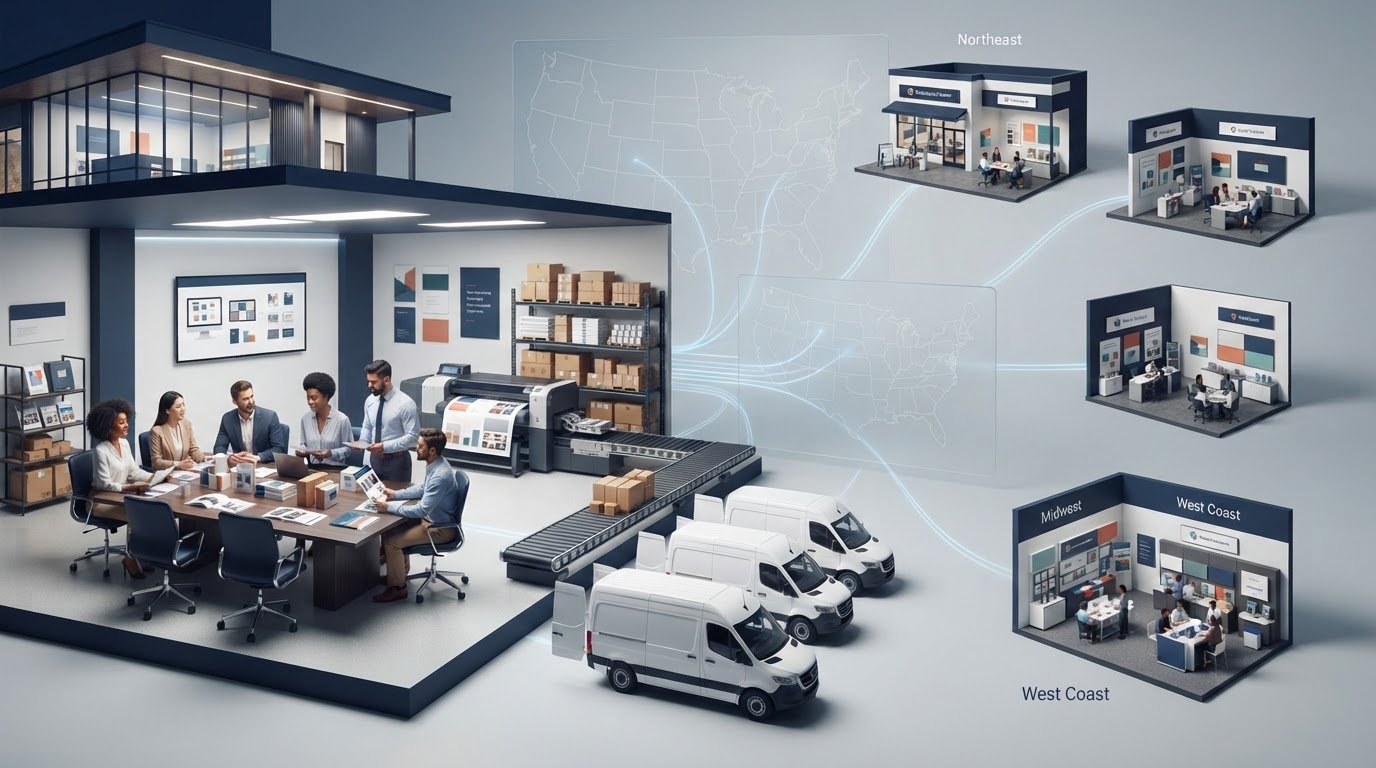
Choosing a production partner involves more than evaluating print quality; it requires assessing the operational infrastructure behind the machine. Linemark serves as a centralized hub for high-capacity projects, where we integrate every phase of the project lifecycle under one roof. By maintaining total control over the large format printing finishing process within our 90,000-square-foot facility, we eliminate the delays and quality variances common with outsourced fabrication. This integrated approach ensures that every wall mural, window graphic, and banner meets the same rigorous standards of precision and durability.
Efficiency is the byproduct of a well-oiled machine. Our facility is engineered to handle complex, high-volume runs that require meticulous attention to detail. When you consolidate production and finishing, you gain a streamlined workflow that moves seamlessly from the printer to the finishing table and finally into kitting and fulfillment. This centralized model ensures that every large format printing finishing requirement, from precision routing to UV coating, is executed with industrial-grade accuracy. It’s an operational advantage that provides organizations with a single point of accountability for both quality and logistics.
High-Capacity Production and On-Site Installation Coordination
With over 30 years of industrial experience, our facility is equipped to scale rapidly for large-scale orders without sacrificing the precision your brand demands. We understand that the journey doesn’t end when the print is finished. Professional installation coordination is a vital component of our service model, ensuring that complex graphics are applied correctly to maximize their functional lifespan. Linemark remains committed to absolute precision in every high-volume run, providing the industrial authority needed to execute your most ambitious environmental projects across the nation.
Strategic Partnerships: From Design to Nationwide Distribution
We position ourselves as a strategic communications ally, supporting your team from initial material selection through to nationwide distribution. Our MarCom On-Demand portals allow marketing professionals to manage large format assets with ease, ensuring that localized branches can order brand-compliant graphics that are produced and shipped from our central facility. This system reduces waste and maintains brand integrity across every geographic location. If you’re ready to streamline your large-scale communication projects, contact us to consult on a tailored production and logistics strategy for your next rollout of wall murals, banners, and signage.
Secure Your Brand’s Visual Legacy
Professional large format printing finishing is the defining factor that transforms a standard digital output into a high-performance environmental asset. By prioritizing the correct lamination, mounting, and structural edge treatments, you ensure your graphics withstand the elements and mechanical stress. This strategic approach doesn’t just protect your marketing investment; it maintains visual consistency across every physical touchpoint in your network. Selecting the right finish is the difference between a temporary sign and a permanent brand statement.
At Linemark, we provide the industrial capacity and technical precision required for complex, high-volume projects. Our 90,000-square-foot production facility is backed by 30+ years of industrial print expertise, allowing us to manage everything from custom fabrication to integrated kitting and nationwide fulfillment. We don’t just print your vision; we engineer it for long-term success. Our team acts as a strategic communications ally, ensuring your graphics arrive on site ready for high-impact installation.
Partner with Linemark for high-capacity large format solutions and experience a seamless transition from production to deployment. Let’s work together to build durable graphics that command attention.
Frequently Asked Questions
What is the difference between lamination and UV coating for large format prints?
Lamination provides a physical film barrier bonded to the print, offering maximum protection against scratches and moisture. UV coating is a liquid seal applied during production, which is more cost-effective for high-volume items like posters. While UV coating protects against light fading, lamination is the superior choice for assets that face physical contact or harsh weather. Choosing between them depends on the graphic’s intended lifespan and environmental exposure.
How long do finished large format graphics typically last outdoors?
The lifespan of outdoor graphics depends on the combination of ink, substrate, and finishing. Most professionally finished assets last between 24 and 48 months. Using high-performance cast laminates can extend this cycle toward the four-year mark by providing a robust defense against UV degradation. Factors like extreme temperature shifts or high wind loads will influence the specific durability of your installation over time.
Can large format prints be finished with anti-graffiti properties?
We can apply specialty anti-graffiti overlaminates that create a chemical-resistant barrier over your graphics. This specific large format printing finishing technique prevents spray paint and permanent markers from penetrating the surface. If the graphic is tagged, you can use approved cleaning agents to remove the graffiti without ghosting or damaging the original image. It’s an essential investment for outdoor murals in high-traffic urban environments.
What is CNC routing and when is it necessary for my signage?
CNC routing is an automated fabrication process that uses a computer-controlled spindle to cut rigid substrates into custom shapes. It is necessary for any project that moves beyond standard rectangular dimensions, such as dimensional lettering or interlocking retail displays. This technology ensures that every piece in a high-volume run is identical, maintaining the precise tolerances required for complex 3D structures and professional environmental branding.
Why do I need a specific slip-rating for floor graphics?
Slip-ratings are critical for public safety and legal compliance. Any floor graphic must utilize a laminate that is UL-certified for slip resistance to ensure pedestrians have adequate traction. Without this specific finish, the graphic could become a hazard, especially in high-traffic areas or environments prone to moisture. Using rated materials protects your brand from liability while ensuring the graphic remains durable under heavy foot traffic.
What finishing is required for a wall mural to ensure it doesn’t peel?
To ensure a wall mural doesn’t peel, you must select an adhesive compatible with the wall’s paint and texture. Applying a protective laminate adds the necessary weight and rigidity to prevent edge curling. This specific large format printing finishing step, combined with meticulous surface preparation, creates a permanent bond. Such a technical approach guarantees that your brand immersion stays intact throughout its entire intended deployment in your facility.
How does finishing affect the recyclability of large format materials?
Finishing often impacts recyclability because lamination bonds different materials, such as plastic film to vinyl, making them difficult to separate. However, the industry is shifting toward mono-material solutions and PVC-free substrates that are easier to process. Regulations like California’s SB 343 now require that at least 60% of a state’s population has access to recycling facilities for a specific material before it can be labeled as recyclable.
Can Linemark handle the distribution of finished graphics nationwide?
Linemark operates a 90,000-square-foot facility designed for integrated kitting and nationwide fulfillment. We handle the entire logistics process, ensuring that your finished graphics are packed securely and distributed to multiple locations simultaneously. This centralized model eliminates the complexity of managing multiple vendors and ensures that every site receives brand-consistent assets on schedule. Our logistics team acts as a strategic ally in your nationwide marketing rollouts.