

 11/20/2026
 Steve Bearden
A printed piece should invite a response, not just deliver a message. To make print marketing interactive, give readers a clear next step, such as scanning a QR code to reach a discount, special offer, or useful digital content. Augmented reality can add another layer by connecting a printed image to an on-screen experience.
Print has a tangible presence; the opportunity is to make that moment lead somewhere. The right interaction supports the campaign goal, makes the offer easy to understand, and gives customers a reason to engage. This guide explains how interactive print can encourage participation, how to assess responses through scans and other actions, and how QR codes connect printed materials to offers and campaign-specific pages. It also shows how to match each format to the message, so every printed piece has a clear role in the customer journey.
Key Takeaways
- Give each printed piece a clear purpose and a simple next step, such as scanning a code to reach relevant digital content.
- Connect print and digital campaigns with consistent messaging, then assess engagement through responses such as scans and interactions.
- Use QR codes to make discounts and special offers easy to access, and direct readers to a campaign-specific destination.
- Choose interactive features that fit the audience and campaign goal, adding complexity only when it strengthens the experience.
1. How do interactive printed materials enhance customer engagement?
Print can hold attention through visual hierarchy, tactile details, and a clear call to action. For example, a brochure can pair product information with a QR code that opens a demonstration or campaign offer. This gives consumers a reason to pause, explore, and respond rather than simply read and move on. The strongest design makes the next step obvious, whether the goal is to explain a service, showcase a product, or connect with a brand.
Print and digital work together when the transition feels relevant. A postcard can direct customers to a campaign-specific landing page, while a catalog can use QR codes to connect featured items with videos or order forms. QR code scanning in marketing and advertising increased by 323% in 2023. That figure points to an established interaction format, but the content behind the code still needs to fulfill the printed promise. Keep the visual cue clear, the destination mobile-friendly, and the message consistent across channels.
Augmented reality can add depth to a printed experience. A reader points a smartphone camera at a marked page element, and a digital overlay can place a 3D product model on the page. Print marketing with an augmented reality experience typically achieves an engagement rate of over 40%. For example, a product brochure can let customers explore a model from different angles, giving them more detail than a static image. AR works best when the added layer answers a customer question or makes a feature easier to understand.
Expert support can help connect a print interaction to the wider campaign. Align the printed call to action, QR destination, and digital advertising message around the same audience and outcome. For example, a campaign promoting a new product can use a printed visual to attract attention, then link to a page with product details. Tracking scans and subsequent engagement helps marketers see which creative prompts a response and where the digital journey can improve.
2. Exactly How Effective Is Interactive Print Marketing?
Print and digital marketing work best when they share a campaign goal, visual style, and message. Adapt print creative for digital placements by resizing graphics for mobile and social, shortening copy, and emphasizing the main benefit or call to action. For example, a brochure headline can become a concise social post while retaining the same offer and brand colors.
Integration starts with a consistent customer journey. A print provider can align the printed call to action with its landing page, email follow-up, or digital advertisement. Campaign teams can then assess response through QR scans, user engagement time, and interaction patterns. A response rate measures recipients who act by purchasing, visiting a website, or contacting the business.
Digital overlays need a defined purpose and a clear production process. First, choose a print trigger, such as a marked image. Then create digital content that adds useful detail and test both recognition and the on-screen experience before launch. The smartphone experience should support the printed message, not distract from it.
For U.S. campaigns, plan for privacy, accessibility, and legal review based on the audience, content, and any information collected. Clear data practices, accessible digital alternatives, and review of applicable requirements help make the experience usable and responsible.
Interactive print costs depend on format, print quantity, finishing, and digital features. Traditional print avoids the extra work of creating digital overlays; augmented-reality overlays of 3D product models generally cost more to create than QR codes.
Examples show how varied the interaction can be: Toyota used pulse sensors on a magazine gatefold’s door handles to display a reader’s heartbeat, while Motorola’s Wired ad let readers change a smartphone image’s color. Strong results start with readable copy, clear graphics, and a QR code with strong contrast. For a coordinated print production workflow, connect the physical design with its digital destination from the start.
3. Offering discounts or special offers through QR codes
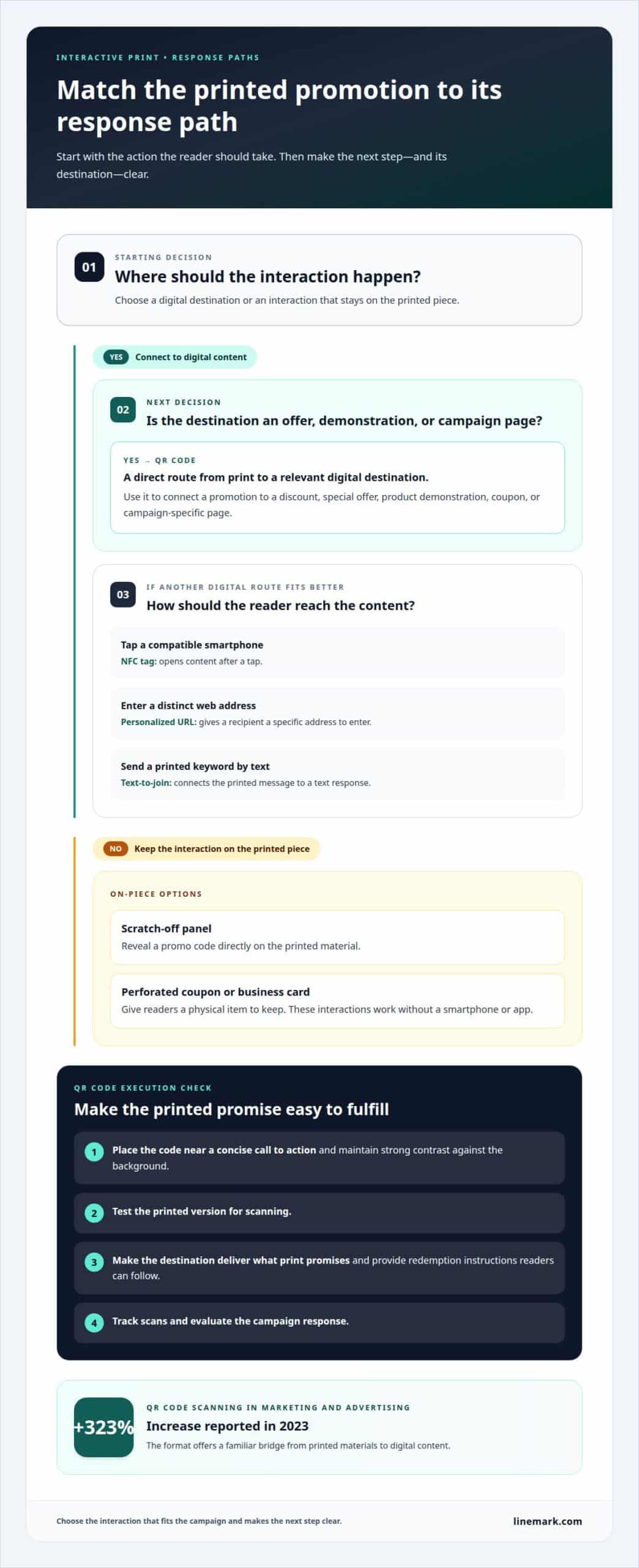
A QR code can turn a printed promotion into a direct route to a discount, special offer, or campaign page. A print provider connects the code to a digital destination and aligns its message with the offer shown in the marketing materials. For example, a brochure can invite customers to scan for a product demonstration or a campaign-specific coupon. That page can help the business track scans and evaluate the campaign’s response.
Good execution starts with a clear purpose. Place the code near a concise call to action, maintain strong contrast against the background, and test the printed version for scanning. The destination should deliver what the print promises, with redemption instructions customers can follow. A brochure might pair a perforated tear-off coupon with a QR code, giving readers the choice to redeem the coupon directly or scan for an online offer. This creates both a physical and a digital response path.
QR codes aren’t the only option for interactive marketing materials. A scratch-off panel can reveal a promo code, while a perforated coupon or business card gives readers something physical to keep. These options work without a smartphone or app, so the interaction happens directly on the printed piece. Make the action and its benefit easy to spot.
Other strategies create digital connections in different ways. A personalized URL gives a recipient a distinct web address to enter; an NFC tag lets a compatible smartphone open content after a tap; and text-to-join invites readers to send a printed keyword by text. Each method links print to a response mechanism, so explain the action and expected destination clearly.
For professional production, digital printing can support variable versions of marketing materials, while a QR code remains positioned consistently within the design. Pairing careful placement with a campaign-specific destination helps connect the physical piece to measurable engagement. A professionally printed brochure can bring the offer and response path together in one coordinated piece.
4. Interactive print marketing
Effective interactive print starts with the audience and the action a campaign should prompt. A print provider can recommend a suitable feature, build it into the layout, and test the finished piece. For example, a door hanger can pair a direct call to action with a perforated coupon that customers can remove and use. A useful way to think about how to make print marketing interactive is to match each feature to a customer need.
Traditional print can invite participation without a smartphone or app. A brochure might use thermochromic ink that changes color when warmed by a hand, revealing a message or visual detail. A printed map can reveal a service area when exposed to heat. These features turn handling the material into the interaction, so make sure the reveal supports the campaign message.
Other formats give the audience something to do or keep. Seed-embedded paper lets recipients plant the printed piece, while a tear-off section can serve as a coupon or business card. A provider can match the format to the distribution context: a door hanger benefits from a simple take-away, while a magazine ad can use a visual reveal to hold attention.
For digital interactions, a QR code can link a printed image to a video, product details, or another useful destination. Make the action visible, maintain strong contrast around the code, and ensure the digital content adds value. Augmented reality can also overlay digital content on a print marker, but it needs clear instructions and a meaningful experience. When deciding how to make print marketing interactive, choose features based on audience needs, not novelty alone.
Measure response against the campaign’s intended action. Scan counts can indicate interest in a QR-linked experience, while coupon redemption or visits to a campaign page show follow-through. Compare those signals with the campaign goal, then use the findings to refine the next print run. A successful interactive piece makes participation clear and gives the response a purpose. Plan an interactive print campaign around the experience you want customers to have.
Linemark
Linemark helps organizations turn campaign goals into coordinated print materials that support customer engagement. For interactive campaigns that need consistent production across formats, Linemark’s commercial printing, digital printing, direct mail, and large-format graphics can support the printed side of the experience.
Bring the campaign objective, audience, key message, and intended response into the planning conversation. These decisions help shape the right printed format and keep the call to action aligned with its digital destination. For example, a direct mail piece can carry a campaign-specific QR code, while large-format graphics can make a promotional message visible in a physical setting.
To connect printed materials with customer response, contact Linemark to discuss your campaign.
Make your next campaign easier to act on
Start by defining the customer action your printed piece should support. With a clear objective, the format and digital connection can work as one coordinated experience rather than separate tactics competing for attention. This gives your team a practical framework for making print marketing interactive in a way that serves the campaign and its audience.
Linemark can bring that plan into production through services such as Custom Book Printing, Direct Mail, and Large Format Graphics. The right fit depends on print’s role, whether it introduces an idea, prompts a response, or keeps a message visible in a physical setting. A clear brief about your audience, message, and desired action gives production a strong starting point.
Turn your campaign objective into a coordinated print experience with Contact Linemark to plan your print campaign. A purposeful next step can help your next printed piece create a more engaging customer journey.
Frequently Asked Questions
Exactly How Effective Is Interactive Print Marketing?
Interactive print can be assessed through responses that connect to a campaign goal. AR-based direct-mail campaigns have been reported to increase response rates from 2-3% to 35%. Treat response as more than a scan: a completed order form or visit to a campaign page shows a further action. Comparing those actions across campaign versions can help identify which experience best supports the desired outcome.
How do interactive printed materials enhance customer engagement?
Interactive materials invite customers to take part rather than simply receive a message. For example, an event program can feature a campaign hashtag, encouraging attendees to share posts and join a wider social conversation. The prompt works best when it gives people a clear reason to participate, such as sharing an event highlight or answering a question tied to the program.
Can interactive elements be added to any type of printed material?
Interactive features can be incorporated into formats such as posters, business cards, packaging, and brochures. Choose the feature based on how people encounter and use each piece. A poster can direct attention to digital content, while packaging can connect a product to a video or order form. For augmented reality, the printed trigger needs to be recognizable, and the digital layer should add useful content.
How does AR in print materials affect consumer memory and brand recognition?
Augmented reality can make print more memorable by adding an active, layered interaction that builds an emotional connection with a brand. To assess recognition, businesses can survey the intended audience about brand recall before and after a campaign. Pairing that feedback with observations of AR interactions gives marketers a clearer view of the experience and its relationship to brand awareness.
What KPIs should I use to measure how successful my interactive print elements are?
Choose KPIs that match the campaign objective. Scan rates and augmented-reality interactions indicate whether people activated the feature; completed purchases or inquiries show further response. Cost per acquisition can also help evaluate efficiency: divide total campaign cost by the number of new customers gained. For awareness-focused campaigns, surveys of brand recognition provide a measure beyond direct response.
What technologies can a print provider use to create high-resolution, interactive documents?
Interactive document production can use advanced scanners, high-definition printers, and image-processing software. Scanners capture source material, image processing prepares visual assets, and high-definition printing reproduces fine detail needed for clear markers or graphics. Together, these technologies support documents designed for digital interactions. The production approach should preserve the visual clarity readers need to recognize the intended interactive element.