

 11/19/2026
 Steve Bearden
A galley proof is a preliminary version of a book, in print or digital form, that authors, editors, and proofreaders review before publication. It gives you a final opportunity to catch errors and make essential corrections, not to reopen the manuscript for broad revisions. Understanding what a book galley proof is also means knowing where it fits in the production process.
It’s easy to treat proof review as one last chance to polish every sentence. But substantial edits can change the layout, shift page breaks, and affect the publication schedule. The most useful review focuses on accuracy: names, facts, typographical mistakes, and other issues that could affect a reader’s understanding.
This guide explains how galley proofs developed, how they differ from page proofs and advance copies, and what you can reasonably correct before a book is printed or finalized for digital distribution. You’ll also see why keeping changes focused helps protect the approved layout and move the book toward publication with clarity.
Key Takeaways
- Recognize how the term “galley” evolved from the trays printers used to hold hand-set type.
- Distinguish a galley, a page proof, and an advance reading copy by their format and purpose.
- Prioritize essential corrections, including errors in names, affiliations, and facts that could affect a book’s meaning.
- Understand how extensive changes can affect pagination, indexing, and the schedule for publication.
Final opportunity to edit before publication
A galley proof gives an author, editor, or proofreader a preliminary version to review before publication. It isn’t the final approved edition, and a galley isn’t automatically authorized for publication. Whether a copy can be distributed or sold depends on the publisher’s approval and applicable rights.
Review the proof against the approved manuscript, then follow the publisher’s instructions for marking corrections and returning it. Focus on errors that affect accuracy, such as a misspelled author name, an incorrect affiliation, or a factual mistake. In academic journals, authors may have only 24 to 72 hours to return corrections. Traditional book publishers may allow around two weeks for page proofs.
Proofs also support publicity and review schedules. Publishers may send galleys or advance reading copies to reviewers, book bloggers, magazines, libraries, influencers, and authors before publication. These copies can support advance reviews and blurbs. A publicity proof for a book with four-color illustrations may omit the illustrations or show them in black and white. Recipients aren’t expected to proofread publicity copies, and minor typesetting errors may remain.
There’s no single production cost for a galley proof. The cost depends on factors such as format, page count, print quantity, and production requirements. A digital proof avoids producing physical copies, while a printed proof involves physical production. The final proof stage can also bring correction charges: publishers may charge for changes to original manuscript text, while typographical or editing errors may be treated differently. Some charge for final-stage alterations by the page.
Keep edits focused. Extensive changes can reflow text, shift pagination, require index updates, and delay publication. If you expect substantial revisions, tell the publisher as soon as possible. In journal publishing, the corresponding author should obtain co-author approval for changes, and major revisions may need editorial board approval. Late proof returns can also delay publication, so follow the stated deadline and submission method.
Meaning and history of galley proofs
The term combines a printer’s physical “galley” with a proof made for checking type. Its meaning has shifted as book production moved from metal type to digital layouts.
The Meaning of Galley Proofs
A galley proof is a preliminary print or digital version used to inspect a book before publication. The name originally described a proof pulled from type arranged in a printer’s galley. Today, readers may encounter the term alongside “uncorrected proof,” especially when reviewing a digital file. Recognizing both terms helps you understand that the document is intended for review, not necessarily the final approved edition.
The History of Galley Proofs
The word “proof,” in its typographical sense, dates to around 1600. By the 1650s, printers used metal trays called galleys to hold hand-set type. They could transfer that type to a small proof press and print a limited number of copies for proofreading. This process let printers inspect the arranged text before preparing it for a larger press run. The term preserves that production history.
Historically, a galley was a container for type, while the proof was the printed sample. The distinction matters: “galley proof” names the review copy by its connection to the typesetting stage. A small proof press produced limited copies, allowing corrections to be considered before the text moved toward printing. This physical setup also explains why the term remains in publishing vocabulary, even though production methods have changed.
Digital typesetting changed how preliminary versions are created and shared. Electronic files may be called digital proofs or PDF proofs, while “uncorrected proof” is now more common than the older “galley proof.” These names describe the same purpose, checking a publication before final approval, in different formats. If you see either term, identify the version and its review purpose before relying on it.
Corrections permitted at the proof stage
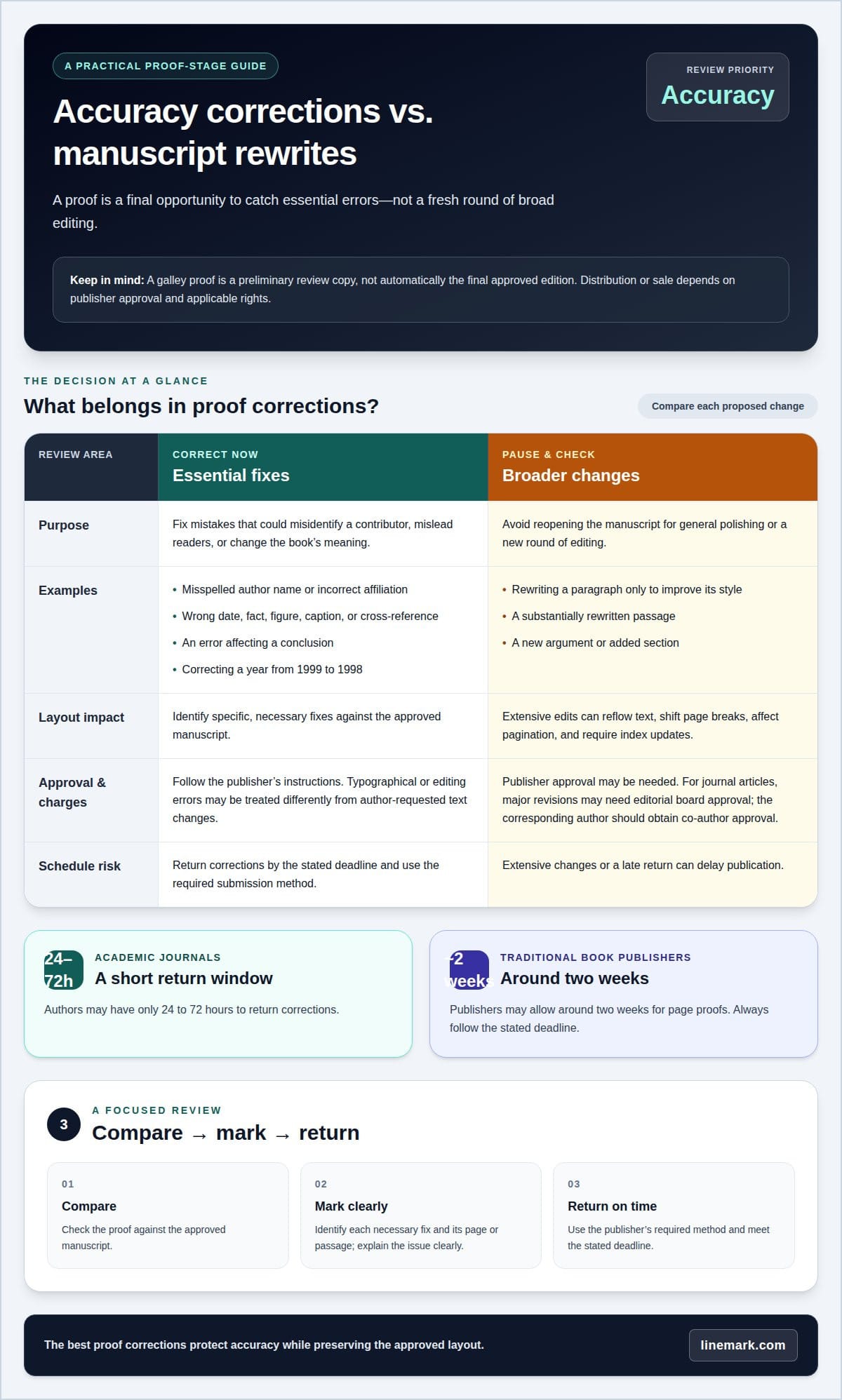
Proof-stage corrections should protect accuracy, not reopen the manuscript for a fresh edit. Focus on mistakes that could misidentify a contributor, mislead readers, or change the book’s meaning. A misspelled author name, incorrect affiliation, wrong date, or error affecting a conclusion deserves attention. Rewriting a paragraph solely to improve its style usually does not.
Use the proof to identify specific, necessary fixes. For example, an author might correct a year from 1999 to 1998 after finding an error in an advance copy. Check names and affiliations, then review dates, figures, captions, cross-references, and any statement that could affect conclusions. If a citation was in press earlier but has since been published, update its publication details where the publisher’s instructions allow it.
Typographical and editing errors are distinct from changes to the original manuscript. Publishers may charge for author-requested alterations to manuscript text, while corrections to typos or editing errors may be treated differently. A broad rewrite can also reflow text, change page breaks, and require index work. Each proposed change should therefore address a clear accuracy problem.
Keep larger revisions separate from routine corrections. A new argument, substantially rewritten passage, or added section may require publisher approval. For journal articles, major author revisions can be subject to editorial board approval. The corresponding author should also obtain co-author approval before submitting changes, so the proof reflects an agreed version.
When an essential correction affects surrounding text, explain the issue clearly and identify the page or passage. Follow the publisher’s instructions for marking and returning proofs. A missed error may remain in the published book, while extensive changes can affect pagination and publication timing. Prioritize factual accuracy, names, and meaning over minor preferences.
What book galleys or page proofs are
A galley or page proof is a prepublication version used for review, production checks, or advance publicity. Its format and production stage help clarify what readers can expect from that copy.
The Definition of Book Galleys and Page Proofs
A book galley is an advanced, unfinalized copy, often made from a manuscript before its final proofread. It may arrive uncut and unbound, as a generic paperback, or electronically. A page proof instead presents the book’s composed pages, usually as a PDF. These formats matter because a galley may not reflect the finished book’s pagination, while a page proof shows the layout being prepared for publication.
Neither label alone guarantees a final edition. A proof may still contain changes, and an advance reading copy may differ from the published book. Check the copy’s stated purpose before relying on its text or appearance. For example, a publicity copy with black-and-white illustrations may not represent the finished color pages.
Uses in Book Publishing
Publishers use galleys and proofs to review text and layout before release and to prepare advance copies for publicity. Reviewers, book bloggers, magazines, libraries, and authors may receive early copies for reviews, blurbs, or reader outreach. An advance reading copy can support presale discussion, though a copy produced before the editing process is complete may contain alternate cover art or text.
Page proofs also help production teams confirm page order, check the table of contents, and compile an index. The printer creates final proofs for publisher approval before a book goes to press. That approval copy is distinct from an early galley sent to a reviewer: one supports production sign-off, while the other supports review or promotion. If you’re planning a finished book, plan your book printing project around the approved pages and final production files.
Linemark: Custom Book Printing
Linemark’s Custom Book Printing helps authors, publishers, associations, and organizations turn approved pages into a finished book. It’s a natural next step once proof corrections are complete and the files are ready for production.
Book specifications and project goals shape the production approach. Linemark provides digital and offset printing solutions, along with binding and finishing, for custom book projects. A clear production plan aligns approved content with the finished format, helping decisions made during proof review carry through to the printed book.
If you’re preparing a book for print, contact Linemark to discuss your project.
Move from proof approval to production
Knowing what a book galley proof is helps you make deliberate decisions before a book moves into production. Once the text and pages are approved, the next step is to align the finished format with how readers will receive and use the book. Planning can also connect the publication with materials that support its release.
Linemark offers Custom Book Printing, Direct Mail, and Large Format Graphics for organizations coordinating printed communications around a publication. These services can support distinct parts of a project, from producing a book to preparing related outreach materials.
If your approved manuscript is ready for its next production stage, contact Linemark about book printing to discuss your project. A clear plan can help carry your work from final approval toward a confident release.
Frequently Asked Questions
What is a book galley proof?
A book galley proof is a preliminary version of a book prepared for review before publication. It may appear as an unbound print copy or an electronic file, depending on the production workflow. The word “proof” signals that content or layout may still change. For example, a reviewer shouldn’t assume an early cover or illustration matches the finished edition.
What is the difference between a galley proof and a page proof?
A galley proof is an early review copy, while a page proof shows the book’s composed pages. The distinction matters when checking page-specific details, such as a running head, image placement, or a table of contents reference. A galley may not show final pagination. Page proofs make it easier to identify the precise page and location of a layout issue.
What is an uncorrected proof copy of a book?
An uncorrected proof is a paper or digital copy that hasn’t received final approval from the author and publisher. It can still contain errors or text that changes before release. Treat it as a working version, not a definitive reference for quotations or page numbers. If you cite it, identify it as an uncorrected proof and don’t assume its wording will remain unchanged.
How do authors and editors review and correct galley proofs?
Authors and editors review the proof against the approved manuscript, then mark each necessary correction using the publisher’s required method. A useful correction identifies the exact location and replacement text, such as changing a misspelled surname in a caption. Keep author-requested revisions distinct from production errors. For coauthored work, the corresponding author should secure co-author approval before submitting changes.
What changes can be made after galley proofs are printed?
After proofs are printed, authors can submit corrections for the publisher to consider before final production, following its instructions. Once the book has been printed, correcting copies already produced generally requires a later edition or another print run. Digital editions can also be updated, but ebook changes take considerable work and publishers don’t make them often.
What is the difference between a galley proof and an advance reader copy (ARC)?
A galley proof is a preliminary review version; an advance reader copy, or ARC, is a nearly finalized copy sent to reviewers and influencers before publication. An ARC supports advance publicity and reader interest, but it may still differ from the final edition if editing continues. For example, an ARC can have alternate cover art or text, so its appearance may not match the published book.