

 08/19/2026
  Steve Bearden
What if your marketing collateral could physically stop a customer in their tracks before they even reach the kitchen counter? In an environment where digital noise is at an all-time high, the battle for attention has moved back to the physical mailbox. Most marketing professionals recognize the frustration of seeing standard postcards yield diminishing returns, often leading them to explore the potential of die cut direct mail. It’s common to worry about the perceived high costs of custom shapes or the technical complexities of USPS regulations for non-rectangular mail. You want a campaign that resonates, yet the path from creative concept to a finished, mailable product often feels fragmented and risky.
This guide demonstrates how to transform standard mailers into high-conversion assets using precision die-cutting technology and strategic design. We’ll show you how to bypass the trash-can filter by leveraging tactile psychology and industrial-scale production. You’ll discover a streamlined approach to increasing ROI and brand recognition through a centralized production and fulfillment model. From navigating the latest 2026 postage rates to mastering complex finishing, we’ll preview the essential steps to turn your print marketing into a high-impact growth engine that scales with your business.
Key Takeaways
- Understand how custom shapes trigger higher brain engagement compared to standard mailers by leveraging the principles of tactile psychology.
- Learn to integrate variable data printing with physical forms to create highly personalized assets that resonate with specific audience segments.
- Master the use of strategic formats, such as die-cut windows, to pique recipient curiosity and drive higher response rates.
- Navigate technical USPS regulations and non-machinable requirements to keep your die cut direct mail campaigns compliant and cost-effective.
- Discover how a centralized production and fulfillment partner can streamline complex workflows and accelerate your speed to market.
Beyond the Rectangle: Why Die Cut Direct Mail Captures Attention in 2026
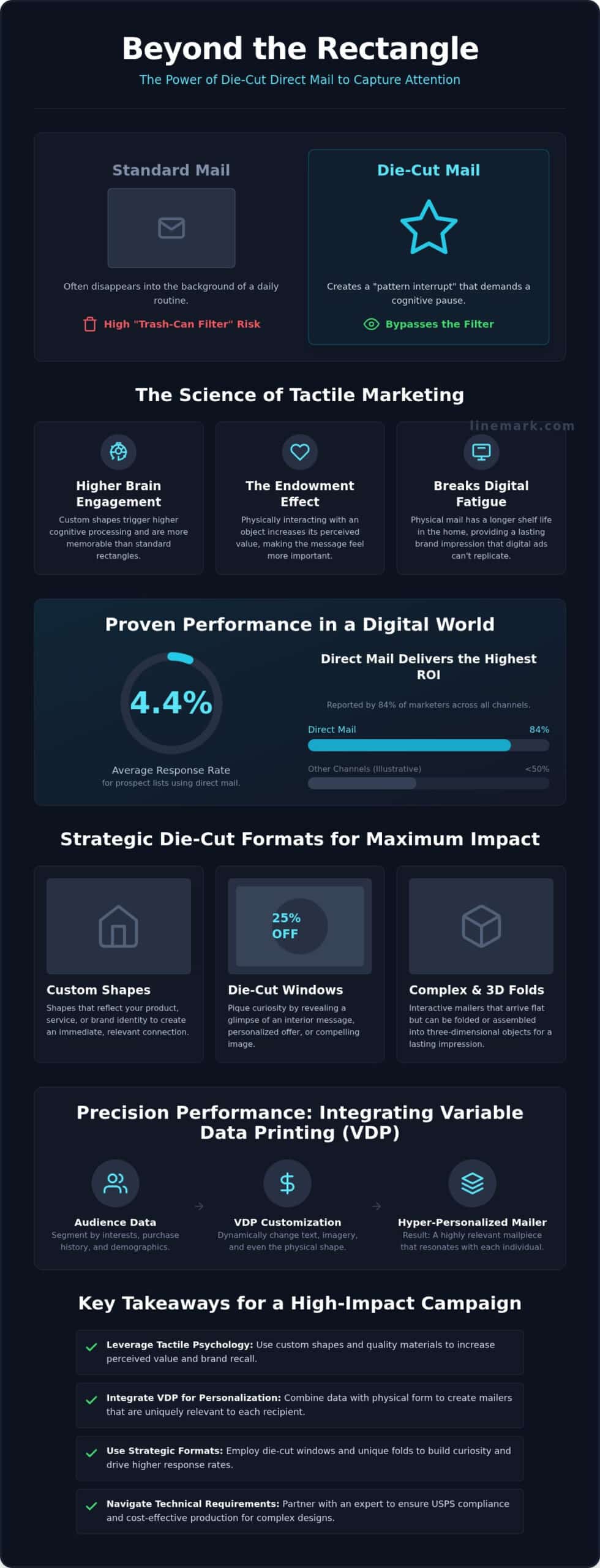
Standard rectangular mailers often disappear into the background of a daily routine. To truly engage a modern audience, brands are moving beyond the four corners of traditional print. At its core, what is die cutting involves the use of specialized steel blades or high-precision lasers to shear through paper and cardstock. This process creates custom shapes, internal windows, and intricate folds that transform a flat sheet into a three-dimensional experience. By 2026, the technology has evolved from simple rounded corners to complex 3D structures that arrive flat but expand upon opening. This immediate visual and physical differentiation is the most effective way to bypass the “trash-can filter” that claims so many standard postcards.
The Science of Tactile Marketing
Touch is a primary driver of brand perception. When a recipient feels a heavy-weight cardstock or encounters a unique texture, their brain instinctively assigns a higher value to the message. This phenomenon is rooted in the “Endowment Effect,” a psychological principle where individuals value an object more highly simply because they’ve physically interacted with it. In high-volume industrial production, sensory branding is the strategic integration of physical textures and structural forms to create a permanent neural link between a brand and a premium experience. Die cut direct mail leverages this tactile psychology to ensure your message isn’t just seen, but felt.
Breaking Through Digital Fatigue
Digital advertisements are fleeting. They vanish with a single swipe or scroll. Physical mail, however, possesses a significantly longer shelf life within the home. A well-designed die-cut piece creates a “pattern interrupt” in the daily mail pile. While standard envelopes feel predictable, a die-cut edge or a windowed glimpse of the interior content demands a cognitive pause. The data supports this physical advantage. In 2026, direct mail continues to achieve an average response rate of 4.4% for prospect lists. Even more telling is that 84% of marketers report that direct mail delivers their highest ROI across all available channels. These outcomes are not accidental. They’re the result of using structural design to create engagement that digital screens cannot replicate.
Success in this space requires more than just a creative shape. It demands a production partner capable of executing complex designs at scale without sacrificing precision. As we move into more intricate structural designs, the bridge between creative vision and logistical reality becomes the most critical component of your campaign’s performance.
The Precision of Performance: Integrating VDP with Custom Die-Cutting
Variable Data Printing (VDP) serves as the engine of modern direct mail, moving far beyond the simple insertion of a recipient’s name. It’s a technology that allows for the mass customization of every element on a printed piece, from the imagery and copy to the structural form itself. When you integrate VDP with die cut direct mail, you’re no longer limited to a single static design for your entire mailing list. Instead, you can create a dynamic campaign where the physical attributes of the mailer respond to the unique data profile of each individual. This convergence of data and structure represents the next frontier in high-impact print marketing.
Hyper-Personalization at Scale
Modern data analytics allow you to dictate the physical shape of a mailer based on specific recipient interests or purchase history. For example, a home improvement brand might send a die-cut mailer shaped like a paintbrush to recent DIY customers, while sending a shape resembling a garden trowel to outdoor enthusiasts. This synergy between variable data printing and structural design ensures that the first tactile interaction is relevant to the consumer’s needs. You can even utilize personalized windows that reveal specific offer codes or localized store maps, turning a simple piece of mail into a customized portal for engagement.
Industrial Precision for Complex Designs
Executing these complex designs at a massive scale requires a sophisticated blend of digital and offset capabilities. While traditional steel-rule dies are the workhorse for high-volume uniformity, modern digital laser cutting provides the agility needed for intricate, personalized runs. Maintaining structural integrity is paramount; factors like paper grain direction and stock weight must be precisely calibrated to prevent warping or tearing during the mailing process. We meticulously monitor these variables within our 90,000-square-foot facility to ensure that every piece meets rigorous quality standards. Achieving absolute registration accuracy is critical in die-cut VDP because even a microscopic misalignment between the printed data and the cut line can compromise the professional aesthetic and functionality of the mailer.
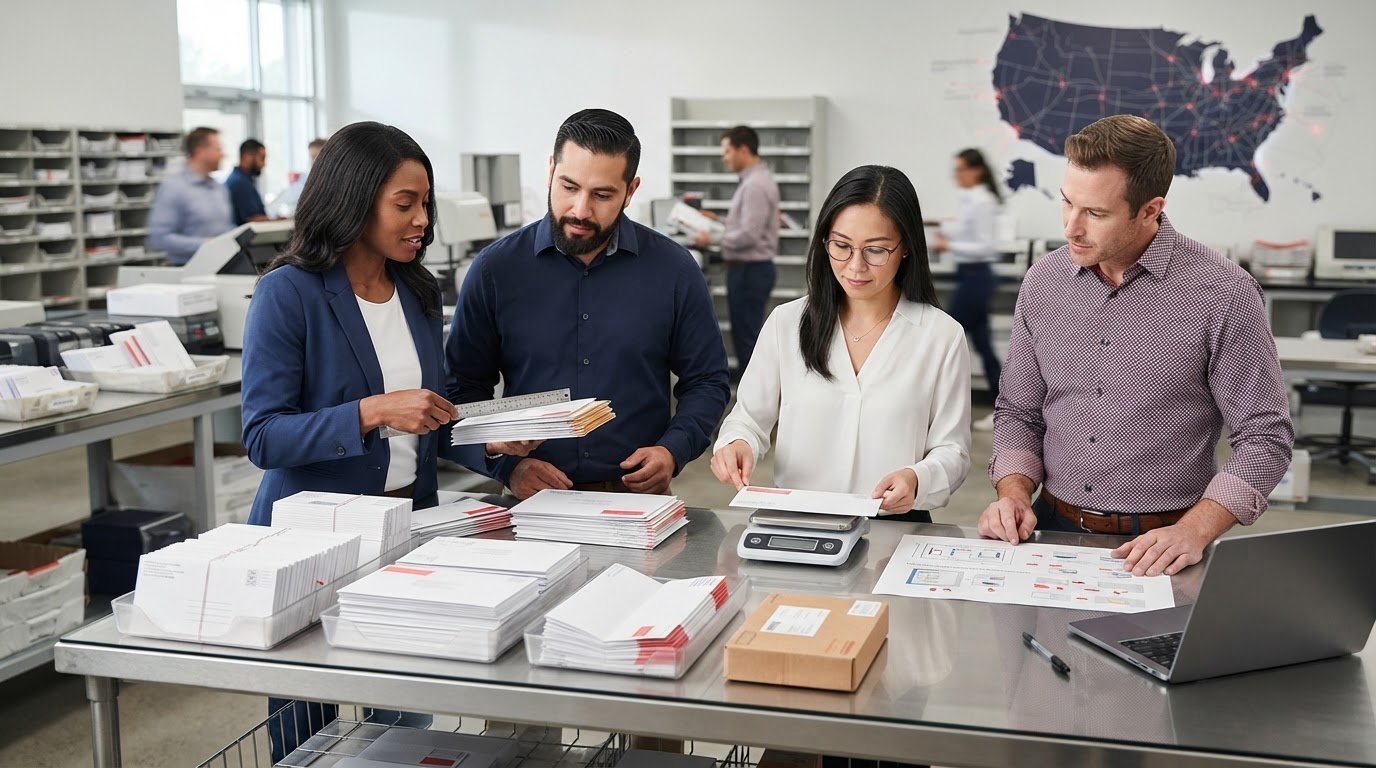
Compliance is equally vital for campaign success. Every custom shape must still adhere to USPS shape requirements to avoid unexpected surcharges or delivery failures. Our team acts as a strategic ally, reviewing your designs to ensure they balance creative “mailbox busting” impact with logistical reality. If you’re looking for a partner to help you navigate these technical nuances, our integrated print and fulfillment solutions are designed to handle complex projects with boutique-level attention to detail.
Strategic Shapes: Comparing Die-Cut Formats for Maximum Campaign ROI
Choosing the right format for die cut direct mail requires a balance between creative disruption and production efficiency. A subtle approach, such as rounded corners or a slight wave along one edge, provides a professional polish without significantly increasing shipping costs. These minor adjustments often satisfy the need for differentiation while remaining within standard automation rates. On the other hand, distinctive custom silhouettes—shapes that mirror a product or brand logo—act as a total pattern interrupt. While the manufacturing of complex silhouettes involves more intricate setup, the resulting surge in engagement often justifies the investment for high-value prospect lists.
The Power of the Window
Die-cut windows create a “peek-a-boo” effect that drives curiosity. By revealing a portion of the internal content, such as a personalized offer or a high-quality product image, you invite the recipient to open the mailer immediately. This layered approach to information delivery turns a passive glance into an active exploration. For maximum impact, place windows to highlight specific VDP elements. However, precise placement is critical for postal machinability. Ensuring that windows don’t interfere with barcode clear zones or compromise the structural strength of the envelope is a technical nuance our team manages during the pre-flight process.
Functional Die-Cuts: Coupons and Detachable Elements
Functionality extends the shelf life of your marketing assets. Perforated pop-out cards, integrated bookmarks, and detachable calendars transform a temporary advertisement into a long-term utility. When a customer places your branded card in their wallet or uses your bookmark, your brand remains top-of-mind for weeks or months. The success of these interactive elements depends heavily on professional binding and finishing techniques. Proper perforation depth ensures that pieces detach cleanly without tearing or falling out prematurely during transit. We utilize advanced finishing equipment to maintain this delicate balance, ensuring that every interactive component functions perfectly for the end user.
Interactive folds represent another strategic choice. Moving from a flat mailer to a 3D brand experience, such as a pop-up structure or a self-folding box, creates a high-impact tactile moment. These formats are especially effective for B2B account-based marketing where the goal is to secure a meeting with a high-level decision-maker. Strategic use of die cut direct mail allows you to tailor the physical experience to the specific needs of your campaign, ensuring that every cut serves a concrete business purpose.
Navigating the Logistics: Design Rules and USPS Requirements
Translating a creative vision into a mailable asset requires a deep understanding of the USPS postal stream. While die cut direct mail offers unmatched engagement, it must adhere to strict physical standards to avoid becoming a “non-machinable” piece. The USPS applies surcharges when a mailer cannot be processed by high-speed sorting equipment. These triggers often include a lack of uniform thickness, excessive rigidity, or an aspect ratio that falls outside the standard 1.3 to 2.5 range. Uniform thickness is particularly vital; any bumps or uneven surfaces created by internal die-cuts can cause jams in high-speed feeders. If your design is too square or too elongated, it’s categorized as non-machinable, which significantly increases your postage costs.
Tabbing is another operational necessity for complex shapes. To keep mailers from opening or snagging during transit, we use translucent wafer seals to secure any loose edges. This ensures your piece arrives in the recipient’s hands exactly as intended, rather than damaged by industrial sorting rollers. Our role as a strategic ally is to help you navigate these technical nuances, ensuring your campaign remains both high-impact and logistically sound.
Designing for the Mail Stream
Avoiding “snag points” is the first rule of structural design. Sharp trailing edges or deep internal cuts can catch on machine belts, leading to destroyed collateral and delivery delays. Weight distribution is equally critical. If a die-cut piece is significantly heavier on one side, it may tumble or jam during automated processing. We perform rigorous pre-flighting on every design to identify these risks before the first sheet hits the press. This meticulous attention to detail protects your investment and ensures a smooth journey through the postal system.
Maximizing ROI Through Postage Optimization
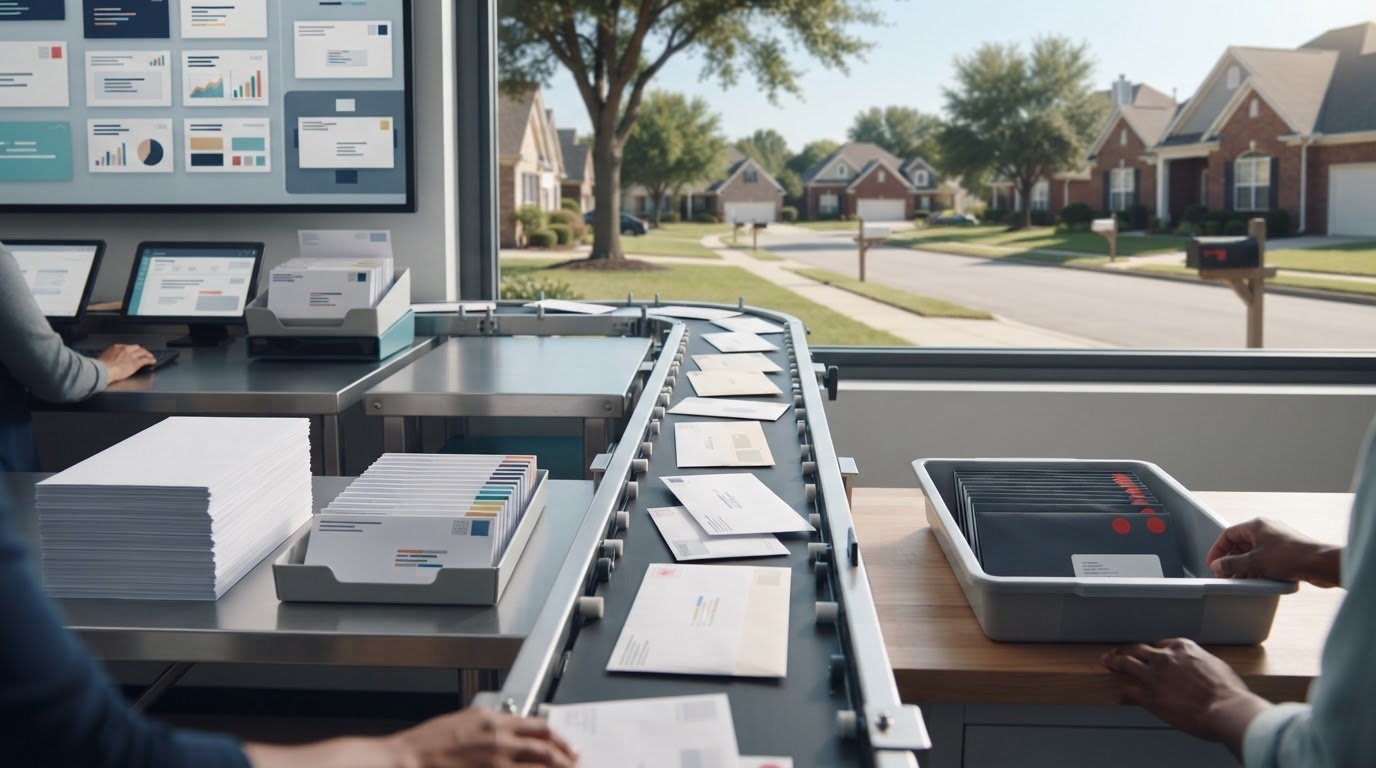
You don’t have to sacrifice impact for affordability. The automation-compatible sweet spot for die-cuts involves keeping the leading and trailing edges straight while focusing custom shapes on the top edge of the mailer. This allows the piece to move through rollers smoothly while still providing a unique silhouette in the mailbox. For larger campaigns, we utilize commingling and drop-shipping to offset potential surcharges. Choosing between First-Class Mail, with its $0.82 stamp rate, and Marketing Mail, which ranges from $0.395 to $0.467 per piece, depends on your required speed of delivery and the specific non-machinable characteristics of your shape. As of July 12, 2026, EDDM retail rates remain a cost-effective $0.260 per piece, provided your piece meets the specific size requirements of being larger than 6.125 inches tall or 11.5 inches long. Postage optimization is the key to scaling your die cut direct mail efforts without breaking the budget. If you want to ensure your next campaign is as efficient as it is creative, you should audit your mailer design with our logistics experts.
Scaling Success with Linemark’s Integrated Die-Cut and Fulfillment Solutions
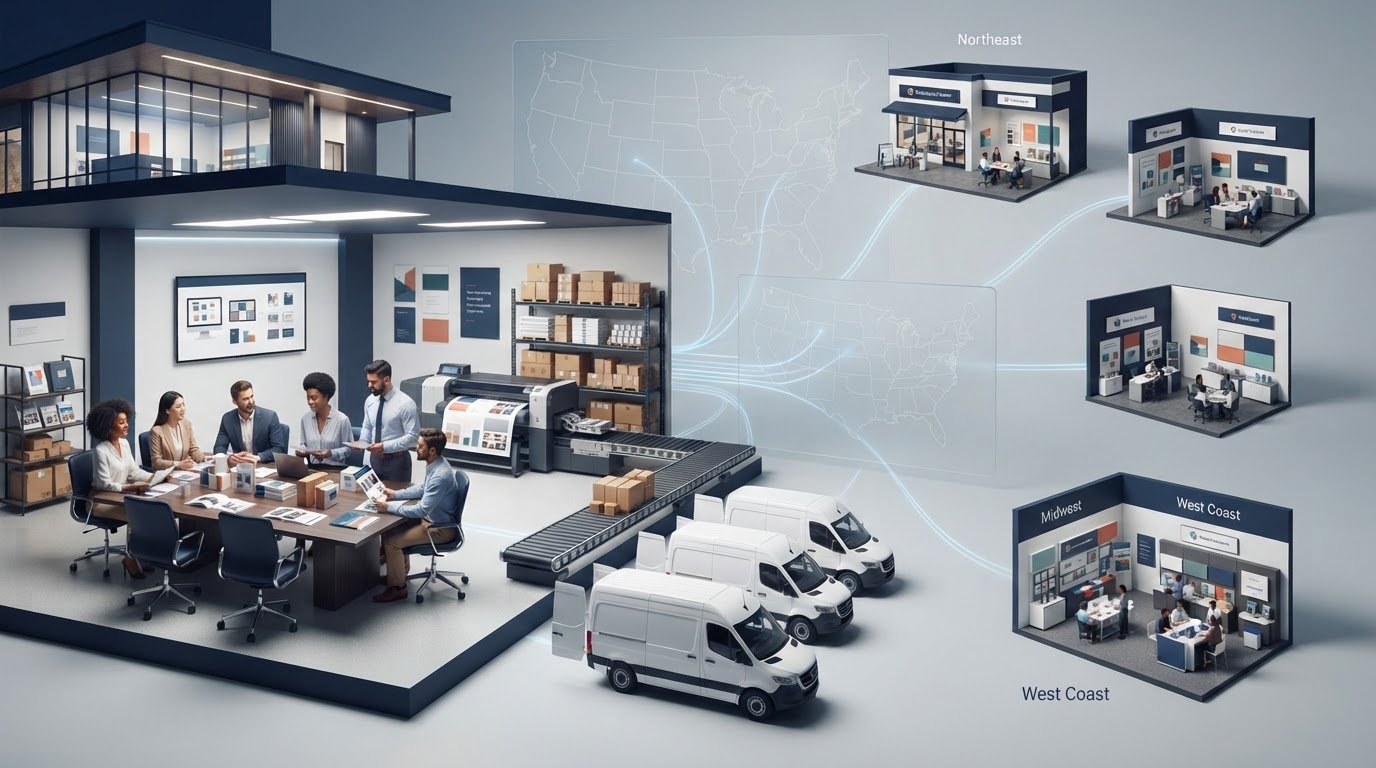
Executing a complex marketing vision requires more than just a creative design; it demands an infrastructure capable of handling industrial scale with boutique precision. We operate from a 90,000-square-foot production and distribution facility, providing the operational breadth necessary to manage high-volume die cut direct mail campaigns. This centralized model ensures that your project moves seamlessly from the initial die-cut to final nationwide distribution without the delays of external logistics. By housing design, production, and fulfillment under one roof, we provide the end-to-end transparency needed to maintain strict timelines and quality standards.
For organizations with distributed teams, maintaining brand consistency across multiple regions is a significant challenge. Our MarCom On-Demand portal solves this by empowering local representatives to order approved, high-impact assets while preserving the integrity of the original design. This technological integration allows your team to deploy sophisticated marketing materials—from custom book printing to intricate kitting projects—with the click of a button. It’s a scalable solution that grows with your organization, turning a localized pilot into a national rollout without friction.
High-Volume Execution Without Compromise
Managing runs of 100,000 or more custom-shaped pieces requires a sophisticated approach to quality control. We utilize automated workflows to reduce human error, ensuring that the structural integrity and registration accuracy discussed in previous sections remain consistent across every single piece. Our 30+ years of industrial experience allow us to identify potential production bottlenecks before they impact your schedule. Whether you’re producing a simple postcard or a complex 3D structure, our facility is equipped to handle the technical demands of mass-scale finishing and nationwide distribution.
Your Strategic Communications Ally
We believe the relationship should be a unified partnership rather than a transactional exchange. As your strategic communications ally, we offer consultative design services to help you optimize shapes for both visual impact and postage efficiency. We don’t just print your files; we analyze your campaign goals to suggest structural improvements that enhance ROI. This proactive spirit values efficiency and high-touch service, ensuring your project is in capable, steady hands from start to finish. You’re invited to scale your next high-impact campaign with Linemark’s direct mail experts and experience the difference of a centralized, tech-savvy production partner.
Scaling Your Vision: The Future of Dimensional Marketing
The transition from standard mailers to high-impact die cut direct mail is a structural pivot toward higher engagement and measurable ROI. By leveraging the principles of tactile psychology and advanced variable data printing integration, your brand can move beyond the limitations of traditional rectangles. Success in 2026 requires a balance between creative ambition and logistical precision, ensuring every custom shape remains compliant with evolving postal regulations while maximizing physical impact. It’s about creating a pattern interrupt that forces a cognitive pause and drives immediate action.
Realizing this potential at scale demands a production environment built for complexity. Our 90,000-square-foot production facility serves as a centralized destination for everything from design consultation to expert kitting and fulfillment services. We operate as a strategic ally, providing the technical expertise and operational breadth needed to transform your communications into a high-performance growth engine. This unified partnership ensures that your project is handled with meticulous attention to detail from the first cut to the final delivery.
Partner with Linemark for High-Impact Die-Cut Direct Mail to begin your journey from concept to nationwide delivery. Your next campaign has the power to redefine your brand presence and deliver results that matter.
Frequently Asked Questions
Does die-cutting direct mail significantly increase postage costs?
Postage increases occur primarily if the piece is categorized as non-machinable due to its shape or aspect ratio. While standard postcards cost $0.65 as of July 12, 2026, non-standard shapes may incur surcharges. However, strategic design can often keep die cut direct mail within automation-compatible limits. We help you optimize dimensions to balance visual impact with the most favorable rates available in the current postal landscape.
What is the minimum order quantity for custom die-cut mailers?
Our facility is optimized for high-volume production, typically starting at quantities that allow for industrial efficiency. While we maintain the attention to detail of a boutique shop, the setup requirements for custom die-cutting favor mid to large-scale campaigns. This approach ensures that the unit cost remains competitive while allowing you to leverage our 90,000-square-foot distribution power for a nationwide rollout or a targeted regional pilot.
Can I use die-cuts on standard postcard stocks?
You can apply die-cuts to various stocks, but we recommend using a heavier weight to maintain structural integrity. Standard postcard stocks work well for simple edges or internal windows. For more intricate silhouettes, a higher caliper paper prevents the piece from warping or tearing during high-speed sorting. Our team evaluates your chosen material to ensure it supports the specific complexity of your die-cut design without compromising durability.
How do I ensure my die-cut design is USPS-compliant?
Compliance is achieved through rigorous pre-flighting and adherence to specific USPS shape requirements. Key factors include maintaining a uniform thickness and avoiding snag points that could catch on sorting equipment. We act as your strategic ally, reviewing every design against current 2026 postal standards. This proactive review identifies potential issues with aspect ratios or barcode clear zones before the production phase begins, protecting your campaign from delivery failures.
What is the typical turnaround time for a die-cut mail campaign?
Turnaround times vary based on the complexity of the cut and the total volume of the run. However, our centralized model significantly reduces lead times by handling production and fulfillment in one location. Most high-volume projects move from final proof approval to the mail stream within a streamlined window. We provide a detailed project timeline upfront, ensuring your team has full transparency into the manufacturing and distribution stages.
Can Linemark handle the fulfillment and kitting of abnormally shaped mailers?
We specialize in the fulfillment and kitting of complex, non-standard mailers within our 90,000-square-foot facility. Our integrated services are designed to manage the nuances of abnormally shaped pieces that require specialized handling or assembly. Whether your campaign involves multi-component kits or unique dimensional folds, our team ensures every element is precisely matched and securely prepared for nationwide distribution, maintaining quality across even the largest scales.
Is laser die-cutting better than traditional die-cutting for high volumes?
Traditional steel-rule die-cutting remains the industry standard for high-volume uniformity and cost-effectiveness. Laser cutting offers superior agility for intricate details and shorter, highly personalized runs involving variable data. The choice depends on your specific campaign goals and the level of detail required. We utilize both technologies to provide the most efficient solution for your project, ensuring that precision is never sacrificed regardless of the total quantity produced.
How does die-cutting impact the durability of the mailer during transit?
Die-cutting can affect durability if not executed with professional precision. We mitigate these risks by using translucent wafer seals to secure loose edges and by carefully selecting paper grain direction to prevent warping. These technical adjustments ensure that your die cut direct mail maintains its structural integrity throughout the entire postal journey. Our industrial-grade finishing processes are designed to protect the professional aesthetic of your piece during transit.