


 06/21/2026
  Steve Bearden
A single oversight in your facility’s wayfinding can trigger a first-time non-compliance penalty averaging between $75,000 and $150,000. For most marketing executives and facility managers, ADA compliant signage printing often feels like a necessary evil that results in generic, unattractive plastic clashing with a carefully curated interior. It’s difficult to reconcile the rigid 2010 Standards for Accessible Design with the fluid, modern aesthetic of a high-growth brand.
We understand that compliance is a regulatory floor, not a design ceiling. This guide will help you master the technical nuances of Grade 2 Braille and mounting heights while leveraging advanced production capabilities to create visually cohesive assets. You’ll learn how to transform mandatory requirements into a sophisticated brand touchpoint that remains consistent across every national location. We’ll walk through the specific material choices and scalable logistics needed to ensure your facilities are both legally protected and aesthetically unified. By the end of this guide, you’ll have a clear roadmap for implementing a signage strategy that prioritizes both precision and partnership.
Key Takeaways
- Understand the strict technical requirements of the 2010 Standards for Accessible Design, including tactile character heights and Grade 2 Braille specifications, to ensure full legal compliance.
- Learn how to elevate your brand through custom ADA compliant signage printing by utilizing sophisticated materials like brushed aluminum and clear acrylic.
- Evaluate different substrates and back-printing techniques that allow your mandatory signage to blend seamlessly with modern office interiors.
- Discover how to scale production and maintain consistency across national locations by centralizing your signage procurement through an integrated MarCom On-Demand portal.
- Gain insights into how industrial-scale production facilities handle high-volume projects with the precision and meticulous detail of a boutique shop.
Understanding ADA Compliant Signage Printing in 2026
Navigating the complexities of ADA compliant signage printing requires more than just following a checklist. It’s about understanding a framework established by the Americans with Disabilities Act of 1990, which eventually led to the current 2010 Standards for Accessible Design (SAD). These standards dictate how permanent rooms, exits, and elevators must be identified to ensure every individual can navigate your facility with dignity. In the past, these signs were often viewed as utilitarian afterthoughts; today, they’ve shifted into integrated environmental graphics that enhance the user experience while meeting strict Department of Justice mandates. We view this transition as an opportunity to align mandatory safety with sophisticated design.
To better understand how these technical requirements are applied during the production process, watch this helpful video:
The Legal Framework: SAD and DOJ Requirements
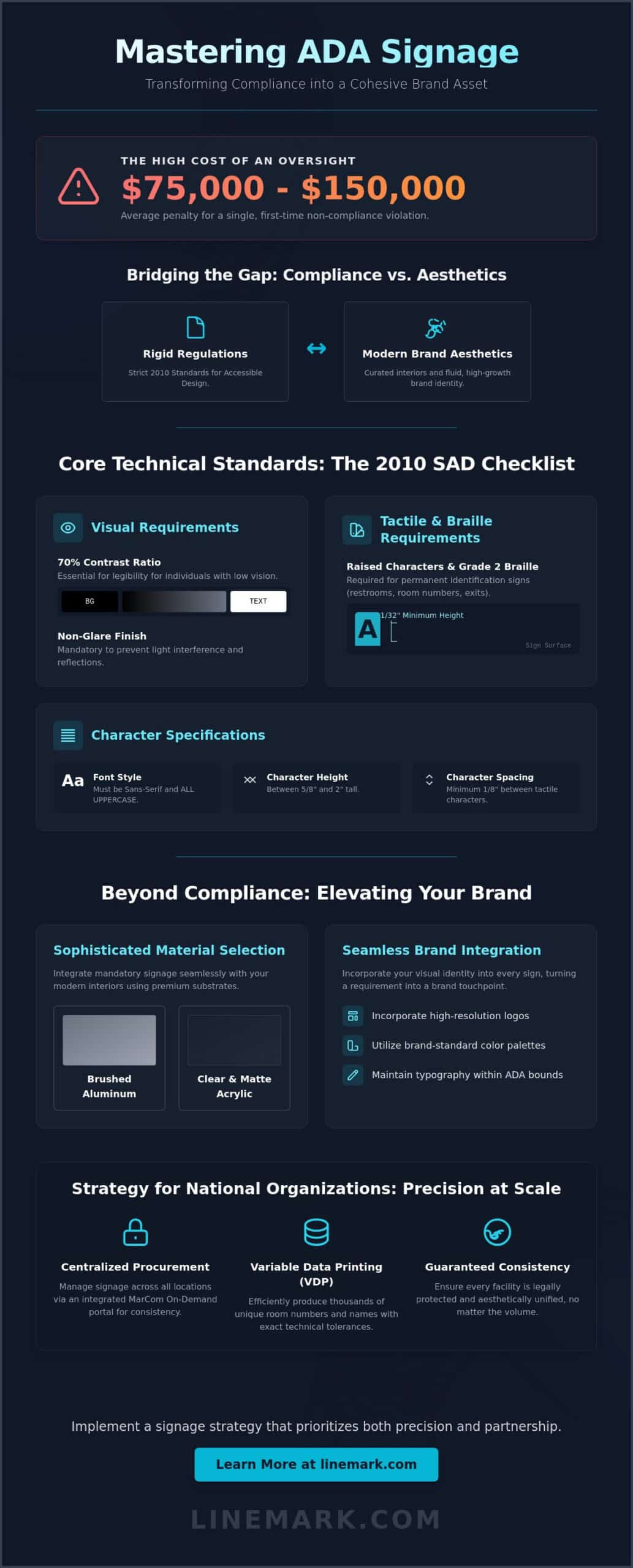
The 2010 SAD revisions clarified the distinction between different sign types. Identification signs for permanent spaces, such as restrooms, room numbers, and exits, must include tactile characters and Grade 2 Braille. Informational and directional signs, while not always requiring tactile elements, must still follow specific visual requirements regarding font size and spacing. A critical factor is the contrast ratio. You must maintain a 70% contrast between characters and their background to ensure legibility for individuals with low vision. Additionally, non-glare finishes are mandatory to prevent light interference. This technical precision is a hallmark of our high-capacity production model, ensuring your facility remains compliant and accessible under federal law.
Beyond Compliance: Signage as a Brand Asset
Compliance doesn’t mean you have to sacrifice your visual identity. Modern industrial printing technology allows us to integrate brand-standard typography and corporate color palettes within the bounds of ADA regulations. We can incorporate high-resolution logos and custom textures into room identification signs. This turns a legal requirement into a sophisticated brand asset. This approach fosters a truly inclusive environment where accessibility feels like a natural part of the architectural design. It’s a strategic way to demonstrate your organization’s commitment to universal design while maintaining a high-end, professional atmosphere across all your locations. We act as your strategic communications ally to ensure these elements are scaled properly across high-volume projects with precision, creating a unified partnership between function and form.
Technical Standards for High-Precision ADA Printing
High-precision ADA compliant signage printing is a matter of industrial engineering. It requires a meticulous approach to tactile character height, which must be a minimum of 1/32 inch above the sign surface. Achieving this consistently across a national rollout demands advanced UV/LED curing technology. This process ensures that the raised elements bond permanently to substrates like matte acrylic or brushed aluminum, preventing the delamination often seen in lower-quality production. By utilizing Variable Data Printing (VDP), we can efficiently manage thousands of unique room numbers and names while maintaining the exact technical tolerances required for legal protection.
Tactile Graphics and Character Spacing
The U.S. Access Board guidelines on signs specify that tactile characters must be sans-serif and entirely uppercase. This isn’t a stylistic choice; it’s a functional requirement for readability by touch. Character height must be calculated based on the mounting height and intended viewing distance, typically ranging from 5/8 inch to 2 inches. For 2026 compliance, tactile character spacing must maintain a minimum of 1/8 inch and a maximum of four times the character stroke width between individual characters. These micro-measurements ensure that your facility remains accessible to every visitor while adhering to federal law.
The Grade II Braille Production Process
Grade II Braille is the mandatory standard for permanent signage in the United States because it uses contractions and short-form words to save space and increase reading speed. We produce these elements using either embedded raster beads or high-build 3D digital printing to create the required domed shape. Each Braille cell must be placed exactly 3/8 to 1/2 inch below the corresponding tactile text. This level of precision is why many national organizations choose to partner with a high-capacity provider for their banners and signage needs, ensuring every piece meets federal standards without sacrificing brand integrity.
Standardized production ensures that Braille dots meet the specific height requirements of 0.025 to 0.037 inches. Our technological pride stems from the ability to automate these complex layouts within our 90,000-square-foot facility. This eliminates the human error often associated with manual Braille placement, providing a scalable solution for multi-facility rollouts. When you treat compliance as a technical discipline, you ensure that your facility is both welcoming and legally secure.
Material Selection and Customization Options
Selecting the right substrate is where technical compliance meets architectural design. Custom ADA compliant signage printing allows for a level of material sophistication that generic, off-the-shelf options simply cannot match. While matte acrylic remains the industry standard for its versatility, high-end corporate environments often demand the weight and texture of brushed aluminum or premium laminates. These materials aren’t just about looks; they must withstand the rigors of high-traffic areas. For instance, back-printing on clear acrylic creates a 3D depth effect while protecting the second-surface graphics from scratches and environmental wear. This technique ensures that your branding remains pristine even in busy hallways or elevator banks.
Advanced Substrates for Modern Interiors
Modern corporate aesthetics often move away from standard plastics. We utilize brushed metal laminates that provide the look of solid steel with a lighter weight and easier installation profile. As sustainability becomes a core corporate value, we’ve also integrated eco-friendly photopolymers and recyclable metals into our production workflows. These advanced materials are treated with specialized non-glare finishes. This is critical because excessive light reflection can render a compliant sign unreadable for those with visual impairments. We prioritize finishes that resist fingerprints, maintaining a professional appearance without constant maintenance. This focus on durability ensures your ADA compliant signage printing investment lasts as long as the building itself.
Color Theory and Accessibility
The International Sign Association ADA standards emphasize that color choice is more than a branding exercise; it’s a safety requirement. Every sign must adhere to the 70% contrast rule between characters and background. This is measured through Light Reflectance Value (LRV). We help you navigate this by analyzing your brand’s PMS colors and identifying pairings that meet federal mandates while staying true to your corporate identity. If your primary brand color has a low LRV, we might suggest using it as the background for high-contrast white tactile lettering.
Our high-capacity facility includes custom paint booth capabilities, allowing us to match exact corporate palettes with industrial-grade precision. This ensures that a signage rollout across fifty national locations remains perfectly consistent. Whether you need exterior-grade aluminum that resists UV fading or interior acrylics that match your office’s specific wall textures, our goal is to provide a seamless integration of brand and accessibility. We don’t just print signs; we manufacture durable communication tools that protect your business and welcome your visitors. By treating color as both a brand asset and a technical specification, we ensure your facility is both welcoming and legally secure.
Strategic Implementation for National Organizations
Scaling a facility rollout across forty states is a logistical minefield. For national organizations, the challenge isn’t just about manufacturing a single sign; it’s about maintaining absolute consistency across a distributed footprint. This is where ADA compliant signage printing moves from a simple production task to a comprehensive logistics solution. When a typical commercial building requires between 50 and 200 ADA-compliant signs, managing that inventory manually is an invitation for error. We solve this by centralizing procurement through integrated MarCom On-Demand portals. These platforms allow your local facility managers to order compliant, brand-standard nameplates and room IDs while you maintain total control over the visual identity and regulatory standards.
A unified environment requires that your signage doesn’t exist in a silo. By coordinating your ADA assets with other large format graphics, such as wall murals and floor graphics, you create a cohesive brand story. Our 90,000-square-foot facility is designed to handle this high-volume production with precision. This ensures that every piece of signage, whether it’s a permanent room ID or a promotional banner, matches your corporate PMS colors and material specifications exactly. We act as your strategic communications ally, moving your project from a business challenge to a concrete, scalable solution.
Managing Multi-Location Signage Consistency
Standardization is the only way to prevent brand drift. We utilize digital asset libraries to house your approved design templates, ensuring that a room ID in Seattle looks identical to one in Miami. This single-source partnership eliminates the risk of local managers ordering non-compliant or “ugly” alternatives from local shops. It also simplifies the process of updating signage for office nameplate changes. By leveraging our Variable Data Printing capabilities within the portal, you can order custom nameplates on-demand, ensuring every new hire is welcomed with a compliant, professionally printed sign that matches the rest of the facility.
Logistics, Kitting, and Nationwide Fulfillment
The final hurdle in any national rollout is the installation. We streamline this through meticulous kitting and fulfillment processes. Each signage package is labeled and organized by floor or wing, significantly reducing lead times and installation errors at the job site. This operational excellence allows you to integrate signage rollouts into broader marketing initiatives, such as new branch openings or rebrands, alongside your direct mail campaigns. Our proactive spirit means we handle the complexity of the logistics so you can focus on your growth. Connect with our team to streamline your national signage strategy and ensure every location is both legally protected and visually cohesive.
The Linemark Advantage in ADA Signage Production
Choosing a partner for ADA compliant signage printing is a decision that impacts both your legal standing and your brand’s perceived quality. With over 30 years of industrial print expertise, we’ve refined a production model that balances high-volume capacity with the meticulous attention to detail usually reserved for boutique shops. We don’t just act as a vendor; we position ourselves as a strategic communications ally. This means we understand how your permanent signage must integrate with your broader marketing collateral, from annual reports to custom book printing projects. Our goal is to provide a centralized destination for all your complex production needs.
Industrial Scale with Boutique Precision
Our 90,000-square-foot advanced facility is the engine behind our operational excellence. This scale allows us to execute large-format technology applications for high-volume ADA orders without sacrificing the precision required for Grade 2 Braille. We utilize data-driven production workflows to ensure that every tactile element and Braille dot is placed with mathematical accuracy. This level of control is vital for national associations and corporations that cannot afford the risk of localized production errors. By leveraging automated systems, we eliminate the variability found in manual processes. Linemark remains dedicated to maintaining the highest standards of precision across every high-volume commercial print run, ensuring that your brand’s integrity is never compromised by scale.
Comprehensive Environmental Graphic Solutions
Elevating Your Facility Strategy with Precision and Scale
Mastering the technical nuances of the 2010 Standards for Accessible Design ensures your organization remains legally protected while fostering an inclusive environment for every visitor. By moving beyond generic plastic and embracing custom ADA compliant signage printing, you transform mandatory requirements into sophisticated brand assets that enhance your interior design. We’ve explored how material selection, technical precision in Grade 2 Braille, and centralized procurement through strategic MarCom On-Demand portals can streamline your operations.
Our team leverages over 30 years of commercial printing expertise within a 90,000-square-foot high-tech production facility to handle your most complex projects. We operate as your strategic communications ally, providing the industrial capacity needed for national rollouts without sacrificing the meticulous detail of a boutique shop. Whether you’re managing a single new construction or a multi-facility refresh, we provide the scalability and precision your brand demands.
Partner with Linemark for your national ADA signage rollout to ensure your facility remains compliant, cohesive, and welcoming for years to come. We look forward to helping you build a more accessible future.
Frequently Asked Questions
What are the main requirements for a sign to be ADA compliant?
ADA compliance requires a specific combination of visual and tactile elements. Signs must feature non-glare finishes, high-contrast characters with at least a 70% ratio, and specific sans-serif fonts. For permanent spaces, you must include tactile lettering raised by 1/32 inch and Grade 2 Braille. Mounting these signs correctly between 48 and 60 inches from the finished floor is also a critical part of the federal mandate.
Do all business signs need to have Braille?
Not every sign in your building requires Braille. The mandate specifically applies to permanent room identification signs, such as those for restrooms, exits, and numbered offices. Signs meant for temporary information or general direction don’t need tactile elements. However, they must still adhere to visual standards regarding font size and contrast to remain inclusive for all visitors and stay within the 2010 Standards for Accessible Design.
What is the difference between Grade 1 and Grade 2 Braille?
Grade 2 Braille is the required standard for ADA compliant signage printing because it’s more efficient for the reader. Unlike Grade 1, which translates every individual letter, Grade 2 uses contractions and short-form symbols to represent common words or letter combinations. This speeds up the reading process and allows for more compact sign designs that still meet all federal accessibility requirements in high-traffic commercial facilities.
Can I use my corporate brand colors on ADA-compliant signs?
You can absolutely use corporate palettes, but contrast is the priority. The law requires a 70% Light Reflectance Value (LRV) difference between the text and the background. If your brand uses a deep navy or dark charcoal, these make excellent backgrounds for white or silver tactile text. We help you select brand-appropriate pairings that maintain full legal compliance without sacrificing your visual identity or modern office aesthetic.
How high should ADA signs be mounted on a wall?
Proper mounting is just as important as the printing itself. The 2010 Standards for Accessible Design require that the baseline of the lowest tactile character is at least 48 inches above the finished floor. The highest tactile character can’t exceed 60 inches. This ensures that the sign is within reach for individuals using wheelchairs and is at a comfortable height for tactile reading by every visitor to your facility.
What fonts are allowed for ADA-compliant tactile text?
Tactile text must use sans-serif fonts to ensure clarity for touch-readers. Standard options like Helvetica, Arial, or Futura are common choices. You must avoid decorative, italic, or condensed styles that could confuse a reader. The characters must also be uppercase for the tactile portion of the sign, though visual-only signs have more flexibility with case and font style as long as they remain legible and high-contrast.
Is a non-glare finish mandatory for all accessibility signage?
A non-glare finish is a mandatory requirement for all ADA-compliant signs. Glossy surfaces create reflections that can obscure text for individuals with low vision or light sensitivity. We use matte acrylics, brushed metals, or specialized coatings to ensure that every sign is readable from multiple angles under any facility lighting. This reduces eye strain and ensures universal access throughout your building regardless of the architectural lighting setup.
How does digital 3D printing improve ADA sign durability?
Modern 3D digital printing creates a chemical bond that is significantly stronger than traditional applique methods. By curing the raised tactile elements and Braille dots directly onto the substrate with UV/LED technology, we eliminate the risk of characters peeling or chipping over time. This technological advancement ensures your ADA compliant signage printing investment remains durable and legible in high-traffic commercial environments, even with frequent physical contact from users.