


 08/06/2026
  Steve Bearden
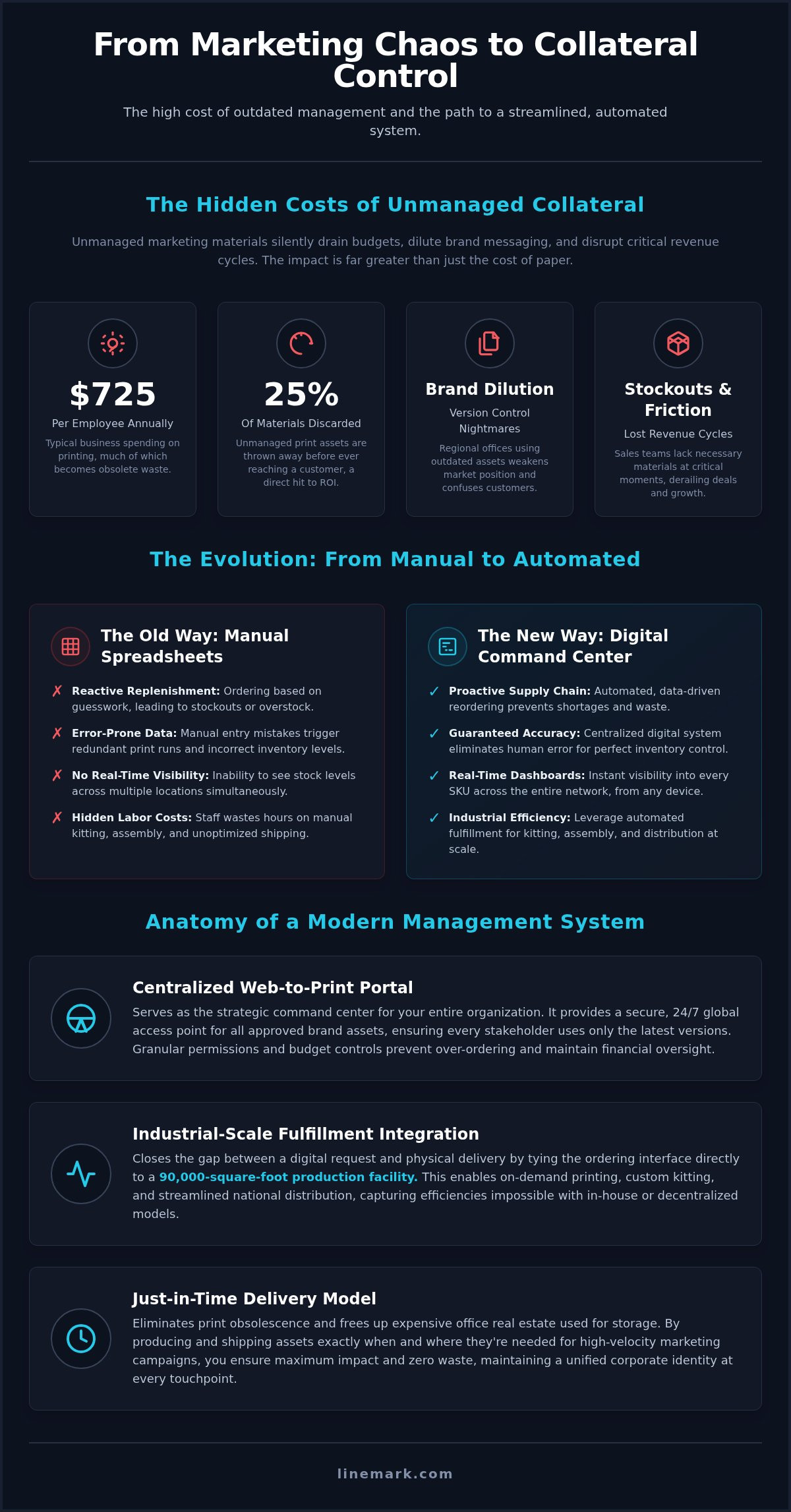
Did you know a typical business spends roughly $725 per employee annually on printing, yet much of that investment ends up as obsolete waste in a storage closet? Effective marketing collateral management is no longer just about storing boxes. It’s about precision logistics and digital-to-physical synchronization that treats your warehouse as a growth driver rather than a cost center.
You’ve likely felt the frustration of discovering a regional office is still using outdated brochures or, worse, facing a stockout during a critical sales push. It’s a common struggle to maintain brand consistency while managing manual inventory across multiple locations. We understand that these operational gaps don’t just waste money; they hinder your speed to market and dilute your brand’s authority.
This guide will show you how to eliminate print waste, automate your replenishment cycles, and synchronize your physical assets with digital speed. We’ll explore how to achieve real-time visibility into stock levels and integrate your ordering systems with industrial-scale fulfillment to ensure your brand stays agile and consistent through 2026. By the end, you’ll see how a centralized command center transforms chaotic logistics into a streamlined, high-tech operation.
Key Takeaways
- Identify the hidden financial drains of print obsolescence and how stockouts disrupt critical revenue cycles.
- Transition from manual spreadsheets to automated marketing collateral management for real-time inventory visibility and data-driven reordering.
- Evaluate the scalability of your current fulfillment model against the efficiencies of a 90,000-square-foot industrial production facility.
- Streamline national distribution through custom kitting and on-demand assembly for regional offices and events.
- Leverage MarCom On-Demand as a centralized command center to synchronize physical marketing assets with the speed of your digital strategy.
The True Cost of Unmanaged Marketing Collateral
Most organizations view their storage closets as a convenience. In reality, they’re a silent drain on the balance sheet. When Marketing collateral isn’t tracked through a centralized system, the financial impact is immediate. Industry data suggests that roughly 25% of unmanaged print materials are discarded before they ever reach a customer. This isn’t just a paper problem. It’s a strategic failure in marketing collateral management that erodes annual ROI.
Beyond the physical waste, the opportunity costs of stockouts can derail entire revenue cycles. If a sales representative arrives at a high-stakes trade show only to find their supply of brochures is empty, the friction created is immeasurable. These gaps in availability force teams to resort to local, low-quality printing or, worse, proceed without the necessary assets to close a deal.
To better understand the operational tools available to solve these challenges, watch this helpful video:
Hidden logistics expenses further complicate the operational picture. Manual kitting, where staff spends hours hand-assembling folders or event kits, represents a significant labor cost that is rarely tracked. When you add unoptimized shipping rates from multiple decentralized locations, the overhead becomes unsustainable. High-capacity organizations require a partner that consolidates these functions to capture industrial-scale efficiencies.
Quantifying Waste in the Corporate Supply Chain
Print obsolescence occurs when materials become outdated before they’re used. This often happens due to minor branding shifts or product updates that make existing stock unusable. Using expensive office real estate to store these items is inefficient compared to professional warehouse environments where space is optimized. Additionally, manual inventory tracking often leads to data entry errors. These mistakes trigger redundant print runs, doubling your costs while adding zero value to your campaigns.
The Brand Consistency Crisis
Decentralized storage creates version control nightmares. When regional offices manage their own supplies, they often use outdated or off-brand versions of critical assets. This fragmentation weakens your market position. A centralized management approach ensures every stakeholder accesses only the latest, approved files. Adopting a just-in-time delivery model supports high-velocity marketing campaigns by ensuring that physical assets arrive exactly when and where they’re needed. This maintains a unified corporate identity across every touchpoint.
Anatomy of an Automated Marketing Collateral Management System
Effective marketing collateral management requires more than just a digital repository for PDF files. It demands a sophisticated infrastructure where software intelligence meets physical production capabilities. While many organizations still rely on static spreadsheets to track their assets, modern leaders have shifted to dynamic digital dashboards that provide real-time visibility into every SKU across their network. This evolution moves the needle from reactive replenishment to proactive supply chain control.
According to the American Marketing Association on Branding, consistency is the bedrock of market trust. Automation ensures that this consistency is never compromised by human error or logistical delays. By tying your ordering interface directly to a 90,000-square-foot production facility, you close the gap between a digital request and physical delivery. This integration is what separates a simple software tool from a true strategic partnership.
The Role of Web-to-Print Portals
A proprietary portal like MarCom On-Demand serves as the strategic command center for your entire organization. It centralizes your brand assets in a secure digital library, offering 24/7 global access to authorized users. By implementing granular user permissions and strict budget controls, you prevent the over-ordering that often plagues decentralized teams. This system also streamlines approval workflows, allowing local offices to customize materials while ensuring they remain within corporate identity guidelines.
Data-Driven Replenishment Strategies
Leveraging historical usage patterns allows you to set precise minimum and maximum inventory thresholds. Predictive analytics can forecast demand for high-volume items like annual reports or seasonal catalogs, ensuring you’re prepared for peak periods without over-investing in storage. Automated alerts play a critical role here. These notifications trigger production before stock hits zero, effectively eliminating the need for high-cost emergency print runs that eat into your margins.
The most resilient systems utilize hybrid inventory models. This approach balances pre-printed static stock for high-volume items with Variable Data Printing (VDP) for personalized or time-sensitive pieces. Integrating these workflows ensures that your direct mail or localized brochures are as agile as your digital assets. If you’re ready to see how this looks in practice, consider exploring our inventory management solutions to bridge the gap between your digital strategy and physical fulfillment.
In-House vs. Outsourced Managed Print Services
Organizations often reach a critical tipping point where internal logistics become a bottleneck for growth. The choice between maintaining an in-house storage room and partnering with a specialized provider is a decision that impacts both your bottom line and your brand’s market reach. While keeping materials nearby feels like control, it often masks a series of “hidden” burdens that drain resources. Effective marketing collateral management requires a level of precision that most internal administrative teams aren’t equipped to sustain as they scale.
In-house operations carry significant overhead costs that are rarely captured on a single line item. You’re paying for climate-controlled real estate, insurance for physical assets, and specialized fulfillment labor. These expenses are often buried in general office budgets, making it difficult to calculate the true cost of every brochure sent to the field. Furthermore, the risk of manual handling errors increases with volume, leading to lost materials and frustrated sales teams.
Evaluating Your Internal Capacity
To determine if your current system is a liability, you must audit your fulfillment efficiency. Ask your team how many hours per week are spent on manual packing and shipping instead of core marketing tasks. If your “warehouse” is a collection of basements or closets, you’re likely facing several red flags:
- Inconsistent Packaging: Materials arrive damaged or poorly presented, reflecting poorly on the brand.
- Retail Shipping Rates: You’re paying standard carrier prices instead of industrial volume rates.
- Version Confusion: Outdated assets are shipped because there’s no digital tie-in to the physical shelf.
The Strategic Advantage of a Print Partner
Transitioning to a professional partner moves your operation from a cost-center model to a scalable communications partnership. By utilizing a 90,000-square-foot production and fulfillment facility, you gain access to industrial-scale kitting expertise that a standard office environment cannot replicate. This ensures that every multi-component kit is assembled with the meticulous attention to detail of a boutique shop but at a much higher velocity.
A significant benefit of this partnership lies in logistics optimization. High-volume printers leverage massive shipping volumes to secure lower postage and freight costs, savings that are passed directly to you. This approach mitigates the risk of secure national distribution, ensuring sensitive materials reach their destination through a well-oiled machine. By integrating your marketing collateral management with a partner’s proprietary technology, you gain enterprise-grade tracking without the high cost of developing internal software. This shift allows your team to focus on high-level strategy while we handle the precision of the physical journey.
Strategic Implementation: From Warehousing to National Distribution
While digital asset management handles the conceptual side of your brand, strategic implementation focuses on the physical reality of your assets. Moving from a digital dashboard to a physical doorstep requires an industrial-scale infrastructure that many organizations lack. A 90,000-square-foot production and fulfillment facility provides the necessary breadth to house bulk materials while maintaining the meticulous precision of a boutique shop. This physical space is where marketing collateral management becomes a tangible competitive advantage, bridging the gap between design and delivery.
National distribution is a complex logistical puzzle that requires more than just a shipping account. It involves optimizing transit times and reducing freight costs across the United States to ensure your materials arrive exactly when they’re needed. Custom kitting adds another layer of sophistication to this process. Assembling multi-component marketing kits on demand for events or regional offices requires a well-oiled machine. Every component must be tracked, from the smallest promotional item to the largest catalog. Regular inventory auditing is essential here. Physical counts must be synchronized with digital records to eliminate the “phantom inventory” that leads to missed deadlines and emergency production costs.
Optimizing the Fulfillment Workflow
Accuracy is the lifeblood of the “pick and pack” process. In high-volume corporate environments, even a minor error rate can lead to significant brand friction. Our facility handles a diverse range of assets with specialized care. This includes managing inventory for high-end custom book printing projects and the complex logistics required for large format graphics. Oversized signage, window graphics, and floor decals require specific handling and protective packaging to ensure they arrive at their destination ready for immediate installation.
Reporting and Continuous Improvement
Data turns raw logistics into an actionable marketing strategy. Monthly usage reports allow you to identify “dead” stock that is simply consuming storage budget and high-velocity movers that require more aggressive replenishment. By analyzing these turnover rates, you can adjust your print run lengths to maximize volume discounts without risking obsolescence. This granular inventory data directly informs future marketing budget allocations. It ensures your capital is invested in the materials that your sales teams actually use and value. If you’re ready to streamline your physical supply chain, consider how our integrated fulfillment solutions can transform your distribution model.
Scaling with Linemark’s MarCom On-Demand
The transition from fragmented logistics to a unified fulfillment strategy requires a partner that balances technological innovation with industrial-grade production. Linemark brings over 30 years of industrial print authority to the table, providing a foundation of reliability that software-only platforms cannot match. Our approach to marketing collateral management integrates proprietary technology with a 90,000-square-foot facility, ensuring that your digital orders are backed by physical excellence. This synergy allows your organization to move beyond transactional printing and enter a strategic communication partnership.
Efficiency at scale is achieved when every asset, from standard brochures to complex large-format graphics, is managed through a single hub. By customizing your MarCom On-Demand portal, you tailor the ordering interface to your brand’s specific needs. This eliminates the confusion of managing multiple vendors and disparate workflows. You gain the agility of a modern tech platform while benefiting from the meticulous attention to detail that only a seasoned production team can provide. It is a holistic journey designed to turn your warehousing from a cost center into a catalyst for national growth.
A Centralized Destination for National Needs
One of the most significant advantages of our model is the elimination of the “middleman.” By keeping production, kitting, and shipping within one facility, we remove the transit delays and communication gaps that often plague distributed marketing. National corporations utilize our centralized hub to maintain absolute brand consistency across thousands of miles. This setup provides the reassurance that every shipment, whether it contains annual reports or window graphics, meets the same high standard of precision. Our case studies demonstrate that when production and warehousing live under one roof, organizations see a marked improvement in their speed to market.
Getting Started with Professional Management
Transitioning your current inventory to a professional management system is a streamlined process designed to minimize disruption. The onboarding journey begins with a comprehensive audit of your existing assets, followed by the physical relocation of stock to our secure facility. We then work closely with your team to set up your MarCom On-Demand library for the first time. This includes establishing user permissions, setting budget controls, and defining automated reorder points based on your historical usage data. This proactive spirit ensures your sales teams are always equipped with the latest approved materials.
If you are ready to transform your logistics and eliminate the waste of unmanaged print, our team is prepared to build your strategic command center. Contact Linemark to streamline your marketing collateral management today.
Transforming Your Supply Chain into a Competitive Advantage
Modern marketing moves at the speed of digital, and your physical assets must keep pace to remain effective. By transitioning away from manual spreadsheets and decentralized storage, you eliminate the high costs of obsolescence and stockouts that drain your budget. Precision marketing collateral management is the essential link between a high-level strategy and successful execution in the field.
Linemark provides the industrial backbone for this operational shift. With a 90,000-square-foot state-of-the-art facility and over 30 years of industrial expertise, we offer a truly integrated tech and logistics platform. This centralized command center ensures that every component, from brochures to large-format graphics, is produced and shipped with meticulous attention to detail. You don’t have to sacrifice quality for scale; our systems are designed to handle both with ease.
Ready to automate your print logistics? Explore MarCom On-Demand.
We’re ready to help you synchronize your physical journey with your digital strategy. Let’s work together to turn your logistics into a reliable growth engine for 2026 and beyond.
Frequently Asked Questions
What is marketing collateral management?
It is the strategic process of overseeing the production, storage, and distribution of physical sales and brand assets. This discipline ensures that every brochure, catalog, and banner is available when needed while minimizing obsolescence and waste. Effective marketing collateral management transforms static warehousing into a dynamic logistics strategy that supports your broader corporate goals.
How does a web-to-print portal help with print inventory?
A web-to-print portal acts as a centralized command center that bridges the gap between digital ordering and physical fulfillment. It allows your team to place orders from a pre-approved library, ensuring brand consistency across every regional office. By integrating directly with our production facility, the portal reduces lead times and provides a streamlined interface for managing high-volume assets.
Can you manage inventory for custom books and large-format items?
Yes, our 90,000-square-foot facility is specifically equipped to handle diverse assets including custom book printing and large format graphics. We maintain specialized storage environments and handling protocols for oversized signage, wall murals, and multi-component kits. This ensures that even your most complex materials are preserved and shipped with the meticulous attention to detail they require.
What is the difference between warehousing and managed print fulfillment?
Warehousing is a passive storage service, while managed print fulfillment is an active, integrated logistics solution. Fulfillment includes the production, kitting, and strategic distribution of assets rather than just housing boxes in a dark corner. This proactive model uses real-time data to optimize marketing collateral management, ensuring your materials remain agile and cost-effective as you scale.
How do automated reorder alerts work?
Automated alerts trigger notifications when your stock levels reach a pre-defined minimum threshold based on your historical usage patterns. This system ensures that production begins before a stockout occurs, eliminating the need for expensive emergency print runs. These data-driven triggers allow you to maintain seamless availability for your sales teams without the need for manual inventory tracking.
Is it more cost-effective to store print or use print-on-demand?
The most efficient approach usually involves a hybrid model that balances bulk printing for high-velocity items with print-on-demand for personalized materials. Storing bulk runs captures significant volume discounts, while on-demand services eliminate waste for time-sensitive or low-volume assets. We help you analyze your turnover rates to determine the ideal production method for every SKU in your library.
How do you handle national distribution for printed materials?
We leverage our centralized production hub to manage logistics across the United States, utilizing high-volume shipping rates to reduce your postage and freight costs. Our integrated facility allows us to kit and ship materials directly from the point of production, which eliminates transit delays. This unified partnership model ensures that your regional offices receive their materials quickly and reliably.
Can I track my collateral inventory levels in real-time?
Real-time tracking is a standard feature of our digital dashboard, providing instant visibility into current stock levels across your entire network. You can monitor usage trends, track active shipments, and view inventory history from any device at any time. This transparency empowers your team to make data-driven decisions about future print runs and strategic marketing budget allocations.