


 08/08/2026
  Steve Bearden
84% of marketers report that direct mail delivers their highest ROI of any channel in 2026, yet even the most sophisticated campaigns fail if they arrive three days after the seasonal peak. When planning a high-volume rollout, the most critical question is always: how long does direct mail take? You shouldn’t have to guess when your message will hit mailboxes. You need a project calendar that accounts for every variable, from the initial digital proof to the final sorting at the postal facility.
We understand that missing a seasonal deadline or seeing a misalignment between your physical and digital ads isn’t just frustrating; it’s a lost opportunity for growth. This 2026 campaign timeline guide provides the realistic benchmarks you need to maintain operational excellence. You’ll discover the specific differences between First-Class and Marketing Mail delivery standards, learn how to navigate the latest USPS service refinements, and find out how integrated logistics can significantly compress your production window.
Key Takeaways
- Map out a realistic 8 to 12-week schedule that balances internal production phases with external postal transit times.
- Identify the critical differences between USPS mail classes to determine exactly how long does direct mail take for your specific 2026 delivery goals.
- Master the six phases of campaign development to ensure creative compliance and strategy are finalized before the printing press starts.
- Implement acceleration strategies like data hygiene and template-driven workflows to reduce lead times for recurring monthly mailings.
- Leverage integrated production and fulfillment to eliminate logistical gaps and maintain a predictable project calendar for high-volume rollouts.
Understanding the Direct Mail Production and Delivery Timeline
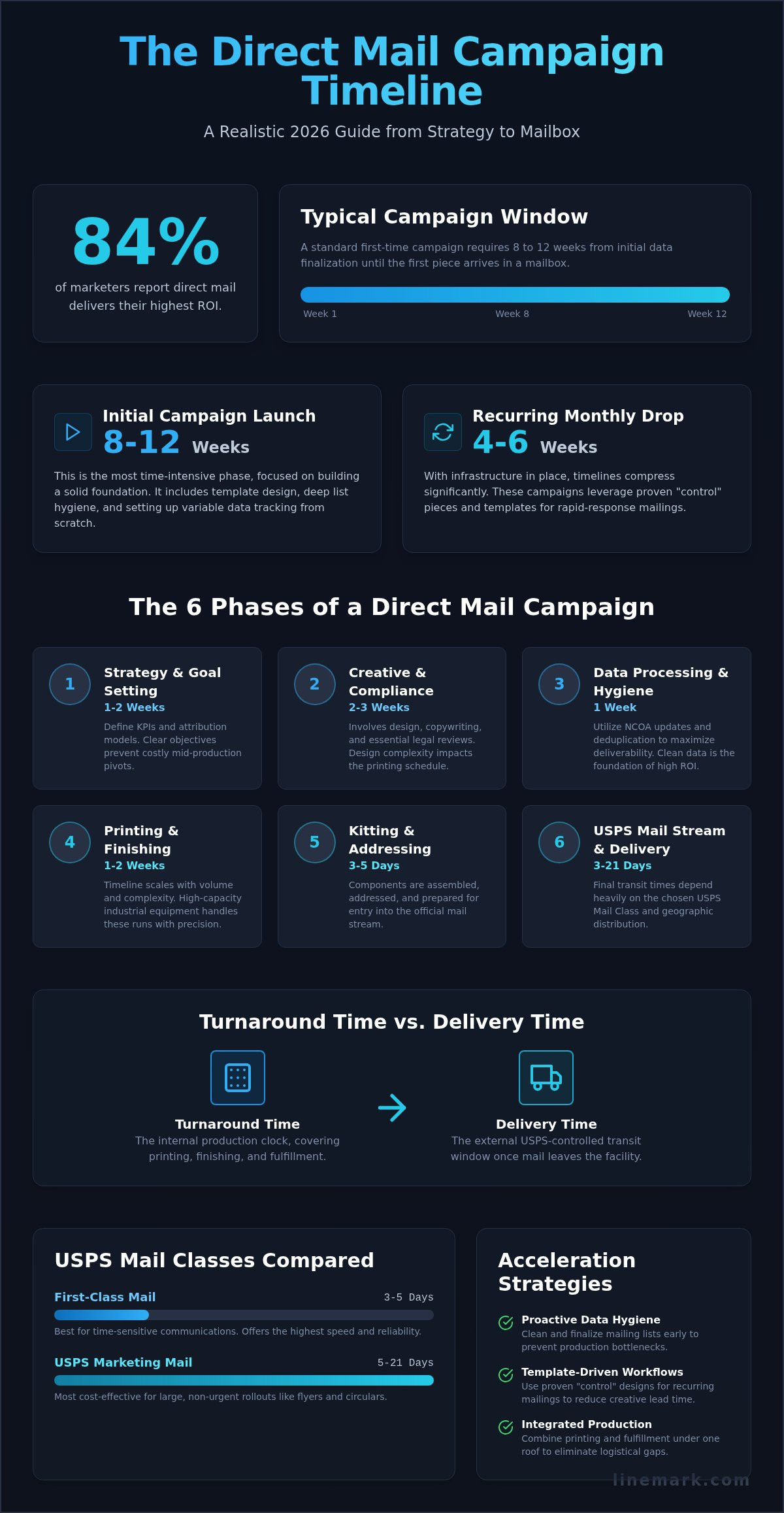
Executing a sophisticated Direct Mail strategy requires looking beyond a single date on a calendar. To accurately answer the question, “how long does direct mail take,” you must view the process as a dual-track operation. It’s not simply a matter of how fast a printer can run. It is the synergy between industrial-scale production and complex postal logistics. A standard first-time campaign typically requires 8 to 12 weeks from strategy to mailbox. The total campaign window is defined as the specific duration from the moment data is finalized until the first mail piece lands in a recipient’s mailbox.
The timeline is split into two distinct phases. The production phase encompasses everything from strategy and data processing to printing, kitting, and fulfillment. Once the mail is induction-ready and handed over to the USPS, the postal transit phase begins. Managing these phases with precision ensures that high-volume projects move through the facility without friction, maintaining the momentum required for large-scale corporate growth.
Initial Campaign vs. Recurring Drop Timelines
The first launch of a new campaign is the most labor-intensive because you’re building a foundation. This period includes establishing template designs, performing deep list hygiene to ensure deliverability, and setting up variable data tracking mechanisms. These foundational steps are why a first-time rollout takes longer. However, once that infrastructure is in place, the timeline compresses significantly. Established recurring campaigns can often be executed in a 4 to 6-week window. By utilizing “control” pieces—proven designs that require minimal adjustment—we can pivot to rapid-response mailings. Strategic planning transforms these variables into a predictable 2026 mailing calendar, allowing your team to focus on performance rather than logistics.
The Difference Between Turnaround Time and Delivery Time
Precision in modern marketing requires a clear distinction between internal and external clocks. Turnaround time refers to the internal production clock at a high-capacity facility. This is the period where technical production, such as variable data printing and professional binding, occurs. In contrast, delivery time is the USPS-controlled transit window once the mail leaves the facility. Understanding this distinction is essential for multi-channel marketing synchronization. If your digital ads launch on day one but your mail has a 10-day delivery window, your messaging will be out of sync. Tracking both metrics ensures that your physical and digital touchpoints reinforce each other. This clarity helps you determine exactly how long does direct mail take for your specific project, ensuring your 2026 campaigns land with maximum impact.
The Six Phases of a Direct Mail Campaign
Determining how long does direct mail take requires a granular look at the six phases of campaign development. Each stage represents a critical milestone where precision and timing intersect to ensure a successful rollout. A predictable schedule is built on the following sequence:
- Step 1: Strategy and Goal Setting (1-2 weeks): This phase defines your KPIs and attribution models. Establishing clear objectives early prevents mid-stream pivots that derail production.
- Step 2: Creative Development and Compliance (2-3 weeks): This involves design and essential legal reviews. Complexity in design, such as custom folds, directly influences the subsequent printing schedule.
- Step 3: Data Processing and List Hygiene (1 week): We utilize NCOA (National Change of Address) updates and deduplication to ensure deliverability. Clean data is the foundation of a high-ROI campaign.
- Step 4: Printing and Finishing (1-2 weeks): The timeline here scales with volume and complexity. High-capacity industrial equipment handles these runs with technical precision.
- Step 5: Kitting and Addressing (3-5 days): This is where components are assembled and prepared for the mail stream. Specialized fulfillment teams manage this high-touch process.
- Step 6: USPS Mail Stream Entry and Delivery (3-21 days): Final transit times depend heavily on the chosen USPS Mail Classes and geographic distribution.
Strategy, Design, and Data Preparation
Finalizing your mailing list early is the most effective way to prevent production bottlenecks. When data hygiene and list procurement happen concurrently with creative development, you eliminate the “waiting period” that often plagues less organized campaigns. Incorporating direct mail best practices during the design phase also streamlines the process. For example, ensuring your creative meets USPS automation standards during the design stage avoids costly re-works and delays. Creative complexity, such as intricate die-cuts or unique paper weights, adds character but requires additional lead time for specialized finishing equipment.
Industrial Printing and Finishing Timelines
The speed of your campaign is often dictated by the technology used in the facility. Offset printing remains the standard for extremely high-volume runs due to its efficiency and unit-cost advantages at scale. Conversely, digital printing allows for variable data integration and faster setup for smaller, more targeted drops. Managing these workflows within a 90,000-square-foot production facility ensures that throughput remains steady even during peak seasonal surges. Specialized finishes like UV coating or soft-touch lamination provide a premium tactile experience, though they require additional curing or processing time. If you want to optimize your schedule, consulting with a strategic communications ally early in the process can help you select the most efficient production methods for your volume.
USPS Mail Classes: How First-Class and Marketing Mail Differ
The choice of mail class is the single most influential factor in your postal transit window. According to USPS mail delivery service standards, First-Class Mail is the premium option, offering a 2-5 day national delivery window. In contrast, USPS Marketing Mail, formerly known as Standard Mail, is the budget-conscious choice with a broader delivery window of 7-21 days. Understanding these classes is the first step in calculating how long does direct mail take for your specific 2026 goals. This decision directly dictates your overall campaign launch date. If you need to hit a specific event date, your mail class choice determines whether you must finalize your files eight weeks in advance or four.
Balancing postage budget against speed-to-market is a strategic exercise. While Marketing Mail offers significant savings for high-volume drops, the lack of a guaranteed delivery window can disrupt multi-channel synchronization. We help partners navigate this trade-off by analyzing campaign goals against the current postal environment. The right choice ensures your message lands when it’s most relevant, not after the opportunity has passed.
When to Invest in First-Class Mail Speed
First-Class Mail is essential for time-sensitive assets. This includes event invitations, limited-time promotional offers, or high-value annual reports where perception and timing are paramount. A major operational advantage of First-Class is the inclusion of forwarding and return services. If a recipient has moved, the mail piece follows them or returns to you with the new address, automatically maintaining your list hygiene. This level of reliability is also why First-Class is the preferred method for custom book printing fulfillment, where customers expect rapid and traceable delivery of their high-value orders.
Maximizing ROI with USPS Marketing Mail
For non-profit appeals and retail catalogs where volume is high and the offer is evergreen, Marketing Mail remains the ideal vehicle. Managing expectations for the 21-day window is key to success. We mitigate these longer transit times through “drop shipping” strategies. By transporting mail directly to local USPS Sectional Center Facilities (SCFs) or Destination Delivery Units (DDUs), we bypass several layers of national sorting. This can shave days off the delivery window and answer the question of how long does direct mail take with much more favorable numbers. In 2026, predicting seasonal volume spikes is especially critical. Election cycles and holiday surges can strain the mail stream, making early induction even more vital for Marketing Mail campaigns that need to land on schedule.
Strategies to Accelerate Your Direct Mail Production
Speed in direct mail isn’t just about the mechanical velocity of a printing press. It’s about the efficiency of the entire workflow. When marketing leaders ask how long does direct mail take, they’re often looking for ways to compress the production cycle without compromising precision. Centralizing your data is the first step. By maintaining a single source of truth for your mailing lists, you reduce the lead times required for processing and hygiene. This proactive approach eliminates the frantic back and forth that usually occurs during the final week of a campaign.
Utilizing pre-approved templates for recurring assets like newsletters or catalogs also shaves days off the calendar. Instead of starting from scratch, your team can focus on content updates while the technical specifications remain constant. We also recommend addressing the “approval bottleneck” early. Establishing a streamlined internal sign-off process ensures that creative and legal reviews don’t stall the project. Moving from data to the mail stream faster requires a partner that acts as a strategic communications ally, anticipating hurdles before they affect the timeline.
Variable Data Printing (VDP) and Speed
Variable Data Printing (VDP) has revolutionized how we handle personalization at scale. In the past, personalized mail required two steps: printing generic shells and then overprinting individual names or addresses. VDP eliminates this inefficiency. Variable Data Printing integrates data and design into a single-pass production step, allowing for high-speed digital output that is unique to every recipient. This technology ensures that personalization doesn’t slow down the press. You get the high response rates of tailored messaging with the turnaround times of a standard run. To refine your 2026 planning, consider reviewing our direct mail strategy guide.
Streamlining Kitting and Fulfillment
The logistical gap between a printer and a fulfillment house is a common source of delay. Keeping inventory and production within one 90,000-square-foot facility eliminates transit time between vendors. Automated kitting further reduces manual labor hours, which is critical for complex packages containing multiple inserts or promotional items. By mailing directly from a centralized national hub, you bypass unnecessary regional transfers. This integrated approach provides a clearer answer to how long does direct mail take by removing the variables associated with third-party logistics. Precision and scale work together to keep your 2026 campaigns moving at the pace of your business.
The Linemark Advantage: Integrated Speed and Scale
Most marketing teams view printing and fulfillment as separate silos. This fragmented approach is often the hidden reason projects stall during the final stretch. At Linemark, we eliminate these friction points by serving as a centralized destination for design, print, and mail. Our 90,000-square-foot facility is engineered for high-volume throughput, allowing us to handle complex commercial printing projects with technical precision. By integrating these services under one roof, we provide a definitive answer to how long does direct mail take by removing the “transit gap” that typically occurs between production and the post office.
We act as a strategic communications ally rather than a simple service provider. This partnership allows us to compress the traditional 12-week campaign window significantly. We identify efficiencies in kitting and fulfillment before the press even starts, ensuring that your nationwide distribution moves seamlessly from the loading dock to the mail stream. Whether you’re scaling from a small targeted list to a massive corporate rollout, our infrastructure ensures that quality control remains absolute without sacrificing speed.
MarCom On-Demand: Reducing Lead Times to Days
Speed in 2026 requires more than just faster machines; it requires digital agility. Our MarCom On-Demand portals automate the ordering process, allowing local teams to trigger mailings in real-time. This technology empowers distributed marketing efforts while maintaining strict corporate brand control. Web-to-print integration means that catalogs or brochures can be customized and ordered in minutes, reducing what used to be a multi-week procurement cycle down to a matter of days. It’s the ultimate solution for brands that need to react to market changes instantly.
Nationwide Distribution from a Centralized Hub
Logistics for brochures, catalogs, and large-format graphics require a sophisticated management system. Our centralized hub simplifies these complexities through in-house inventory management. We store your recurring mailers and kitted components, allowing for on-demand fulfillment that bypasses the lead times of traditional production runs. This model ensures that every piece meets our standards for precision and quality control, regardless of the scale. Our integrated model provides a clear roadmap for how long does direct mail take when deadlines are non-negotiable. When you consolidate your workflows within a single high-capacity facility, you gain the predictability needed to dominate the 2026 market.
Mastering Your 2026 Direct Mail Schedule
Success in modern marketing requires more than just a calendar; it demands a strategic understanding of how production phases and postal transit windows intersect. You’ve discovered that while a first-time rollout typically spans 8 to 12 weeks, established workflows and integrated logistics can significantly compress that window. The specific answer to how long does direct mail take depends on your choice of mail class and the technical efficiency of your production partner.
By consolidating your design, print, and fulfillment within a single 90,000-square-foot high-capacity facility, you eliminate the delays inherent in multi-vendor logistics. Our advanced Variable Data Printing (VDP) capabilities and in-house kitting ensure that your message is both personalized and ready for nationwide fulfillment without unnecessary idle time. This holistic approach transforms direct mail from a transactional task into a predictable, scalable engine for your corporate growth.
Streamline your next campaign with Linemark’s integrated direct mail services. We look forward to ensuring your 2026 projects land with precision and impact.
Frequently Asked Questions
How long does it take to print and mail 10,000 postcards?
Standard production for 10,000 postcards typically requires three to five business days once the digital proof is approved. High-capacity digital presses handle this volume with extreme precision, allowing for rapid transition to the kitting and addressing phase. After production, the total time depends on your chosen mail class. First-Class Mail adds two to five days for delivery, while Marketing Mail can extend the window by several weeks.
What is the fastest way to get direct mail delivered?
The most efficient path to delivery combines First-Class Mail with centralized production and strategic drop shipping. By producing your materials in a high-capacity facility and transporting them directly to local USPS Sectional Center Facilities, you bypass multiple layers of national sorting. This integrated approach significantly reduces the time from data finalization to the mailbox, ensuring your time-sensitive offers land exactly when they are most relevant.
Does the size of the mail piece affect the delivery time?
Size directly impacts how the USPS processes your campaign. Standardized dimensions, such as 6×9 or 6×11 postcards, move through automated sorting equipment at maximum velocity. Conversely, oversized or non-machinable pieces often require manual handling, which can trigger delays. Selecting dimensions that meet automation standards is a critical step in determining how long does direct mail take for your specific project goals.
How far in advance should I plan a holiday direct mail campaign?
You should begin the planning phase at least 12 to 16 weeks before your target delivery date. Seasonal surges in 2026, particularly during election cycles and the Q4 holiday peak, put immense strain on the national mail stream. Starting early allows you to secure production slots and account for potential postal logjams, ensuring your seasonal messaging doesn’t arrive after the opportunity for conversion has passed.
What causes the most common delays in direct mail production?
Data hygiene issues and internal approval bottlenecks are the most frequent causes of project stalls. When mailing lists require extensive cleaning or creative files are delayed in legal review, the production clock cannot start. Establishing a streamlined sign-off process and performing list maintenance early in the strategy phase prevents these common friction points from derailing your 2026 campaign timeline and keeps your rollout on schedule.
Can I track my direct mail pieces once they are with the USPS?
Yes, modern tracking is achieved through Intelligent Mail Barcodes (IMb) and the USPS Informed Delivery service. These technical tools provide near real-time visibility as your mail pieces move through various distribution centers. This data allows marketing teams to synchronize digital follow-ups with the exact moment a physical piece arrives, creating a high-touch, multi-channel experience that maximizes your total return on investment.
How does variable data printing impact the production schedule?
Variable Data Printing actually accelerates the schedule by integrating personalization into a single-pass production step. Older methods required printing generic shells and then performing a secondary overprinting run for addresses and names. VDP removes this extra stage, answering the question of how long does direct mail take with a much more efficient timeline. You get the benefits of tailored messaging without adding days to the production calendar.
Is First-Class mail worth the extra cost for speed?
First-Class Mail is a vital investment for time-sensitive promotions, event invitations, and high-value corporate reports. Beyond the faster two to five-day delivery window, it includes essential forwarding and return services. If a recipient has moved, the USPS will forward the piece or return it to you with the new address. This automated list hygiene provides significant long-term value that often outweighs the initial postage premium.