


 08/02/2026
  Steve Bearden
What if you could track a 50,000-piece bulk mailing with the same granular precision as a single Priority Mail package? For many marketing leaders, the ‘last mile’ of delivery remains a frustrating black box, making it difficult to prove ROI to stakeholders or sync digital follow-ups with physical arrivals. Mastering usps direct mail tracking isn’t just about logistics; it’s about transforming a traditional medium into a data-driven powerhouse. With the USPS reporting over 78.7 million active Informed Delivery users as of early 2026, the gap between physical mail and digital attribution has finally closed.
It’s understandable to feel a sense of uncertainty when you can’t confirm exactly when your message reaches its destination. You need more than just a vague delivery window to execute a sophisticated, multi-channel strategy. This guide provides the technical roadmap to implement a reliable tracking system for every mailer, ensuring you can reduce ‘lost’ mail anxiety and maximize your campaign performance. We’ll break down the latest Intelligent Mail barcode (IMb) requirements, explain how to leverage the 62.1% average open rate of Informed Delivery emails, and show you how to turn raw postal data into a streamlined, high-tech marketing solution.
Key Takeaways
- Master the architecture of the Intelligent Mail barcode (IMb) to establish a reliable foundation for usps direct mail tracking across your entire campaign.
- Implement a clear protocol for securing Mailer IDs and assigning unique sequence numbers to ensure every piece is accounted for during delivery.
- Differentiate between the tracking capabilities of targeted campaigns and EDDM to set realistic expectations for delivery verification.
- Bridge the gap between physical and digital channels by using Informed Delivery as a tool for immediate attribution and engagement monitoring.
- Evaluate print partners based on their capacity for advanced Variable Data Printing and their ability to integrate tracking directly into the production workflow.
The Architecture of USPS Direct Mail Tracking in 2026
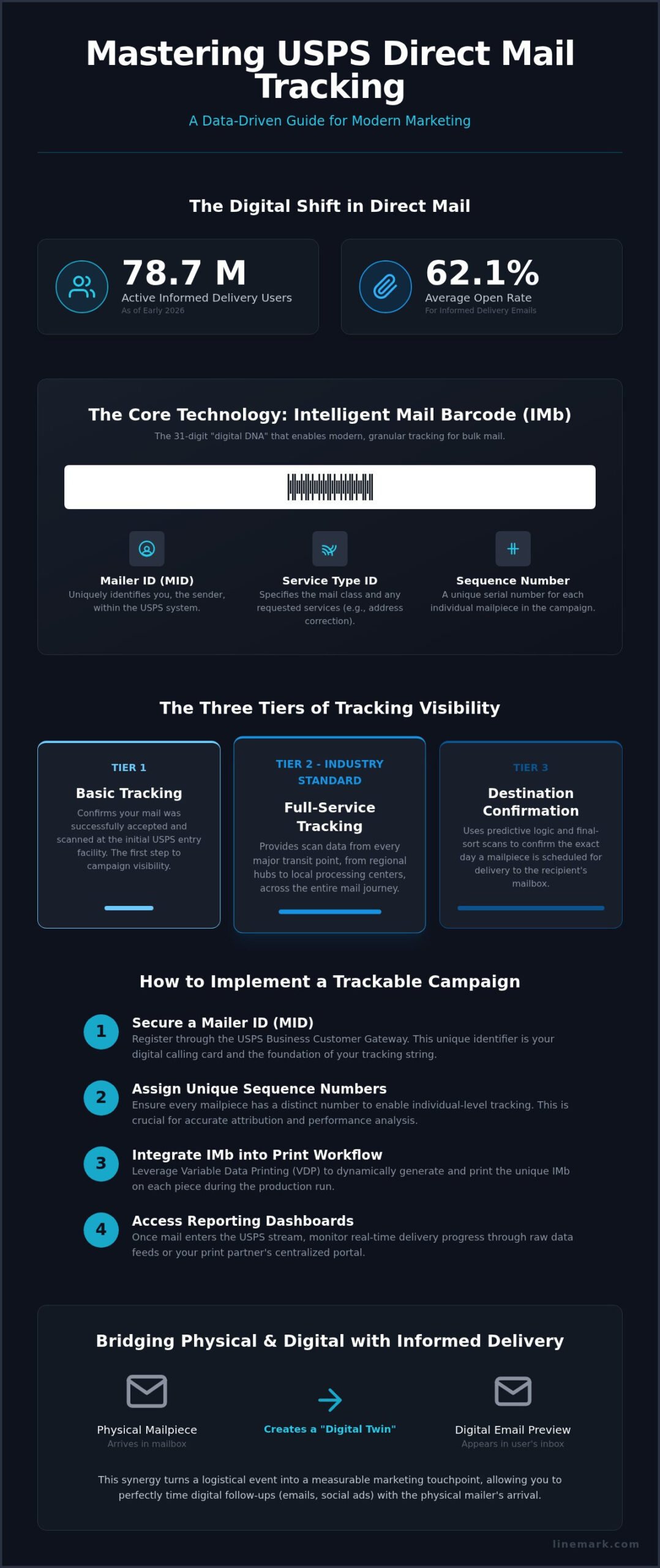
Modern usps direct mail tracking is no longer a passive process of “send and hope.” It’s a sophisticated data ecosystem built on the Intelligent Mail Barcode (IMb). Many professionals confuse bulk tracking with the tracking numbers used for single Priority Mail packages. They’re fundamentally different. A package tracking number is a one-to-one identifier. In contrast, bulk tracking is a one-to-many system that encodes your Mailer ID (MID) and Service Type Identifier (STID) into a single, high-density barcode. This allows you to monitor thousands of individual interactions simultaneously. This visibility is the backbone of operational excellence, letting you coordinate email or social media follow-ups to hit exactly when your physical mailer arrives.
Understanding the Intelligent Mail Barcode (IMb)
The IMb is a 31-digit tracking string that serves as the digital DNA of your mailpiece. It has completely replaced legacy POSTNET and PLANET barcodes, offering a far more robust data payload. This barcode identifies the mailer, the specific class of mail, and the unique sequence number of the piece. Every time your mailpiece passes through a USPS sorting facility, it generates a digital “ping.” These pings provide real-time data on the geographic location and processing status of your campaign. For businesses managing high-volume direct mail fulfillment, this level of detail is essential for maintaining a transparent supply chain.
The Three Levels of Tracking Visibility
Successful usps direct mail tracking offers three distinct tiers of data, each providing deeper insights into your campaign’s progress:
- Basic Tracking: This confirms that your mail was successfully scanned at the initial entry facility. It’s the bare minimum required to know your campaign is in the system.
- Full-Service Tracking: This is the industry standard for 2026. It provides scan data at every major transit point in the journey, from regional hubs to local processing centers.
- Destination Confirmation: This is the most transformative tier. It uses predictive logic and final-sort scans to tell you the exact day a mailpiece should land in a recipient’s mailbox.
By integrating these levels with consumer-facing tools like Informed Delivery, you create a unified marketing journey. With Informed Delivery adoption reaching over 78 million active users in 2026, the physical mailpiece now has a “digital twin” that appears in a recipient’s inbox before they even walk to their mailbox. This synergy allows you to turn a logistical event into a measurable marketing touchpoint, ensuring your brand stays top-of-mind across multiple channels.
How to Track Targeted Direct Mail Campaigns Step-by-Step
Moving from the technical architecture of the IMb to a live campaign requires a disciplined execution of four critical steps. Establishing a reliable usps direct mail tracking workflow ensures that every piece of mail is visible from the moment it leaves the 90,000-square-foot production facility until it reaches the recipient’s home. This process transforms a logistical necessity into a strategic advantage, allowing for precise marketing attribution.
- Step 1: Secure a Mailer ID (MID). This unique identifier is your calling card within the USPS system. You must register through the USPS Business Customer Gateway to receive your MID.
- Step 2: Assign unique sequence numbers. To track individual performance, every mailpiece needs a distinct sequence number. This prevents data overlap and allows you to identify exactly which customer has received your message.
- Step 3: Integrate the IMb into your print workflow. This is where variable data printing becomes essential. The barcode must be dynamically generated and printed on each piece during the production run.
- Step 4: Access reporting dashboards. Once the mail enters the stream, you can pull raw data feeds or view centralized reports through a partner’s portal to monitor delivery progress in real time.
Setting Up Your Mailer ID (MID)
Your Mailer ID is the foundation of your tracking string. The USPS issues two types of MIDs: a 6-digit version for high-volume mailers who send over 10 million pieces annually, and a 9-digit version for smaller, targeted campaigns. While you can manage this registration through the Business Customer Gateway, many organizations prefer to have their communications ally handle the MID management. This ensures that the ID is correctly formatted to qualify for the best possible automation rates and is properly synced with the official USPS Informed Delivery service.
Interpreting Scan Data
Raw usps direct mail tracking data can be overwhelming without proper context. When a status shows as “In Transit,” it indicates that the mail pallet has been scanned at a regional distribution center. An “Out for Delivery” signal is generated when the individual piece is sorted for a specific carrier route. Perhaps most importantly, tracking identifies “Undeliverable as Addressed” (UAA) mail. This data is a goldmine for list hygiene, allowing you to remove dead addresses and reduce waste in future mailings. For brands focused on efficiency, partnering with an expert in Direct Mail can help translate these complex data points into actionable marketing insights.
Tracking Every Door Direct Mail (EDDM): Myths vs. Reality
A common misconception in the marketing community is that Every Door Direct Mail is a “black hole” for data. Skeptics often claim that because EDDM lacks an individual Intelligent Mail Barcode for every household, it’s impossible to verify delivery. This isn’t true. While you can’t see exactly when a specific resident opens their mailbox, you can achieve precise logistical visibility through refined usps direct mail tracking strategies. The focus simply shifts from individual piece monitoring to verifying the “Drop-Off” at the local Post Office, or Delivery Distribution Unit (DDU).
In 2026, the architecture of EDDM tracking relies on verifying the chain of custody. You’re tracking the shipment of mail bundles rather than the single postcard. This distinction is vital for marketing leaders who need to coordinate digital “surround sound” campaigns with physical arrivals. By confirming when your pallets hit the DDU, you can trigger social media ads or email follow-ups to hit those same ZIP codes with high confidence. This collaborative approach ensures your brand remains top-of-mind during the critical 48-hour window after a mailer lands.
EDDM Retail vs. EDDM Commercial Tracking
The tracking method you use depends on your campaign scale. Retail EDDM, which costs $0.247 per piece as of July 2026, provides a tracking number for the shipment of bundles. This confirms your mail arrived at the facility responsible for the final sort. Commercial EDDM requires a different reporting mindset. Instead of a tracking number, you rely on the “Statement of Mailing” (PS Form 3602). This document, stamped by the USPS, serves as official proof that your high-volume campaign was accepted into the postal stream. It’s a critical tool for proving compliance and timing to stakeholders who demand transparency.
Proxy Tracking Methods for EDDM
To bridge the gap between logistics and attribution, savvy brands use proxy methods that act as “ghost” tracking. QR codes are the most effective solution for this. By assigning a unique QR code to each carrier route, you can track engagement levels with pinpoint accuracy. When a recipient scans the code, you gain immediate digital attribution that mirrors the physical delivery window. You can also deploy dedicated landing pages or phone lines to isolate the performance of specific geographic areas. These digital triggers allow you to calculate an “Estimated Delivery Window” with high precision, turning a saturation campaign into a measurable marketing asset. As your strategic communications ally, we help you implement these high-tech solutions to ensure no piece of mail goes uncounted.
Beyond Logistics: Digital Attribution and Informed Delivery
The evolution of usps direct mail tracking has reached a point where physical delivery and digital interaction are inseparable. While the IMb tracks the piece through the postal system, USPS Informed Delivery provides a “digital twin” that lands in the recipient’s email inbox before they even open their mailbox. This service has seen massive adoption, reaching 78.7 million active users as of March 2026. For marketers, this isn’t just a convenience; it’s a powerful attribution engine that bridges the gap between the mailbox and the smartphone.
The Power of Informed Delivery Interactive Campaigns
An interactive campaign allows you to replace the standard grayscale scan of your mailpiece with a full-color ride-along image. This digital touchpoint includes a clickable link, providing an immediate “click” tracking metric that traditional mail previously lacked. With the average open rate for Informed Delivery “Daily Digest” emails sitting at 62.1%, the visibility is unparalleled. This system allows you to capture digital engagement data long before the physical piece is retrieved. It’s the ultimate tracking tool for 2026 because it combines the high trust of physical mail with the instant feedback of digital marketing.
Advanced Attribution: QR Codes and PURLs
To achieve true 1:1 attribution, you must design your mailers with “Scan-to-Track” functionality in mind. By leveraging advanced Variable Data Printing (VDP), you can generate unique QR codes or Personalized URLs (PURLs) for every recipient on your list. This creates a dedicated tracking path that identifies exactly who responded and when. This level of precision is what transforms a service provider into a strategic communications ally.
- Unique QR Codes: These allow for instant mobile engagement and track individual response rates across different segments.
- Personalized URLs: PURLs provide a tailored web experience that continues the conversation started on the physical mailer.
- Attribution Window: Tracking these digital triggers helps you measure the “Attribution Window,” or the time elapsed between delivery and action.
Integrating these digital elements with a platform like MarCom On-Demand allows you to automate follow-up actions based on delivery data. When the USPS system confirms a piece has landed, your digital triggers can immediately deploy an email or social ad to reinforce the message. This unified approach ensures that your marketing spend is fully optimized. Partner with a strategic communications ally to master your direct mail tracking and digital attribution.
Choosing a Print Partner for Full-Cycle Tracking Visibility
Selecting the right production partner is the final, most critical step in securing full-cycle visibility for your marketing campaigns. High-volume projects demand more than just a printer; they require a strategic ally with the infrastructure to handle complex logistics without sacrificing precision. Operating from a 90,000-square-foot high-tech facility, Linemark provides the industrial scale necessary to manage massive data sets while maintaining the meticulous attention of a boutique shop. This centralized approach to direct mail fulfillment ensures that every logistical “ping” is captured and translated into meaningful business intelligence. When you centralize your production and distribution, you eliminate the data silos that often lead to “lost” mail anxiety.
Our advanced technological capabilities allow us to incorporate usps direct mail tracking technology directly into the production workflow. This ensures no piece of mail enters the stream without its digital footprint. By bridging the gap between high-capacity production and tailored service, we ensure that even the most intricate tracking requirements are met with operational excellence. This agile problem-solving spirit is what transforms a standard vendor relationship into a unified partnership, positioning your organization to win in a competitive 2026 landscape.
Linemark’s Data-Driven Approach
Our commitment to precision is rooted in over 30 years of national distribution experience. We don’t just print barcodes; we manage the entire technical architecture of usps direct mail tracking so your team can focus on high-level strategy. By integrating USPS data directly into our client-facing dashboards, we move the conversation beyond “did it arrive?” to “how is it performing?” This transparency allows you to monitor inventory levels and campaign status in real-time, providing a clear view of your marketing ROI. We handle the complexities of the IMb and USPS regulations, providing you with a streamlined, high-tech solution that is both efficient and thorough.
Scalability and Precision
Modern marketing requires the ability to pivot and scale instantly. Whether you’re running a single-version saturation campaign or a complex, multi-version initiative using Variable Data Printing (VDP), our facility is equipped to deliver. Our “boutique attention, industrial scale” philosophy means your project receives dedicated expert oversight regardless of its volume. We view our services as a catalyst for your growth, providing the technical production capabilities needed to maintain a steady, confident communication rhythm with your audience. Ready to gain full visibility into your next project? Contact Linemark for a Direct Mail Strategy Session.
Transforming Postal Data into Marketing Intelligence
Mastering the nuances of usps direct mail tracking represents a strategic shift from simple distribution to precise marketing attribution. By leveraging the technical architecture of the Intelligent Mail barcode and the interactive potential of Informed Delivery, you bridge the gap between physical logistics and digital engagement. This transparency allows your team to coordinate multi-channel efforts with surgical timing, ensuring every mailpiece serves as a catalyst for growth rather than a source of uncertainty. You’ve moved beyond the basic question of delivery to a sophisticated understanding of how physical touchpoints drive digital actions.
Operational excellence requires a partner capable of merging industrial scale with technological innovation. With over 30 years of industrial print expertise and advanced Variable Data Printing technology, Linemark manages the complexities of nationwide fulfillment and logistics so you don’t have to. We turn raw postal data into clear, actionable insights through our centralized production workflow. Ready to gain full visibility into your next campaign? Streamline Your Direct Mail with Linemark’s Tracking Solutions and take control of your marketing ROI today. Your strategic journey toward total campaign visibility starts with a partner you can trust.
Frequently Asked Questions
Can I track a direct mail campaign like a regular USPS package?
Bulk mail requires the Intelligent Mail Barcode (IMb) rather than a single tracking number. While you won’t enter a code into a standard search bar for every piece, usps direct mail tracking allows you to monitor thousands of mailers simultaneously. This aggregate data provides a high-level view of your campaign’s progress through the postal system, from initial entry to final sorting at regional hubs.
What is the difference between IMb and a standard tracking number?
A standard tracking number identifies a single parcel, while the IMb is a 31-digit string designed for industrial sorting. The IMb encodes your specific Mailer ID and a unique sequence number for each piece. This structure allows high-volume printers to track entire pallets of mail while still maintaining the ability to identify individual delivery signals at the household level during the final sort.
How do I know if my EDDM flyers were actually delivered?
You verify EDDM delivery by tracking the shipment of bundles to the local Delivery Distribution Unit (DDU). Once the USPS accepts the bundles at the DDU, you receive a stamped Statement of Mailing. For engagement verification, savvy marketers use proxy methods like route-specific QR codes or unique phone lines to confirm that the mailers reached their intended audience and triggered a response.
What does ‘Informed Delivery’ mean for my marketing tracking?
Informed Delivery creates a digital touchpoint that appears in a recipient’s inbox before the physical mail arrives. For your usps direct mail tracking, this means you can measure digital open rates and click-through rates on ride-along images. It transforms tracking from a purely logistical tool into a performance marketing metric, providing immediate data on how many users interacted with your offer digitally.
Is there a way to see exactly which person on my list opened their mail?
You cannot track the physical act of opening an envelope, but you can achieve 1:1 attribution through digital triggers. By using Variable Data Printing to place unique QR codes or Personalized URLs (PURLs) on each mailer, you identify exactly which individual took action. This creates a clear conversion path that links a specific physical address to a digital response in your CRM system.
What should I do if my USPS tracking shows a delay in my campaign?
If you identify a bottleneck in the scan data, you should immediately coordinate with your print partner to investigate the specific sorting facility. Use this information to pause or delay your synchronized digital ads or email follow-ups. Precision in tracking allows you to remain agile, ensuring you don’t waste digital spend on recipients who haven’t yet received your physical message in their mailbox.
How much does it cost to add tracking to a direct mail campaign?
Incorporating tracking into a professional campaign often adds minimal overhead because it utilizes the existing IMb infrastructure required for automation discounts. High-volume partners integrate this technology directly into the production workflow. Rather than a separate fee, tracking is typically part of a holistic journey that includes data management, variable printing, and nationwide fulfillment to ensure the best possible ROI for your campaign.
Can my printer provide a dashboard for my mail tracking data?
Strategic communications allies provide centralized portals to visualize your campaign’s lifecycle. Platforms like MarCom On-Demand offer real-time dashboards that show delivery status, inventory levels, and response data in one location. This level of transparency moves the conversation from simple logistics to strategic performance, allowing marketing executives to prove ROI to stakeholders with concrete, data-backed reports that drive future growth.