


 06/22/2026
  Steve Bearden
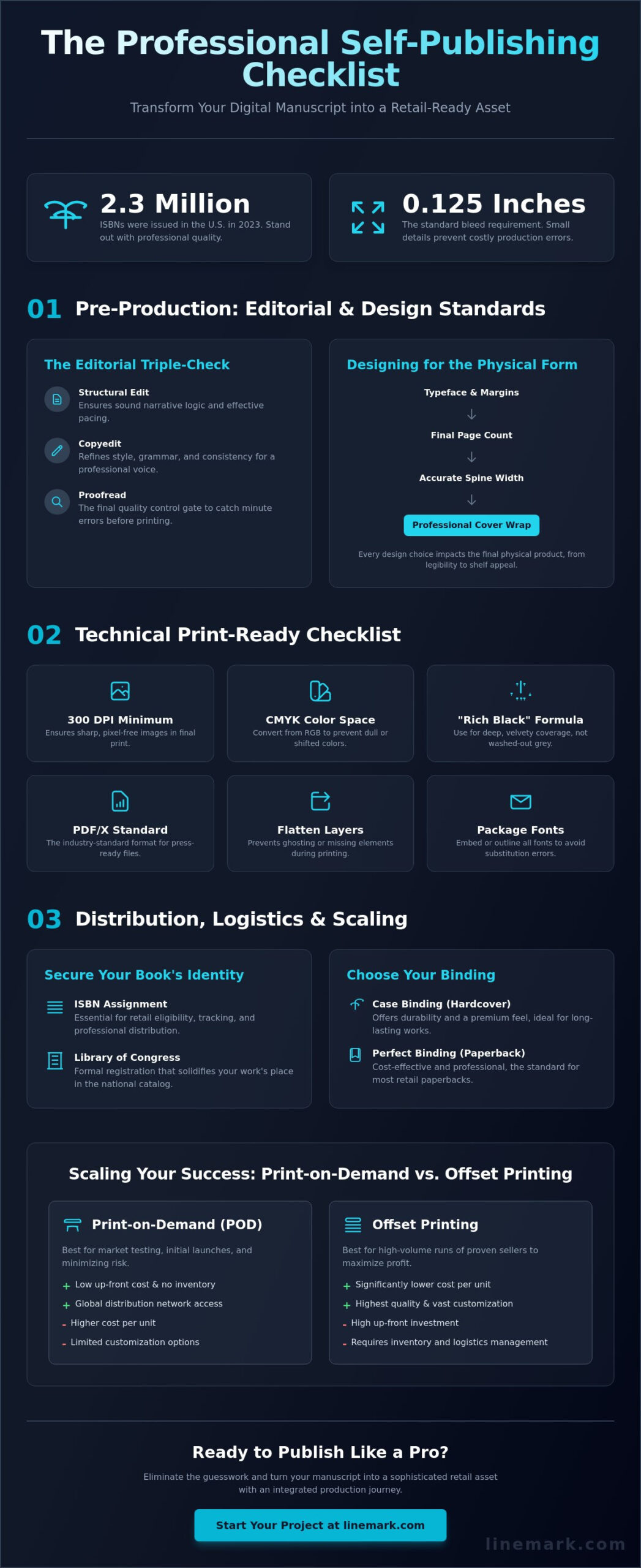
What if the difference between a bestseller and a garage full of returns is exactly 0.125 inches of bleed? In 2023, 2.3 million ISBNs were issued in the U.S., meaning your work enters a marketplace where technical errors translate directly into lost revenue. If you feel overwhelmed by the transition from a digital file to a physical object, you aren’t alone. This self-publishing a book checklist is built to eliminate the guesswork, helping you manage the technical specifications and distribution logistics required for a professional-grade release.
We believe that your production process should be as refined as your prose. It’s common to worry about the complexities of spine width calculations or the 8% rise in paper costs reported in March 2026. This guide provides a clear framework to ensure your project meets the highest editorial and manufacturing standards. You’ll learn how to manage ISBN registration, master technical print specifications, and select the binding and finishing options that transform your manuscript into a sophisticated retail asset through an integrated production journey.
Key Takeaways
- Establish editorial excellence by transitioning from a creative manuscript to a production-ready file through developmental and copyediting standards.
- Navigate complex technical requirements such as DPI minimums and color space conversions using our comprehensive self-publishing a book checklist.
- Enhance the tactile experience of your work by selecting physical specifications like Case Binding and specific paper weights tailored to your genre.
- Secure your book’s professional identity and retail eligibility by correctly managing ISBN assignments and Library of Congress registrations.
- Identify the precise moment to scale your production from print-on-demand to high-volume offset printing to optimize your unit costs.
The Pre-Production Phase: Editorial and Design Standards
Every professional book begins as a manufacturing blueprint. The history of self-publishing shows that while barriers to entry have fallen, the bar for retail quality has risen. You aren’t just writing; you’re developing a product that must withstand the scrutiny of the global marketplace. This initial phase is the most critical entry in your self-publishing a book checklist because it transforms a creative draft into a precise technical asset.
To better understand how to set your project up for success from the very beginning, watch this helpful video:
The Editorial Triple-Check
A rigorous editorial workflow is essential for operational excellence. Start with a structural edit to ensure your narrative logic is sound and your pacing is effective. Follow this with a comprehensive copyedit to refine style, grammar, and consistency. The final proofread acts as your quality control gate. It catches the minute errors that compromise your authority. Fixing a typo during the layout stage is a minor adjustment; finding it in a printed run of a thousand units is a significant setback for your brand.
Designing for the Physical Form
Book design is where creative vision meets technical specification. You must respect the “safe zone” or “inner gutter” to ensure text remains legible near the binding. Your choice of typeface and margin width isn’t merely an aesthetic decision. These factors determine your final page count, which dictates the precise width of your spine. An accurate spine calculation is required for a professional cover wrap. If your spine width is off by even a few millimeters, your cover art won’t align correctly, resulting in a product that looks amateurish on a retail shelf.
The Technical Print-Ready Checklist: Avoiding Production Delays
Transitioning from a digital manuscript to a tangible asset requires a shift in perspective. You’re now entering the manufacturing stage where creative choices must align with industrial capabilities. Success depends on following a rigorous self-publishing a book checklist that prioritizes technical accuracy over creative intent. While modern publishing models offer more autonomy than ever, they also place the burden of quality control squarely on the author’s shoulders. Precision at this stage prevents costly reprints and ensures your debut meets professional expectations.
Color Management and Resolution
Images must meet a minimum threshold of 300 DPI at their final print size. Anything lower results in pixelation that compromises the integrity of your work. You should also verify that every asset is converted to CMYK. Commercial presses use cyan, magenta, yellow, and black inks to build the color spectrum. If you submit RGB files, which are designed for light-emitting screens, the final printed colors will appear dull or shifted. Use a “Rich Black” formula for large areas of dark color to ensure deep, velvety coverage rather than a washed-out grey. Flattening layers and checking for transparency issues during this stage prevents unexpected ghosting or missing elements during the plate-making process.
The PDF/X Standard
The industry relies on specific file formats to bridge the gap between your workstation and the industrial press. Utilizing custom book printing standards means exporting your work as a PDF/X-1a or PDF/X-4 file. These formats serve as the gold standard because they ensure all fonts are embedded and all color profiles are locked. When exporting from professional tools like Adobe InDesign or Affinity Publisher, always include a 0.125-inch bleed on all four sides. This extra margin allows the industrial trimmer to cut through the paper without leaving unsightly white slivers at the edge of your pages.
Running a pre-flight check within your software helps identify missing fonts or low-resolution graphics before you submit your files. If you don’t embed your fonts, the printer’s system might substitute them with a generic typeface, causing your carefully designed layout to reflow and break. Converting text to outlines is a secondary option for cover files, though it’s less efficient for long-form interior text. For authors seeking a seamless transition from file to finished product, partnering with an agile print expert ensures these technical nuances are managed with industrial precision. This collaborative approach turns a complex logistical hurdle into a predictable, repeatable production process.
Selecting Physical Specifications: Binding, Paper, and Finishes
Once you’ve secured your digital files, the next critical phase in your self-publishing a book checklist involves selecting the physical materials that define your brand. These choices aren’t just cosmetic; they impact everything from production costs to shipping logistics. Professional-grade binding and finishing transform a stack of paper into a retail-ready product. Every decision at this stage should be a strategic one, aimed at aligning your book’s tactile experience with its genre and intended audience.
Binding Options for Every Genre
The binding method you choose dictates the longevity and utility of your book. Perfect binding remains the industry standard for trade paperbacks, offering a clean, squared spine that allows for clear title placement. For a more premium or archival feel, case binding provides the structural integrity required for high-value releases. Resources like the BCcampus Self-Publishing Guide provide a strong foundation for understanding how these planning stages intersect with final production. While perfect binding is agile and cost-effective, saddle stitch binding is often the better choice for thin booklets or workbooks. For manuals and journals, spiral and wire-o binding are essential because they allow the book to lay flat during use.
Tactile feedback acts as a silent narrator for your quality standards. Standard novels typically utilize 50lb paper, which provides a comfortable weight for casual reading without adding unnecessary bulk to your distribution costs. In contrast, coffee table books or high-end catalogs require 80lb or heavier stock to prevent ink show-through and support high-resolution imagery. Texture further refines this experience. Gloss finishes make colors pop, matte provides a sophisticated look, and uncoated paper offers a classic, organic feel that’s easy on the eyes during long reading sessions.
The Impact of Specialty Finishes
Innovation in digital production has made premium finishes accessible for projects of any scale. Spot UV coating allows you to highlight specific design elements, like a logo or title, by applying a high-gloss layer over a matte base. This contrast creates an immediate visual and tactile impact that signals professional quality. Lamination is another critical factor; it increases durability for high-use books and protects the cover from scuffing during the fulfillment process. For those aiming for a luxury market position, foil stamping adds a metallic brilliance that suggests a high-tier publication. These integrated services act as a catalyst for growth, ensuring your book doesn’t just sit on a shelf but commands attention in a competitive marketplace.
Distribution and Logistics: The Business of Being an Author
Publishing a book is a creative triumph; managing it effectively is a logistical operation. Your self-publishing a book checklist must include the legal and digital identity of your work to ensure it survives the transition to the retail marketplace. For authors looking to understand how specialized digital platforms operate, you can learn more about Sale of Christian books and media resources to see how niche content is managed. This infrastructure allows you to move beyond simple digital files and into the realm of scalable business management. By establishing a robust framework for distribution early, you avoid the technical bottlenecks that often stall a book’s momentum after its initial release.
ISBNs and Legal Requirements
Your International Standard Book Number (ISBN) is the unique identifier that allows libraries, wholesalers, and retailers to track your work. While many platforms offer free ISBNs, professional authors typically choose to purchase their own. This decision ensures that you, or your specific imprint, remain the publisher of record. Once you secure your ISBN, you must generate a high-resolution, print-ready barcode for your back cover. This barcode is a non-negotiable requirement for physical retail sales. For authors based in the United States, registering with the Library of Congress is a vital step to ensure your title is included in the national bibliography and preserved for future generations. Protecting your intellectual property through formal copyright registration provides the legal foundation necessary for any serious publishing project.
Fulfillment and Inventory Strategy
Scaling your success requires a shift from passive distribution to active inventory management. While print-on-demand offers a low barrier to entry, it often lacks the unit-cost efficiency and finishing quality required for high-volume success. Transitioning to a model that includes professional warehousing allows you to respond to sudden market demands with agility. Utilizing MarCom On-Demand portals enables you to manage your author brand inventory from a single, centralized dashboard. This technology ensures that your promotional materials and book stock are always synchronized and ready for deployment.
Effective logistics also involve how your work reaches influential voices. Kitting and fulfillment services allow you to create custom packages for reviewers or influencers, bundling your book with branded collateral to create a premium experience. When combined with strategic direct mail campaigns, these efforts can significantly amplify your market presence. Managing metadata, such as keywords and categories, ensures your work remains searchable in global databases, turning your logistics plan into a powerful marketing engine. To master the complexities of modern distribution and secure your place in the retail landscape, partner with an expert logistics ally who can provide the industrial capacity your project deserves.
Scaling Your Success: Moving from POD to Professional Printing
Print-on-demand (POD) serves as a vital entry point for many authors, yet it eventually becomes a bottleneck for those seeking true market expansion. Once your sales data confirms a steady demand, your self-publishing a book checklist must evolve to include high-volume manufacturing strategies. Transitioning from the reactive nature of POD to the proactive efficiency of professional printing allows you to capture higher margins and ensure a superior product that stands up to the most rigorous retail standards. This shift isn’t just about volume; it’s about moving from a transaction-based model to a strategic production journey.
The Unit Cost Breakthrough
The financial logic for scaling is rooted in the ROI of bulk manufacturing. While POD costs remain static regardless of the number of copies you order, professional offset or high-volume digital printing offers a significant unit-cost advantage as your order size increases. For most successful authors, the 500-unit mark represents a critical threshold where the per-book cost drops enough to dramatically increase profit margins per sale. Beyond the financial gains, the quality difference is undeniable. Offset printing provides a level of ink saturation and crispness that laser-based POD simply cannot replicate. This ensures that every copy in a large run maintains the exact same color fidelity and structural integrity, protecting your brand’s reputation as you reach a national audience.
Operational excellence also means maintaining brand consistency across multiple print runs. When you rely on a high-capacity commercial partner, you gain access to sophisticated color management systems that ensure your third or fourth printing looks identical to your first. This consistency is vital for authors building a multi-title series or those whose work relies on high-resolution graphics and precise brand colors. By integrating your production with a centralized manufacturing ally, you eliminate the variability that often plagues smaller, distributed print networks.
Your Strategic Printing Partner
Choosing a manufacturing ally with industrial authority is the final step in securing your book’s physical quality. Linemark provides 90,000 square feet of high-capacity production power, offering the agile problem-solving capabilities of a boutique shop with the scale of a global leader. This infrastructure allows you to manage complex, high-volume projects with precision, from custom book printing and sophisticated binding to automated kitting and fulfillment. We don’t just print your work; we serve as a strategic communications ally that understands the nuances of modern marketing and logistics.
A unified partnership ensures that your inventory management and distribution are as streamlined as your printing process. By leveraging a centralized destination for all your needs, you can focus on your creative growth while we handle the technical complexities of manufacturing and national distribution. To transform your manuscript into a retail-ready asset that commands attention, contact Linemark today for a personalized manufacturing consultation. Let’s build a repeatable, scalable production process that acts as a catalyst for your long-term success.
Mastering Your Industrial Production Journey
Success in the modern publishing market requires a shift from creative writing to strategic manufacturing. You’ve learned how to navigate technical hurdles like color space conversion and bleed margins while selecting the physical specifications that elevate your brand. By following this comprehensive self-publishing a book checklist, you’re no longer just an author; you’re the manager of a sophisticated production cycle. Transitioning from print-on-demand to high-volume manufacturing is the catalyst that turns a manuscript into a scalable business asset.
Your work deserves a manufacturing ally that matches your ambition. With over 30 years of industrial printing expertise and a 90,000-square-foot high-tech production facility, our team specializes in custom book manufacturing and fulfillment. We provide the precision required to handle complex projects at any scale, ensuring your files translate perfectly to the physical form. Request a Professional Book Printing Quote Today to begin your holistic journey toward a retail-ready release. We’re ready to help you build a lasting legacy through operational excellence.
Frequently Asked Questions
How long does the professional book printing process take?
Standard production turnaround typically ranges from 10 to 15 business days following the final approval of your proofs. This specific timeline ensures that every stage of the binding and finishing process meets our high industrial quality standards. Complex projects that include premium specialty finishes might require a longer production window. We maintain a steady and controlled pace to ensure that every unit in your run is manufactured with meticulous precision.
What is the minimum order quantity for custom book printing?
Minimum order quantities depend on the specific printing technology utilized for your project. Digital printing offers an agile solution for shorter runs, while offset printing provides the best unit-cost advantage for higher volumes. We recommend consulting with our production experts to find the most efficient path for your project. This flexibility ensures your self-publishing a book checklist remains adaptable to your current growth stage and budget.
Do I need a separate ISBN for my hardcover and paperback versions?
You are required to assign a unique ISBN to every distinct format of your book. Industry standards dictate that paperbacks, hardcovers, and ebooks are separate products that need individual identifiers for retail tracking. This practice ensures that your metadata remains accurate across global distribution networks and library systems. Maintaining this level of technical detail is a signature of a professional author who values long-term brand integrity and retail eligibility.
What is the difference between bleed and margin in book design?
Bleed is the area where your design extends beyond the trim line, while margin is the safe space between your text and the page edge. Bleed, typically set at 0.125 inches, prevents white slivers from appearing after the industrial trimmer cuts the paper. Margins ensure your prose doesn’t disappear into the gutter or get cut off during the binding process. Both are critical for a professional-grade finish.
Can I print a single proof copy before committing to a large run?
We provide physical or digital proofs to ensure your project meets technical specifications before moving to full-scale production. Reviewing a proof is a vital step in any self-publishing a book checklist to catch potential layout errors early. This verification process builds confidence and prevents costly reprints by confirming that every detail aligns with your creative vision. It’s a key part of our collaborative partnership approach.
How do I calculate the spine width for my book cover?
Spine width is determined by your final page count and the specific weight of the paper stock you select. You calculate the width by multiplying the total page count by the pages per inch (PPI) of your chosen paper. Our team provides precise templates based on these technical specifications to ensure your cover art wraps perfectly. This level of accuracy is essential for achieving a sophisticated, retail-ready appearance on the shelf.
What file format is best for sending my manuscript to a commercial printer?
The gold standard for commercial printing is a high-resolution PDF/X-1a or PDF/X-4 file. These specific formats lock your color profiles and embed your fonts to prevent character reflow during the plate-making process. Using these professional standards ensures a seamless transition from your digital workstation to our industrial press. Always verify that your images are at least 300 DPI to maintain the clarity and integrity of your work.
Does Linemark handle the shipping and distribution of my books?
Yes, we provide comprehensive kitting and fulfillment services to manage your entire distribution logistics from a centralized location. Our 90,000-square-foot facility handles everything from warehousing your inventory to shipping individual orders or bulk shipments to global retailers. This integrated approach allows you to scale your author brand efficiently while we maintain the meticulous attention to detail required for professional fulfillment. We act as your strategic communications ally throughout the journey.