

 08/17/2026
  Steve Bearden
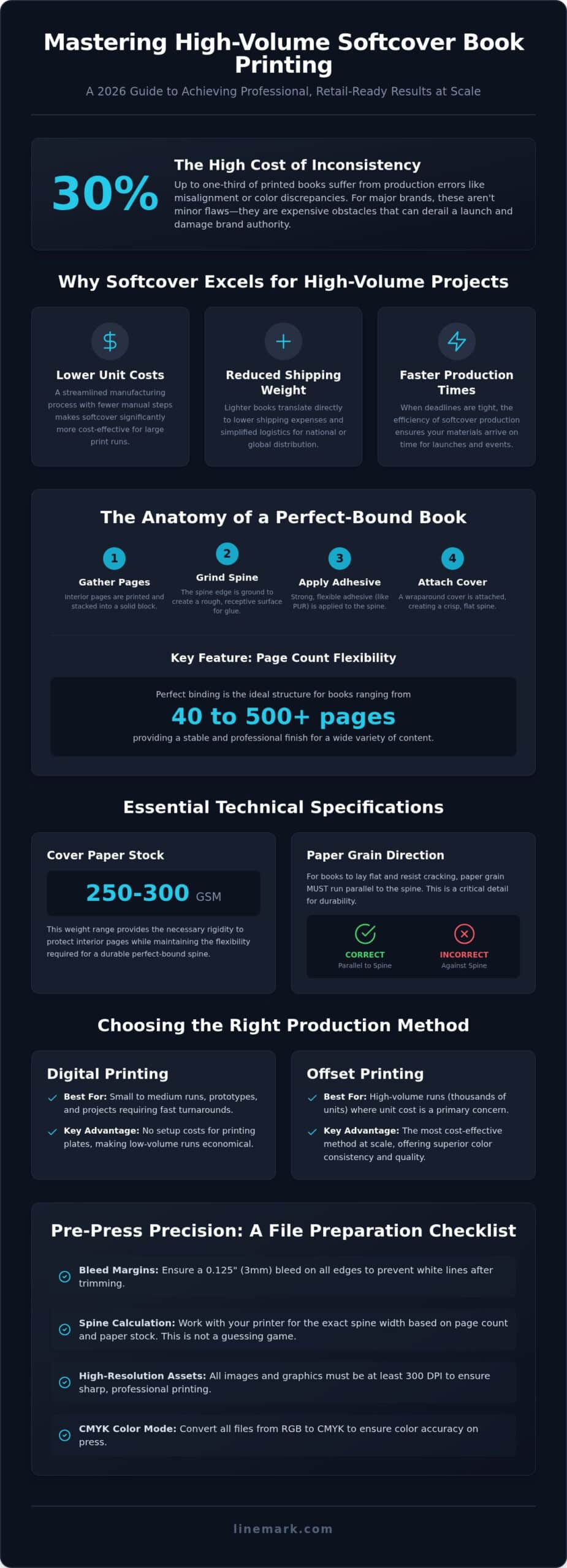
Did you know that up to 30% of printed books suffer from misalignment or color discrepancies that can derail a major brand launch? For marketing executives and publishers, these inconsistencies in softcover book printing aren’t just minor errors; they’re expensive obstacles to growth. You’ve likely experienced the frustration of low-end print-on-demand services where quality fluctuates and technical specs like spine width feel like a guessing game. It’s difficult to scale with confidence when your production partner can’t guarantee a retail-ready finish for every unit in a high-volume run.
We understand that your books are a direct reflection of your organization’s authority. This 2026 guide is designed to help you master the technical nuances of production so you can achieve predictable, professional-grade results at scale. We’ll show you how to move beyond transactional vendors and establish a strategic production model that integrates high-tech binding with national distribution. From understanding the shift toward PUR binding standards to optimizing your files for industrial-grade offset and digital presses, we’re covering the essential steps to ensure your project arrives on time and exactly as intended.
Key Takeaways
- Identify why perfect binding is the essential standard for achieving retail-quality results in commercial paperback production.
- Select the optimal paper weights and grain directions to ensure your softcover book printing projects achieve maximum durability and flexibility.
- Understand the strategic shift between digital and offset methods to balance unit costs with your specific volume and distribution requirements.
- Master the technical precision of file preparation, focusing on exact bleed margins and spine calculations to ensure a seamless transition to the press.
- Leverage integrated fulfillment and inventory management to transform individual print runs into a scalable, nationwide communications strategy.
The Professional Advantage of Softcover Book Printing
Many organizations view softcover printing as a secondary option to hardcover, but in a high-volume commercial environment, it’s the industrial standard for versatility and logistical efficiency. Professional softcover book printing leverages advanced binding techniques to deliver a product that feels substantial and authoritative while remaining cost-effective for large-scale distribution. Corporations and non-profits rely on this format for everything from comprehensive annual reports to technical training manuals. It’s a strategic choice that prioritizes accessibility without sacrificing your brand’s perceived value.
The durability of modern softcover manufacturing has evolved. With high-quality stocks and advanced adhesives, these books are built to withstand heavy use in professional settings. They offer a level of portability that hardcover books can’t match, making them the preferred choice for field guides, educational materials, and trade paperbacks that need to be handled frequently. By choosing this format, you’re investing in a product that balances tactile quality with operational practicality.
Why Softcover Outperforms Hardcover for High-Volume Projects
When scaling a project to thousands of units, the logistical benefits of softcover become undeniable. Unit costs are lower because the manufacturing process is streamlined, requiring fewer manual assembly steps than case binding. Weight is another critical factor. Softcover books are lighter, which reduces shipping expenses and simplifies national distribution. Production timelines are also faster. When you’re facing a tight deadline for a product launch or a board meeting, the speed of softcover production ensures your materials arrive when they’re needed. It’s about operational excellence. You get a retail-ready product that fits your budget and your timeline.
The Anatomy of a Perfect-Bound Book
The gold standard for professional softcover production is known as perfect binding. This process involves gathering the interior pages into a block, grinding the spine edge to create a receptive surface, and applying a strong adhesive to attach a wraparound cover. The result is a crisp, flat spine that allows for printed titles and branding, making the book easily identifiable on a shelf. This method is the foundation of high-quality paperback production.
- Adhesive Integrity: Modern glues provide superior strength, ensuring pages remain secure even with frequent use.
- Cover Continuity: The wraparound cover allows for a seamless visual experience from front to back, which is essential for brand continuity.
- Page Count Flexibility: Perfect binding is ideal for books ranging from 40 to over 500 pages, providing a stable structure for a wide variety of content types.
By understanding these technical components, you can better collaborate with your production partner to ensure the final product meets your exact specifications. This technical precision is what separates a standard print job from a professional-grade publication.
Technical Specifications: Binding, Paper, and Finishes
The success of high-volume softcover book printing depends on technical precision long before the first sheet hits the press. Professional production requires a deep understanding of how paper weight, grain direction, and finishes interact to create a durable, retail-quality product. Selecting the right GSM (grams per square meter) is the first step in defining the book’s physical presence. For a truly professional feel, cover stocks should typically fall between 250gsm and 300gsm. This weight provides the necessary rigidity to protect the interior pages while maintaining the flexibility required for a perfect-bound spine.
Grain direction is a technical detail that often separates industrial-grade manufacturing from amateur print runs. When paper is manufactured, the fibers align in a specific direction. For books to open easily and resist spine cracking, the grain must run parallel to the spine. This alignment ensures the book stays flat when opened and enhances its longevity in high-use environments. Balancing opacity and bulk is equally critical for high-page-count manuals. You need a paper that prevents ink show-through without making the book unnecessarily thick, which can inflate shipping and storage costs.
Choosing the Right Paper Stock
Your choice between coated and uncoated stocks should be driven by the book’s primary purpose. Coated stocks, available in gloss or matte, are ideal for vibrant color reproduction in catalogs or annual reports. Uncoated stocks offer a tactile, classic feel that improves readability for text-heavy professional manuals. Many organizations now prioritize sustainable options, utilizing FSC-certified or recycled stocks to align with corporate ESG goals. Finding the right balance between aesthetic impact and operational efficiency is a hallmark of a sophisticated production strategy.
Premium Cover Finishes and Textures
Finishes do more than just protect the ink; they communicate brand authority. Soft-touch lamination is a popular choice for executive reports, providing a velvet-like texture that resists fingerprints. For projects requiring high durability, an aqueous coating provides a protective layer that stands up to frequent handling. If you want to highlight specific brand elements, consider spot UV or foil stamping. These techniques create a visual contrast that draws the eye to logos or titles. To ensure your project utilizes the most advanced binding and finishing capabilities, it’s essential to partner with a high-capacity operation that understands these nuances.
Choosing the Right Production Method: Offset vs. Digital
The decision between digital and offset production is the most critical factor in determining your project’s ROI. While consumer-facing services often push a one-size-fits-all digital model, a professional approach requires matching the technology to the specific goals of your organization. At our 90,000-square-foot facility, we maintain both advanced digital and high-capacity offset lines. This dual capability ensures that your softcover book printing project isn’t limited by equipment constraints but is instead guided by the most efficient path to market. It’s about precision, scale, and meeting the specific demands of modern marketing and logistics.
Digital Printing and Variable Data (VDP)
Digital printing has evolved far beyond its early limitations, now delivering near-offset quality with incredible speed. It’s the ideal solution for short-run projects or when inventory management requires a more agile, on-demand approach. One of the most transformative advantages of this method is Variable Data Printing (VDP). We can personalize individual books for specific regions, chapters, or even individual members of an association. This level of customization turns a standard publication into a targeted communication tool. By leveraging digital technology, you can maintain lower stock levels while ensuring your content remains current and relevant to your audience.
Offset Printing for Industrial Scale
For high-volume commercial runs, offset printing remains the undisputed leader in quality and cost-efficiency. This method uses a plate-based ink transfer process that provides superior color depth and precision, particularly for large areas of solid color or complex gradients. While the initial setup involves creating plates, the unit costs drop dramatically as the volume increases. Research indicates that ordering 1,000 copies of a book can reduce the per-book cost by over 50% compared to a run of 200 copies. This makes offset the strategic choice for high-volume catalogs and annual reports where brand consistency across a massive run is non-negotiable. When you scale with offset, you aren’t just saving money; you’re ensuring that every copy meets the exact same industrial standard of excellence.
Essential File Preparation: Ensuring Print-Ready Precision
Precision in file preparation is the bridge between a digital concept and a physical reality. In high-speed industrial environments, minor file errors are magnified across thousands of units, leading to costly delays and material waste. Ensuring your files are print-ready isn’t just about aesthetics; it’s about operational continuity and brand integrity. When you’re managing a softcover book printing project at scale, technical accuracy in your design files ensures that the final product mirrors your organization’s professional standards.
Color management is another pillar of print-ready precision. Industrial presses operate in the CMYK color space, which differs significantly from the RGB profiles used on digital screens. To maintain consistent corporate branding, you must convert all images and vector assets to a standardized CMYK profile before submission. This prevents unexpected color shifts that could compromise your visual authority. By addressing these technical requirements early, you streamline the production journey and guarantee a retail-quality result.
Mastering Bleed and Margin Specs
Standard production requires a 0.125 inch bleed on all sides of your cover file. This extra image area provides a safety margin for the high-speed trimming process, ensuring no white slivers appear at the edges of your full-wrap covers. You should also maintain a safe zone for critical text and logos, keeping them at least 0.25 inches away from the trim line. For perfect-bound books, don’t forget to account for the “hinge.” This is the vertical score roughly 0.25 inches from the spine that allows the cover to open without putting excessive stress on the adhesive bond.
Spine Design and Gutters
You must calculate the exact spine width only after the final paper stock has been selected because the bulk of the paper determines the physical thickness of the book. Centering text on the spine requires this specific measurement to ensure your title looks balanced on a shelf. For the interior, you must account for the “grind” area. During the binding process, roughly 0.125 inches of the interior gutter is ground away to allow the glue to penetrate the paper fibers. Setting gutter margins of at least 0.75 inches prevents your text from disappearing into the spine, ensuring a comfortable reading experience. To ensure your project meets these industrial standards, it’s vital to collaborate with a partner experienced in custom book printing and technical file verification.
Beyond the Press: Fulfillment and Scalability
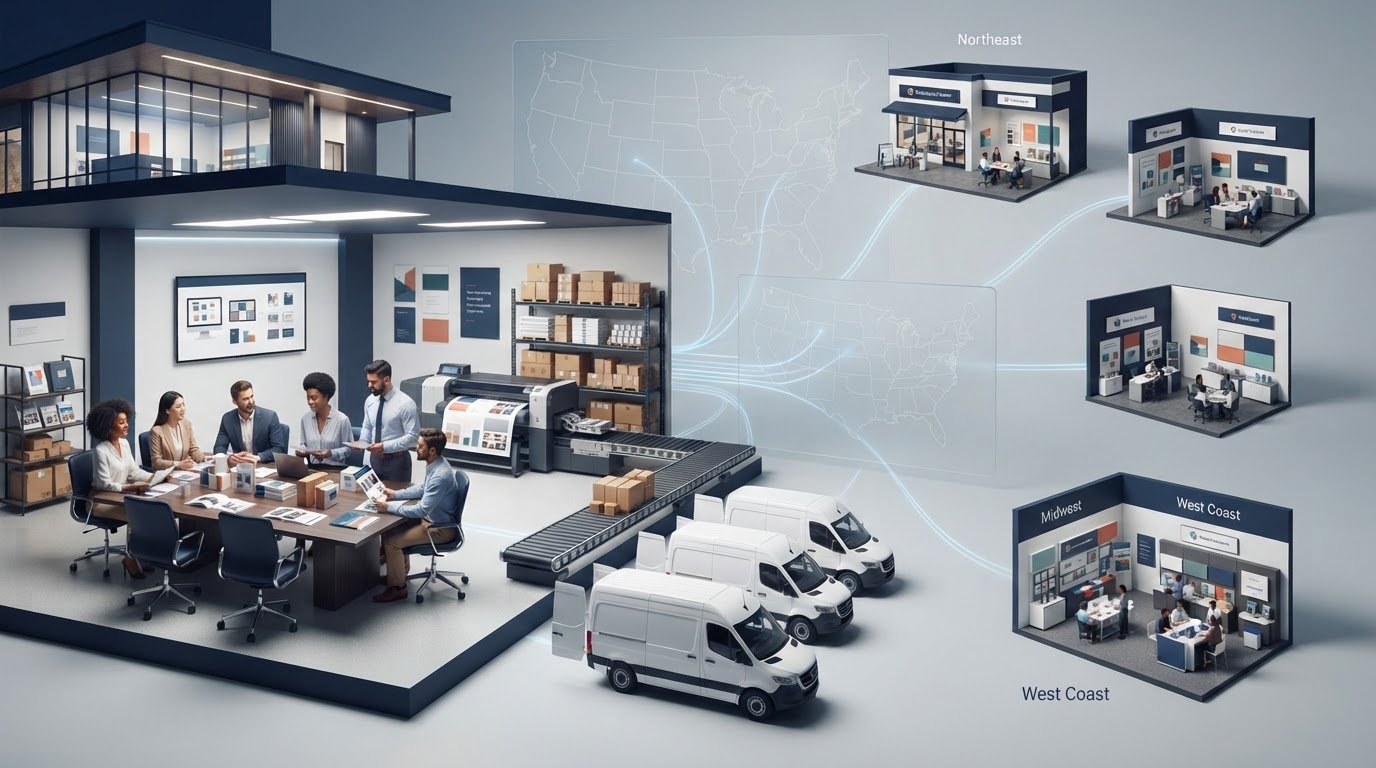
The final stage of a successful book project occurs after the press stops. For large organizations, the challenge shifts from production to the complexities of nationwide distribution. Integrating high-volume softcover book printing into your supply chain requires more than just a print vendor; it demands a logistics partner. Centralized inventory management allows your organization to maintain stock in a single, high-capacity facility, reducing overhead and ensuring that every unit shipped meets the same rigorous quality standards.
This logistical efficiency is amplified when you combine production with direct mail strategies. A professional-grade book is a powerful touchpoint that can be mailed directly to key stakeholders or prospects, turning a standard publication into a high-impact marketing asset. To manage this at scale, many organizations utilize MarCom On-Demand portals. These platforms allow distributed teams to order materials as needed, ensuring that your brand remains consistent across every region while eliminating the waste associated with outdated stock.
Kitting and Multi-Piece Fulfillment
Complex projects often require more than just a single book. We specialize in kitting, where your books are combined with brochures, newsletters, or even large-format graphics into a single, cohesive package. This process is handled with industrial precision to ensure that every component is accounted for and professionally presented. Custom packaging solutions are essential during this stage. We design protective enclosures that prevent edge damage and spine crushing during transit, ensuring your softcover book printing project arrives in pristine, retail-ready condition. With real-time tracking and a national fulfillment network, your organization maintains complete visibility over the entire journey from our warehouse to the end-user’s door.
Strategic Partnerships for Long-Term Growth
Moving from transactional printing to a unified production journey is a catalyst for organizational growth. A strategic ally doesn’t just fulfill an order; they anticipate your evolving needs and provide the technological infrastructure to support them. By viewing custom book printing as part of a holistic communication plan, you can leverage our 30 years of experience to streamline your operations. This partnership model ensures that as your volume increases, your unit costs remain predictable and your quality stays uncompromised. It’s a steady, confident approach to communications that allows you to focus on your core mission while we handle the technical complexities of production and distribution.
Transforming Complex Production Into a Strategic Advantage
Mastering the technical nuances of softcover book printing is more than a production requirement; it’s a strategic move to solidify your brand’s authority. By aligning your project with industrial standards like perfect binding and precise CMYK color management, you ensure every unit reflects your organization’s commitment to excellence. Success in 2026 requires moving beyond transactional vendors to find a partner that integrates advanced technology with a national distribution network.
With over 30 years of industrial print expertise and a 90,000-square-foot production facility, we provide the scale and precision your high-volume projects demand. Our integrated kitting and nationwide fulfillment services ensure your materials move from the press to the end-user with absolute efficiency. We’re ready to help you navigate the complexities of modern manufacturing and logistics to achieve retail-quality results every time.
Request a custom book printing consultation with Linemark today. We look forward to becoming your strategic ally in high-volume communications.
Frequently Asked Questions
What is the minimum page count for perfect-bound softcover books?
Perfect binding requires a minimum of 40 pages to create a viable spine surface for the adhesive to bond effectively. If your document is thinner than this threshold, we typically recommend saddle stitching to ensure structural integrity and prevent page loss. For professional softcover book printing, this minimum ensures the spine is wide enough to accommodate the grinding and gluing process. This results in a crisp, durable finish that maintains its shape in retail or corporate environments.
How do I calculate the spine width for my softcover book cover?
Spine width is calculated by multiplying the total page count by the caliper, or thickness, of your specific interior paper stock. Because different stocks have varying “bulk” levels, you must finalize your interior paper choice before setting your cover dimensions. We provide exact templates once your page count and GSM are confirmed. This technical precision prevents misalignment of spine text and ensures the cover wraps perfectly around the interior block during high-speed binding.
Can I use variable data printing on the cover of my softcover book?
You can utilize variable data printing on book covers when using our digital production lines. This allows you to customize titles, names, or localized branding for specific distribution segments without interrupting the production journey. It’s a highly effective way to increase engagement for member directories or personalized manuals. Our digital presses maintain industrial-grade quality while providing the agility needed for these sophisticated, targeted communication strategies that turn standard books into personalized assets.
What is the difference between gloss and matte lamination for book covers?
Gloss lamination provides a high-shine finish that enhances color vibrancy and offers superior resistance to scuffs and moisture. It’s ideal for catalogs where visual impact is paramount. Matte lamination offers a non-reflective, sophisticated texture that communicates executive authority and is easier to read under bright lights. Both options provide a protective barrier that extends the life of your softcover book printing project, though matte is often preferred for a modern, premium feel.
How does paper weight affect the overall thickness of my book?
Paper weight, measured in GSM, directly correlates to the thickness and “bulk” of the finished product. A higher GSM interior stock results in a thicker spine and a more substantial tactile feel, but it also increases the book’s weight and shipping costs. Balancing these factors is essential for high-volume projects. We help you select a stock that provides the necessary opacity and durability while remaining logistically efficient for your nationwide fulfillment needs.
What is the standard turnaround time for high-volume offset book printing?
Standard turnaround for high-volume offset projects typically ranges from 10 to 15 business days following final proof approval. This timeline accounts for industrial setup, including plate creation and specialized binding and finishing. Digital runs can often be completed faster for time-sensitive reports. We coordinate every stage of the process, from the press to kitting and distribution, to ensure your project stays on schedule and meets your organization’s specific delivery requirements without sacrificing quality.
Do I need a separate file for the book cover and the interior pages?
You should provide two distinct PDF files: one for the wraparound cover and another for the interior pages. The cover file must be designed as a single flat spread containing the back, spine, and front panels, including the necessary 0.125 inch bleed. The interior file should be submitted as a single PDF with pages in sequential order. This separation allows our pre-press team to verify technical specs for each component independently before production begins.
How do I ensure my corporate colors remain consistent across digital and offset runs?
Consistency is achieved by utilizing standardized CMYK color profiles and professional-grade color management systems across all our presses. We utilize G7 master printing standards to ensure that the visual output on our digital lines matches our high-capacity offset equipment. This unified approach prevents color drift and ensures your brand’s visual identity remains stable regardless of the production method or volume. Our experts monitor every run to maintain the industrial precision your organization expects.