

 06/30/2026
  Steve Bearden
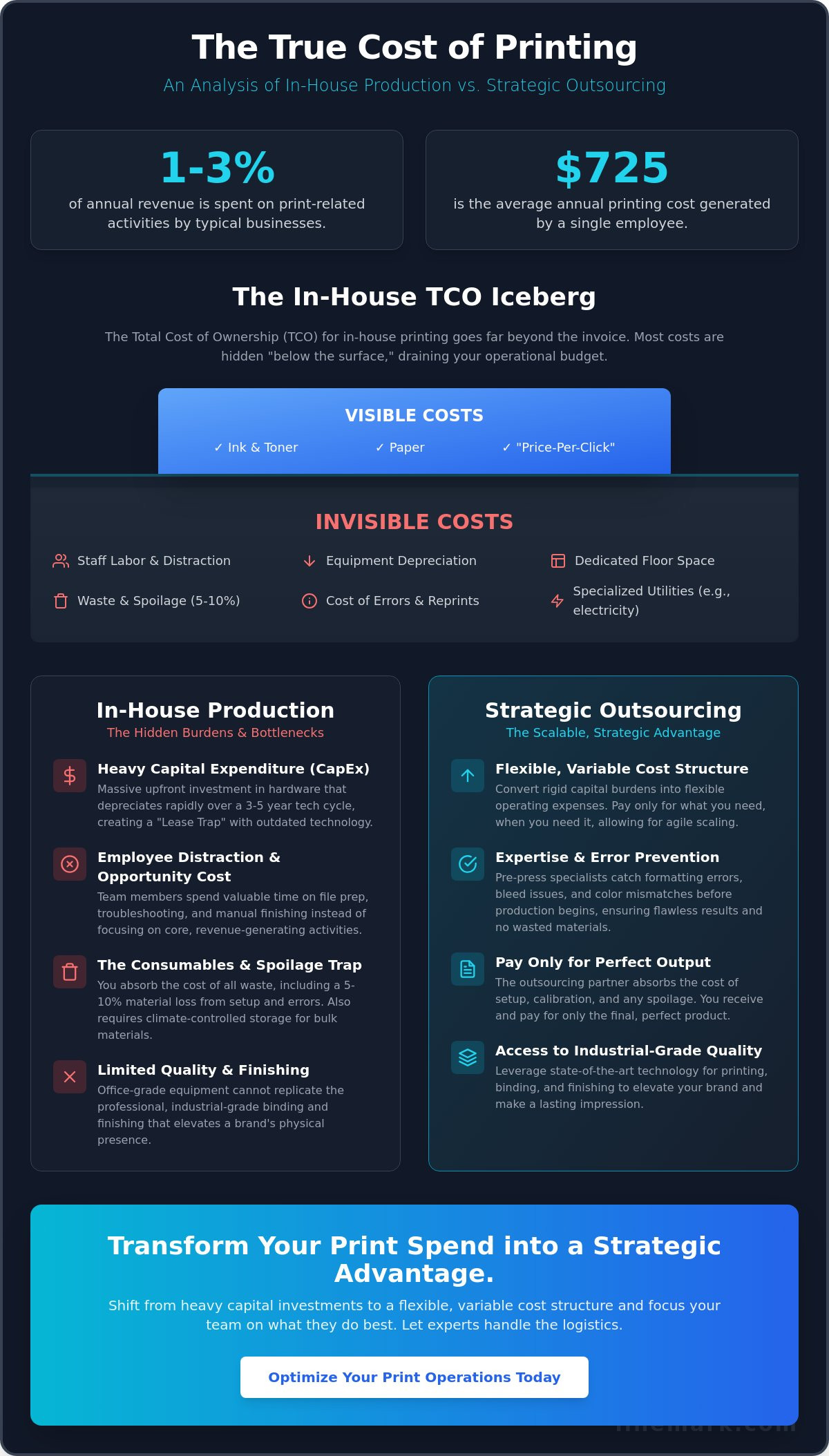
Most organizations view printing as a minor line item, yet typical businesses spend between 1% and 3% of their annual revenue on print-related activities. When you factor in that the average employee generates $725 in annual printing costs, the financial impact of your production model becomes impossible to ignore. Our 2026 in-house printing vs outsourcing cost analysis moves beyond the simple price of toner to examine the total cost of infrastructure that often drains operational budgets.
It’s frustrating when your team spends hours troubleshooting a mid-grade office machine instead of focusing on high-value growth initiatives. We understand that consistent quality and operational uptime are non-negotiable for a scaling business. This guide provides a clear framework for calculating your true total cost of ownership and demonstrates how an agile outsourcing partnership can transform your logistical overhead into a scalable strategic advantage. We’ll examine the hidden burdens of equipment depreciation, the cost of wasted staff time, and the transformative power of industrial-scale efficiency.
Key Takeaways
- Understand the full scope of your Total Cost of Ownership by identifying the invisible infrastructure costs that DIY production often hides.
- Pinpoint the efficiency threshold where in-house machines become operational bottlenecks that hinder your ability to scale effectively.
- Leverage this in-house printing vs outsourcing cost analysis to transition from heavy capital investments to a flexible, variable cost structure.
- Elevate your brand’s physical presence through industrial-grade binding and finishing that office-grade equipment simply cannot replicate.
- Learn how MarCom On-Demand provides a centralized destination for managing distributed marketing needs without the burden of internal logistics.
The Visible vs. Invisible Costs of In-House Printing
Effective fiscal management begins with a comprehensive in-house printing vs outsourcing cost analysis. Most decision makers focus on the visible invoice, but the Total Cost of Ownership (TCO) encompasses every resource required to produce a finished piece. In industrial print production, TCO accounts for the hardware, the operator’s salary, and the specialized environment the machinery requires. While direct costs like ink and paper are easily tracked, indirect costs such as high-voltage electricity and dedicated floor space often remain hidden in general overhead. The business practice of outsourcing provides a strategic way to bypass these complexities and focus on your core objectives.
To better understand how these costs fluctuate based on your production model, watch this helpful video:
The “price-per-click” model on leased equipment is particularly deceptive. It presents a predictable per-page rate but ignores the labor costs associated with kitting, binding, and finishing. Professionals absorb the cost of errors, but in-house mistakes are paid for twice: once in wasted materials and again in lost time. A thorough in-house printing vs outsourcing cost analysis reveals that these “clicks” are only a fraction of the total investment required to maintain an internal department.
Capital Expenditure (CapEx) and Rapid Depreciation
Acquiring industrial-grade digital or offset presses represents a massive capital commitment. Unlike standard office equipment, these machines operate on a relentless 3-5 year technology cycle. Rapid depreciation can significantly impact a balance sheet, as the resale value of high-capacity hardware drops sharply once newer, more efficient models hit the market. This creates a “Lease Trap” where long-term equipment commitments limit your business agility. You are often forced to use outdated technology while competitors utilize the latest industrial advancements through a strategic partner. Strategic outsourcing converts these rigid capital burdens into flexible, variable costs that scale with your actual needs.
The Consumables Trap: Beyond Ink and Paper
Maintaining a production-ready environment requires more than just high-yield toners and specialized substrates. Bulk paper requires climate-controlled storage to prevent environmental damage from humidity or temperature fluctuations, which can lead to paper curls and machine jams. This inventory takes up valuable square footage that could be utilized for revenue-generating activities. Spoilage is defined as the 5-10% of materials lost to setup and calibration. When you manage production internally, your company absorbs the cost of every misfeed and color-matching error. A professional partnership ensures that you only pay for the perfect final product, not the waste generated to get there.
The Labor and Opportunity Cost of DIY Production
A common misconception in the in-house printing vs outsourcing cost analysis is the belief that proximity equals speed. While having a machine in the next room feels convenient, the clock doesn’t start when the “print” button is clicked; it starts with file preparation and ends with final finishing. When internal staff manage production, the time spent on setup, loading substrates, and manual binding often exceeds the turnaround time of a professional partner. This labor is rarely free. It represents a significant diversion of resources away from your company’s core mission.
Professional pre-press experts provide a layer of security that office-grade production lacks. These specialists catch formatting errors, bleed issues, and color profile mismatches before a single sheet of paper is used. In a DIY environment, these errors often go unnoticed until the entire run is completed. This leads to costly reprints and wasted materials. By shifting these responsibilities to a strategic ally, your team avoids the “Technical Friction” of troubleshooting software and hardware. Instead, they focus on high-stakes strategy while experts ensure every piece meets industrial standards.
Skilled Labor vs. Employee Distraction
High-quality custom book printing and complex marketing collateral require specialized binding and finishing skills that take years to master. When a marketing manager is pulled from lead generation to become a de-facto print shop manager, the opportunity cost is immense. If a senior staff member spends just four hours a week managing production hurdles, your organization loses over 200 hours of high-value labor annually. The training burden also remains constant. As print software evolves, your team must dedicate time to learning new interfaces rather than perfecting their own professional crafts. You can reclaim this lost productivity by integrating commercial printing solutions into your standard workflow.
Maintenance, Downtime, and Technical Troubleshooting
High-volume digital equipment requires frequent service calls to maintain precision. In a corporate setting, a single machine failure creates a “Downtime Domino Effect.” If your internal printer goes offline during a critical campaign launch, every related channel is halted. This lack of redundancy is a primary risk identified in any thorough in-house printing vs outsourcing cost analysis. Industrial facilities like Linemark maintain a fleet of redundant, high-capacity presses to ensure 99.9% uptime. While your internal team might spend hours on the phone with technical support, a professional partner operates as a well-oiled machine, delivering consistent results regardless of individual hardware maintenance cycles.
Scaling Challenges: Why Volume Dictates the Decision
Scaling a business requires a precise understanding of when internal processes stop being an asset and start becoming a liability. In any in-house printing vs outsourcing cost analysis, volume is the primary driver of efficiency. Small, intermittent projects might seem manageable on office equipment, but as your output grows, you’ll inevitably hit an “Efficiency Threshold.” This is the point where your internal machines become a bottleneck, slowing down marketing deployments and creating friction across departments. Professional partners mitigate this by providing the industrial capacity necessary to handle rapid growth without capital strain.
Commercial printers maintain a significant advantage through economies of scale. Because we purchase substrates, inks, and binding materials in massive quantities, we often secure rates 40-60% lower than retail prices available to individual businesses. These savings are passed directly to you, often making the total cost of an outsourced project lower than the raw material costs of a DIY run. Additionally, industrial facilities solve the “Seasonal Surge” problem. In-house units often sit idle for eight months of the year, only to face mechanical failure under the heavy stress of a Q4 rush. A strategic partner offers the elasticity to handle these peaks with ease.
The Threshold of Efficiency: When DIY Fails
Identifying the right time to transition requires monitoring specific operational indicators. If your team faces any of the following, your internal production has likely reached its limit:
- Internal turnaround times for basic collateral exceed 48 hours.
- Staff members are manually folding, stapling, or kitting materials.
- Print quality is inconsistent across different runs or machines.
- You’re facing the “Step-Cost” problem, where you need 1.5 printers but have to buy 2 to meet demand.
Specialized projects like large format graphics highlight these limitations. A standard office wide-format printer may take thirty minutes to produce a single high-resolution banner, while industrial production lines output dozens in the same timeframe with superior color consistency. Outsourcing ensures you don’t have to over-invest in hardware that you only use at full capacity a few times a year.
Inventory Management and Storage Burdens
The physical footprint of a print shop is an expensive hidden cost. Every square foot dedicated to paper storage or machine placement is space that isn’t being used for revenue-generating activities like sales or product development. By utilizing professional kitting & fulfillment services, you reclaim your facility and eliminate the logistical headache of inventory tracking. Centralized distribution through a professional hub significantly reduces nationwide shipping costs compared to the fragmented approach of office-based mailing.
Beyond the Invoice: Strategic Advantages of Outsourcing
A sophisticated in-house printing vs outsourcing cost analysis must extend beyond the line items on a quote. While internal production often focuses on basic output, a strategic partnership provides access to a “Quality Gap” that office-grade machines cannot bridge. The tactile experience of a marketing piece often dictates how a brand is perceived. Professional finishing options, such as soft-touch lamination or precision spot UV coatings, create a sensory impact that signals authority and attention to detail. These are not merely aesthetic choices; they are industrial tools that elevate your brand above the noise of a crowded marketplace.
Security is another area where the DIY model often falters. While some believe internal production is inherently safer, industrial facilities utilize rigorous data encryption and secure processing protocols that far exceed standard office network security. Protecting sensitive client information requires more than a locked room; it requires a sophisticated infrastructure designed for high-volume data integrity. Transitioning to an expert ally ensures your projects benefit from the latest advancements in technical production without the burden of maintaining the security stack yourself.
Industrial Technology and Specialized Finishing
Precision in finishing is what separates a standard document from a high-stakes communication tool. For organizations producing annual reports or training manuals, specialized binding techniques like Smyth sewn or PUR binding are essential for durability and a professional “lay-flat” experience. These methods require complex machinery and skilled operators that are rarely cost-effective to maintain in-house. Similarly, large-format projects like wall murals or floor graphics demand professional installation and UV-resistant inks to ensure longevity. By outsourcing, you gain access to these premium capabilities on demand, ensuring every piece of collateral reflects your operational excellence.
Data Integrity and Variable Data Printing (VDP)
Personalization is no longer optional for effective direct mail. Variable Data Printing (VDP) allows for the mass customization of every individual piece in a run, from unique names and addresses to tailored imagery based on recipient data. Industry data indicates that VDP can increase direct mail ROI by 2x to 5x compared to static mailings. Managing the complexity of these large mailing lists requires expert oversight to ensure data accuracy and USPS postal optimization. Linemark utilizes advanced security protocols to protect client data throughout the high-volume mailing process, providing a level of reliability that internal departments simply cannot match. You can partner with our experts to integrate high-impact personalization into your next campaign.
Optimizing Your Print Spend with a Strategic Partner
Transitioning from a rigid in-house model to a strategic partnership fundamentally matures your financial structure. By outsourcing, you convert heavy fixed costs, such as machinery leases and dedicated production salaries, into flexible variable costs. You only pay for the materials you actually use. This shift represents the final, most impactful step in a comprehensive in-house printing vs outsourcing cost analysis. It replaces a static capital burden with an agile system that grows alongside your organization.
To better understand how this transparency applies to automated mailing workflows, you can explore Per-Piece Transactional Mailing Fees options as a benchmark for variable pricing models.
A unified partnership provides a centralized destination for all your production needs. Instead of managing separate vendors for custom books, direct mail, and signage, you consolidate your workflow into a single, high-capacity stream. This integration reduces administrative friction and ensures that your brand standards are applied consistently across every medium. The transition process is designed to be seamless. It begins with a thorough audit of your current production spend and moves toward a fully automated fulfillment solution tailored to your specific volume requirements.
The MarCom On-Demand Advantage
Maintaining control is often the primary concern for businesses considering a move away from internal production. MarCom On-Demand solves this challenge by providing a sophisticated web-to-print portal. This platform allows your team to manage brand assets from a secure, centralized interface. It ensures brand consistency across national locations while empowering local managers to order materials as needed. The “Order-on-Demand” model effectively eliminates the financial drain of inventory waste and obsolescence. Automated workflows further reduce the hidden administrative costs of ordering print, allowing your marketing team to focus on high-level strategy rather than logistical troubleshooting.
Leveraging National Fulfillment and Distribution
Operating from a centralized 90,000-square-foot facility provides logistical advantages that an office-based shop cannot replicate. High-volume production is supported by advanced kitting and fulfillment services that streamline the journey from the press to the final recipient. Professional postal optimization is a key component of this efficiency. Through presorting and co-mingling, organizations can reduce postage costs by 8% to 15%, as verified by industry standards. This level of precision ensures that your direct mail campaigns are both high-impact and cost-effective. To see how these efficiencies apply to your specific volume, contact Linemark for a comprehensive print spend audit and custom quote.
Future-Proofing Your Production Strategy
Deciding between internal operations and a professional partnership is a pivotal moment for any scaling organization. This in-house printing vs outsourcing cost analysis demonstrates that true value isn’t found in a price-per-click lease, but in the agility and quality of your final output. By moving away from the “Lease Trap” and reclaiming your team’s focus, you position your business to handle any market demand with precision. Accessing industrial-grade technology ensures your brand maintains a tactile edge that office equipment cannot replicate.
Linemark brings over 30 years of industrial print expertise to every project. Our 90,000-square-foot high-capacity production facility is designed to handle complex logistics at scale, while our status as a G7 Master Qualified Printer guarantees absolute color precision. We’re ready to act as your strategic communications ally, providing the infrastructure you need to grow without the burden of capital expenditure. Take the first step toward a more efficient production model today. Request a Strategic Print Audit from Linemark and discover how a unified partnership can transform your operational overhead into a catalyst for growth.
Frequently Asked Questions
What is the primary cost difference between in-house and outsourced printing?
The primary difference lies in the transition from rigid fixed costs to flexible variable expenses. In-house production requires ongoing investment in equipment, floor space, and specialized labor regardless of your actual output. Outsourcing replaces these capital burdens with a model where you only pay for finished products, effectively eliminating the financial drain of machine depreciation and idle capacity.
At what volume does outsourcing become more cost-effective than in-house printing?
Outsourcing becomes more cost-effective when your production needs exceed the speed and finishing capabilities of standard office hardware. A detailed in-house printing vs outsourcing cost analysis usually shows that industrial facilities leverage economies of scale to purchase materials at 40% to 60% less than retail. This makes professional production more economical for any project requiring high volume or complex binding.
How does outsourcing affect the turnaround time for urgent print projects?
Industrial partners often deliver urgent, high-volume projects faster than an internal team because of redundant, high-capacity hardware. While an office printer is physically closer, it lacks the throughput to handle thousands of impressions quickly. A professional facility operates as a well-oiled machine, completing complex kitting and finishing tasks in a fraction of the time it takes for manual internal processing.
Can an outsourced partner guarantee the same brand consistency as an in-house team?
Professional partners guarantee superior consistency through advanced color-matching technology and G7 Master Qualification. Office-grade equipment often suffers from color drift and inconsistent registration between runs. An industrial ally uses sophisticated calibration protocols to ensure your brand’s visual identity remains precise across every medium, from digital brochures to large format graphics.
What are the hidden maintenance costs of owning commercial print equipment?
Hidden costs include specialized climate control, high-voltage electricity, and the materials lost to spoilage during setup. An in-house printing vs outsourcing cost analysis must also account for the opportunity cost of pulling marketing staff away from their core roles to manage repairs. These invisible expenses often exceed the visible price of toner and paper.
How does variable data printing (VDP) impact the cost-benefit analysis of direct mail?
Variable Data Printing transforms direct mail from a static expense into a high-conversion strategic asset. By personalizing every piece with unique recipient data, VDP can increase response rates by 2x to 5x. While this complexity is difficult to manage in-house, a professional partner’s automated workflow makes high-impact personalization a standard, cost-effective part of your campaign strategy.
Is outsourcing more or less secure for sensitive corporate data?
Outsourcing is typically more secure because industrial facilities utilize dedicated data encryption and rigorous processing protocols. Protecting sensitive corporate information requires an infrastructure designed for data integrity and compliance. Professional partners maintain secure environments that far exceed the security capabilities of a standard office network, ensuring your data remains protected throughout the production cycle.
How do MarCom On-Demand portals help manage costs for distributed teams?
These portals manage costs by centralizing brand assets and enabling an order-on-demand fulfillment model. This eliminates the need for expensive internal inventory storage and prevents the waste associated with outdated materials. By automating the ordering process, these portals reduce administrative labor and ensure distributed teams maintain brand consistency without the need for local production oversight.