

 08/13/2026
  Steve Bearden
A hardcover book is not merely a collection of printed pages; it’s a high-stakes engineering project where a single binding error can dismantle a brand’s authority in seconds. You likely understand that the transition from a digital manuscript to a physical masterpiece is often fraught with technical hurdles. Inconsistent glue application in short runs and complex file specifications frequently cause costly production delays that stall your momentum. These friction points don’t just waste time. They compromise the perceived value of your intellectual property and your ability to meet market demand.
This guide empowers you to master the technical nuances of professional hardcover book printing while providing a roadmap to scale your manufacturing with industrial-grade precision. We’ve built this resource to transform your production cycle into a streamlined, predictable engine of growth. We’ll examine the mechanics of durable case binding, the specific requirements for production-ready files in 2026, and the strategic advantages of integrated fulfillment for high-volume distribution. By the end of this article, you’ll have the framework to move from simple manufacturing to a sophisticated, scalable communications strategy that ensures every copy meets the highest industrial standards.
Key Takeaways
- Understand the technical construction of case binding, including the use of heavy-duty binders board and internal components like headbands for industrial-grade durability.
- Identify the critical tipping point between digital and offset production to optimize your unit economics without sacrificing brand-critical color precision.
- Master pre-press standards for professional hardcover book printing by accurately calculating spine width based on paper caliper and hinge requirements.
- Learn how to leverage a high-capacity production facility to bridge the gap between manufacturing and nationwide distribution through integrated kitting and fulfillment.
What is Professional Hardcover Book Printing?
Professional hardcover book printing, technically referred to as case binding, is the process of encasing a book block within a rigid protective cover. This cover, or “case,” is constructed from heavy-duty binders board, typically ranging from 70pt to 120pt in thickness. The board is then wrapped in a variety of premium materials, including litho-wrapped printed paper, cloth, or leather. This creates a structural integrity that softcover alternatives simply cannot match. In a commercial context, this manufacturing process is a strategic tool used to transform standard information into a high-value physical asset.
There is a significant distinction between consumer-grade photo books and industrial-grade commercial book manufacturing. While consumer products focus on accessibility for individual users, professional manufacturing prioritizes consistency across thousands of units. It requires advanced digital and offset technology to ensure that every copy maintains the same color fidelity and binding strength. For organizations, this isn’t just about printing pages; it’s about engineering a product that represents their brand authority in a tangible, lasting format. Our approach treats every project as a complex manufacturing assignment that demands meticulous attention to detail.
The Strategic Advantage of Case Binding
The primary benefit of case binding is longevity. These books are engineered to withstand decades of use, making them the standard for definitive works. Beyond durability, the physical weight and structure of a hardcover book signal premium value to the recipient. The moment a client or stakeholder holds a casebound volume, the tactile experience reinforces the importance of the content. Luxury brands and professional associations prioritize this format because it positions their message as essential and permanent. It moves the communication from a disposable marketing piece to a permanent fixture on a shelf or desk.
Common Use Cases for Custom Book Printing
Organizations utilize hardcover book printing for projects where the medium must match the message’s prestige. Common applications include:
- Annual Reports and Commemorative Books: High-end reports that document a corporation’s history or yearly achievements require a format that reflects stability and success.
- Technical Manuals and Reference Guides: Documents that face frequent handling in industrial environments benefit from the reinforced spine and rigid covers of case binding.
- Premium Marketing Catalogs: For luxury real estate or high-end industrial equipment, a hardcover catalog serves as a high-impact sales tool that remains in the prospect’s office long after a brochure would be discarded.
The Anatomy of a High-Quality Casebound Book
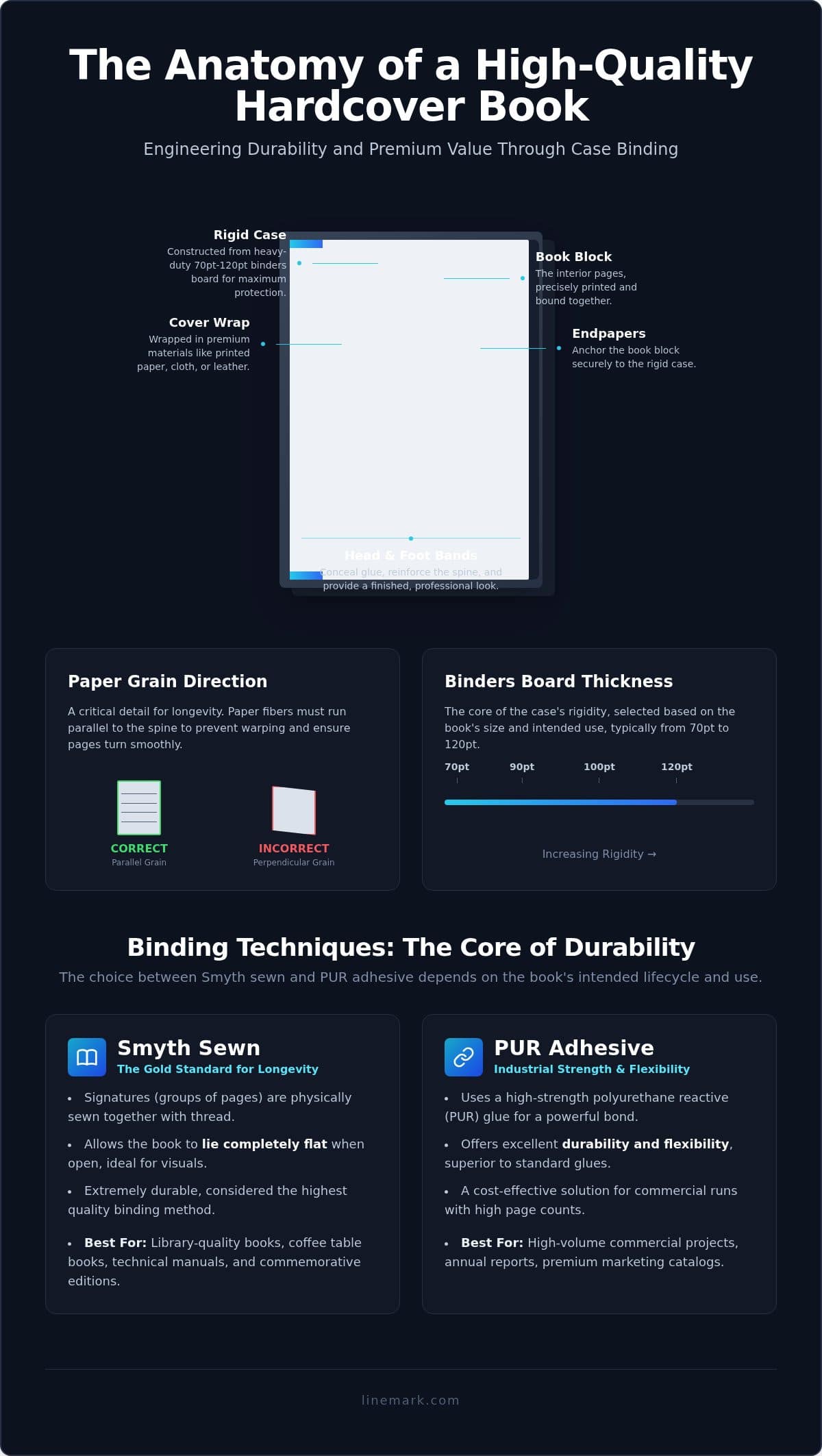
A premium book is a sum of its engineering parts. The foundation of high-quality hardcover book printing lies in the “case” itself. We construct these cases using binders board ranging from 70pt to 120pt thickness. This density provides the necessary rigidity to protect the interior pages from environmental factors and heavy handling. Inside, endpapers serve a dual purpose: they provide a visual transition from the cover and anchor the book block securely to the boards. These are typically a heavier weight paper designed to handle the mechanical stress of opening and closing. Decorative headbands and footbands are applied to the top and bottom of the spine, offering a finished look that conceals the glue and reinforces the structure.
Precise paper selection is just as vital as the board thickness. We always account for grain direction, ensuring the paper fibers run parallel to the spine. If the grain is perpendicular, the pages will resist turning and the entire book may warp over time. This technical foresight prevents common manufacturing defects that plague lower-quality productions, ensuring your investment maintains its integrity across different climates and storage conditions.
Binding Techniques: Smyth Sewn vs. PUR Adhesive
The choice between Smyth sewn and PUR adhesive binding for your hardcover book printing project depends on the book’s lifecycle. Smyth sewn is the gold standard for library-quality books. It involves sewing folded signatures together with thread, allowing the book to lie completely flat when opened. This is ideal for coffee table books or reference manuals where hands-free reading is essential. Conversely, PUR adhesive uses high-strength polyurethane glue. It’s a durable, cost-effective solution for commercial runs where high page counts require a permanent, flexible bond that won’t crack under stress or temperature fluctuations.
Cover Materials and Specialized Finishes
The exterior of your book is your first opportunity to establish brand authority. A printed litho case allows for full-color graphics to be wrapped around the board, usually protected by a gloss or matte laminate for extra durability. For a more traditional aesthetic, cloth or faux leather textures provide a sophisticated feel that resonates with luxury markets. You can further enhance these materials through advanced binding & finishing techniques:
- Foil Stamping: Adds a metallic, reflective gleam to titles and logos for a high-end look.
- Spot UV: Applies a glossy coating to specific design areas to create tactile depth and visual contrast.
- Soft-Touch Lamination: Provides a velvety texture that encourages the reader to engage with the product longer.
If you’re unsure which combination fits your distribution goals, our team can help you select the optimal structural components for your next project.
Digital vs. Offset: Scaling Your Hardcover Production
Selecting the appropriate technology for hardcover book printing is a pivotal decision that dictates both your unit economics and your speed to market. The choice isn’t merely about quality; it’s about matching production capabilities to your specific distribution goals. While digital printing has revolutionized short-run accessibility, offset printing remains the industrial standard for high-volume, brand-critical projects. Understanding the technical tipping point between these two methods ensures you don’t overpay for small batches or sacrifice quality during a massive rollout.
The primary differentiator lies in the setup process. Offset requires the creation of physical plates and a longer calibration period, which translates to higher initial costs but significantly lower per-unit prices as volume increases. Digital printing bypasses plate production, allowing for near-instantaneous starts. This technical agility makes digital ideal for rapid prototyping or limited editions, while offset provides the stability needed for consistent color reproduction across tens of thousands of copies.
When to Choose Offset Printing
Offset is the definitive choice for high-volume runs, typically starting at 500 copies or more. At this scale, the initial setup investment is absorbed by the volume, resulting in superior unit economics. Beyond cost, offset printing offers unmatched color precision. When your project requires specific Pantone (PMS) matching for corporate identity or luxury branding, offset’s ink-on-paper process delivers a level of vibrancy and consistency that toner-based systems struggle to replicate. It also provides the greatest versatility in paper stock selection, handling textured or heavy-weight papers with ease.
The Rise of High-Capacity Digital Printing
Modern digital technology has closed the quality gap, offering a sophisticated solution for agile marketing strategies. Integrating custom book printing with digital workflows allows for variable data printing, where each hardcover edition can be personalized for the recipient. This is a transformative tool for high-value sales pursuits or exclusive membership rewards. Digital production excels in speed-to-market, often reducing lead times from weeks to days. It enables organizations to maintain leaner inventories, printing exactly what they need for niche audiences without the risk of overproduction. This “just-in-time” manufacturing model turns your physical books into a flexible, responsive communication asset.
Precision matters in every run. Whether you’re launching a national campaign or a specialized reference guide, our 90,000-square-foot facility provides the industrial capacity to pivot between these technologies as your project demands. We help you navigate these technical nuances to ensure your hardcover book printing project is both a manufacturing success and a strategic win.
Design and Pre-Press Standards for Professional Results
Achieving industrial-grade quality requires a transition from creative design to technical manufacturing. In hardcover book printing, the pre-press stage is where structural integrity is established. If your files don’t account for the physical dimensions of the binders board or the mechanical requirements of the hinge, the final product will fail. We view pre-press not as a checklist, but as a precision engineering phase that guarantees your book functions perfectly from the first opening.
Standard print projects often require a 0.125″ bleed. However, hardcover manufacturing demands a significantly larger margin, typically between 0.75″ and 0.8″. This extra material is necessary because the cover image must wrap entirely around the thick binders board and be glued to the interior. Without this “wrap-around” bleed, you risk seeing raw board edges on your finished product. Additionally, all high-resolution PDF exports must utilize CMYK color profiles and have all fonts embedded to prevent rendering errors during the transition to our digital or offset presses.
Spine Width and Gutter Management
Calculating your spine width is a critical technical step that relies on the paper’s caliper, measured as Pages Per Inch (PPI). The standard formula we use is (Page Count / PPI) + Board Thickness. A failure to account for the board’s physical bulk results in a spine that is too narrow, causing the cover to pull or sit unevenly. Similarly, gutter management is vital. Because the binding process consumes a portion of the inner margin, you must maintain a safety zone for text and critical graphics. We recommend keeping essential content at least 0.5″ away from the gutter to ensure it doesn’t disappear into the fold.
Proofing Protocols for Large Runs
We utilize a multi-tiered proofing strategy to eliminate risk before full-scale production. Digital proofs are excellent for verifying layout and content accuracy. However, for brand-critical projects, we recommend physical contract proofs. These are printed on the actual substrate to ensure color matching is exact. Finally, a physical hardcover mock-up allows you to test the weight, hinge flexibility, and overall tactile feel of the book. This proactive approach ensures that the final industrial-scale run meets your exact specifications without surprises.
Before you finalize your files, consult our technical specifications to ensure your layout is production-ready and optimized for our manufacturing workflow.
Strategic Partnership: From Manufacturing to Fulfillment
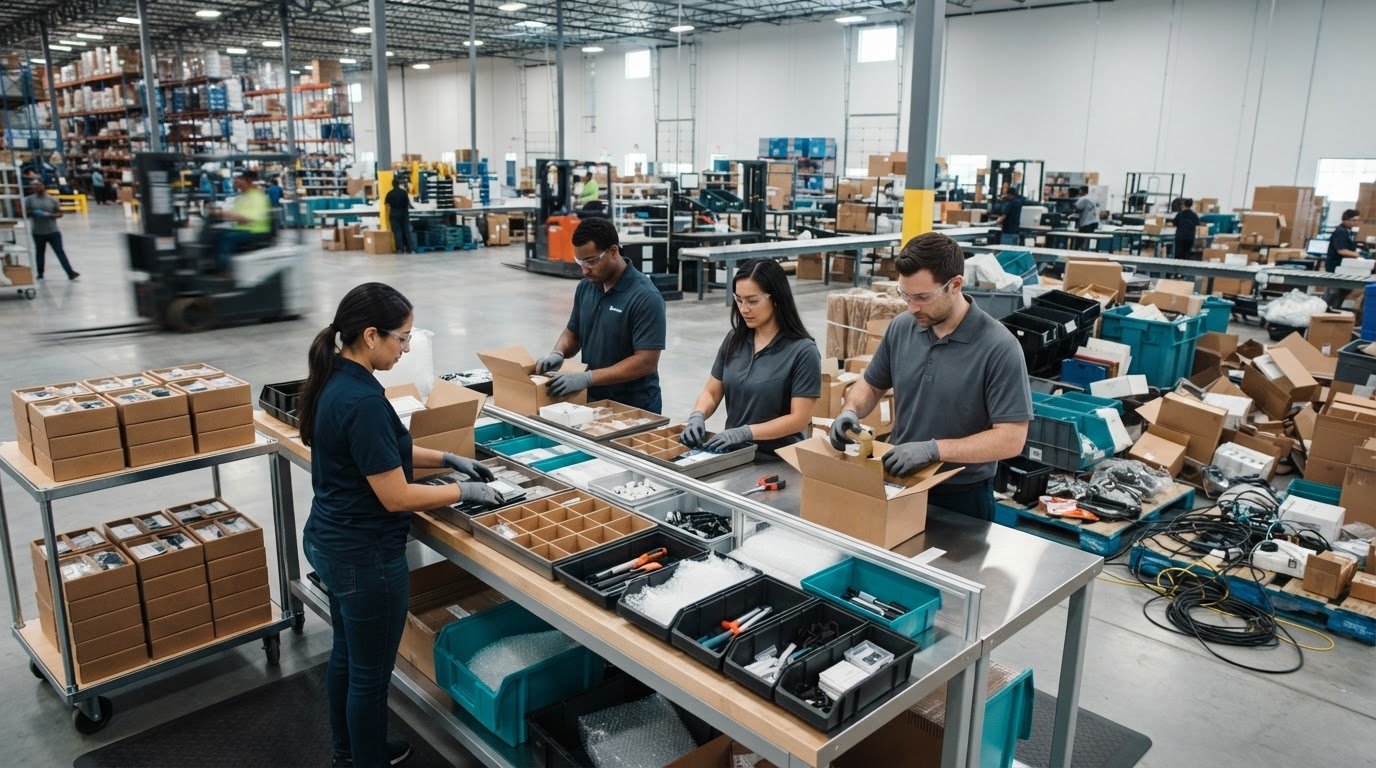
High-quality hardcover book printing is only the first stage of a successful communications strategy. Once the manufacturing is complete, the challenge shifts to logistics. Our 90,000-square-foot production facility serves as a centralized hub where industrial-grade manufacturing meets sophisticated distribution. This integrated approach ensures that your complex projects move seamlessly from the press to the end user without the friction of managing multiple vendors. We don’t just act as a transactional supplier; we function as a strategic ally that understands the nuances of modern supply chain management and inventory control.
Our facility’s scale allows us to maintain meticulous attention to detail while processing high-volume orders. By consolidating production and logistics, we provide a streamlined path from the initial file upload to final delivery. This model is particularly effective for organizations that require a catalyst for growth through large-scale, high-impact physical communications.
Integrated Kitting and Nationwide Distribution
Many national campaigns require more than just a single book. You might need to bundle your hardcover editions with personalized letters, brochures, or promotional items to create a unified brand experience. Our specialized kitting & fulfillment services allow for this level of complexity at scale. By housing production and distribution under one roof, we eliminate the transit times and potential damage associated with shipping books to a separate fulfillment house. Our warehousing solutions provide a secure environment for long-term inventory management, allowing you to release stock on-demand based on real-time market needs. This single-source model reduces operational overhead and ensures that every recipient receives a pristine, professionally assembled package.
MarCom On-Demand: Managing Your Book Assets
Efficiency in 2026 demands digital integration. We provide a marcom on-demand portal that allows your regional offices or various departments to order pre-approved book assets instantly. This platform ensures that your brand consistency remains intact, even when distribution is decentralized across the country. You can track production status and shipping details in real-time, providing the visibility needed for critical deadlines. Data-driven strategies power this system, helping you manage inventory levels with precision and reducing the waste associated with overprinting. By leveraging our technological infrastructure, you transform your hardcover book printing project from a physical product into a dynamic, managed asset that supports your organization’s broader marketing goals.
Scale Your Vision with Industrial Precision
Professional book manufacturing is a sophisticated balance of structural engineering and strategic logistics. You’ve seen how mastering pre-press standards and selecting the optimal binding method ensures your content carries the weight of authority it deserves. Whether you’re utilizing the agility of digital production for personalized runs or the efficiency of offset for national distribution, the objective remains the same: industrial-grade durability and brand consistency.
At Linemark, we bring 30+ years of industrial print expertise to every project. Our 90,000-square-foot high-capacity facility handles the most complex hardcover book printing requirements, moving your work seamlessly from the press to our comprehensive kitting and fulfillment center. This unified approach eliminates operational friction and transforms your physical books into powerful, distributed marketing assets. It’s a holistic journey designed to help you scale with confidence.
Ready to elevate your next production? Request a Custom Quote for Your Hardcover Project and partner with a team that values precision at every scale. Your project is in capable, steady hands.
Frequently Asked Questions
What is the minimum order quantity for custom hardcover book printing?
Our facility is optimized for high-capacity commercial production, focusing on runs where industrial-grade quality and unit economics align with professional distribution goals. While we handle a range of project scales, the most cost-effective results are typically achieved at volumes that leverage our offset and high-speed digital capabilities. It’s best to discuss your specific requirements with our team to determine the optimal production path for your volume.
How do I calculate the spine width for my hardcover book?
The precise spine width is determined by dividing your total page count by the paper’s Pages Per Inch (PPI) and then adding the thickness of the binders board. This calculation is a critical technical step that ensures the cover wraps correctly around the book block without pulling. Using the specific PPI for your chosen paper stock prevents structural defects and ensures a professional fit for the final manufactured product.
What is the difference between Smyth sewn and adhesive case binding?
Smyth sewn binding involves stitching folded signatures together with thread to allow the book to lie flat, while adhesive binding uses high-strength glue to secure the pages. Smyth sewing is the preferred method for premium reference works that require hands-free reading. Adhesive binding, particularly using PUR technology, provides a durable and flexible bond that is excellent for high-volume commercial projects where speed and cost-efficiency are priorities.
Can I use variable data printing on a hardcover book?
You can utilize variable data printing to create personalized hardcover editions for exclusive membership rewards or high-value sales pursuits. This technology allows for unique text and graphics to be integrated into each copy during the production run. It’s a transformative tool that combines the prestige of hardcover book printing with the precision of data-driven marketing to create a more impactful, tailored recipient experience.
How long does the production process take for a high-volume hardcover run?
A typical high-volume production cycle ranges from several business days to a few weeks, depending on the complexity of your binding and finishing choices. Factors such as specialized foil stamping, custom cover materials, and integrated kitting requirements will influence the final timeline. We maintain a steady and controlled communication rhythm throughout the process to ensure your project stays on schedule and meets your critical distribution deadlines.
What type of paper stock is best for premium hardcover interiors?
Premium interiors generally utilize 70lb to 100lb text weights in matte, gloss, or uncoated finishes depending on the intended use. High-resolution photography projects benefit from coated stocks that enhance color vibrancy and detail. Text-heavy manuals or history books often use uncoated stocks for superior readability. Selecting a stock with high opacity is essential to prevent image show-through and maintain the professional integrity of the layout.
Do you offer integrated fulfillment and shipping for large book orders?
We provide comprehensive kitting and fulfillment services directly from our 90,000-square-foot facility to streamline your entire supply chain. This centralized model allows us to manage your inventory and execute nationwide distribution on-demand. By integrating production and logistics, we reduce operational friction and ensure your hardcover book printing project is handled with meticulous attention to detail from the initial press run to the final delivery.
What is the standard bleed requirement for a casebound cover?
Casebound covers require a significantly larger bleed margin than standard print projects, typically ranging from 0.75″ to 0.8″ on all sides. This extended area is necessary because the cover material must wrap entirely around the thick binders board to be glued to the interior. Providing this ample bleed ensures a seamless finish with no raw board edges visible, which is a hallmark of professional, industrial-grade book manufacturing.