

 08/15/2026
  Steve Bearden
In a marketplace crowded with digital noise, your brand’s physical presence shouldn’t just be seen; it must be felt. Most high-volume marketing materials suffer from a generic aesthetic that fails to stop a prospect’s hand, yet spot UV printing offers a specialized solution to this common tactile deficit. You likely recognize the frustration of investing in a large-scale project only to have the final product feel flat and uninspired. We understand that for an annual report or a premium catalog to succeed, it needs a finish that communicates authority before a single word is read.
This guide explores how to leverage high-gloss finishes as a strategic catalyst for brand engagement. You’ll discover how to create sophisticated, sensory experiences that drive professional authority and response rates. We’ll examine the technical precision required for industrial-grade curing, innovative applications for 2026 campaigns, and the streamlined workflow needed to move from a complex design file to a flawless, high-capacity production run. By the end, you’ll have the confidence to transform standard print into a powerful tool that stands up to the rigors of the postal system and commands the attention your brand deserves.
Key Takeaways
- Learn how liquid polymer coatings create high-contrast tactile experiences that distinguish your brand when it’s competing against generic, flat materials.
- Understand the industrial curing process that ensures precision and durability for high-volume projects, from direct mail to premium catalogs.
- Master the technical requirements for spot UV printing, specifically the use of 100% K mask layers to guarantee flawless results during production.
- Discover how to scale premium finishes across your organization by integrating them into automated MarCom On-Demand portals for consistent brand execution.
- Explore strategic applications for custom book covers and annual reports that leverage sensory appeal to drive higher reader engagement.
Understanding Spot UV Printing: The Science of Tactile Marketing
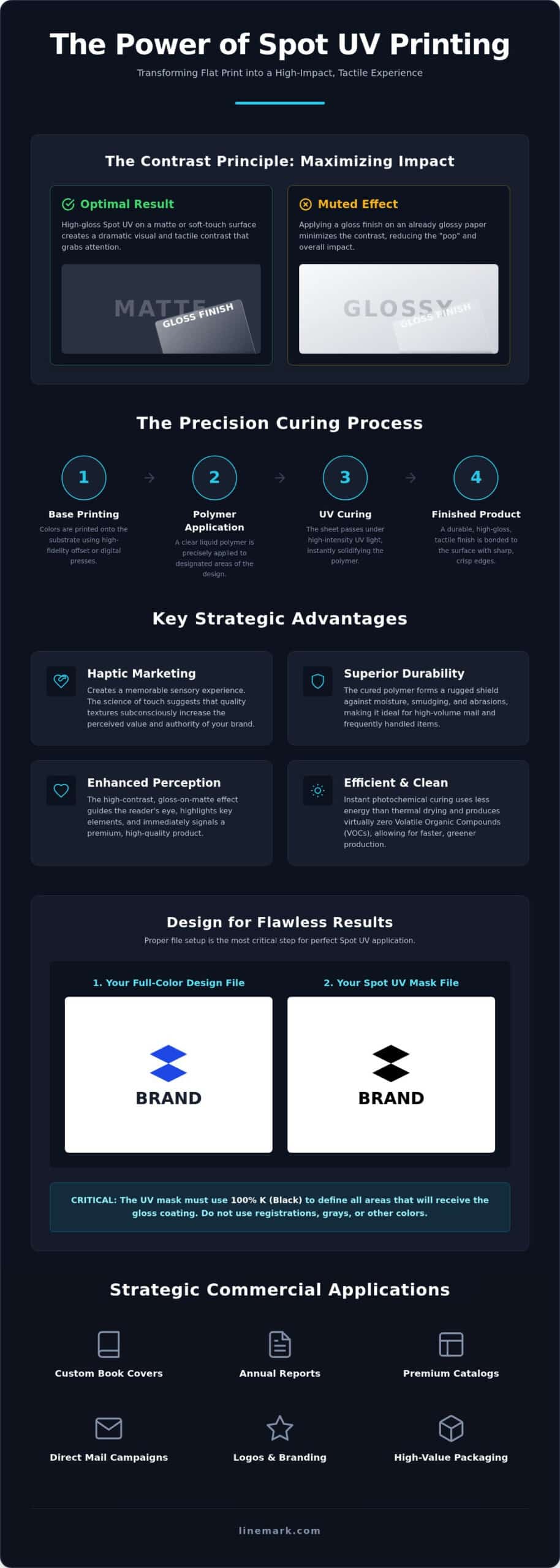
Spot UV printing represents a sophisticated intersection of chemistry and design. Unlike traditional aqueous coatings that dry through evaporation, spot UV utilizes a liquid polymer that remains fluid until it passes under a high-intensity ultraviolet light source. This instantaneous curing process “freezes” the polymer in place, creating a durable, high-gloss surface that can be applied with surgical precision to specific design elements. While a “flood” UV coating covers the entire substrate for general protection, “spot” application is a deliberate choice to create visual and physical depth. This targeted approach generates a high-contrast finish that demands attention by playing with light and shadow.
The environmental profile of this technology aligns with modern sustainability goals. Because the curing process is photochemical rather than thermal, it requires significantly less energy than traditional drying ovens. Additionally, the lack of evaporating solvents means the process produces virtually zero Volatile Organic Compounds (VOCs), making it a cleaner choice for high-volume production facilities. This efficiency doesn’t just benefit the planet; it allows for faster turnaround times on complex projects without sacrificing the integrity of the finish.
The Contrast Principle: Gloss vs. Matte
The efficacy of spot UV printing relies heavily on the substrate beneath it. When applied to a high-gloss paper, the effect is muted; however, when paired with a matte or soft-touch velvet lamination, the visual “pop” is dramatic. This contrast guides the reader’s eye, pulling focus toward logos, key product features, or primary calls to action. Optimal visibility is achieved when the gloss finish provides a stark refractive difference against a non-reflective, matte-laminated surface. By isolating the shine, you create a visual hierarchy that highlights the most critical elements of your marketing collateral.
Haptic Marketing and the Science of Touch
In a digital-first economy, physical touch has become a rare and valuable brand touchpoint. Haptic marketing focuses on how tactile sensations influence consumer behavior and brand perception. Research in sensory marketing suggests that when people touch a high-quality material, they experience a psychological phenomenon where they subconsciously assign a higher value to the object. This tactile strategy is particularly effective in custom book printing, where the weight and texture of a cover can signify the authority of the content within. Raised textures trigger neurological engagement that flat digital screens can’t replicate, fostering deeper brand recall and a sense of premium quality during every interaction.
The Technical Process: How UV Curing Delivers Precision at Scale
Executing high-impact spot UV printing requires a seamless transition from traditional ink application to advanced photochemical curing. The process begins after the base color is applied via offset or digital printing. Once the ink is set, the sheets move into a specialized UV coating station. Here, a liquid polymer is applied with surgical accuracy to the designated areas of the design. Unlike standard varnishes that soak into paper fibers, this polymer sits on the surface, waiting for the catalyst that will transform it into a solid, glass-like finish.
The defining moment of the process occurs under high-intensity ultraviolet lamps. As the sheet passes through the curing chamber, UV light triggers an instantaneous chemical reaction that “freezes” the liquid polymer. This isn’t a traditional drying phase; it’s a molecular bond that occurs in milliseconds. This rapid solidification prevents the coating from spreading or bleeding, which is how we maintain the sharp, crisp edges required for intricate logos and fine typography. Beyond the visual appeal, this cured layer provides a rugged shield against moisture, smudging, and the heavy abrasions typical of high-volume mail sorting systems.
Registration and Precision in High-Volume Print
In the world of industrial-scale production, registration is the difference between a premium product and a wasted run. High-volume projects require equipment that can maintain perfect alignment between the printed image and the UV layer at high speeds. We utilize advanced optical sensors that read registration marks on every individual sheet, adjusting the application in real-time to compensate for even the slightest mechanical shifts. For complex commercial designs, we often employ “trapping” techniques, slightly overlapping the UV mask to ensure the finish hits the target perfectly every time. If you’re managing a high-stakes campaign, our team can guide you through the best commercial printing configurations to ensure your finish is both durable and precise.
Substrate Compatibility: Beyond Standard Paper
While spot UV is versatile, it performs best on specific materials that can support the weight and tension of the cured polymer. We generally recommend a minimum paper weight of 16pt for stability; thinner stocks may curl as the polymer shrinks slightly during curing. This technology isn’t limited to traditional marketing collateral, however. It’s increasingly used to add depth to large format graphics and environmental branding. From thick cover boards for corporate catalogs to synthetic stocks for outdoor signage, the application of a targeted gloss layer enhances the structural integrity and visual weight of the material, ensuring your brand’s physical touchpoints feel as substantial as they look.
Strategic Commercial Applications: Elevating High-Stakes Collateral
Spot UV printing isn’t just a decorative flourish for small-scale boutique projects. It’s a strategic communication tool designed for high-stakes corporate environments where precision and authority are non-negotiable. When you produce annual reports or premium catalogs at scale, the finish becomes a silent ambassador for your brand’s stability and attention to detail. By applying this tactile layer to specific imagery or typography, you transform a passive reading experience into an active sensory interaction. This level of intentionality is what separates standard commercial printing from a high-impact marketing asset that commands a seat at the executive table.
In the competitive field of custom book manufacturing, spot UV creates immediate shelf appeal. It allows specific design elements on a cover to catch the light, making a title stand out in a retail setting or a professional library. This application isn’t limited to small formats. We also see significant growth in using these finishes for large-format graphics, including wall murals and window graphics. Adding a premium texture to environmental branding transforms a standard office space into an immersive brand experience that reflects industrial-grade quality and innovation.
Direct Mail and Fulfillment Integration
Many organizations overlook the logistical benefits of specialized finishes. Spot UV is a secret weapon for high-conversion direct mail campaigns because it adds a layer of physical protection. Postcards and self-mailers often face heavy friction within the postal system; however, the cured polymer used in our process acts as a shield against scuffing. We meticulously balance aesthetic impact with postal machine compatibility to ensure your pieces arrive in pristine condition. Our integrated kitting and fulfillment workflows are designed to handle these premium finishes with the same care they were printed with, ensuring no loss of quality from the press to the prospect’s mailbox.
Corporate Identity and Brand Standardization
Consistency is the foundation of professional authority. Using spot UV to unify a brand across diverse media, such as stationery, quarterly reports, and newsletters, creates a cohesive visual language that’s easily recognizable. For non-profits and associations, this level of polish builds trust with donors and members by signaling a commitment to excellence. We help our partners standardize these applications across their entire portfolio, ensuring that a glossy logo on a brochure matches the precision of the finish on an annual report. This unified approach to specialty finishes reinforces your position as a leader in your industry.
Design and File Preparation for Flawless Spot UV Results
The bridge between a creative vision and a high-capacity production run is a correctly prepared digital file. While the previous sections highlighted the strategic impact of spot UV printing, the execution depends on technical precision during the design phase. You need to provide a roadmap for the press. This is done through a dedicated “Mask” layer; it acts as a binary instruction set for the liquid polymer application, telling our machinery exactly where the gloss should begin and end.
Vector paths are non-negotiable for sharp UV edges. Unlike raster images that rely on pixels, vector paths provide mathematical instructions that remain crisp at any resolution. This ensures that the boundary between the matte substrate and the glossy finish is razor-sharp. If you use rasterized masks, you risk “stair-stepping” or blurred edges that diminish the professional authority of your collateral. The industry standard for these mask files is 100% K (Black). This high contrast allows our equipment to read the mask with absolute clarity, ensuring the sensors register the “on” and “off” signals for the polymer with zero ambiguity.
Setting Up Your Mask File in 5 Steps
Follow these steps to ensure your file integrates seamlessly with our industrial production workflow:
- Step 1: Duplicate the specific design elements you want to highlight onto a completely separate layer in your design software.
- Step 2: Rename this layer clearly, such as “Spot_UV_Mask,” so it’s easily identifiable by the prepress team during the kitting process.
- Step 3: Set the fill of these elements to 100% Spot Black (100% K) and ensure the “Overprint Fill” option is selected in your attributes panel.
- Step 4: Convert all text to outlines. This eliminates font compatibility issues and ensures the UV hits the exact shape of your typography without shifting.
- Step 5: Export your final document as a high-resolution PDF with all layers preserved and no downsampling of vector data.
Common Pitfalls to Avoid in UV Design
Managing the physical limitations of the polymer is as vital as the digital setup. One common issue involves placing UV over fold lines or trim edges. Because the cured polymer is a rigid solid, it can crack if the paper is bent or cut directly through the finish. We recommend a “safe zone” of at least 1/8th of an inch away from all folds and trims to maintain the integrity of the finish.
Designers should also avoid extremely thin lines or small fonts. Anything under 1pt or 6pt type may not register correctly because the liquid polymer has a physical surface tension that prevents it from adhering to microscopic paths. Finally, remember that spot UV requires solid shapes. Gradient masks don’t work; the process is binary, meaning the finish is either 100% present or not there at all. If you’re ready to move from design to production, our team can review your files through our commercial printing services to ensure every detail is optimized for the press.
Scaling Your Brand with Integrated Portals and Fulfillment
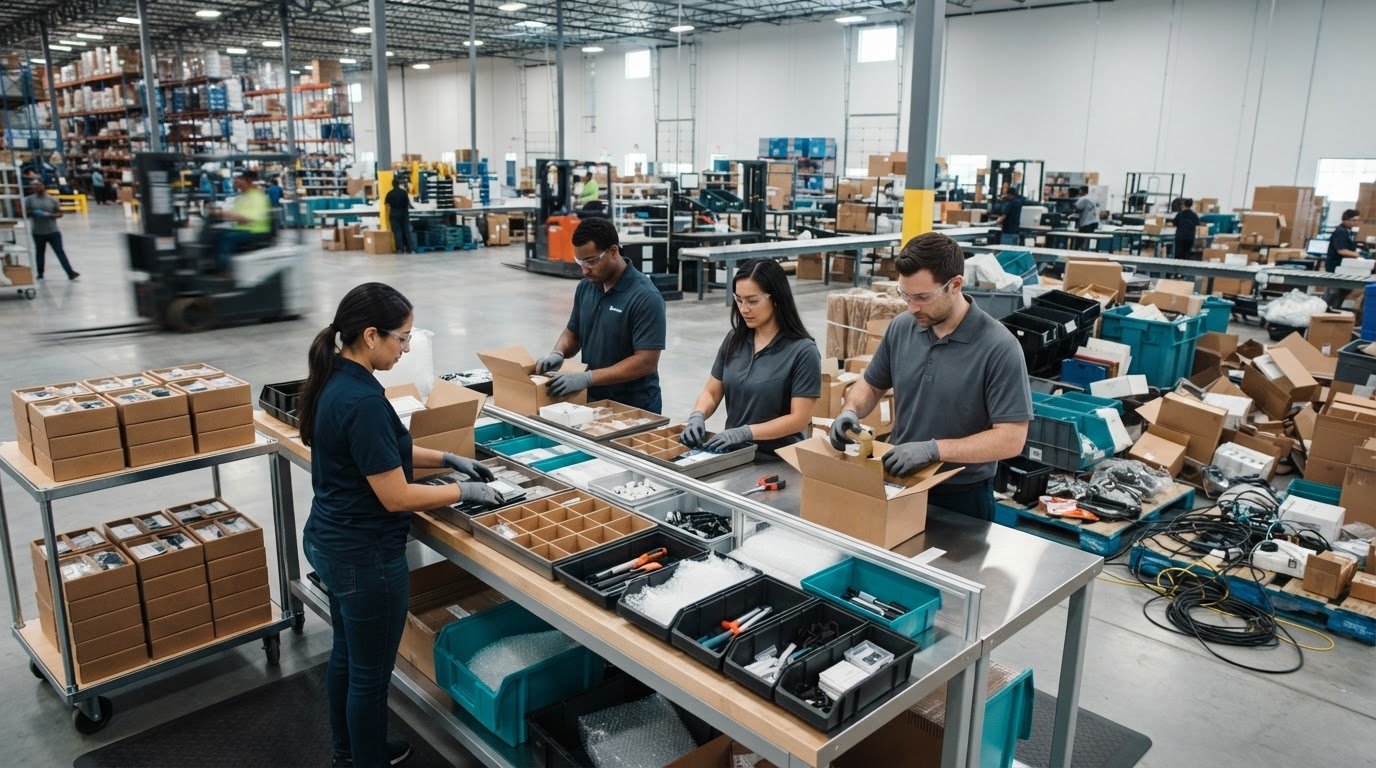
Managing premium finishes at a national scale requires more than just high-end machinery; it demands an integrated logistical framework. When your marketing strategy involves thousands of high-impact catalogs or direct mailers, maintaining the integrity of spot UV printing across every piece becomes a challenge of operational excellence. We don’t view this as a simple transaction. Instead, we provide a holistic journey that bridges the gap between complex production and nationwide distribution. By centralizing your production in a 90,000-square-foot facility, you gain the efficiency of industrial-grade curing alongside the meticulous quality control of a seasoned partner.
Our role as a strategic communications ally is to ensure that your tactile marketing efforts are both scalable and consistent. This transition from a transactional model to a unified partnership allows you to leverage our 30 years of industrial expertise to solve complex production challenges before they reach the press. Whether you’re producing annual reports for stakeholders or high-volume postcards for a national campaign, our facility is designed to handle the nuances of modern marketing and logistics with absolute precision.
MarCom On-Demand: Automation for Premium Print
One of the most significant risks to brand authority is the fragmentation of design standards across regional offices or sales teams. Integrating your premium collateral into a marcom on-demand portal solves this by providing pre-approved templates. These digital environments allow your distributed workforce to order brochures or newsletters with spot UV printing already configured in the file architecture. This automation eliminates common design errors and ensures that every piece, regardless of where it’s ordered, meets your exact specifications. It’s a scalable solution that protects your brand identity while empowering your team to deliver high-touch marketing materials on demand.
From Production to Nationwide Distribution
Precision doesn’t stop when the sheets leave the press. The logistics of kitting and fulfillment are just as critical as the print itself. Materials featuring specialized finishes require careful handling during the assembly of direct mail packages or retail signage kits. We manage your inventory in a centralized, tech-forward warehouse, ensuring that your UV-finished materials are stored in optimal conditions and shipped with protective packaging. This end-to-end oversight means your high-stakes collateral arrives in the hands of your prospects exactly as intended. By leveraging our high-capacity production capabilities and streamlined distribution networks, you can focus on growth while we handle the complexities of your physical brand presence.
Mastering the Future of Tactile Marketing
Specialized tactile finishes are more than a visual enhancement; they’re a strategic differentiator that bridges the gap between digital noise and physical authority. By mastering the technical nuances of vector mask preparation and leveraging industrial-grade curing, you’ll ensure your high-stakes collateral commands attention. Whether you’re producing annual reports or high-volume direct mail, the precision of a liquid polymer finish transforms generic materials into premium brand touchpoints that drive engagement.
Scaling this impact across a national workforce requires a partner who understands both the art of the press and the science of logistics. With over 30 years of commercial print expertise and a 90,000-square-foot production facility, we’re built to handle your most complex high-capacity projects with absolute precision. Our integrated MarCom On-Demand portal solutions allow you to automate these sophisticated finishes, maintaining perfect brand consistency from coast to coast.
Elevate your brand with professional spot UV printing from Linemark. We’re ready to help you turn your strategic vision into a tactile reality.
Frequently Asked Questions
What is the difference between spot UV and spot varnish?
Spot UV utilizes a liquid polymer cured by ultraviolet light to create a high-gloss, raised finish, while spot varnish is a thinner, ink-based coating. UV offers superior depth and durability compared to traditional varnishes. This makes it the preferred choice for high-stakes projects like annual reports where a tactile, premium feel is essential for brand authority and visual impact.
Can I apply spot UV to both sides of a printed piece?
You can apply this finish to both sides of a project, though it requires strategic design to maintain structural integrity. High-volume projects like brochures often benefit from double-sided application to create a cohesive sensory experience for the reader. It’s vital to ensure the paper weight is sufficient to prevent curling or set-off during the industrial curing process on the second pass.
Does spot UV printing work on all types of paper stock?
Spot UV printing performs best on coated stocks, specifically those with a matte or velvet lamination. Uncoated papers are too porous; the liquid polymer sinks into the fibers rather than sitting on the surface to create a gloss. We recommend using a minimum of 16pt cover stock to provide the necessary stability for the photochemical curing process and prevent warping.
How does spot UV affect the recyclability of my printed materials?
Modern UV coatings are generally considered recyclable and don’t prevent paper from being processed in standard de-inking facilities. Because the polymer is solid and cured, it’s easily separated from the paper fibers during the recycling process. This allows you to achieve a high-impact aesthetic for your catalogs without compromising your organization’s commitment to sustainable procurement and environmental responsibility.
Why is a matte or soft-touch lamination recommended under spot UV?
A matte or soft-touch lamination provides the necessary refractive contrast to make the glossy UV layer stand out. Without this non-reflective base, the visual impact of the gloss is significantly diminished. This combination creates a sophisticated interplay of light and texture that guides the reader’s eye toward your most critical brand elements and primary calls to action on high-stakes collateral.
What is the typical turnaround time for a high-volume spot UV project?
Turnaround times vary based on project scale, yet our high-capacity facility is designed for rapid execution of complex finishes. While standard print runs are fast, adding a specialized curing stage requires additional time for precise registration and quality checks. Most high-volume commercial projects move from the press through our finishing department within a few business days of final file approval.
Can I use spot UV on variable data printing (VDP) projects?
You can integrate spot UV printing with variable data printing to create highly personalized, premium marketing materials. This allows you to apply a tactile finish to individual names, specific images, or unique offer codes within a single print run. It’s an effective strategy for high-conversion direct mail campaigns that require both personalization and a sophisticated, sensory-driven aesthetic.
How do I ensure the UV coating doesn’t crack on the folds of my brochure?
To prevent cracking, you should keep the UV mask at least 1/8th of an inch away from all fold lines and trim edges. The cured polymer is a rigid solid; it doesn’t have the flexibility of paper fibers and will fracture if bent. Strategic design ensures the finish remains intact while the piece maintains its professional appearance throughout its distribution lifecycle.