

 07/01/2026
  Steve Bearden
What if your national campaign’s visual integrity is being dismantled by a single regional office using unapproved assets on a local printer? It’s a scenario that many marketing executives face; seeing a precisely calibrated brand palette shift from the lofty white of Pantone 11-4201 Cloud Dancer on a custom book to a dull grey on a regional floor graphic. You already know that managing brand consistency in print is no longer just a design challenge. It’s a complex logistical hurdle where paper stock, ink chemistry, and decentralized execution often collide to create costly errors.
We’re here to help you regain control and eliminate the high costs of reprinting. You’ll learn how to maintain flawless visual integrity across high-volume commercial print runs and complex national marketing campaigns. We’ll explore the technological shifts of 2026, including how centralized digital portals and updated ISO printing standards provide the predictable color accuracy your brand demands. From streamlined distribution to the latest in variable data printing, we’re outlining the roadmap to a unified brand presence.
Key Takeaways
- Understand why physical marketing assets require more rigorous governance than digital channels due to the permanent nature of ink on substrate.
- Discover how G7 Certification serves as the industrial gold standard for achieving predictable color accuracy across diverse materials and paper stocks.
- Master the art of managing brand consistency in print by implementing a centralized MarCom On-Demand portal to eliminate unauthorized regional production.
- Learn the technical requirements for scaling assets across varied formats, from the precise spines of custom book printing to high-impact large format graphics.
- Shift your operational model from transactional vendor relationships to a strategic partnership that integrates kitting and fulfillment for a unified end-user experience.
The Fundamentals of Brand Consistency in Modern Print
Brand consistency represents the visual and tactile uniformity of all physical marketing assets. It is the bedrock of brand management fundamentals. When your brand colors, logos, and textures remain identical across every medium, you build a recognizable identity that commands respect. This uniformity isn’t just about aesthetics; it’s about reliability. A partner who can maintain these standards across high-volume runs ensures that the brand’s message is never lost in translation between the screen and the substrate.
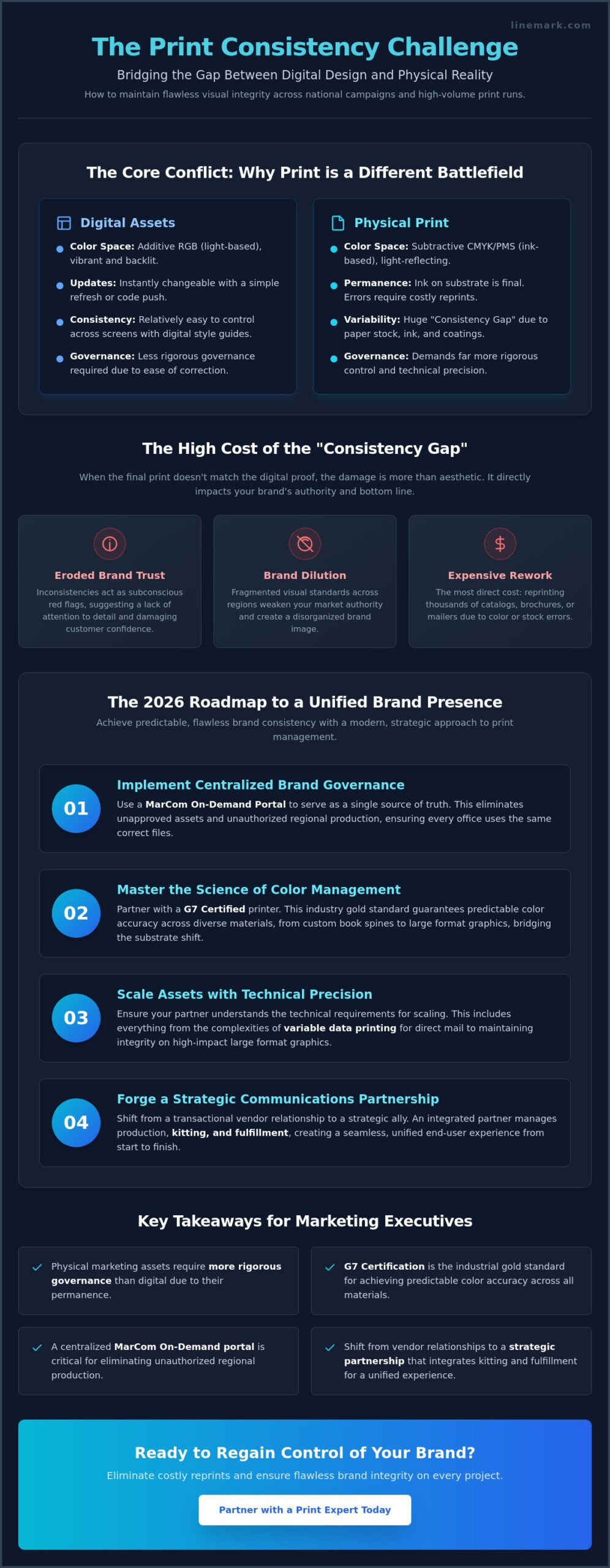
Unlike digital channels where updates happen in real-time, print is permanent. You can’t hit a refresh button on a thousand catalogs or a national direct mail campaign. Because of this permanence, managing brand consistency in print requires a level of precision that digital assets simply don’t demand. Stricter governance is necessary because every physical item is a lasting representation of your organization’s quality. Errors are not just visually jarring; they’re expensive and potentially damaging to your market authority.
To better understand this concept, watch this helpful video:
The “Consistency Gap” describes the discrepancy between a high-resolution digital mockup and the final physical product. On a monitor, colors are backlit and vibrant. In the hands of a customer, those same colors are reflected off paper fibers. Factors like paper porosity, ink absorption, and coating finishes can alter the visual output significantly. Bridging this gap requires a deep technical understanding of how different substrates react to various printing processes, ensuring the final product matches the original vision.
Modern consumers in 2026 prioritize authenticity and tangible experiences. A brand that presents a polished digital persona but delivers a poorly printed brochure or a mismatched mailer appears disorganized. Physical touchpoints are an extension of your brand’s promise. They must feel as premium as the services you provide. In an era of digital saturation, the quality of your physical materials serves as a powerful differentiator that proves your commitment to excellence.
The Psychology of Visual Trust and Recognition
When a customer encounters a brochure with a slightly different shade of blue than your website, it triggers a subconscious red flag. This inconsistency suggests a lack of attention to detail, which can erode trust instantly. Tactile consistency is equally vital. The weight of a business card or the texture of an annual report communicates your brand’s stability and quality. Brand Dilution is the erosion of market authority through fragmented visual standards.
Commercial Print vs. Digital: Why Consistency is Harder on Paper
Digital screens operate in an infinite RGB color space, but print is bound by the physical limitations of ink, toner, and paper. Environmental factors like warehouse lighting or UV exposure can also affect how a product looks over time. Managing brand consistency in print is significantly more complex than digital management. A national campaign requires a centralized production partner to ensure every asset, regardless of where it is printed, meets the same rigorous standards of precision and quality.
The Science of Color Management: Achieving Uniformity Across Substrates
Managing brand consistency in print begins with a fundamental shift from the additive color world of RGB screens to the subtractive world of physical ink. While digital displays use light to create millions of colors, commercial printing relies on CMYK (Cyan, Magenta, Yellow, and Black) or the Pantone Matching System (PMS). PMS is essential for spot-color precision, ensuring your specific brand blue remains constant across every run. However, simply choosing a Pantone swatch isn’t enough. You must understand how these pigments interact with physical surfaces to avoid the “Substrate Shift,” where the same ink looks different on varied materials.
The industrial benchmark for this precision is G7 Certification. This isn’t just a label; it’s a rigorous calibration process that ensures color consistency across different printing devices and substrates. By focusing on gray balance and tonal curves, G7-certified partners provide a predictable visual outcome whether you’re producing a direct mail piece or a high-end catalog. This level of technical governance is why many organizations model their internal guidelines after established frameworks like the University of Florida’s official print standards, which detail exact color specifications for various applications.
Navigating Color Models: Pantone, CMYK, and Beyond
Choosing between offset and digital printing depends on your specific needs for volume and precision. Offset printing remains the gold standard for high-volume runs where PMS spot colors are non-negotiable. Digital printing has evolved rapidly. By 2026, extended gamut printing has become more prevalent, allowing digital presses to hit up to 90 percent of the Pantone library. When setting your standards, define “Tolerance Levels” using Delta E values. This numerical measurement of color difference allows you to maintain strict control over variance, ensuring that even in high-volume production, the human eye cannot detect shifts between batches.
Material Impact: How Paper Stock and Substrates Alter Perception
The choice of paper significantly alters how a color is perceived. A brand blue printed on a 100lb gloss cover will appear more vibrant and saturated than the same ink on a 70lb uncoated text stock, which absorbs more pigment and dulls the finish. Paper brightness also plays a critical role. A warm white paper will shift your colors toward yellow, while a cool white can make them appear more blue. These nuances are amplified when moving to specialized materials. For instance, large format graphics like vinyl or fabric require distinct color profiles to account for their unique textures and light-reflection properties.
To succeed, develop a comprehensive Print Brand Kit. This document should specify color values for every major substrate your brand uses. It’s a proactive way to ensure your strategic communications ally has a clear roadmap for every project. If you’re ready to see how precision engineering can protect your visual identity, consider how our commercial printing solutions can unify your national campaigns.
Leveraging MarCom On-Demand for Centralized Brand Governance
While G7 certification and color profiles provide the technical foundation, the human element often remains the weakest link in the chain. Traditional brand manuals are passive documents that sit on shelves or in static PDFs; they don’t actually stop a regional manager from using a low-resolution logo or an outdated font. To solve this, sophisticated organizations are moving toward marcom on-demand platforms. These Web-to-Print portals act as a living brand manual, automatically enforcing standards at the point of creation. By centralizing the production process, you ensure that managing brand consistency in print becomes a systematic outcome rather than a manual oversight.
The transition to a centralized portal shifts the focus from policing errors to empowering teams. When templates are pre-approved and locked, the risk of visual drift disappears. This technological pride is not just about control; it’s about providing your regional partners with the tools they need to succeed without compromising the organization’s visual integrity. It transforms the printing process into a streamlined, high-tech solution that scales with your business.
Eliminating Rogue Printing with Automated Workflows
Rogue printing occurs when local offices bypass corporate standards to meet urgent deadlines. Automated workflows eliminate this risk by providing a structured path from customization to production. In this model, corporate teams lock essential brand elements like logos, colors, and legal disclaimers within templates. Local users can only edit specific fields, such as contact information or regional offers. Once the customization is complete, the system routes the order for corporate approval before it hits the press. This permissions-based access ensures that every asset produced meets your rigorous standards. The result is a significant reduction in design time and the complete elimination of costly print errors caused by unapproved assets.
Digital Asset Libraries and Version Control
The danger of outdated assets is a constant threat to brand integrity. When regional teams store files on local hard drives, they inevitably use retired logos or expired campaign imagery. A centralized digital asset library within your portal provides a single source of truth. Whether you are launching a nationwide direct mail campaign or updating regional signage, the system ensures every user accesses the most current iteration. This version control is vital for maintaining market authority and legal compliance across distributed networks. Centralization is the enemy of inconsistency. By leveraging these high-tech solutions, you transform your print operation from a fragmented liability into a streamlined, high-capacity engine for growth.
Maintaining Integrity in Large Format and Direct Mail
Expanding your brand presence from a standard brochure to a twenty-foot wall mural introduces significant technical hurdles that can compromise visual standards. The most common point of failure is the improper scaling of assets. While vector files remain mathematically perfect at any size, raster images depend on pixel density. When you are managing brand consistency in print at a national scale, you must ensure your source files meet the resolution requirements for their final application. A logo that looks sharp on a postcard will appear pixelated and unprofessional on a window graphic if the resolution isn’t meticulously managed from the start.
Precision is equally critical in custom book printing. Maintaining consistency across spines, covers, and interiors requires a partner who understands how different binding methods affect the visual layout. A spine that is off-center by even a fraction of an inch disrupts the shelf presence of an entire series. We approach these complex projects with industrial authority, ensuring that the tactile experience of the book matches the visual integrity of the brand’s digital identity.
Scaling Brand Assets for Environmental Graphics
Environmental graphics like wall murals and banners require a deep understanding of viewing distance. Graphics intended for roadside viewing can often utilize a lower DPI (dots per inch) because the human eye cannot perceive fine details from fifty feet away. However, graphics in a retail lobby or hallway must maintain high-resolution clarity. For outdoor applications, you must also specify UV-resistant inks to prevent brand fading. A faded logo suggests a brand in decline; using specialized inks ensures your visual authority remains vibrant regardless of environmental exposure.
Use this checklist to audit your large-format proofs before a national rollout:
- Confirm all logos and icons are in vector format to allow for infinite scaling.
- Verify that image resolution matches the intended viewing distance.
- Validate that bleed and safety zones account for hardware and installation requirements.
- Ensure ink specifications include outdoor durability or anti-scuff coatings where necessary.
Personalization without Fragmentation: The Role of VDP
Variable Data Printing (VDP) allows you to personalize content without sacrificing brand governance. According to USPS research, 68% of consumers are more likely to engage with a message personalized to their interests. The challenge is ensuring that dynamic content, such as a customer’s name or a localized offer, doesn’t break the static brand elements of the layout. By locking brand-consistent fonts and color palettes within your VDP fields, you maintain a unified voice while delivering a tailored experience. This balance between dynamic engagement and static integrity is what separates a professional direct mail campaign from a fragmented one. If you are ready to scale your environmental presence, explore our specialized large format graphics solutions today.
Partnering with a Strategic Communications Ally for National Scale
The traditional model of a print vendor is transactional. You send a file; they send a box. For organizations operating at a national level, this model is insufficient for managing brand consistency in print. You need a strategic communications ally. This shift represents a move toward a unified partnership where the provider understands your long-term marketing goals and logistics. An ally doesn’t just execute a project; they protect your brand equity by ensuring that every touchpoint, from a single postcard to a high-volume catalog run, meets the same rigorous standards of excellence.
True brand governance extends far beyond the moment the ink dries. It encompasses the entire journey from the press to the end-user’s hands. We leverage our 90,000-square-foot facility to manage high-volume national demand with the precision of a boutique shop. This industrial capacity is essential for maintaining control over complex projects that require simultaneous distribution across multiple regions. By housing production and logistics under one roof, we minimize the variables that lead to color variance and operational friction.
Beyond the Press: Kitting, Fulfillment, and Logistics
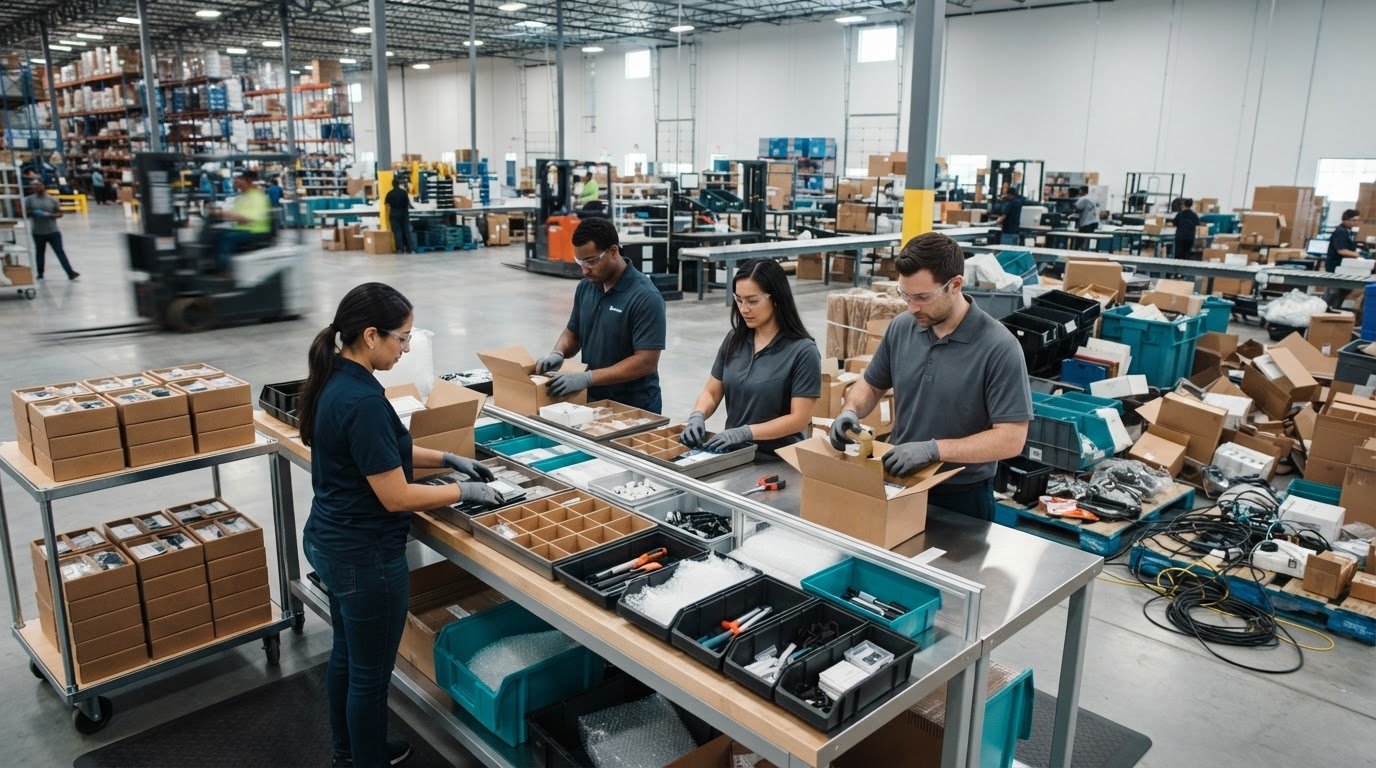
The final brand experience is often determined by how a shipment arrives. A poorly packed kit or a disorganized fulfillment process can damage brand perception before the customer even sees the printed material. If a regional office receives a damaged display, the brand appears compromised. Integrated kitting and fulfillment ensure that every component is handled with care and organized for maximum impact upon arrival. Effective inventory management also plays a vital role. It ensures that your essential brand materials are always available and ready for immediate distribution from a centralized hub, reducing lead times and eliminating the need for local, unmanaged storage.
Selecting a High-Capacity Production Partner
When selecting a partner to secure your visual identity, look for specific markers of operational excellence. G7 certification is a non-negotiable requirement for predictable color accuracy across diverse substrates. Equally important is the ability to offer MarCom portal capabilities that automate brand governance. A partner with diverse production equipment, including both offset and digital presses, provides the flexibility to choose the best method for each project without sacrificing quality. Single-source production remains the most effective way to reduce the risk of color variance across different media types.
Technology and industrial capacity are the twin pillars that protect your brand in 2026. By combining sophisticated Web-to-Print portals with large-scale production capabilities, you create a well-oiled machine that can handle any challenge. This proactive spirit values efficiency and high-touch service, ensuring your project is in capable, steady hands. Partner with Linemark to secure your brand consistency at scale and transform your print operations into a catalyst for growth.
Securing Your Visual Identity Across National Markets
Managing brand consistency in print is no longer a matter of manual oversight; it’s a strategic imperative that demands industrial precision and high-tech automation. You’ve seen how G7-certified color management and centralized MarCom portals eliminate the consistency gap and rogue printing. These tools transform a fragmented marketing operation into a unified, scalable engine for growth. By leveraging data-driven personalization and specialized large-format production, your brand maintains its authority at every customer touchpoint.
We bring over 30 years of experience in complex commercial fulfillment to every partnership. Our 90,000-square-foot high-capacity production facility is designed to handle national demand while maintaining meticulous attention to detail. With our G7 Master Qualification, we ensure your brand colors remain flawless across every substrate. It’s time to move beyond transactional vendor relationships and embrace a strategic communications ally that understands the nuances of modern logistics.
Streamline your national brand management with Linemark’s MarCom On-Demand solutions.
Your brand deserves a partner that values precision as much as you do. Let’s build a unified future together.
Frequently Asked Questions
What is the most common cause of brand inconsistency in print?
Decentralized production and a lack of standardized technical specifications are the primary drivers of visual drift. When regional offices use local vendors without corporate oversight, they often bypass calibrated workflows and G7 standards. This lack of centralized governance results in significant variations in color and layout that erode your market authority over time. Establishing a single source of truth is the only way to eliminate these discrepancies.
How does paper type affect my brand colors?
Paper porosity and brightness directly alter how ink is absorbed and how light reflects off the finished surface. Uncoated stocks absorb more pigment, which can make colors appear muted or darker; gloss coatings keep the ink on the surface for higher vibrancy. You must utilize specialized color profiles for each substrate to ensure your brand blue looks identical on a matte brochure and a gloss catalog.
What is a MarCom On-Demand portal and do I need one?
A MarCom On-Demand portal is a centralized Web-to-Print platform that allows users to customize pre-approved templates while locking core brand elements. It is essential for organizations with distributed teams that need to scale production without risking visual integrity. This system automates the governance of your brand standards, ensuring that every piece of collateral ordered by a regional office is perfectly aligned with corporate requirements.
Is Pantone or CMYK better for brand consistency?
Pantone is the superior choice for absolute color precision because it uses specific premixed pigments rather than a four-color mix. While CMYK is more cost-effective for full-color photography and digital runs, Pantone ensures your primary brand colors remain identical across different presses. Successfully managing brand consistency in print often requires a strategic combination of both systems depending on the specific project requirements and budget.
How can I prevent regional offices from using old logos in their print materials?
Implementing a centralized digital asset library with strict version control is the most effective solution for asset management. By providing a single source of truth within a production portal, you ensure that regional teams can only access and use the most current, approved files. This technological barrier eliminates the risk of rogue printing using outdated logos stored on local hard drives or legacy servers.
What is G7 certification and why does it matter for my brand?
G7 certification is an industrial calibration standard that ensures color consistency across different printing devices and materials by focusing on gray balance. It matters because it provides a predictable visual outcome regardless of where or how a piece is produced. Partnering with a G7-certified provider guarantees that your brand identity remains stable across your entire marketing mix, from brochures to large format graphics.
Can Variable Data Printing maintain my brand standards?
Variable Data Printing (VDP) maintains brand standards by integrating dynamic content into a static, pre-approved layout that is locked against unauthorized changes. By hard-coding brand-consistent fonts and color palettes into the variable fields, you can personalize direct mail or postcards without compromising visual integrity. This technology allows for high-engagement, personalized marketing that remains 100 percent on-brand at every touchpoint.
How do I ensure large-format signs match my brochures?
Achieving a match between large-format graphics and small-scale collateral requires specialized color profiles and high-resolution vector assets. Because different inks and substrates are used for wall murals or banners, your production partner must calibrate these devices to a unified industrial standard. Managing brand consistency in print across varied scales depends on this technical alignment to ensure your visual presence is unified in every environment.