


 08/29/2026
  Steve Bearden
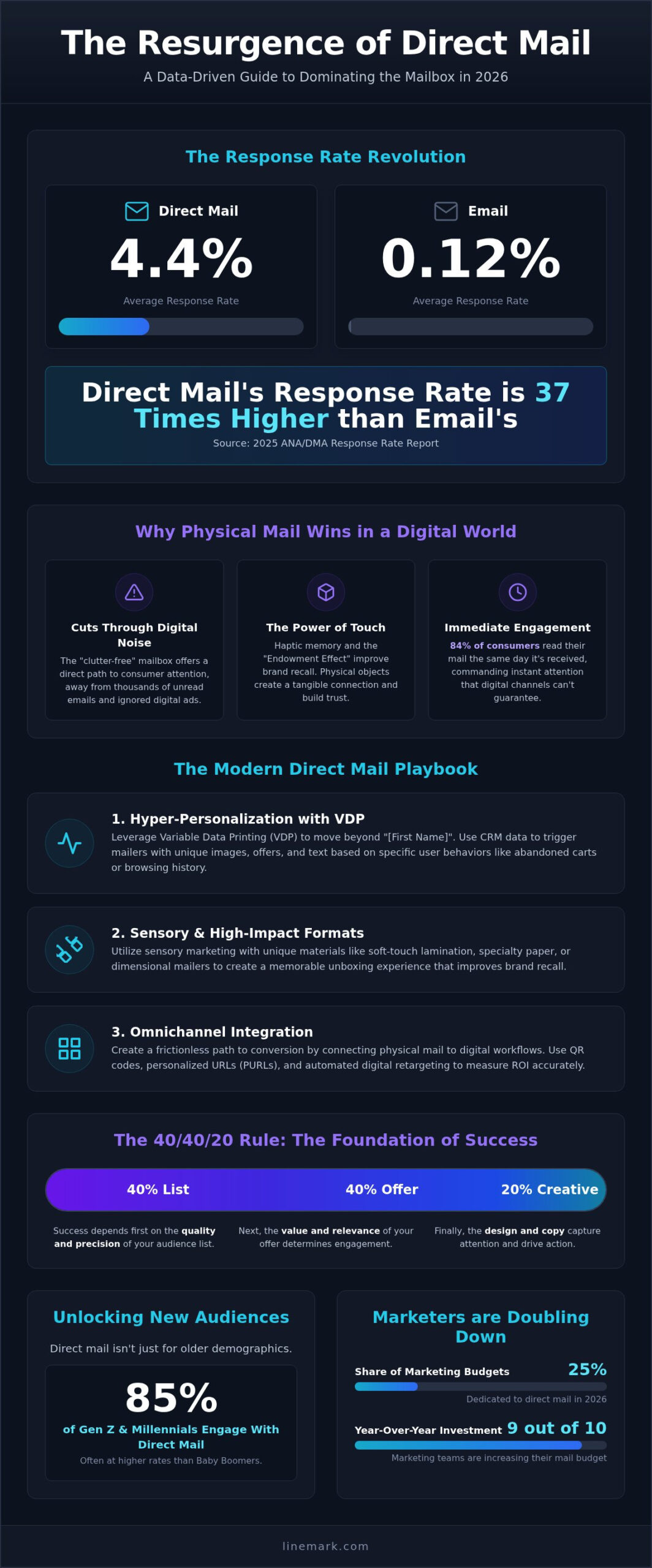
Direct mail’s average response rate of 4.4% is now 37 times higher than email’s average of 0.12%, according to the 2025 ANA/DMA Response Rate Report. In an era where digital ad performance is declining and cost-per-acquisition is climbing, the mailbox has become the most reliable space to capture undivided attention. If you’re searching for how to increase direct mail response rates, you understand that standard postcards are no longer enough to break through the noise. Success in 2026 requires a sophisticated blend of industrial precision and hyper-personalized data.
It’s frustrating to watch your digital marketing budget yield diminishing returns while your brand gets lost in an endless scroll. We’re here to help you move beyond industry averages by mastering the data-driven tactics and high-impact production techniques that drive record-breaking ROI. This guide provides a strategic roadmap for integrating variable data printing, seamless omnichannel workflows, and advanced fulfillment logistics. You’ll learn how to transform your mailers into high-performance assets that improve brand recall and deliver measurable growth through a unified, tech-forward approach.
Key Takeaways
- Capitalize on the surge in direct mail ROI by leveraging physical touchpoints to overcome the digital fatigue and inbox saturation common in 2026.
- Learn how to increase direct mail response rates by implementing advanced variable data printing that moves beyond simple names to deep, behavior-based personalization.
- Utilize sensory marketing and high-impact formats like soft-touch lamination or dimensional mailers to improve brand recall and drive immediate engagement.
- Create a frictionless path to conversion by integrating physical mail with digital workflows through QR codes, personalized landing pages, and automated retargeting.
- Scale complex campaigns with confidence by utilizing high-capacity production facilities and integrated fulfillment logistics that ensure precision at any volume.
The Evolution of Response: Why Direct Mail ROI is Surging in 2026
Digital saturation has reached a breaking point. As consumers filter out hundreds of daily emails and ignore programmatic ads, the physical mailbox has regained its status as a high-intent environment. Understanding how to increase direct mail response rates begins with recognizing that mail isn’t just a legacy channel; it’s a strategic communications tool. In 2026, 25% of marketing budgets are dedicated to direct mail, with nine out of ten teams increasing their investment year-over-year. This surge is driven by the need for reliable, high-impact touchpoints that digital platforms can no longer guarantee.
Understanding the 2026 Direct Mail Landscape
Current benchmarks reveal a stark contrast between physical and digital engagement. According to the 2025 ANA/DMA Response Rate Report, the average direct mail response rate across all industries is 4.4%. This is 37 times higher than email’s average of 0.12%. For house lists, these figures climb even higher, reaching between 5% and 9%. These numbers prove that the mailbox is no longer a place for “junk mail.” Instead, it’s a premium destination for personalized communication. Marketers are shifting away from transactional blasts and moving toward sophisticated Direct Mail Marketing strategies that prioritize precision over volume. The “clutter-free” mailbox has become a significant competitive advantage. While digital inboxes are crowded with thousands of unread messages, the physical mailbox offers a clear path to the consumer’s attention.
The Psychology of the Physical Touchpoint
Pixels are fleeting, but paper is persistent. Research into haptic memory suggests that the sense of touch significantly improves message retention and brand recall. When a prospect holds a high-quality postcard or catalog, they experience the “Endowment Effect,” a psychological phenomenon where individuals value an object more highly simply because they possess it. This physical connection builds a level of trust that digital channels struggle to replicate in an era of online misinformation. 84% of consumers read their mail on the same day they receive it, showing that the physical touchpoint commands immediate attention. This engagement isn’t limited to older demographics. 85% of Gen Z and Millennials engage with direct mail, often at higher rates than Baby Boomers. By focusing on the tactile experience, brands can secure a permanent place in the consumer’s home and mind. This tangibility transforms a simple advertisement into a tangible brand asset, making direct mail the preferred channel for high-value customer acquisition.
The Data-First Framework: Increasing Response Through Hyper-Personalization
Modern direct mail is an engineering challenge as much as a creative one. Moving beyond “Dear [First Name]” requires a robust technological infrastructure that treats data as the primary driver of engagement. If you’re analyzing how to increase direct mail response rates, the answer lies in the precision of your list and the depth of your personalization. High-capacity operations now leverage first-party data to create mailers that feel like private conversations rather than mass broadcasts. This shift from transactional printing to data-driven communication is what separates record-breaking ROI from industry averages.
Leveraging Variable Data Printing (VDP)
Variable Data Printing (VDP) is the engine of 1-to-1 marketing at scale. It allows for the seamless integration of unique images, offers, and text on every individual piece without slowing down the production cycle. By connecting your CRM directly to the print workflow, you can trigger mailers based on specific customer behaviors. Imagine a prospect receiving a postcard featuring the exact product they abandoned in their digital cart, accompanied by a map from their front door to your nearest storefront. This level of technical execution creates a frictionless bridge between the physical and digital worlds. Utilizing sophisticated Variable Data Printing allows brands to maintain this meticulous attention to detail even during high-volume national campaigns.
Strategic List Segmentation
The 40/40/20 rule remains the foundational law of direct mail: 40% of your success depends on the list, 40% on the offer, and 20% on the creative. In 2026, list hygiene is a high-stakes operational requirement. Regular audits and deliverability checks prevent wasted postage and ensure your message reaches the intended recipient. Beyond basic demographics, psychographic targeting and intent-based segmentation allow you to dictate content based on past purchase behavior. We now use AI-driven predictive modeling to identify high-value prospects who mirror your best customers. This proactive approach ensures your resources are focused on individuals with the highest propensity to convert.
Data is the foundation of every successful campaign. A clean, segmented list ensures that your high-impact production techniques aren’t wasted on disinterested audiences. When you combine industrial-grade production with surgical data precision, you create a powerful catalyst for growth. This integrated strategy is the most effective way to master how to increase direct mail response rates in a competitive market. It transforms your direct mail from a simple service into a strategic communication asset that delivers measurable results.
Sensory Marketing & High-Impact Formats: Designing for the Mailbox
The physical nature of mail provides a sensory experience that digital channels cannot replicate. When considering how to increase direct mail response rates, you must look beyond the copy and focus on the physical delivery mechanism. High-impact formats and tactile finishes serve as the first line of defense against the “trash-can reflex.” They signal quality before a single word is read. In a 2026 marketplace where digital trust is low, the weight and texture of your mailer act as silent proof points for your brand’s legitimacy.
Optimizing Format for Conversion
Choosing the correct format is a strategic decision based on your campaign goals and target audience. Oversized postcards, such as 6×11 or 9×12 inches, offer maximum visual real estate and are virtually impossible to ignore in a standard stack of mail. For high-end lead nurturing, custom book printing transforms your marketing message into a permanent resource. These bound pieces carry a higher perceived value, making them ideal for annual reports or comprehensive product catalogs that prospects want to keep. In the B2B sector, dimensional mailers remain the gold standard for response. The “lumpy envelope” strategy creates immediate curiosity, ensuring your package is opened by the decision-maker rather than discarded by a gatekeeper. These formats demand engagement through their sheer physical presence.
Advanced Binding and Finishing Techniques
Finishing is where industrial precision meets creative strategy. Specialized coatings like soft-touch lamination or high-gloss Spot UV provide a tactile contrast that encourages prospects to linger on your piece. Soft-touch finishes offer a velvety, premium feel that builds brand trust through haptic engagement. Meanwhile, die-cutting allows you to break the traditional rectangular mold, creating unique shapes that stand out visually and physically. Utilizing professional binding & finishing services ensures that every element, from the fold to the laminate, is executed with meticulous attention to detail. This level of production quality elevates your brand perception, moving your direct mail from a transactional piece to a sophisticated communication asset.
The weight of your paper stock is another critical variable. Utilizing 100lb or 120lb cover stock provides a sense of substance and durability. Heavier stocks don’t just survive the postal sorting process; they feel important in the recipient’s hand. Interactive elements like scratch-offs or pop-up structures further increase engagement by turning a passive reading experience into an active one. These sensory triggers are essential tools for any marketer looking for how to increase direct mail response rates while building long-term brand recall.
Omnichannel Integration: Connecting Physical Mail to Digital Conversions
Direct mail in 2026 functions as a high-performance anchor within a larger digital ecosystem. It isn’t a standalone tactic. If you want to master how to increase direct mail response rates, you must create a frictionless bridge between the physical mailbox and the digital storefront. This integration ensures that your brand remains top-of-mind across multiple touchpoints, significantly amplifying the impact of your total marketing spend. When physical and digital channels work in harmony, they create a compound effect that drives higher conversion rates than either could achieve alone.
Digital Bridges and Tracking Mechanisms
The most effective campaigns utilize clear, scannable entry points like custom QR codes and Personalized URLs (PURLs). For maximum impact, QR codes should be placed in a prominent “action zone” with a strong, benefit-driven call to action. Design matters here. A well-placed code with a high-contrast border invites immediate scanning. PURLs take this a step further by providing granular tracking for every individual recipient. This allows you to see exactly who visited your landing page, even if they didn’t complete the purchase. This data is vital for building multi-touch attribution models. Instead of guessing which channel drove the sale, you can accurately measure the influence of your mailer on digital conversions. This visibility is essential for optimizing your strategy and proving the ROI of your physical assets.
The Integrated Campaign Workflow
Timing is the secret to the “Amplification Effect.” Synchronizing your mail drops with digital ad spend or email follow-ups ensures a consistent brand presence. One of the most powerful applications of this technology is retargeting with mail. By triggering a physical postcard based on website abandonment, you reach prospects exactly when their interest is highest. This proactive approach turns a lost digital lead into a tangible opportunity. For distributed marketing teams, utilizing MarCom On-Demand portals allows for the seamless execution of these complex workflows across national territories. These portals ensure brand consistency while allowing local agents to trigger personalized, high-impact mailers at the push of a button. Automating these triggers based on digital behaviors ensures your marketing remains agile and responsive to consumer needs.
Success in modern marketing requires a unified partnership between your physical and digital strategies. By removing the silos between these channels, you create a holistic journey for your customers. To see how these integrated solutions can transform your next campaign, partner with our strategic communications experts today.
Operational Excellence: Scaling Your Direct Mail Strategy
Execution is where strategy meets reality. If you’ve mastered data and design, the final piece of the puzzle regarding how to increase direct mail response rates is operational precision. High-capacity production ensures your campaign hits the mailbox at the exact moment your digital ads are peaking. Without this logistical backbone, even the most personalized mailer loses its relevance. We operate a 90,000-square-foot production facility designed to handle these complex, high-volume requirements with industrial-grade reliability. This infrastructure allows us to maintain campaign momentum, ensuring that a national rollout feels as personal and precise as a targeted pilot program.
High-Volume Production Logistics
Scale isn’t just about volume; it’s about maintaining surgical consistency across every asset. Centralized kitting & fulfillment reduces the risk of manual errors in multi-part mailers, which is critical when response rates depend on the correct offer reaching the correct recipient. When your campaign includes a personalized letter, a bound catalog, and a promotional insert, the assembly must be perfect. We manage the entire supply chain from initial print production to national distribution. This streamlined workflow improves speed-to-market, allowing you to react to market shifts in real-time. It also ensures your brand identity remains intact across everything from variable data postcards to large-format graphics.
Choosing a Strategic Communications Ally
A successful direct mail strategy requires more than a service provider. It demands a strategic communications ally who understands the nuances of modern marketing. This relationship should be a unified partnership focused on long-term growth rather than a series of transactional orders. When evaluating a partner, look beyond the equipment. Assess their data security protocols and their ability to process complex variable data sets without friction. We position ourselves as a centralized destination for diverse marketing needs. We provide the meticulous attention of a boutique shop with the capacity of a national leader. This proactive spirit ensures that your projects are in capable hands, allowing your team to focus on high-level strategy while we handle the technical production and logistics.
Operational excellence is the catalyst for client growth. By moving from a transactional exchange to a premium, holistic journey, you build a foundation for scalable success. This steady, controlled approach to production builds security, making you feel that your projects are managed by seasoned experts. When your logistics are as sharp as your data, you don’t just reach the mailbox; you dominate it.
Engineering the Future of Direct Mail Response
Mastering how to increase direct mail response rates in 2026 requires a shift from transactional printing to a unified, data-driven partnership. We’ve explored the necessity of hyper-personalization through variable data, the sensory power of high-impact finishes, and the seamless integration of physical and digital workflows. These components, when executed with industrial precision, transform a simple mailer into a high-performance catalyst for brand growth. Success at scale depends on the logistical backbone of your production partner.
With 30+ years of industrial print expertise and a 90,000-square-foot high-tech production facility, we provide the capacity and meticulous attention to detail required for complex national campaigns. From comprehensive kitting and fulfillment to national distribution, our team ensures your message reaches the mailbox with surgical accuracy. It’s time to move beyond industry averages and secure the record-breaking ROI your brand deserves. Optimize your next campaign with Linemark’s Direct Mail experts and experience the power of a strategic communications ally. Your growth is our priority, and we’re ready to build it together.
Frequently Asked Questions
What is a good direct mail response rate in 2026?
A good direct mail response rate in 2026 averages 4.4% across all industries, according to the 2025 ANA/DMA Response Rate Report. For house lists containing existing customers, response rates typically range between 5% and 9%, while prospect lists average between 2% and 4.4%. These figures outperform email’s average response rate of 0.12% by a significant margin. Understanding these benchmarks is the first step in learning how to increase direct mail response rates through targeted segmentation.
How does Variable Data Printing (VDP) improve response rates?
Variable Data Printing (VDP) improves response rates by enabling 1-to-1 personalization at scale. Instead of generic messaging, VDP allows for unique images, offers, and text tailored to each recipient’s past purchase behavior. This technical precision creates a deeper connection with the prospect, moving the piece from a transactional advertisement to a relevant communication. Integrating CRM data directly into the print workflow ensures that every mailer feels specifically engineered for the individual recipient.
Can I track direct mail conversions as accurately as digital ads?
You can track direct mail conversions with high accuracy using digital bridges like QR codes and Personalized URLs (PURLs). These tools allow you to attribute specific digital actions to individual physical mailpieces. By implementing multi-touch attribution models, you can see how a mailer influenced a web visit or a final purchase. This data-driven approach removes the guesswork from your campaign, providing the same level of transparency you expect from your digital advertising channels.
Which direct mail format has the highest ROI?
Direct mail campaigns sent to house lists offer the highest Return on Investment (ROI), averaging 161% in 2026. While postcards are cost-effective for high-volume awareness, dimensional mailers often yield the highest response rates for B2B lead generation. The “lumpy envelope” strategy ensures the piece is opened, while the substance of the offer drives the conversion. The best format depends on your specific goals, audience intent, and the complexity of your messaging requirements.
How does paper weight and finish affect my campaign’s success?
Paper weight and specialized finishes significantly influence perceived brand value and engagement. Utilizing heavier stocks, such as 100lb cover, provides a sense of substance that survives the postal process and feels premium in the hand. Tactile finishes like soft-touch lamination or Spot UV coatings trigger haptic memory, which improves message retention. These sensory elements help stop the “trash-can reflex,” encouraging recipients to spend more time interacting with your brand’s physical collateral.
What is the 40/40/20 rule in direct mail marketing?
The 40/40/20 rule states that 40% of your campaign’s success depends on the quality of your mailing list, 40% on the strength of your offer, and 20% on the creative execution. This fundamental law highlights that even the most beautiful design won’t save a campaign sent to the wrong audience. To master how to increase direct mail response rates, you must prioritize list hygiene and compelling, personalized offers before focusing on the visual aesthetics.
How can I integrate direct mail with my existing digital marketing funnel?
Integrating direct mail into your digital funnel involves triggering physical mailpieces based on online behaviors. For example, you can automate a retargeting postcard to be sent when a customer abandons a high-value cart. Utilizing MarCom On-Demand portals allows distributed teams to launch these integrated campaigns seamlessly. By synchronizing your mail drops with digital ad spend, you create an “Amplification Effect” that reinforces your brand across multiple physical and digital touchpoints.
What are the USPS promotions and incentives available for 2026?
Effective July 12, 2026, the USPS implemented several changes, including a weight limit increase for Marketing Mail flats to 20 ounces and Carrier Route flats to 24 ounces. The retail rate for a standard postcard is $0.65, while first-class stamps are $0.82. Marketers should also prepare for temporary peak holiday price increases effective from October 4, 2026, through January 17, 2027. Staying informed on these regulations helps you optimize postage costs and campaign timing.