


 08/28/2026
  Steve Bearden
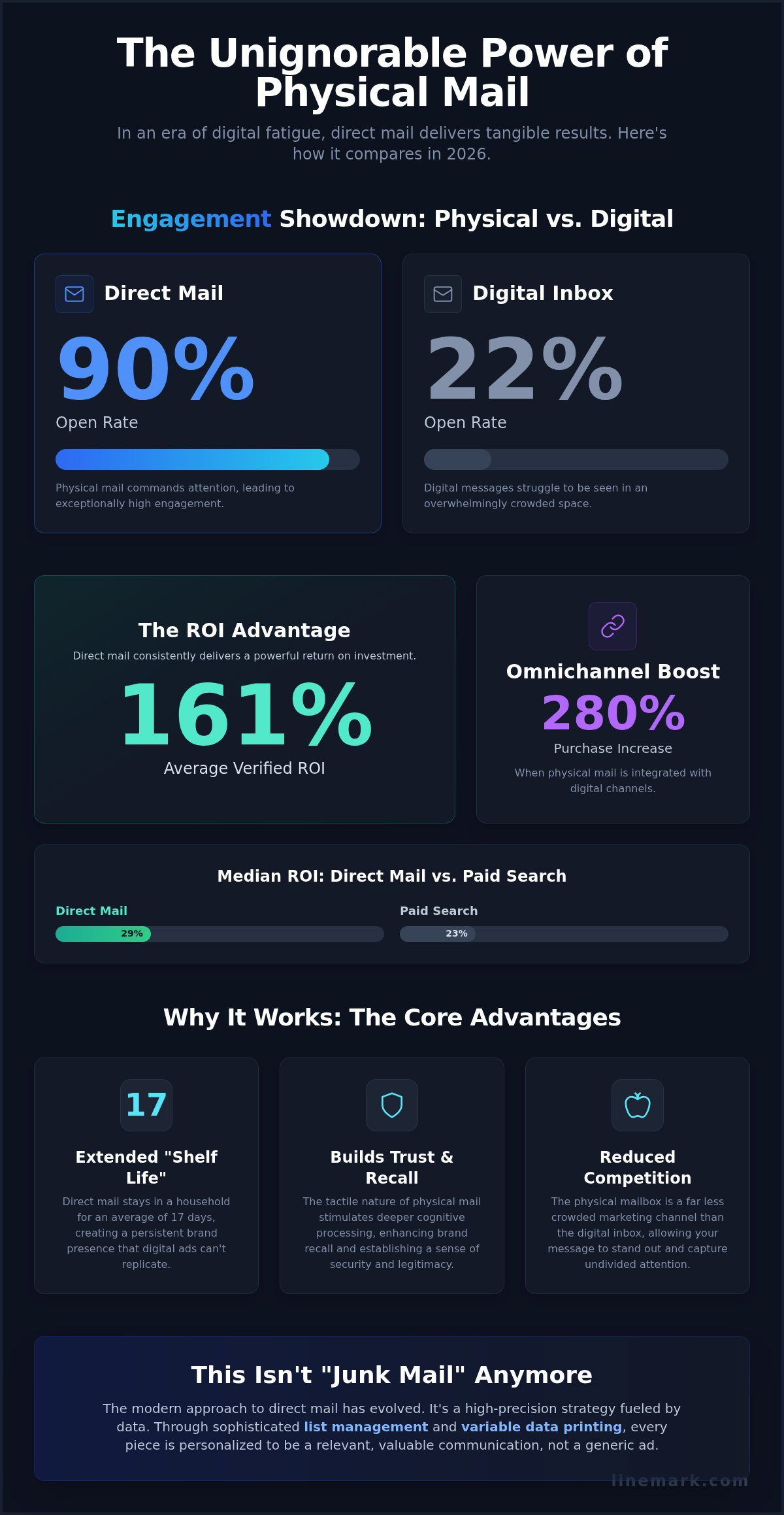
While digital inbox open rates struggle to reach 22 percent, physical mail continues to command attention with open rates as high as 90 percent in 2026. This stark contrast highlights a growing reality for modern brands; digital fatigue is real, and it’s expensive. You’re likely seeing your customer acquisition costs climb while your online ads face more competition than ever. It’s difficult to build trust when your message is just one of a thousand notifications on a glass screen. Effective direct mail list management has become the secret weapon for marketers who need to reclaim their audience’s focus and drive a verified 161 percent average ROI.
You know that physical touchpoints create a more meaningful connection, yet the complexity of logistics and postage often feels like a barrier to entry. This guide provides a clear framework for launching high-precision campaigns that function like a well-oiled machine. We’ll examine how variable data printing turns generic mailers into personalized assets. You’ll learn how to integrate physical mail with your digital channels to boost purchases by up to 280 percent. From sophisticated list hygiene to nationwide fulfillment, we’ll outline the path to becoming a strategic communications ally in a physical world.
Key Takeaways
- Learn how to overcome digital ad fatigue by leveraging high-precision, 1-to-1 targeting that captures focused recipient attention.
- Master the technical nuances of direct mail list management and data processing to ensure maximum deliverability and campaign accuracy.
- Identify the optimal physical format for your goals, from high-impact postcards for quick reminders to catalogs designed for extended brand engagement.
- Streamline your national operations by utilizing centralized warehousing and automated fulfillment to move projects seamlessly from press to mailbox.
- Transition from transactional printing to a collaborative partnership model that treats your marketing production as a holistic, high-ROI journey.
What is Direct Mail Marketing and Why Does It Work in 2026?
Direct mail marketing is a high-precision strategy that involves sending physical communications to targeted prospects or customers to trigger a specific response. It’s an industrial-grade solution to the problem of digital saturation. While email inboxes are overflowing with ignored notifications, physical mail arrives in a tangible format that demands physical interaction. This medium isn’t a legacy relic; it’s a strategic communications ally for brands that need to cut through the noise. You’re not just sending paper; you’re delivering a brand experience that occupies a unique space in the consumer’s daily routine. This requires a sophisticated approach to direct mail list management to ensure that your physical assets are reaching the highest-value prospects.
One of the most compelling reasons for this channel’s success in 2026 is the “shelf life” of a physical piece. Industry data suggests that direct mail stays in a household for an average of 17 days. This longevity provides multiple opportunities for engagement that a fleeting digital ad simply cannot match. It creates a persistent presence on a kitchen counter or office desk, keeping your brand top-of-mind long after an email would have been deleted or buried.
To better understand this concept and the metrics that drive success, watch this helpful video:
The ROI Advantage of Physical Mail
Recent benchmarks show that direct mail delivers a median ROI of 29 percent, outperforming paid search which typically sits at 23 percent. This financial advantage stems from the psychological impact of tactile marketing. Touch builds a higher level of brand recall and trust compared to visual-only digital stimuli. By focusing on high-value conversions, you can effectively lower your Customer Acquisition Cost (CAC) through a medium that recipients perceive as more substantial and reliable. The ROI advantage is driven by several key factors:
- Higher Recall: Tactile interaction stimulates deeper cognitive processing.
- Reduced Competition: The physical mailbox is significantly less crowded than the digital inbox.
- Trust: Physical mail is often viewed as more official and secure than digital messaging.
Direct Mail vs. Digital Marketing Fatigue
The perception of “junk mail” is a ghost of the past, largely dispelled by sophisticated direct mail list management. Modern campaigns don’t rely on mass-market volume. Instead, they use precise data processing to ensure that every recipient has a genuine need for the offer. This technical rigor transforms a generic advertisement into a relevant service. Marketers are bridging the gap between physical and digital worlds by integrating QR codes that lead recipients directly to personalized landing pages. In 2026, returning to traditional channels is a calculated move for those pursuing high-ticket acquisition in an era of digital exhaustion. It’s about being present where your audience is most likely to pay attention.
The Anatomy of a Data-Driven Direct Mail Campaign
Modern marketing has evolved beyond the “spray and pray” tactics of the past. Precision is now the industrial standard. Data-driven strategies serve as the engine for scalable growth, allowing brands to treat every recipient as an individual rather than a data point. By utilizing behavioral data, such as recent website visits or digital engagement patterns, sophisticated mailers can trigger physical communications that arrive at the exact moment of relevance. This level of accuracy is only possible through rigorous direct mail list management, which ensures your data remains a strategic asset rather than a logistical liability.
The effectiveness of modern direct mail lies in its ability to foster trust through high-quality, targeted physical touchpoints. It’s no longer about sheer volume; it’s about the technical synergy between your data files and the production floor. When you move from mass messaging to 1-to-1 communication, you’re not just sending mail; you’re building a bridge between a business challenge and a concrete, scalable solution.
Variable Data Printing (VDP): 1-to-1 Marketing at Scale
VDP is the catalyst for this transformation. It allows for the seamless integration of unique names, personalized offers, and custom imagery on every piece of mail within a high-volume run. The impact on engagement is profound. Research suggests that integrating direct mail with digital channels can lead to a 280 percent increase in purchases compared to single-channel campaigns. This process requires marrying clean data files with flexible creative templates. It demands a high-capacity operation that maintains meticulous attention to detail, ensuring every personalized element aligns perfectly with the recipient’s profile.
Mailing List Management and Segmentation
Success starts with distinguishing between your house lists and prospect lists. Your house list contains existing customers who already value your brand, while prospect lists are the frontier for new acquisition. Effective direct mail list management involves segmenting these audiences by demographics, purchasing history, and specific behaviors. This ensures your message resonates with the recipient’s current needs.
Logistics play a critical role in maintaining campaign integrity. To ensure maximum deliverability, you must employ NCOA (National Change of Address) and CASS processing. These technical protocols verify addresses and update records, preventing wasted postage and ensuring your message reaches its destination. If you’re looking to refine your data strategy, exploring custom direct mail solutions can help bridge the gap between raw data and high-ROI results.
Choosing the Right Format: Postcards, Catalogs, and Beyond
Format selection is the tactical bridge between your data and the recipient’s hands. While we previously established the power of data-driven targeting, the physical medium determines the duration of your message’s “shelf life.” A postcard might trigger an immediate digital action, whereas a premium catalog often serves as a persistent brand reference in a household or office. This decision must align with your direct mail list management strategy, ensuring the format matches the recipient’s specific stage in the customer journey. Strategic binding and finishing choices further enhance this experience, transforming a simple communication into a premium, tactile brand encounter.
Postcards: The High-Speed Conversion Engine
Postcards represent the most cost-effective entry point for high-volume acquisition campaigns. Their lack of an envelope removes a barrier to entry, placing your offer directly in front of the recipient the moment they retrieve their mail. To maximize impact, successful marketers follow the 40/40/20 rule: 40 percent of success depends on the audience, 40 percent on the offer, and 20 percent on the creative execution. Consider these design standards for your next run:
- Standard Sizes: Ideal for high-frequency reminders and quick-read discount codes.
- Oversized Formats: Use 6″ x 9″ or 6″ x 11″ dimensions to dominate the mailbox and increase visibility.
- Tactile Coatings: Soft-touch or high-gloss finishes can differentiate your brand from standard utility mail.
Catalogs and Newsletters: Building Long-Term Loyalty
High-end catalogs are undergoing a significant resurgence as brands seek deeper storytelling opportunities. By applying sophisticated custom book printing techniques, you can transform a standard marketing piece into a permanent brand asset. This format is particularly effective for association newsletters and non-profit donor retention, where building long-term loyalty is the primary objective.
The choice between offset and digital printing depends on your specific volume and personalization needs. Offset printing offers industrial efficiency for massive, uniform runs, while digital printing excels at the 1-to-1 personalization we discussed in the context of VDP. Regardless of the production method, your results rely on how your direct mail list management protocols segment your most loyal advocates to receive these high-value communications. This ensures that your investment in premium formats is always directed toward the audiences most likely to respond.
Scaling Success with Automated Fulfillment and Logistics
The transition from a data file to a physical mailbox is a complex industrial journey. It’s the stage where technical precision meets operational scale. While your direct mail list management ensures the right people are targeted, your fulfillment strategy determines if those assets arrive intact and on time. National brands require a centralized approach to warehousing and inventory management to maintain a steady flow of communications without the friction of local vendor fragmentation. This allows you to treat your marketing collateral as a dynamic resource that’s always ready for deployment.
Scaling a campaign across multiple regions requires more than just a printer; it demands a strategic communications ally. By centralizing your production and logistics, you eliminate the inconsistencies that often plague decentralized models. This unified approach ensures that every piece, from a simple postcard to a complex dimensional mailer, meets your brand’s exact specifications before it enters the postal stream.
MarCom On-Demand: Marketing Automation for Print
The MarCom On-Demand portal technology represents the marriage of high-tech software and industrial power. These proprietary portals empower distributed teams to order localized, brand-compliant mailers through a streamlined interface. It’s a solution that maintains rigid brand consistency while allowing for the local-level personalization that drives response rates. Real-time inventory tracking and automated reordering protocols prevent campaign delays, ensuring your teams never run out of the critical assets they need to close deals.
Industrial-Scale Fulfillment and Nationwide Distribution
Operating out of a 90,000-square-foot production facility provides the capacity for high-volume storage and rapid deployment. This scale is essential for handling complex kitting projects where high-quality print collateral is combined with promotional items for dimensional mail. Our logistics expertise allows for strategic nationwide distribution, which significantly reduces both postage costs and transit times. By utilizing deeper sorting and carrier route optimization, you can maximize your budget while ensuring your message reaches its destination with surgical precision. If you’re ready to optimize your physical outreach, you can explore our fulfillment and kitting services to see how we handle large-scale logistics with boutique-level attention to detail.
Successful direct mail list management is only half the battle. The other half is ensuring that your physical inventory is managed with the same level of data-driven rigor as your mailing files. This holistic journey, from the first data query to the final delivery, is what transforms a simple mailing into a high-ROI strategic asset.
Partnering with a Strategic Communications Ally
In an era where digital noise is constant, finding a partner who views your project as a holistic journey is essential. Transactional printing is a commodity; strategic communications is a competitive advantage. You need a centralized destination that manages the entire lifecycle of a campaign, from the initial direct mail list management to final nationwide distribution. This partnership ensures that complex, high-volume projects are handled with the precision required for high-ROI outcomes. When you shift from a vendor mindset to a collaborative model, your marketing efforts gain the structural support needed to scale without friction.
A seasoned expert does more than put ink on paper. They navigate the shifting landscape of postal regulations and industrial production timelines to protect your bottom line. By positioning operational excellence as the catalyst for your growth, a strategic ally transforms a business challenge into a streamlined, high-tech solution. This unified approach provides design support, production, kitting, and distribution under one roof, eliminating the inconsistencies that arise from managing multiple fragmented vendors.
The Industrial Advantage: Capacity and Precision
Scale matters when executing national campaigns. A 90,000-square-foot facility provides the capacity to store, kit, and ship millions of pieces while maintaining the meticulous attention to detail usually found in boutique shops. By marrying the precision of industrial offset printing with the agility of digital Variable Data Printing, we provide a technical environment that scales with your acquisition goals. With over 30 years of experience, our team understands that reliability is the foundation of any partnership. We handle the heavy lifting of logistics and production so your internal teams can focus on high-level strategy and creative innovation.
Next Steps: Launching Your 2026 Strategy
Modern marketing isn’t about solving one problem at a time. It’s about building an integrated system that addresses business challenges at their root. A consultative approach to direct mail marketing ensures that every variable, from format choice to postage optimization, is calculated for maximum impact. We don’t just execute orders; we provide the industrial power and technical insight required to drive measurable growth.
Effective direct mail list management and industrial-grade production are the twin pillars of physical campaign success. When you’re ready to cut through the digital noise and drive measurable growth with data-driven communications, it’s time to move beyond transactional service providers. Partner with Linemark for your next nationwide direct mail campaign and experience the security of having your project in capable, steady hands.
Mastering Your Physical Brand Presence in 2026
Physical marketing in 2026 isn’t about sheer volume; it’s about the technical synergy between data and delivery. You’ve seen how precision 1-to-1 targeting and variable data printing can transform a simple mailer into a high-ROI asset. By focusing on rigorous direct mail list management, you ensure that your message reaches the right hands at the most impactful moment. This strategic approach cuts through digital noise and builds the long-term trust that glass screens often fail to provide.
Scaling these efforts requires an industrial ally capable of handling complex logistics with surgical accuracy. We provide the infrastructure to turn your business challenges into concrete results, leveraging our 90,000-square-foot high-capacity facility and 30+ years of industrial print expertise. As a strategic communications partner for national brands, we’re ready to help you navigate the nuances of modern fulfillment and distribution. Our operation is designed to act as a catalyst for your growth, ensuring every project is handled with meticulous attention to detail.
Streamline your communications with Linemark’s national direct mail services. Your next high-growth campaign is ready to take flight.
Frequently Asked Questions
Is direct mail marketing still effective in 2026?
Physical mail remains a high-performance channel for cutting through digital noise. With open rates near 90 percent in 2026, physical mail provides a tangible touchpoint that digital ads can’t match. It’s particularly effective for high-value acquisition and building trust in a landscape of AI-generated content. Modern brands use it as a strategic ally to complement their online presence, driving growth through physical interaction that stays in the home for weeks.
How much does a direct mail campaign typically cost?
Costs are determined by variables including format, volume, and list requirements. Postage rates, such as the 2026 USPS Marketing Mail incentives, play a significant role in the total investment. Production factors like paper stock and specialty finishing also influence the budget. We focus on optimizing every logistical detail to ensure your campaign delivers a high return on investment while maintaining the industrial quality your national brand requires for success.
What is Variable Data Printing (VDP) and how does it help?
VDP is a digital printing technology that allows every piece in a single run to be unique. You can customize names, images, and offers for each recipient based on your direct mail list management data. This level of personalization significantly increases response rates by making the content relevant to the individual. It’s an industrial-scale solution for 1-to-1 marketing that bridges the gap between mass production and personal, meaningful connection with your audience.
Can I track the results of my direct mail marketing?
Tracking is achieved through integrated digital touchpoints like unique QR codes, personalized URLs, and dedicated phone numbers. These tools allow you to monitor engagement in real-time and attribute conversions directly to specific physical mail pieces. By analyzing this data, you can refine your audience segments and improve the performance of future campaigns. This visibility transforms physical mail into a measurable, data-driven component that integrates seamlessly with your existing digital marketing stack.
What is the best format for a direct mail piece?
The optimal format depends on your specific campaign goals and target audience. Postcards are excellent for high-impact, quick-read offers and reminders due to their inherent cost-effectiveness. In contrast, high-end catalogs and newsletters are better suited for brand storytelling and long-term loyalty building. We help you evaluate the “shelf life” and engagement level required for your message to select the specific format that maximizes your visibility and long-term ROI.
How long does it take to launch a direct mail campaign?
Timelines depend on project complexity, but most campaigns move from final art approval to the mail stream within a few business days. Complex projects involving kitting or custom binding may require additional production time. Our 90,000-square-foot facility is built for industrial efficiency, ensuring that even large-scale nationwide distributions are handled with speed and precision. We work as an agile problem-solver to meet your critical market deadlines without sacrificing quality.
Do I need to provide my own mailing list?
You can provide your own house list or we can assist in acquiring targeted prospect lists based on your customer profile. Sophisticated direct mail list management includes cleaning and verifying your data through NCOA and CASS processing to ensure maximum deliverability. Whether you are nurturing existing relationships or pursuing new acquisitions, we ensure your data is optimized for the highest possible response rates and minimal postage waste across the country.
What is MarCom On-Demand and how does it work?
MarCom On-Demand is a proprietary portal technology that centralizes your marketing assets for automated ordering. It allows distributed teams to customize and order brand-compliant materials while maintaining rigid corporate standards. The system tracks inventory in real-time and streamlines the fulfillment process from a single industrial location. It’s a high-tech solution for national brands that need to manage complex, distributed marketing efforts with the operational excellence and precision of a unified partner.