

 10/11/2026
  Steve Bearden
What if your trade show’s biggest missed opportunity happens after the booth comes down? A trade show checklist for marketers should do more than track booth logistics. It should connect campaign goals, event materials, lead capture, and follow-up so each part supports a measurable result.
Deadlines, approvals, booth messaging, and lead plans can fall out of sync, especially when several teams share responsibility. Collecting promising leads is only the first step if no one owns what happens next. A clear plan helps your team stay aligned before the show, work consistently on-site, and follow up while conversations are still fresh.
This checklist covers practical steps before, during, and after the event, with a focus on ownership, coordinated campaign assets, and a repeatable lead process. It also shows how print, signage, direct mail, and fulfillment can support one consistent event campaign, from preparation through post-show outreach.
Key Takeaways
- Use a trade show checklist for marketers to connect business goals, campaign assets, lead capture, and follow-up in one plan.
- Assign owners and track deliverables from kickoff through post-show review, accounting for organizer requirements and internal approvals.
- Choose booth graphics, brochures, catalogs, postcards, and digital content based on their audience, purpose, and role in the campaign.
- Set lead fields and qualification criteria before the event so staff can capture useful notes and route contacts consistently.
- Coordinate print production, direct mail, and fulfillment to keep event materials aligned and post-show outreach moving.
Trade Show Checklist for Marketers: Set Goals Before You Book the Booth
Define the business outcome before choosing booth features, graphics, or campaign materials. A trade show can support product discovery, business networking, and face-to-face conversations. The overview of What is a Trade Show? provides useful context. Your goal determines what the booth needs to communicate and what your team should do next.
Start your trade show checklist for marketers with decisions the team can use to guide planning:
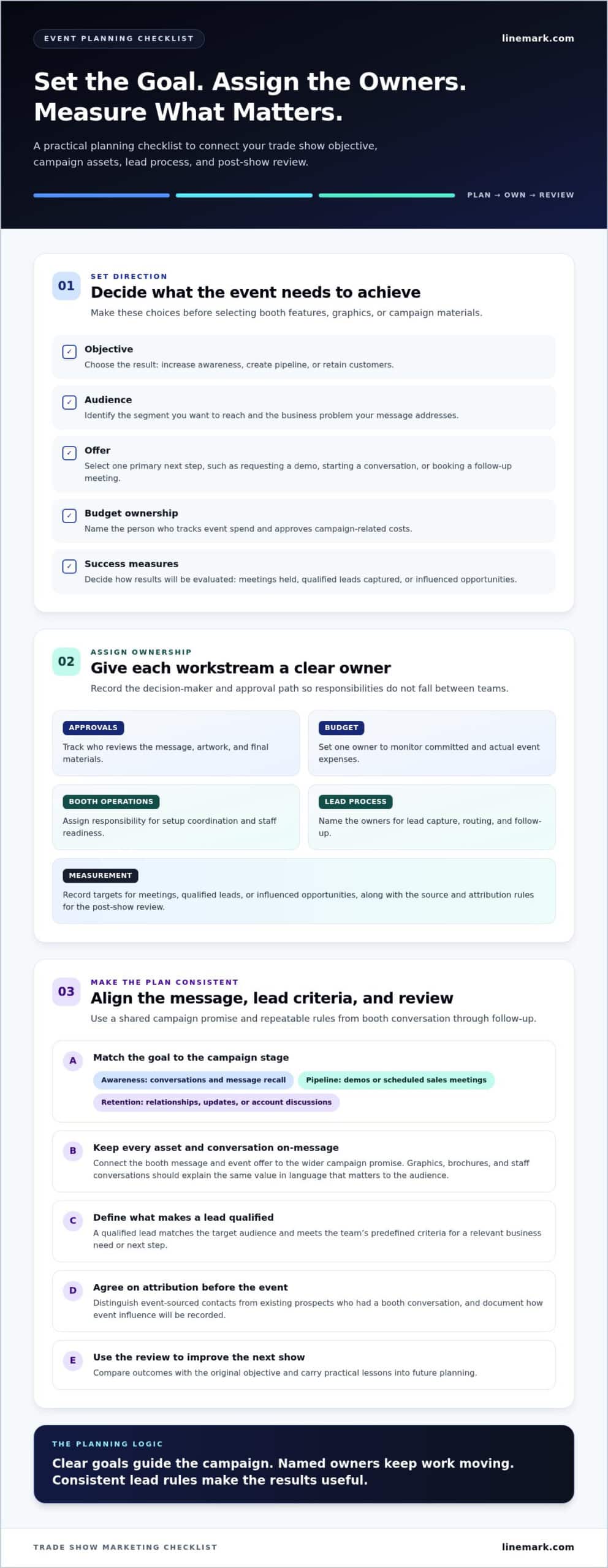
- Objective: Choose the result the event should support, such as increasing awareness, creating pipeline, or retaining customers.
- Audience: Identify the segment you want to reach and the business problem your message will address.
- Offer: Select one primary action, such as requesting a demo, starting a conversation, or booking a follow-up meeting.
- Budget ownership: Name the person responsible for tracking event spend and approving campaign-related costs.
- Success measures: Decide how you’ll evaluate results, including meetings held, qualified leads captured, or influenced opportunities.
Define the audience, offer, and event objective
Let the campaign stage shape your objective. An awareness-focused event may prioritize conversations with a defined audience and clear message recall. A pipeline program may emphasize demos or scheduled sales meetings. A customer-retention goal could focus on strengthening existing relationships, sharing relevant updates, or arranging account discussions.
Connect the booth message and event offer to the wider campaign promise. If the campaign introduces a new solution to operations leaders, for example, the graphics, brochure, and staff conversation should explain the same value in language that matters to that audience. A focused offer gives visitors a clear next step instead of competing calls to action.
A qualified trade show lead is a contact who matches your target audience and meets the team’s predefined criteria for a relevant business need or next step.
Assign owners and agree on success measures
Clear ownership keeps approvals, spending, and follow-through from slipping between teams. Assign a named owner to each workstream, then record the decision-maker and approval path for materials and messaging. Booth staff should know who manages lead capture and who is accountable for post-show follow-up.
- Approvals: Track who reviews the message, artwork, and final materials.
- Budget: Set one owner to monitor committed and actual event expenses.
- Booth operations: Assign responsibility for setup coordination and staff readiness.
- Lead process: Name owners for capture, routing, and follow-up.
- Measurement: Record targets for meetings, qualified leads, or influenced opportunities, along with the source and attribution rules for the post-show review.
Agree on attribution before the event. Decide how the team will distinguish event-sourced contacts from existing prospects who had a booth conversation, and document how event influence will be recorded. Consistent rules make the final review more useful: the team can compare outcomes with its original objective and carry practical lessons into the next show.
Build a Trade Show Marketing Timeline That Keeps Every Deliverable on Track
A reliable timeline works backward from the event and makes ownership visible at every stage. Marketers control the campaign brief, internal approvals, asset choices, staffing, and follow-up plan. Show organizers set requirements such as submission processes and delivery instructions, while internal reviewers may add approval steps. Track these dependencies separately so an external deadline or pending decision doesn’t quietly derail production.
The International Trade Administration’s Preparing for a Business Trade Show offers additional guidance on goals, budgeting, and pre-event preparation. Use it alongside the event’s exhibitor information and your internal project tracker.
Before the show: coordinate messaging and production
Begin with the event objective, audience needs, offer, budget owner, and approval path. Then build one deliverables tracker for print collateral, booth graphics, presentations, and lead-capture materials. Record an owner, status, reviewer, and next decision for each item. Teams managing collateral across locations can use MarCom On-Demand workflows to support consistent materials across distributed teams.
Final readiness checks before travel
Once assets are approved, confirm that contact details, calls to action, and messaging match across every format. Test lead-capture tools, access permissions, and backup procedures, then brief staff on how to record useful notes. Prepare a handoff plan that identifies who receives event leads and notes, how they’re routed, and when follow-up begins.
Use this sequence as the working schedule for your trade show checklist for marketers. Set timing relative to the event, then adjust it around organizer requirements and internal review needs.
- At kickoff: Confirm the event goal, target audience, primary offer, working budget, and accountable owners. Identify the organizer information the team needs, including submission steps and delivery instructions.
- During planning: Build the campaign brief and deliverables tracker. Map each asset to its purpose, audience, owner, review stage, and planned use. Confirm staffing coverage and who will manage lead capture.
- At creative review: Circulate copy and artwork to the right reviewers. Consolidate feedback, resolve conflicting edits, and approve final files before production planning proceeds.
- During production and logistics: Coordinate print production, graphics, packing, shipping, and delivery plans against event instructions. Keep status updates in the shared tracker so teams can spot dependencies early.
- Before travel: Check that approved materials and staff instructions are ready. Test presentation equipment and lead tools, verify access, and rehearse the backup process. Prepare follow-up templates and routing details in advance.
- After the show: Reconcile captured contacts and event notes, route leads according to the handoff plan, and compare results with the original measures. Record lessons for the next event.
A coordinated production and fulfillment plan can simplify handoffs between campaign materials and event logistics. Linemark supports connected print, graphics, and fulfillment workflows. Explore Linemark’s marketing support as you map your deliverables.
Compare Trade Show Marketing Assets by Job, Audience, and Follow-Up
Choose event materials based on the job each one needs to do, not by habit. A large graphic can help attendees recognize your brand and orient themselves, while a brochure or digital resource can carry more detail into a sales conversation. The right mix depends on the audience, campaign objective, booth experience, and what the team will do after the show.
Use this comparison to connect each asset to a purpose and a next step. For production considerations such as scale, placement, and material use, explore this large-format graphics guide.
| Asset | Audience | Purpose | Distribution moment | Follow-up role |
|---|---|---|---|---|
| Large-format graphics | Attendees moving through the show floor | Support visibility, recognition, and navigation | Displayed throughout the event | Reinforce the campaign message in recap materials or post-show outreach |
| Brochures | Visitors seeking a concise overview | Summarize key benefits, services, or next steps | Shared after a relevant booth conversation | Give sales teams a consistent reference for follow-up |
| Catalogs | Buyers comparing a broader offering | Provide more detailed product or service information | Offered selectively to interested prospects | Support continued evaluation after the event |
| Postcards | Target accounts or contacts suited to a later touchpoint | Extend the event message through direct mail | Sent before or after the show, based on campaign timing | Prompt a response, meeting, or return to a relevant resource |
| Digital content | Visitors who want an interactive or shareable resource | Present demos, detailed information, or a digital destination | Shown or shared during a conversation | Provide a trackable next step for post-show engagement |
Choose assets that support the attendee journey
Consider what an attendee needs at each moment. High-visibility graphics should make the booth easy to recognize and communicate a focused message, not carry dense product education. After a useful conversation, concise print collateral gives visitors something portable to review. Digital content can support a demo or provide a destination for continued exploration, while a catalog makes sense when a prospect needs a wider view.
Personalized materials can make outreach more relevant when audience data and campaign goals support the coordination required. Align each asset’s message and next step so the handoff from booth conversation to follow-up feels connected.
Plan for quantity, reuse, and distribution
Estimate quantities based on the audience you expect to reach, how materials will be distributed, and the booth team’s plan. A document intended for targeted conversations may need a different quantity from a handout placed for broad pickup. Avoid treating every attendee as the same prospect.
Separate durable graphics designed for reuse from event-specific pieces that may need new dates, offers, or calls to action. For recurring shows or distributed teams, plan storage and inventory workflows so current materials are easy to locate and outdated versions are identified. Your trade show checklist for marketers should connect each asset to an owner, intended use, and post-show role.
Run the Show Floor and Follow Up With a Clear Lead Workflow
Lead capture works best when staff know what to record and what happens next. Before the event, align the team on the audience, qualification criteria, required fields, and handoff process. That way, a scanned badge becomes the start of a useful record, not just another contact in a database.
During the show: capture useful context, not just contact details
Brief booth staff before doors open. Review the target audience, core message, event offer, and who can answer specialized questions or handle an escalation. Keep the guidance practical: staff should be able to explain the campaign consistently, ask relevant questions, and record what the attendee wants to do next.
Set the lead fields before anyone scans or enters contacts. A focused form might include contact details, organization, audience fit, area of interest, stated need, qualification status, assigned owner, and agreed next step. Define qualification criteria in plain language, such as whether the contact fits the target segment and has expressed a relevant need or follow-up interest. Avoid collecting fields the team won’t use.
- Before opening: Confirm staff access to capture tools, review the message and offer, and clarify lead ownership.
- After each conversation: Add a concise note about the attendee’s interest, need, and agreed action while the details are fresh.
- At day’s end: Check for missing information, duplicate records, unclear notes, and contacts without an assigned owner. Resolve gaps while the booth team still remembers the conversation.
These simple checks keep records usable and help prevent promising conversations from getting lost in a batch of scans.
After the show: route leads and measure campaign impact
Move records through a clear sequence: deduplicate them, segment by fit and intent, assign an owner, and send the appropriate follow-up. Use the attendee’s expressed interest and agreed next step to personalize outreach. A demo request, for example, calls for a different response than a contact who asked for general information. Coordinate sales and marketing messaging so follow-up continues the booth conversation.
Physical outreach can extend that conversation. A postcard or other direct mail piece may suit a segment that would benefit from a tangible reminder, while digital follow-up can point to a relevant resource or next action. Choose the channel based on the audience and campaign purpose, and explore the direct mail marketing guide for more on planning physical outreach.
Finally, compare event results with the goals and attribution rules set during planning. Review meetings, qualified leads, and influenced opportunities alongside record quality and follow-up completion. Note which conversations and messages moved prospects forward, where handoffs stalled, and what the team should adjust at the next show. A useful trade show checklist for marketers accounts for both the interaction and the action that follows it.
For coordinated event outreach, explore Linemark’s direct mail and fulfillment support.
Connect Trade Show Print, Fulfillment, and Follow-Up With Linemark
A trade show campaign doesn’t end with booth setup. Printed collateral, large-format graphics, direct mail, and fulfillment can work together across event preparation and post-show outreach. Linemark supports this operational side as a production and communications partner, helping marketers connect approved campaign direction and assets with print production, storage, kitting, and distribution.
Bring the full asset plan into view early. For each item, identify its purpose, audience, quantity needs, destination, and whether it will be reused or replenished. This gives production and fulfillment teams a clearer picture of how event materials need to move and helps reduce avoidable handoffs between campaign tasks.
Coordinate physical campaign assets through one workflow
Start with approved artwork, content, and production specifications for each piece. Then map them to the event plan: large-format graphics establish the booth presence, brochures give visitors concise information to take away, and other collateral supports conversations or later outreach. Linemark’s commercial and digital printing, offset printing, and large-format graphics capabilities can support a coordinated set of materials, with production planned around the campaign’s requirements.
Fulfillment adds another layer of organization. Kitting can bring selected items together for event or post-event distribution, while direct mail can extend the campaign to contacts after the show. Variable data printing can support personalized pieces when the audience information and campaign purpose call for that approach. Define the intended recipients and next step for each item so materials contribute to a connected experience rather than becoming a collection of unrelated deliverables.
Make repeat events easier to manage
For teams attending multiple events, inventory management can help track reusable graphics and replenishable collateral. Keep records that distinguish durable assets from materials tied to a specific event, offer, or date. That visibility helps teams plan what to use again, what needs replenishing, and what should be updated before another campaign.
Distributed teams also need a reliable way to work with approved collateral. MarCom On-Demand can support consistent brand assets and ordering workflows across teams, helping align repeat requests with established campaign materials. Combined with storage and fulfillment, that approach can make it easier to prepare and distribute the right items without rebuilding the process for every event.
Use your trade show checklist for marketers to connect each asset to its production, inventory, and follow-up needs. Linemark brings printing, graphics, direct mail, variable data printing, and fulfillment together as practical parts of a broader communications program. Explore Linemark’s printing and communications services to plan your trade show print and fulfillment requirements.
Make Your Next Trade Show Program Easier to Execute
Let your next event build on what you learn from this one. Capture which materials supported useful conversations, where handoffs slowed down, and what attendees needed after leaving the booth. Those insights can shape a more repeatable program, with clearer production decisions and follow-up workflows at each show.
Linemark brings more than 30 years of experience supporting print and communications projects. Its 90,000-square-foot facility supports work spanning production, storage, and nationwide distribution, helping marketers coordinate the operational details behind complex campaigns.
Use your trade show checklist for marketers as a working plan, then refine it with each event. Explore Linemark’s printing and communications services to plan the print and fulfillment needs behind your next trade show program.
Frequently Asked Questions
How far in advance should marketers start planning for a trade show?
Start planning at least six months before the event when possible, especially if the program includes several printed pieces, booth graphics, or coordinated outreach. Early planning gives the team time to confirm the event’s requirements, organize internal reviews, and coordinate production and delivery. Build the schedule backward from the show, with milestones for decisions and approvals. If planning starts later, prioritize items with the longest approval or production dependencies first.
What should a trade show lead capture form include?
A useful form captures enough information to guide a relevant next action without making conversations feel like data entry. Include contact details, company, role, area of interest, and a short note about the attendee’s need or question. Add a field for the agreed follow-up action, such as sending a resource or arranging a meeting. Keep field labels clear, and test the form on the devices staff will use at the booth.
How do marketers measure trade show ROI?
Measure ROI against the event’s original business objective, then compare the value attributed to the show with the total event investment. A common calculation is (attributed return minus event cost) divided by event cost. Since revenue may take time to emerge, also track indicators such as meetings held, qualified opportunities created, and progress through the sales pipeline. Document how event influence is assigned so the post-show analysis uses consistent rules.
What marketing materials should I bring to a trade show?
Bring materials that serve distinct functions: booth graphics for visibility, brochures for concise overviews, and catalogs when attendees need a wider selection of information. Prepare a digital resource for visitors who prefer to explore or share information online. A staff reference sheet with approved talking points can also help keep conversations aligned. Before packing, check that every item reflects the current campaign and has a clear purpose at the event.
How can a company keep trade show materials consistent across multiple events?
Establish a controlled library of approved files, with clear version names and an owner responsible for updates. Separate reusable graphics and evergreen collateral from event-specific pieces that need revised dates, offers, or calls to action. A shared ordering workflow, such as MarCom On-Demand, can help distributed teams access approved materials. Track inventory and retire outdated versions so teams don’t accidentally use collateral that no longer reflects the campaign.
What should happen to trade show leads after the event?
Clean and deduplicate records, then assign each contact to an owner based on fit, interest, or account responsibility. Use the conversation notes to tailor the next message, and include any resource or action promised at the booth. Record follow-up outcomes in the team’s CRM or tracking system so sales and marketing can see what happened next. Review lead quality and pipeline progress against the event’s goals to inform future planning.