

 06/09/2026
  Steve Bearden
If your high-volume mailers are indistinguishable from the rest of the stack, why should a recipient treat them as anything other than a commodity? You likely recognize that premium finishes are essential for authority, yet the fear of “cheap-looking” digital alternatives or production delays often stalls the creative process. Utilizing professional foil stamping and embossing services is no longer just about aesthetics. It’s a strategic industrial decision to transform your print assets into high-performance communication tools that command attention.
We understand the precision required to scale these finishes without sacrificing quality or missing critical deadlines. This guide will show you how to leverage tactile finishes to increase your direct mail open rates and build a brand image that feels as substantial as it looks. You’ll discover the technical nuances of die production, the truth about foil longevity in 2026, and how to select the right substrate for a flawless, high-capacity run that won’t flake or peel. We’ll move from identifying your specific business challenge to presenting a streamlined, high-tech solution that ensures your brand remains a leader in a crowded market.
Key Takeaways
- Understand how the haptic effect of tactile finishes creates a multi-sensory brand experience that increases recall and drives higher engagement rates.
- Differentiate between hot and cold foil mechanisms to determine which industrial process offers the brilliance and durability your high-volume project requires.
- Implement vector-based design standards for foil stamping and embossing services to prevent common production issues like foil fill-in or registration errors.
- Leverage a framework for visual depth by selecting between embossing, debossing, and blind finishes to create a sophisticated, high-end brand identity.
- Streamline the deployment of specialty finishes through a MarCom On-Demand portal to ensure brand consistency and operational excellence at scale.
The Science of Tactile Marketing: Why Foil and Embossing Drive ROI
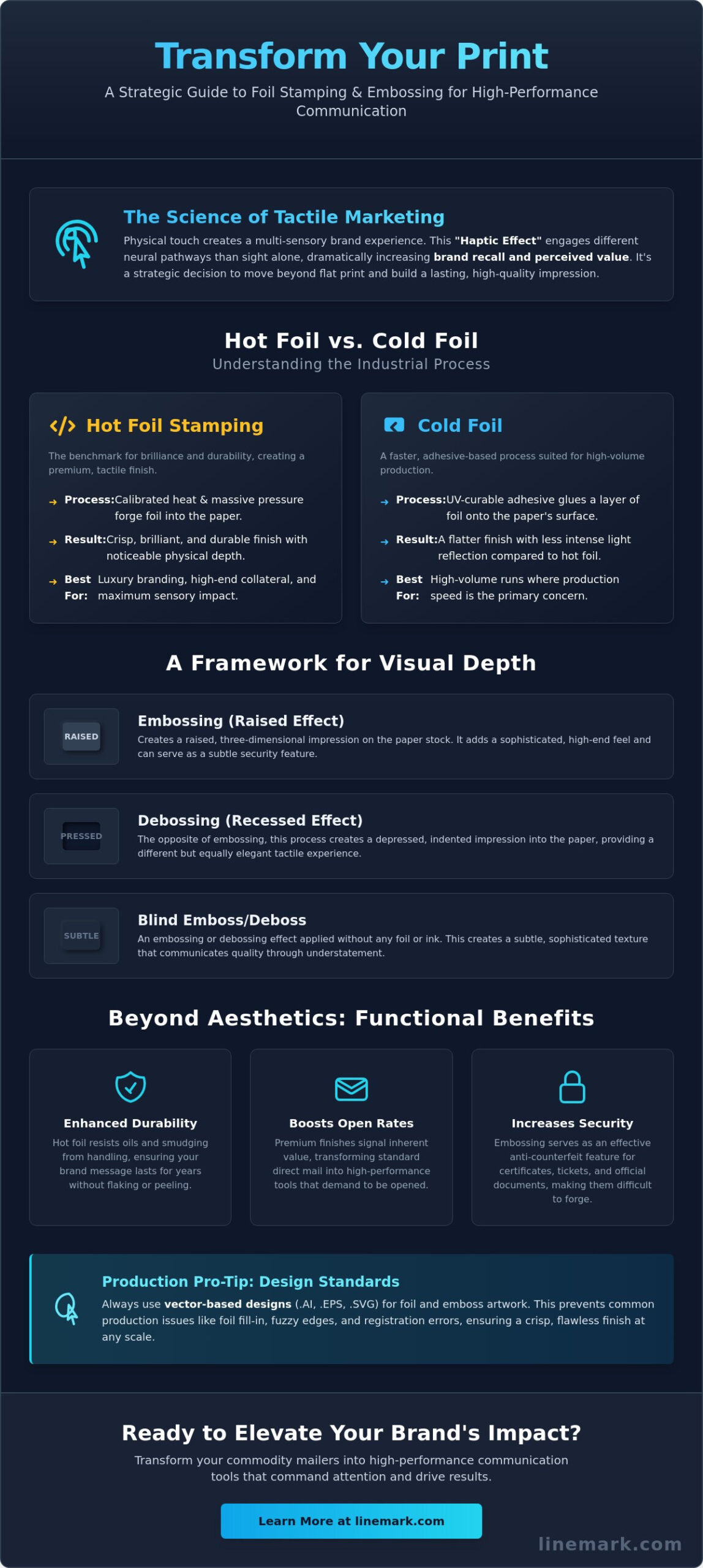
Physical touchpoints provide a rare opportunity for unfiltered connection in a saturated digital market. High-quality foil stamping and embossing services serve as more than just decorative layers; they’re multi-sensory brand touchpoints that communicate stability and precision. When a prospect runs their fingers across a raised logo or a metallic finish, they experience the “Haptic Effect.” This physiological response increases brand recall because the brain processes tactile information through neural pathways that are distinct from visual stimuli. It’s a strategic industrial decision to move beyond flat print.
Genuine Hot Stamping utilizes calibrated heat and massive pressure to bond metallic or pigment foil directly to the paper fibers. This creates a crisp, durable finish that digital alternatives cannot replicate. While digital “sleeking” or inkjet foils might work for low-volume proofs, they often lack the physical depth and structural integrity required for high-volume commercial print. We focus on the industrial-grade precision of metal dies to ensure every impression is identical, from the first sheet to the fifty-thousandth.
To better understand the mechanical precision behind these finishes, watch this helpful video:
The ROI of the First Impression
Commodity print often ends up in the recycling bin because it lacks a sense of inherent value. Premium finishes signal to the recipient that the contents deserve their time. For luxury sectors and B2B services, the inclusion of foil on direct mail pieces significantly boosts open rates compared to standard envelopes. It transforms a standard marketing piece into a high-performance communication tool. This is particularly vital for high-stakes collateral like annual reports, where brand authority and financial transparency must be communicated through every physical detail. You aren’t just printing a report; you’re building a tactile case for your organization’s growth.
Beyond Aesthetics: Functional Benefits of Specialty Finishes
Specialty finishes offer utility that goes beyond visual appeal. Embossing can serve as a subtle yet effective security feature for certificates and transcripts, making them significantly harder to forge. In high-touch environments, hot foil stamping provides exceptional durability. It resists the oils from skin that cause standard inks to fade or smudge over time. This resilience contributes to a “keep-sake” quality for custom books and catalogs. When your materials feel substantial and look pristine after repeated use, your brand message remains on a client’s desk or shelf for years without flaking or peeling. It’s an investment in the longevity of your marketing assets.
Hot Foil Stamping vs. Cold Foil: Understanding the Industrial Process
Hot foil stamping remains the benchmark for brilliance in premium print. This process relies on a mechanical bond created through the intersection of heat and pressure. Unlike cold foil, which uses a UV-curable adhesive to glue foil to the surface, hot stamping utilizes a metal die to strike the foil directly into the paper fibers. Selecting the right foil stamping and embossing services involves more than picking a color; it requires an understanding of how different foils react with your chosen paper stock to Influence Customer Perception through a sense of permanence and quality. While cold foil is faster for massive web-fed runs, it often results in a flatter finish that doesn’t capture light with the same intensity as its hot-stamped counterpart.
The chemistry of the foil itself is a feat of industrial engineering. Each roll contains a release coat that ensures the foil separates cleanly from its polyester carrier during production. Beneath that, the color or metallic coat provides the visual impact, followed by a specialized adhesive layer that activates only when the heated die makes contact. This layered approach allows for a range of finishes, from classic gold and silver to sophisticated matte pigments and clear foils. Metallic inks, by contrast, are simply pigments with metal flakes; they lack the reflective depth and tactile “crush” that only a physical die can provide.
The Anatomy of a High-Quality Foil Stamp
Precision starts with the selection of the die material. Magnesium dies are cost-effective for shorter runs or projects with softer paper stocks. However, for high-volume commercial print, brass dies are the industry standard because they hold fine detail longer and resist the wear of repeated strikes over thousands of impressions. Achieving crisp, fine-line details requires a master-level understanding of the equipment settings. Dwell time is the critical factor in foil adhesion, representing the exact duration the heated die remains in contact with the substrate to ensure a perfect transfer without bleeding.
Foil Selection for Brand Consistency
Maintaining corporate identity across thousands of impressions requires a partner who understands color physics and material science. We help you match foil selections to your brand standards, ensuring your logo looks identical on a postcard as it does on a catalog cover. Clear foils are an increasingly popular choice for a minimalist aesthetic, offering a “spot UV” effect that feels more integrated and durable than traditional coatings. For those requiring extra security or visual flair, holographic foils provide multi-dimensional patterns that are difficult to replicate. If you’re ready to see how these finishes can transform your next project, our team can help you select the optimal foil stamping and embossing services for your specific volume and substrate requirements.
Embossing, Debossing, and Blind Finishes: A Framework for Visual Depth
Creating a three-dimensional experience on a two-dimensional surface requires a mastery of pressure and material physics. Embossing and debossing are the primary tools for achieving this structural depth. While embossing raises the image above the paper surface by pressing the substrate between a male and female die, debossing pushes the design into the material to create a depressed, recessed effect. These techniques are fundamental to high-end foil stamping and embossing services because they transform the paper itself rather than just adding a layer of ink. When implemented correctly, they offer a level of tactile sophistication that digital printing cannot replicate.
Single-Level vs. Multi-Level Sculptural Dies
The visual impact of your project often depends on the complexity of the die. Single-level dies create a uniform raised surface, which is ideal for clean, modern logos and bold typography. In contrast, multi-level sculptural dies allow for varying depths and rounded edges, creating a 3D effect similar to a minted coin. While the initial investment in sculptural die-making is higher, the cost-benefit ratio for high-volume runs is excellent because it provides a unique, high-performance finish that competitors using standard methods can’t match. The depth of the die must be meticulously calibrated to the paper weight to prevent the fibers from tearing during the strike.
The Aesthetic of Debossing
Debossing offers a different sensory appeal, often preferred for organic or letterpress-style branding. It works exceptionally well with thick, soft-touch paper stocks that can “cradle” the impression without showing a bruise on the reverse side. We see a strategic increase in the use of debossing within direct mail campaigns to encourage physical interaction; recipients are naturally inclined to run their fingers over a recessed design. This physical engagement bridges the gap between a standard marketing message and a memorable brand experience. By selecting the right foil stamping and embossing services, you ensure that these technical nuances are handled with the precision your brand deserves.
Production Standards: Designing and Preparing Files for Multi-Dimensional Print
Precision in high-volume production begins long before the press starts. To maximize the efficiency of foil stamping and embossing services, your source files must meet industrial grade specifications. We require vector-based artwork, specifically in AI or EPS formats, to ensure the die-making equipment can interpret your design with mathematical accuracy. Raster images, even at high resolutions, lack the clean paths necessary for the physical strike of a metal die. This technical requirement is the first step in ensuring your brand assets translate perfectly from a digital screen to a physical substrate.
When designing for foil, you must account for the physical behavior of the material under heat and pressure. Maintaining a minimum stroke weight and sufficient gutter space between design elements prevents “foil fill-in.” This occurs when the foil bridges small gaps and obscures fine detail. Generally, a minimum stroke of 1pt is recommended for most metallic foils. Selecting the right paper stock is equally vital; the GSM, tooth, and coating of the paper influence how the foil adheres and how deep an emboss can strike without compromising the paper’s structural integrity.
Technical Specifications for Die Creation
Setting up your files correctly ensures a seamless transition from design to production. You should define your specialty finishes using dedicated “Spot Color” layers named clearly, such as “Foil” or “Emboss.” Enabling “Overprint” for these layers is essential. It prevents the underlying ink from being knocked out, which avoids unsightly white gaps if there’s a microscopic shift during registration. Smooth paper substrates typically allow for finer detail, while textured stocks require bolder designs to ensure the foil seats properly within the tooth of the paper. Our team works as a strategic ally to review these nuances before the first die is cast.
Avoiding Common Production Pitfalls
Large solid areas of foil present unique challenges, such as trapped air between the die and the substrate. We utilize “venting” in the die, which involves creating small, invisible channels that allow air to escape to ensure a smooth, bubble-free transfer. You should also be cautious when foiling over heavy ink coverage or specific soft-touch laminations, as the chemical bond may be compromised. These technical considerations are even more critical when combining specialty finishes with large format graphics for high-impact displays. Our proofing process provides a final layer of security, allowing you to verify alignment and registration before we commit to a high-volume run.
If you’re ready to ensure your artwork is production-ready, consult with our technical team today to review your file specifications for flawless foil stamping and embossing services.
Scaling Excellence: Integrating Specialty Finishes into High-Volume Fulfillment
Scaling premium print requires more than just high-end machinery. It demands an infrastructure capable of maintaining boutique-level detail across tens of thousands of units. Our 90,000-square-foot facility is engineered for this exact purpose. With over 30 years of industrial experience, we’ve moved beyond the role of a simple vendor. We act as a strategic communications ally, ensuring that complex foil stamping and embossing services are accessible and consistent across your entire organization. This operational breadth allows us to handle the nuances of modern marketing and logistics without sacrificing the precision your brand requires.
Precision at scale is about more than just the press strike. It involves a unified partnership where your premium finishing needs are integrated into a broader supply chain. While boutique shops might struggle with the throughput required for national campaigns, our high-capacity operation thrives on complexity. We bridge the gap between a business challenge and a concrete, scalable solution, providing a centralized destination for everything from annual reports to direct mail. This steady, controlled approach builds a sense of security, ensuring your project is in capable hands from the initial design review to final delivery.
MarCom Portals: Premium Print on Demand
Centralizing your brand assets through a MarCom On-Demand portal allows you to offer foil-stamped templates to local branches or agents without risking brand dilution. We automate the workflow from the moment an order is placed to the final specialized finishing stage. This ensures that a brochure produced for a satellite office matches the tactile quality of one sent from your corporate headquarters. Brand integrity is maintained through pre-approved design parameters that respect the technical requirements of die-based finishing, making high-end finishes a standard part of your distributed marketing strategy.
National Logistics and Fulfillment Integration
Premium finishes lose their impact if the logistics chain is fragmented. By keeping our foil stamping and embossing services in-house, we eliminate the delays and risks associated with third-party finishers. This centralized approach allows for immediate kitting and fulfillment. We manage the inventory of your high-value embossed collateral, ensuring that items are stored and handled with the meticulous attention they deserve. Whether you need a national rollout or targeted regional distribution, our integrated system provides the scalability required for high-performance communications. Contact Linemark to discuss your high-volume premium print strategy and discover how our industrial authority can elevate your brand.
Future-Proofing Brand Authority through Industrial Print Innovation
Tactile finishes are no longer an optional luxury; they’re a strategic necessity for organizations that value authority and recall. We’ve examined how technical precision in die creation and substrate selection eliminates the risks of “cheap-looking” alternatives or production delays. By integrating professional foil stamping and embossing services into your marketing mix, you ensure that every touchpoint communicates quality and durability. This approach moves your print strategy from a commodity exchange to a high-performance communication asset that drives measurable results.
Our 90,000-square-foot high-capacity production facility provides the industrial strength needed to scale these finishes across national campaigns without sacrificing precision. With 30+ years of expertise and integrated MarCom On-Demand portals, we offer a streamlined path to consistent brand management at any volume. We act as your strategic ally, combining large-scale efficiency with the meticulous detail required for premium results. Partner with Linemark for Scalable Premium Print Solutions and experience the confidence that comes with placing your project in seasoned, capable hands. We’re ready to help you build a brand image that stands the test of time.
Frequently Asked Questions
What is the difference between foil stamping and digital foil?
Hot foil stamping uses heat and a metal die to bond foil directly into the paper fibers, creating a physical “crush” and a permanent bond. Digital foil relies on an adhesive or toner to stick foil to the surface without pressure. This results in a flatter, less durable finish that often lacks the brilliance and tactile depth of traditional methods. For high-volume projects, the industrial-grade bond of hot foil ensures your materials don’t flake or peel during heavy handling.
Can I use foil stamping and embossing on the same design element?
You can combine these finishes using a specialized “combination die.” This tool allows the press to execute both techniques in a single pass, ensuring perfect registration between the color and the raised texture. This integrated approach is a highly efficient method for creating complex, multi-dimensional logos that command attention on premium collateral. It eliminates the need for multiple press runs, which maintains the structural integrity of the paper while reducing production time.
What paper stocks work best for deep embossing and debossing?
Heavier paper stocks with long fibers provide the best results for deep sculptural finishes. Generally, stocks over 100lb cover or 300 GSM offer the structural integrity needed to hold a deep impression without tearing the substrate. Uncoated stocks with a slight “tooth” provide excellent grip for the foil adhesive. We recommend testing specific coatings first, as some high-gloss finishes can interfere with the heat-activated bonding process required for a clean transfer.
How much time does custom die-making add to a production schedule?
Custom die-making typically adds two to four business days to the initial production schedule. However, our integrated workflow manages this process concurrently with paper procurement and pre-press preparation to minimize any impact on the final deadline. Once a die is created, it’s archived for future high-volume runs, allowing for faster turnaround on repeat orders. We prioritize early vector file verification to ensure die production begins the moment you approve the design.
Are there limitations on the size of the foil-stamped area?
Limitations are generally dictated by the press bed size and the power of the heating elements. While we can foil large areas, solid blocks of foil require “venting” in the die to prevent air bubbles from being trapped during the strike. For extremely large graphics, we often recommend breaking the design into strategic sections to ensure consistency. Our technical team reviews your artwork to ensure the surface area is optimized for a clean, consistent transfer across the entire run.
Is hot foil stamping durable enough for direct mail through the USPS?
Hot foil stamping is exceptionally durable and easily survives the friction of USPS sorting equipment. Because the foil is heat-bonded into the paper, it doesn’t flake off like some lower-quality digital alternatives. This makes it an ideal choice for direct mail campaigns where the piece must arrive in pristine condition. Using high-quality foil stamping and embossing services ensures your mailers maintain their premium authority from the sorting facility to the recipient’s door without losing their luster.
Can you match a specific Pantone color with foil stamping?
You cannot mix foil like liquid ink, so a 1:1 Pantone match isn’t always possible through standard metallic rolls. However, the range of available foil pigments is vast, and we can usually find a near-perfect match for your corporate standards. For absolute brand consistency, we offer matte pigment foils. These provide a flat, opaque color similar to traditional ink but with the unmistakable tactile depth that only a physical die strike can provide.
Does embossing work on both sides of a sheet of paper?
Embossing can be applied to both sides, but it requires careful planning to manage the “bruising” or show-through on the reverse side. A raised image on the front will naturally create a corresponding depression on the back. To avoid interfering with text or graphics on the second side, we often recommend using thicker, multi-ply stocks. This allows the impression to be deep on one side while remaining relatively subtle on the other, preserving the legibility of your content across the entire piece.