

 06/10/2026
  Steve Bearden
With the global die cutting market projected to reach $4.6 billion in 2026, the era of the standard rectangular mailer is officially over. You’ve likely noticed that standard shapes often fail to capture attention in a crowded marketplace, yet managing inconsistent cuts on high-volume orders remains a significant logistical concern. Utilizing die cutting for custom print shapes shouldn’t be a source of friction. Instead, it’s a precise, industrial-scale asset that bridges the gap between creative vision and national distribution.
We understand that achieving a premium tactile feel while ensuring brand consistency across thousands of units is your top priority. This guide provides the strategic roadmap you need to master the technical nuances of precision production. You’ll learn how to leverage the latest automation to improve efficiency by up to 30%, navigate new 2026 environmental regulations like the EU’s PPWR, and use digital finishing to drive higher engagement without sacrificing quality. We’re moving beyond simple aesthetics to focus on scalable, high-impact results for your next major campaign.
Key Takeaways
- Learn how the “Pattern Interrupt” effect leverages non-rectangular designs to capture audience attention and significantly increase response rates in high-volume campaigns.
- Discover the technical differences between steel rule and digital methods to select the most cost-effective production path for your specific run size and complexity.
- Master the precision of dieline creation and over-bleed requirements to ensure flawless execution of die cutting for custom print shapes across every unit.
- Understand the logistical advantages of integrating binding and finishing with centralized fulfillment to reduce transit damage and maintain brand consistency.
- Explore how MarCom On-Demand portals streamline the management and distribution of complex, custom-shaped marketing assets across national branch networks.
The Strategic Value of Die Cutting for Custom Print Shapes
Precision is the hallmark of modern commercial printing. Die cutting for custom print shapes is no longer a luxury; it’s a strategic necessity for brands looking to differentiate their physical assets in a saturated market. At its core, the process involves using specialized steel blades or high-powered lasers to shear substrate into non-standard geometries. This technical capability, which you can explore further by Understanding Die-Cutting Technology, allows marketing collateral to break free from the constraints of the standard 90-degree corner. It transforms a simple piece of paper into a functional, interactive tool that serves as a catalyst for brand growth.
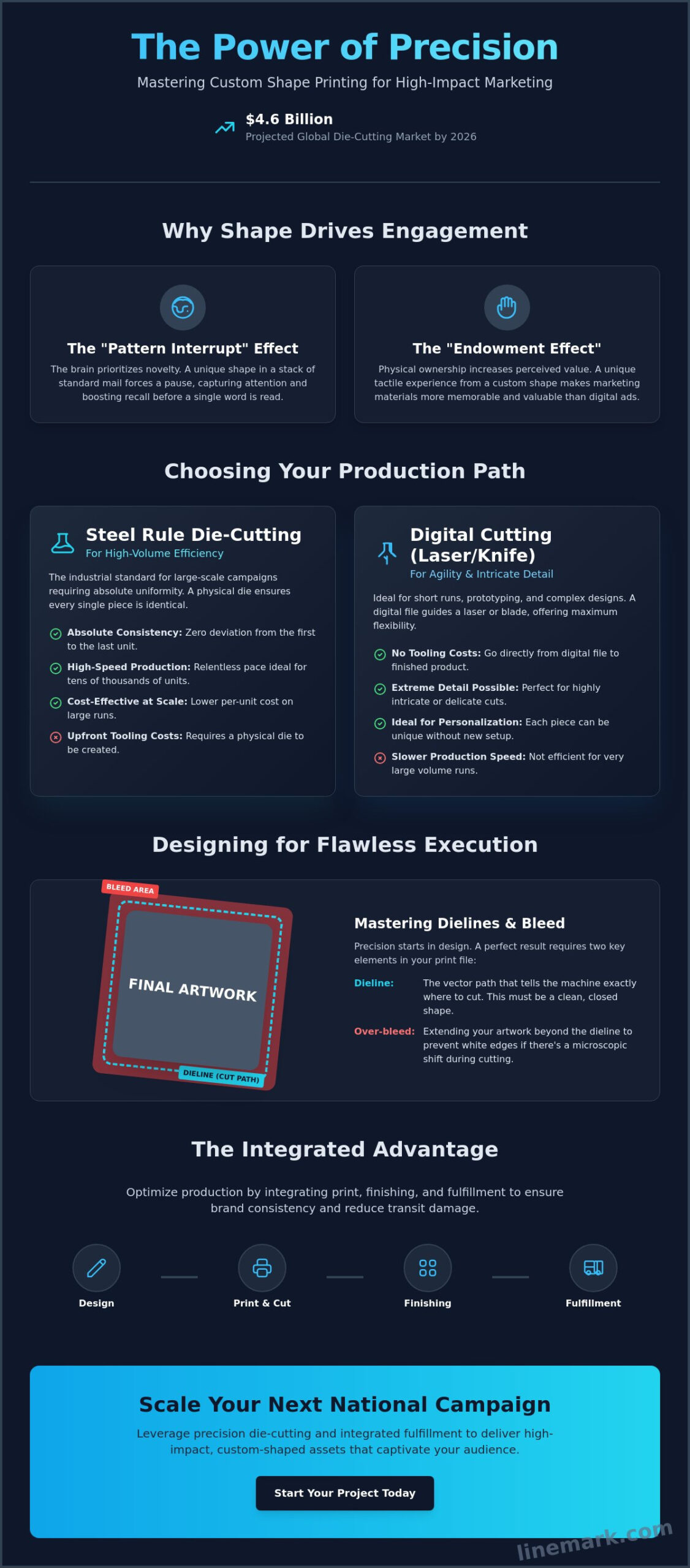
The human brain is hardwired for survival, which means it prioritizes the novel over the familiar. In a mailbox filled with standard envelopes, a die-cut piece acts as a “pattern interrupt.” This cognitive shift forces the recipient to pause and process the unique silhouette, leading to faster response times and higher recall. By utilizing silhouette-based recognition, national corporate campaigns can establish a visual shorthand that consumers recognize instantly. It’s about creating an immediate mental connection before a single word of copy is read.
To better understand how these files are prepared for the press, watch this helpful video:
Beyond the Rectangle: Why Shape Drives Engagement
Custom edges do more than just look interesting. They create a sophisticated visual hierarchy that guides the viewer’s eye toward your primary messaging or call to action. Whether a brochure mimics the shape of the product it describes or a direct mail piece features a unique window, these shapes drive engagement. Industry data suggests that unique shapes in direct mail significantly outperform standard postcards in open rates because they demand physical interaction. For high-volume projects, this means every unit is an active participant in the brand story rather than a passive piece of paper.
Tactile Marketing in a Digital-First World
In an era of digital saturation, the “Endowment Effect” remains a powerful psychological tool for marketers. This principle suggests that once a person physically holds an object, they attribute higher value to it. Die cutting for custom print shapes enhances this effect by providing a unique tactile experience that digital ads simply cannot replicate. We see high-capacity commercial printers investing heavily in sophisticated finishing equipment to meet this demand for differentiated physical assets. The challenge lies in balancing this aesthetic complexity with the structural integrity required for national distribution. A well-designed die-cut piece must survive the rigors of high-volume kitting, fulfillment, and shipping without compromising its precision or visual impact.
Steel Rule Die-Cutting for High-Volume Efficiency
The power of the steel rule method lies in its mechanical simplicity and relentless pace. In a 90,000-square-foot industrial environment, these presses operate with a level of precision that ensures consistency across tens of thousands of units. Because the die is a fixed physical tool, there’s zero deviation in the cut path from the first sheet to the last. This reliability is why we recommend this method for large-scale commercial printing and direct mail campaigns that require absolute brand uniformity.
Digital Laser and Knife Cutting for Prototyping
Digital methods provide the agility needed for the early stages of a campaign. Laser cutting offers extreme detail but carries a risk of charring on certain paper stocks due to the heat involved. CNC knife cutting avoids this issue, providing clean edges without thermal damage. While digital methods are slower than mechanical presses, they’re the most cost-effective path for short-run personalized assets. If you’re looking to refine your project’s final look, exploring our Binding & Finishing
Designing for Precision: Creating Perfect Dielines and Print Files
The transition from a creative concept to a physical product requires a meticulous digital foundation. Precision in die cutting for custom print shapes begins long before the paper reaches the press. It starts within Adobe Illustrator or InDesign, where the file must be architected to withstand the mechanical realities of high-speed industrial finishing. We recommend establishing a dedicated spot color, typically named “Dieline,” and setting it to overprint. This ensures the cut path is visible to our production team and automated sensors without appearing on the final printed marketing asset.
Mechanical movement is an inherent part of the printing process. Even with the most advanced equipment, paper can shift slightly as it moves through the press at high speeds. To account for this, designers must incorporate “Over-Bleed.” While standard print projects might require a 1/8-inch bleed, complex custom shapes often benefit from a 1/4-inch bleed to ensure total ink coverage even if a minor mechanical shift occurs. Additionally, consider the minimum radius of your corners. Sharp, 90-degree internal cuts create stress points that can lead to paper tearing during the stripping process. Implementing a subtle radius preserves the structural integrity of the piece.
The Anatomy of a Professional Dieline
A Dieline is the digital blueprint for physical production. It’s the map that tells the machine exactly where to cut, fold, or tear. For a successful high-volume run, your vector paths must be closed and simplified. Overlapping paths or stray anchor points can cause the cutting head to stutter, leading to inconsistent edges. You must clearly differentiate between three primary line types:
- Cut Lines: Solid lines indicating where the blade will fully penetrate the substrate.
- Score Lines: Dotted or dashed lines that signify a partial cut, allowing the paper to fold cleanly without cracking.
- Perforation Lines: Specific dash patterns used for tear-off coupons or interactive mailers.
Managing Bleeds and Safe Zones for Custom Shapes
When the edge of your paper is non-linear, the “Safe Zone” becomes more critical than ever. We suggest keeping essential text and logos at least 1/8 inch away from any cut line. This buffer protects your brand elements from being trimmed if the substrate moves during the run. For those integrating these shapes into Direct Mail Marketing, the stakes are even higher. Your templates must account for USPS sorting requirements, ensuring that custom edges don’t interfere with barcode readability or the automated “grippers” used in postal processing. Balancing bold design with these logistical constraints is what separates a beautiful concept from a functional, high-engagement marketing tool.
High-Volume Applications: Transforming Marketing Collateral at Scale
Scaling production requires a partner that understands the intersection of aesthetics and operational logistics. Die cutting for custom print shapes allows national brands to maintain a unified identity while delivering high-impact physical touchpoints across diverse markets. Whether you’re producing brochures, catalogs, or mailers, consistency is paramount. A die-cut silhouette used in a direct mail piece should mirror the precision of the shaped window in your latest annual report. This unified approach ensures that every piece of collateral reinforces the brand’s visual language, creating a seamless experience for the end user.
Custom Die-Cut Direct Mail for Higher Open Rates
The primary goal of any direct mail campaign is to survive the journey from the mailbox to the kitchen table. Standard pieces often end up in the recycling bin before they’re even read. Custom shapes dramatically shift the “Hand-to-Trash” ratio by inviting physical curiosity. We utilize “Trailing Edge” shapes that comply with strict postal automation standards while providing a tactile edge that sticks out among flat envelopes. Integrating Variable Data Printing (VDP) with these shapes takes personalization a step further. Imagine a mailer where the die-cut shape itself changes based on the recipient’s geographic location or purchase history. This level of hyper-personalization, executed at scale, is a powerful driver of ROI for modern marketing teams.
Interactive Elements in Custom Book Manufacturing
In the world of high-end corporate communications, Custom Book Printing offers a unique opportunity for sensory engagement. Die-cut covers can reveal internal imagery or textures, adding a premium, multi-layered feel to annual reports and limited-edition brand books. Beyond aesthetics, custom shapes provide functional utility. Shaped dividers and thumb-tabs turn complex manuals and catalogs into intuitive, user-friendly tools. For limited runs, these elements enhance the unboxing experience, making the physical act of opening the book feel like a curated event. If you’re ready to scale your next campaign with precision, explore our full range of Commercial Printing solutions to see how we can bring your vision to life.
Optimizing Production with Integrated Print Finishing and Fulfillment
Precision on the press is only half the battle. The true value of die cutting for custom print shapes is realized when those assets are seamlessly integrated into your broader supply chain. A standalone die-cut piece is a novelty; however, a die-cut piece that arrives undamaged as part of a perfectly timed national kitting project is a strategic tool. Managing these complex shapes at scale requires moving beyond transactional printing toward a unified partnership that handles everything from the initial cut to final delivery. Our 90,000-square-foot facility is designed to act as a centralized destination where production and logistics converge, ensuring that your high-volume orders maintain their integrity from our floor to your customer’s door.
Quality control at this scale is a rigorous process. When you’re managing a run of 100,000+ units, even a minor calibration error can lead to significant waste. We utilize automated sensors and manual checkpoints to ensure that every custom edge remains sharp and consistent. By housing our Binding & Finishing services under the same roof as our printing and fulfillment teams, we eliminate the risks associated with third-party transit. This consolidated approach reduces your supply chain footprint and ensures that specialized packing protocols are followed to protect delicate, non-linear edges from transit damage.
Scaling Production through MarCom On-Demand Portals
Empowering local teams to execute national campaigns often leads to design friction and brand dilution. We solve this by leveraging MarCom On-Demand portals. These web-to-print platforms allow your regional branches to order corporate-approved die-cut assets through pre-set templates. By locking in the dielines and brand standards at the portal level, you ensure that every unit ordered across the country matches your original vision. It’s a scalable solution that provides the agility of local ordering with the control of a centralized marketing department. This system transforms die cutting for custom print shapes from a complex one-off project into a repeatable, on-demand asset.
Centralized Distribution and Kitting for Custom Assets
Shipping custom-shaped items isn’t a standard procedure. Because these pieces often feature unique protrusions or delicate windows, they require specialized kitting and fulfillment protocols. Our team specializes in combining these high-impact die-cut pieces with standard collateral in a unified, secure package. Whether it’s a “pop-up” mailer that needs to lay flat for transit or a shaped divider for a custom book, our kitting process is engineered to prevent edge curling or tearing. This meticulous attention to detail ensures that the “unboxing” experience remains premium, regardless of how far the package has traveled through the national distribution network. For companies managing these logistics across remote sites, maintaining a strong data link via hardware from 4gltecpe.com ensures real-time tracking and coordination stay seamless.
Scaling Precision for Your Next National Campaign
Mastering die cutting for custom print shapes is the definitive way to break through digital noise and drive tangible response rates in 2026. By aligning sophisticated dieline design with the right industrial cutting technology, your brand can move beyond standard rectangles to create high-impact marketing assets. We’ve explored how integrating these shapes into a centralized fulfillment ecosystem ensures that every unit maintains its structural integrity and brand consistency across thousands of units.
Success in high-volume production requires more than just a vendor; it demands a strategic ally. With over 30 years of industrial print expertise and a 90,000-square-foot production and fulfillment facility, we have the capacity to handle your most complex projects without sacrificing detail. Our integrated MarCom On-Demand portal technology further streamlines the process, allowing you to manage custom assets with unprecedented efficiency. We look forward to helping you transform your creative vision into a scalable, high-performance reality.
Request a Precision Die-Cutting Quote from Linemark Today
Frequently Asked Questions
What is the difference between die cutting and laser cutting for custom shapes?
Die cutting uses physical steel rule blades to shear through material, while laser cutting uses a high-intensity beam of light to vaporize it. Die cutting is the superior choice for high-volume efficiency and consistent edges on thicker paper stocks. Laser cutting excels in intricate, lace-like details or rapid prototyping where the cost of a physical tool isn’t justified.
How much does a custom die cost for a large-scale print project?
The cost of a custom die is influenced by the complexity of the design and the total linear inches of the cutting blade. While there is an initial investment for the physical tool, this cost is amortized over the entire run. For large-scale projects, this mechanical method results in the lowest per-unit cost compared to digital alternatives.
Can I use die cutting on heavy cardstock or specialized substrates?
Industrial die cutting for custom print shapes is highly effective on heavy cardstock, corrugated boards, and even specialized synthetic substrates. Traditional steel rule dies provide the mechanical force necessary to achieve clean, crisp edges on thick materials that might otherwise char under a laser or snag under a digital knife. This makes it ideal for durable marketing assets.
What are the USPS requirements for die-cut direct mail pieces?
USPS requirements focus on the aspect ratio and the ability of automated machinery to grip the piece. Custom shapes must maintain a rectangular base or use a trailing edge design to prevent jamming in high-speed sorters. It’s essential to ensure that your dieline leaves adequate space for the Intelligent Mail barcode and the required postage indicia to avoid surcharges.
How do I prepare a dieline for a commercial printer?
You should create your dieline as a vector path in a dedicated spot color, typically labeled Dieline or Cut. Set this stroke to overprint so it doesn’t interfere with the underlying artwork during the digital proofing process. Ensure all paths are closed and simplified to prevent the cutting equipment from stuttering or creating jagged edges during the production run.
Is die cutting cost-effective for short-run digital print orders?
Digital die cutting is the most cost-effective solution for short-run orders because it removes the need for a physical die. This allows brands to test unique shapes or personalized designs without the upfront tooling expense. As volume increases beyond a few thousand units, transitioning to traditional steel rule die cutting offers better speed and significant long-term savings.
Can I combine die cutting with other finishes like foil stamping or UV coating?
You can certainly combine die cutting with premium finishes like foil stamping, embossing, or spot UV coating. In our facility, we manage these multi-stage projects by ensuring perfect registration between the print, the finish, and the final cut. This integrated approach creates a multi-sensory experience that significantly increases the perceived value of your high-volume marketing assets.
What is the typical turnaround time for a custom die-cut production run?
Typical turnaround times include an initial window for die fabrication, followed by the production run and stripping process. While adding a custom shape adds a few days to the schedule compared to a standard straight trim, the engagement lift usually justifies the extra time. Our centralized production model helps minimize these timelines by keeping all finishing and kitting in-house.