

 10/04/2026
  Steve Bearden
A corporate calendar succeeds when print, personalization, and delivery work together. The right custom calendar printing for corporate gifts can keep your brand visible throughout the year, but choosing a format and coordinating versions, production, and distribution takes more than a polished design.
A useful, well-made gift reflects well on your organization. The challenge is making practical choices that keep the calendar relevant to recipients, consistent with your brand, and manageable to produce at scale.
This guide walks through selecting a calendar format and content, maintaining design consistency across audiences, and planning personalization, production, and fulfillment as one workflow. Linemark’s digital and offset printing, variable data printing, and fulfillment services help bring those details together around your corporate gifting objectives.
Key Takeaways
- Match wall or desk calendar formats to where recipients will use them and how your brand should appear.
- Align the calendar’s duration and start month with your campaign schedule and gifting plans.
- Use variable data printing to tailor selected elements across recipient groups while maintaining a consistent design.
- Plan custom calendar printing for corporate gifts by coordinating quantities, approvals, production, and delivery as one workflow.
- Build quantities around recipient segments, internal needs, and a deliberate reserve to support a smoother distribution plan.
Why Custom Calendar Printing Works for Corporate Gifts
A corporate calendar can do more than carry a logo. It gives recipients a practical item to use and a place for your brand to appear as they plan their days. A corporate calendar gift is a branded, functional printed piece designed for a defined audience, with its content and format planned around how recipients will use it. That purpose helps keep the gift relevant rather than making it a generic promotional item.
Start with the relationship you want to recognize. Client appreciation may call for useful, polished content; employee recognition can reflect internal culture and shared milestones; partner gifts can support an ongoing working relationship; and event follow-up can extend the conversation beyond the occasion. Custom calendar printing for corporate gifts works best when the audience and objective shape the design. Print choices are part of that planning, building on a long history of printing that connects artwork decisions with the finished piece.
For a visual overview of personalized calendar design, watch this video:
Which corporate audiences are a good fit for calendar gifts?
Clients may keep a calendar in a home office or shared workplace, while employees may value dates tied to team activities or company milestones. Partners might use one in a meeting space, and association members may appreciate information relevant to their field. Consider recipients’ roles and settings: a desk-based audience may benefit from a compact format, while a shared office may suit a calendar that several people can view. Match practical value to the relationship, not just the brand message.
What makes a branded calendar feel useful rather than generic?
Make dates easy to read and the layout simple to scan. Choose photography or editorial content that speaks to the audience, then leave enough open calendar space for notes and appointments. Keep brand elements consistent and intentional, but remember that a larger logo alone won’t make the piece useful. Audience fit does: content people return to, presented in a format that suits their routine, gives the calendar a clear purpose beyond promotion.
How to Choose Calendar Formats, Artwork, and Print Specifications
Choose the format and specifications together, starting with the recipient’s setting and intended use. A calendar for a shared office has different visibility needs from one placed beside an individual’s monitor. That audience-led decision also guides artwork, calendar duration, and production planning for custom calendar printing for corporate gifts.
Wall calendar or desk calendar: which suits the recipient?
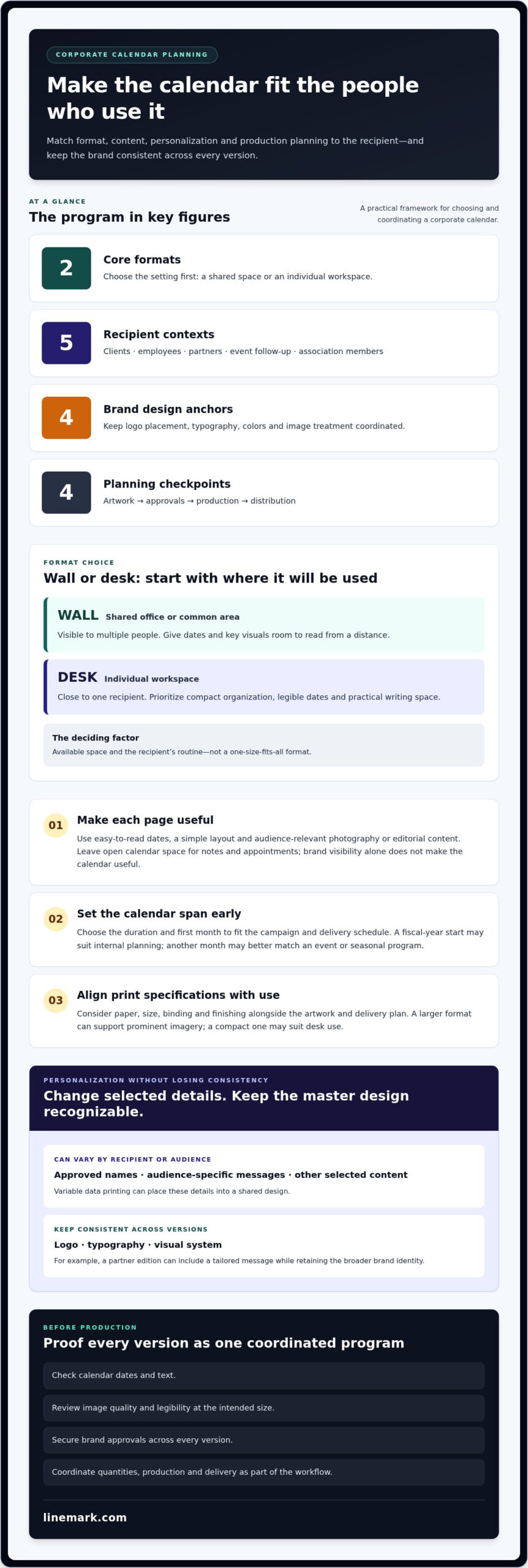
Use the recipient’s available space and routine as your guide. A wall format can make dates visible at a glance in a shared area; a desk format keeps information close at hand in an individual work area. Neither is automatically better. Select the format that fits where the calendar will be used and how recipients need to reference it.
| Format | Setting | Visibility | Design implications |
|---|---|---|---|
| Wall | Shared office or common area | Visible to multiple people | Give dates and key visuals room to read from a distance. |
| Desk | Individual workspace | Close to one recipient | Prioritize compact organization, legible dates, and practical writing space. |
How should brand artwork and monthly content be planned?
Build a consistent visual system for logo placement, typography, colors, and image treatment. Monthly themes can add interest or share useful brand content, but they shouldn’t compete with dates or leave recipients without room to write. Treat every page as part of one coordinated design, not a collection of unrelated promotions.
Choose the calendar duration and start month to fit the campaign purpose and delivery schedule. A calendar that begins with the fiscal year may suit an internal planning cycle, while another start month may align better with an event or seasonal program. Set the intended first month early so artwork, approvals, production, and distribution can be planned in sequence. Don’t assume every calendar follows the same annual span.
Paper, size, binding, and finishing affect a calendar’s appearance, handling, and use. Consider these choices alongside the artwork and distribution plan: a larger format may support prominent imagery, while a compact one may better suit desk use. Align specifications with how recipients will handle the finished piece and how it will be delivered.
Before approving artwork, review the calendar dates and text, check image quality and legibility at the intended size, and secure brand approvals across every version. A structured proofing process helps maintain a consistent design while catching errors before production. Linemark coordinates commercial print planning around artwork and distribution requirements. Explore commercial printing support.
How Personalization and Print Production Shape the Calendar Program
Personalization can make a calendar feel more relevant, but it adds decisions to the production workflow. For custom calendar printing for corporate gifts, define which elements change by recipient or audience and which stay consistent across the program. That distinction helps protect brand consistency while allowing thoughtful variation.
Personalization changes selected details for the recipient; the master design keeps the brand recognizable across every version. Variable data printing can place approved names, audience-specific messages, or other selected content into a shared design. For example, a partner version might include a tailored message while retaining the same logo, typography, and visual system as other editions.
When does variable data printing add value to a calendar gift?
Use variable data when a difference is meaningful to the recipient, not simply because it can be added. First, organize clean, permission-appropriate data and define which fields may vary. Then establish a controlled template, map each field, review sample versions, and approve the final proof. Check spelling, placement, and audience-to-version assignments carefully. Personal touches can make a gift feel more considered, though they don’t guarantee a particular response.
How should buyers compare digital and offset calendar production?
Compare the complete project rather than relying on a universal quantity cutoff. Digital and offset production each have a role; the appropriate approach depends on the job’s quantity, schedule, artwork variation, and specifications. When content changes across multiple versions, variable data and version handling become important planning considerations. A consistent design across the run may call for a different production approach.
Keep finishing and version control in the same conversation as the print method. The calendar’s format, binding, handling, and distribution can affect production planning, while approval checkpoints help ensure each version matches its intended audience. A practical sequence is to:
- Set the master design and identify exactly which elements can vary.
- Prepare and validate recipient data, then assign each record to an approved version.
- Review representative proofs for content, layout, and correct variable fields.
- Approve the complete production plan, including finishing and version handling, before the run proceeds.
This coordinated approach gives marketing and production teams a shared reference point. It also helps prevent a personalized detail from disrupting the design system or creating uncertainty about which version goes to which audience.
How to Plan Calendar Quantities, Approvals, and Delivery
A coordinated plan connects the recipient list to final delivery, with clear ownership at each step. For custom calendar printing for corporate gifts, estimate quantities by recipient segment, include calendars for internal teams, and set a deliberate reserve for late additions or replacements. This creates a more useful count than applying one broad estimate to every audience.
What should a corporate calendar project brief include?
Use a single project brief to keep decisions visible across marketing, production, and fulfillment. Record the purpose, audience segments, quantity by version, format preferences, brand assets, and delivery destinations. Name the decision-maker, artwork owner, proof approver, and person responsible for recipient data. Establish version naming conventions, such as audience and revision, so files and approvals remain traceable.
Set milestones backward from the intended gifting date, allowing time for internal review, artwork preparation, proofing, production, and delivery planning. Build the schedule around the project’s approvals and requirements rather than assuming a standard lead time.
How can calendar gifts reach recipients efficiently?
Choose distribution based on how recipients are organized and how the gift will be presented. Centralized delivery can suit an office or event where calendars will be handed out together. Individual mailing may make sense for dispersed recipients or a campaign tied to personal addresses. In either case, treat recipient data, packaging, address handling, and fulfillment as connected parts of the plan.
A clear sequence helps keep the work controlled:
- 1. Define the audience and count. Segment recipients, include internal needs, and set a reserve.
- 2. Build the brief and artwork plan. Confirm formats, assets, destinations, owners, and version names.
- 3. Review and approve proofs. Assign one approval owner to consolidate feedback, and maintain a version log showing the current file and its status.
- 4. Release the approved job. Align production and finishing with the final quantity and version plan.
- 5. Coordinate delivery and inventory. Match centralized or individual distribution to the audience; plan storage and inventory coordination if gifts will be sent in phases or reused for later outreach.
This sequence reduces avoidable confusion, especially when multiple versions and destinations are involved. For a wider view of how recipient targeting and delivery fit together, explore Linemark’s direct mail marketing strategy. Linemark can coordinate print and fulfillment planning through your project plan.
Plan Custom Calendar Printing for Corporate Gifts with Linemark
Custom calendar printing for corporate gifts brings together more than artwork and a print run. Linemark coordinates commercial printing, variable data printing, binding and finishing, and fulfillment as connected parts of production. The plan can account for the calendar’s intended audience, approved versions, production requirements, and distribution needs from the outset.
With over 30 years of experience and a 90,000-square-foot production facility, Linemark brings established production capabilities to projects that require careful coordination. Digital and offset printing, variable data, and fulfillment can be considered together, with the approach tailored to the project rather than treated as separate decisions.
What does an integrated calendar production workflow address?
An integrated plan aligns artwork, specifications, recipient data, finishing, and delivery requirements. A shared approval process helps keep logos, colors, messaging, and variable details consistent across versions and recipient groups. It also gives marketing and production teams a clear reference as the project moves from brief and planning through proofing, printing, and distribution.
Calendar programs can also connect with broader campaign materials. For teams coordinating print across departments or locations, Linemark’s MarCom On-Demand planning offers a framework for aligning materials with wider communications needs.
How can marketing teams move from concept to a production-ready brief?
Bring the key decisions together before production planning begins. A concise brief should identify:
- Audience and objective: Who will receive the calendar, and what is the gifting purpose?
- Format and quantity: Which format suits recipients, and how many are needed by audience or version?
- Content and personalization: What artwork, calendar details, and recipient-specific elements belong in the piece?
- Distribution: Will calendars go to one location, individual recipients, or multiple destinations?
- Approvals: Who owns the brand assets, consolidates feedback, and gives final approval?
Gather approved brand files and organize recipient data before finalizing the production plan. Assign one approval owner and establish how versions will be named and tracked. These steps create a shared source of truth and help teams keep design, print, and distribution aligned.
Ready to turn a calendar gifting concept into a coordinated print and fulfillment plan? Plan a print project with Linemark and bring your audience, artwork, personalization, and distribution requirements into one conversation.
Turn Your Calendar Gift Plan into a Coordinated Print Program
A successful corporate calendar gift starts with recipient needs, then carries those decisions through format, artwork, personalization, approvals, and delivery. Choose content and specifications that make the calendar genuinely useful, and keep versions organized so the brand stays consistent across audiences. A clear quantity and fulfillment plan connects the finished piece to the people it’s meant for.
That’s the value of treating custom calendar printing for corporate gifts as a complete production program, not simply an artwork task. Linemark brings over 30 years of experience and a 90,000-square-foot production facility, with digital and offset printing, variable data, finishing, and fulfillment capabilities to coordinate key project stages.
Bring your audience, gifting objective, artwork, and distribution needs into one brief, then shape a production plan around them. Plan your corporate calendar print project with Linemark and take the next step toward a useful, polished gift program. With a unified plan, your team can move forward with clarity and confidence.
Frequently Asked Questions
Are custom calendars good corporate gifts?
Yes, custom calendars can be useful corporate gifts when their format and content suit the recipients. A calendar may support client appreciation, employee recognition, partner gifting, or event follow-up, but its value depends on how well it fits the audience’s routines. Prioritize legible dates, practical writing space, and relevant content. A well-planned calendar can keep your brand present in a recipient’s workspace without relying on a prominent logo alone.
What types of custom calendars can businesses give as gifts?
Businesses commonly consider wall and desk calendar formats for corporate gifting. A wall calendar can work in a shared office or common area where several people need to see dates. A desk format can suit an individual workspace with limited room. Compare recipient setting, available space, and intended use before choosing. Content, calendar duration, and starting month can also be tailored to the campaign’s purpose and timing.
Can a corporate calendar start in a month other than January?
Yes, a corporate calendar can be planned around a start month that fits the campaign or audience. For example, a business may align the calendar with a fiscal or program year, or distribute it in connection with an event. Decide the start month early so the calendar content, approval schedule, production plan, and delivery timing work together. The right choice depends on when recipients will receive and begin using it.
How do you personalize calendars for corporate gifts?
Personalize selected elements, such as recipient names, audience-specific messages, or approved versions for different groups. Variable data printing can place changing information into a consistent master design, helping the brand remain recognizable across versions. Start with organized, permission-appropriate recipient data, define which fields can vary, and carefully proof representative versions. For custom calendar printing for corporate gifts, personalization should feel relevant to recipients while keeping content accurate and the design easy to use.
How do I choose between digital and offset calendar printing?
Compare digital and offset production based on the complete project, including quantity, schedule, artwork variation, and specifications. There isn’t one universal volume rule that determines the right method. Projects with multiple versions may require close attention to variable content and version control, while other jobs may prioritize a consistent design across the run. Include finishing and delivery requirements in the production plan, then align the method with the approved project details.
When should a business start planning custom calendar gifts?
Start planning early enough to coordinate audience selection, quantities, artwork, reviews, production, and delivery around the intended gifting date. The time needed depends on project details and internal approval steps, so set milestones backward from the target date rather than assuming a standard schedule. Allow decision-makers time to review dates, content, and brand elements, and organize recipient information before final proof approval to reduce avoidable workflow delays.
Can custom calendars be mailed directly to clients or employees?
Yes, calendars can be planned for direct distribution to clients or employees, with the approach shaped by the audience and campaign. Centralized delivery may suit a shared office or event, while individual mailing can serve recipients at different destinations. Coordinate the recipient list, address handling, packaging plan, and fulfillment steps as one workflow. Linemark’s direct mail and fulfillment capabilities support coordinated print and distribution planning for corporate communications projects.