

 10/05/2026
  Steve Bearden
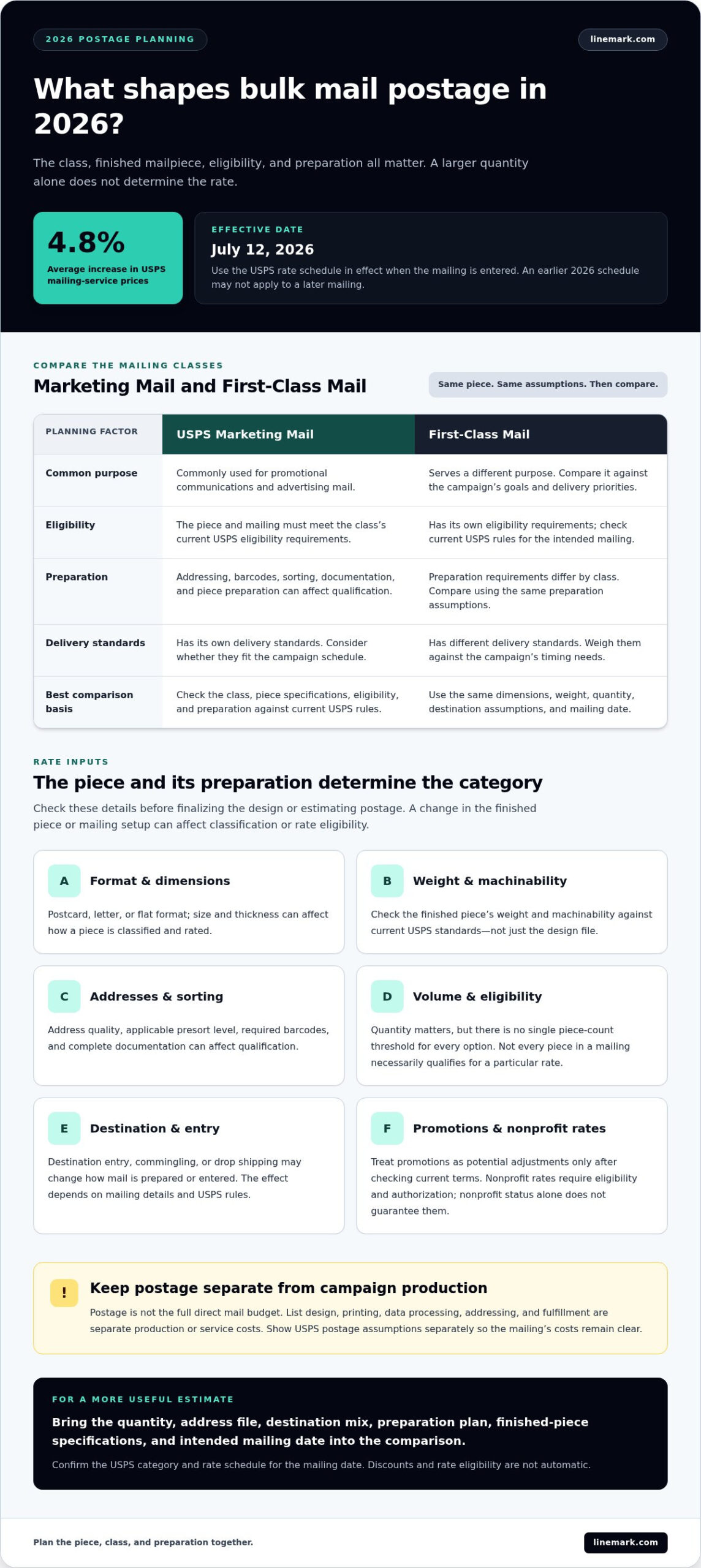
A larger mailing doesn’t automatically mean lower postage per piece. The bulk mail postage rates 2026 depend on the mailpiece, its eligibility, and how it’s prepared. The same campaign can produce different estimates depending on its specifications. USPS mailing-service prices increased by an average of 4.8% effective July 12, 2026, making current rate details especially important for planning.
If you’re unsure which mail class applies, how presort levels affect postage, or whether a design could change a piece’s rate category, you’re not alone. “Bulk mail” generally refers to USPS Marketing Mail for promotional campaigns, but discounts aren’t automatic. Format, weight, addressing, barcoding, sorting, and volume all help determine the applicable rate.
This guide explains the factors behind 2026 USPS bulk mailing rates, compares common mailing approaches using consistent assumptions, and lists the information you’ll need for a more useful campaign estimate. It also explains why print specifications and mailing preparation should be planned together, while keeping postage separate from production and fulfillment charges.
Key Takeaways
- Check a mailpiece’s dimensions, weight, shape, and machinability to identify which USPS rate category may apply before finalizing the design.
- Compare USPS Marketing Mail and First-Class Mail against the same campaign goals, delivery priorities, and preparation assumptions.
- For a more useful estimate of bulk mail postage rates 2026, gather the quantity, address file, destination mix, preparation plan, and intended mailing date.
- Coordinate print specifications, data processing, and mailing preparation, but keep postage estimates separate from production and fulfillment charges.
Bulk mail postage rates in 2026: what the term means
Bulk postage is USPS postage for a mailing, based on its mail class, eligibility, preparation, and the postal rules and rate schedule in effect on the mailing date. “Bulk mail” is commonly used to mean advertising mail, but it doesn’t identify one universal rate or guarantee a discount. USPS categories have their own qualification and preparation requirements. Sending a large quantity alone doesn’t determine the postage category or final amount.
For planning, “bulk mail” often refers to USPS Marketing Mail, a class used for promotional mail. The term is also used less formally, so identify the actual USPS category before estimating. This overview of what bulk mail means provides background, while USPS rules determine eligibility and postage.
For a closer look at how postage categories fit into campaign planning, watch this overview:
What counts as bulk mail for postage planning?
Bulk mailing describes how mail is sent. A discounted rate depends on meeting the requirements for the selected class and rate category. Those requirements may cover volume, addressing, barcodes, sorting, documentation, and piece preparation. There isn’t one piece-count threshold that applies to every mailing option. Check the USPS eligibility rules for the intended class and mailing date, and distinguish the total mailing quantity from the number of pieces that qualify for a particular rate.
Estimate bulk mail postage rates 2026 using the USPS rate schedule effective on the date the mailing is entered. USPS mailing-service prices changed effective July 12, 2026, so an earlier 2026 schedule may not apply to a later mailing. Confirm the applicable schedule when setting the budget and again as the mailing date approaches.
Postage versus the full direct mail budget
Postage is one part of a direct mail campaign’s cost. Design, printing, data processing, addressing, and fulfillment are separate production or service components, not USPS postage. Show them separately in the estimate so you can compare postage assumptions without mixing them with the cost of producing and preparing the mailing.
A practical budget lists the USPS category and postage calculation separately from print specifications, list processing, and distribution requirements. Planning these elements together helps align the piece and its preparation with the intended mailing approach, while keeping each cost visible. Quantity matters, but it doesn’t replace the eligibility and preparation details that shape the final postage category.
What determines bulk mail postage rates in 2026?
Bulk mail postage depends on the USPS class, mailpiece shape, dimensions, weight, machinability, preparation, and entry method. Nonprofit rates have separate eligibility requirements. Each factor can affect the rate category, so quantity alone won’t establish the final postage. The Postal Regulatory Commission explains the framework for setting postal rates and the roles of the USPS and regulators in What determines bulk mail postage rates.
Mail class, format, weight, and dimensions
USPS Marketing Mail and First-Class Mail serve different purposes and have distinct eligibility, preparation, and delivery standards. They aren’t interchangeable just because a piece has the same address or format. A postcard, letter, or flat may be classified and rated differently, and added weight or dimensions can affect that classification. Check current USPS standards for size, thickness, weight, and machinability against the finished piece, not just the design file.
Presort, address quality, and mailing preparation
Presorting means organizing mail according to USPS preparation rules, such as the applicable sort level and destination. Accurate addresses support processing, while required barcodes and complete mailing documentation help establish whether the mailing meets the selected category’s conditions. These steps can affect rate eligibility, but savings aren’t automatic. The mailing must meet current standards, and a larger quantity can’t replace compliant addresses, sorting, or documentation.
Promotions, nonprofit eligibility, and entry options
USPS promotions are separate from base postage rates. Their availability, terms, and qualification criteria can change, so treat an incentive as a potential adjustment only after checking current USPS guidance. Nonprofit rates aren’t a general discount for organizations with a nonprofit mission. Eligibility and authorization requirements apply, so verify them for the mailing and rate being considered.
Destination entry, commingling, or drop shipping may change how mail is prepared or entered into the postal network. The effect depends on the mailing’s details and applicable USPS rules. Compare each option using the same piece specifications, destination assumptions, and mailing date. Linemark’s direct mail services bring production and preparation planning together around project specifications and distribution needs.
Which 2026 bulk mailing option should you compare?
Start with the campaign’s purpose, audience, schedule, and finished mailpiece, not a rate alone. The bulk mail postage rates 2026 that apply depend on the selected class and whether the piece and its preparation qualify under current USPS rules. Use the same dimensions, weight, quantity, destination assumptions, and mailing date when comparing approaches.
Marketing Mail or First-Class Mail?
USPS Marketing Mail is commonly used for promotional communications. First-Class Mail may fit when the mailing’s purpose and delivery priority call for that class. Neither is universally cheaper or better. Eligibility rules, preparation standards, format, and service expectations differ, so check current USPS requirements and service information for the specific mailing.
| Option | Common formats | Preparation and eligibility | Delivery priority |
|---|---|---|---|
| USPS Marketing Mail | Eligible letters, flats, and other formats under applicable standards | Must meet current class requirements, including preparation and volume conditions where applicable | Use when the campaign can follow Marketing Mail service expectations; verify current USPS guidance |
| First-Class Mail | Eligible postcards, letters, and flats | Must meet the selected First-Class category’s format and preparation standards | May suit mailings with a higher delivery priority; confirm current service information |
Format matters. A postcard, letter, or flat may have different size, thickness, weight, and machinability standards. Classify the finished piece, not just its intended marketing use.
Presort, commingling, and destination entry
Presort organizes pieces by destination according to USPS rules. Commingling combines eligible mail from multiple sources for sorting. Destination entry involves transporting mail to a USPS facility closer to its delivery area. These methods can change preparation steps and transportation logistics, and may affect rates or qualification when current rules allow.
None guarantees savings. Compare the postage implications alongside added handling and transportation requirements, using the actual mailpiece, address file, destination mix, and mailing plan. Confirm that each approach meets current USPS standards before including an assumed benefit in the estimate.
When USPS promotions may change the calculation
USPS promotions are separate from base postage rates and may require enrollment or specific formats and campaign conditions. Before using one to compare options, verify the active 2026 dates, eligible mailpieces, and terms in current USPS program information. Treat a promotion as a conditional adjustment, not a rate that automatically applies to every campaign.
The right option is the one that fits the campaign’s goals, schedule, audience, and mailpiece specifications, with preparation and logistics costs considered alongside postage.
How to estimate 2026 bulk mail postage before production
A reliable estimate starts with the piece you intend to mail, not a generic rate chart. Gather the specifications and campaign assumptions first, then match them to the USPS rules and rate schedule that apply on the planned mailing date. An estimate of bulk mail postage rates 2026 is only as useful as its inputs, so flag details that may change before approving production.
The information to gather before checking rates
Build a working specification that records the campaign goal, quantity, audience, desired in-home timing, likely mail class, finished format, dimensions, material, and estimated weight. Include the address file’s status, destination mix, and intended preparation method. List assumptions about eligibility, presort, destination entry, or promotions separately so they can be verified rather than treated as settled facts.
A practical sequence for building an estimate
- Choose a likely mail class. Match the campaign purpose and timing needs to a candidate class. Then compare the actual piece with that class’s current format and eligibility standards.
- Verify the postal basis. Use the USPS schedule and qualification rules effective on the mailing date. Check preparation assumptions, including sorting and address requirements, against current guidance.
- Separate the cost components. Estimate postage using the qualifying piece count and applicable rate category. List printing, data processing, addressing, handling, and fulfillment or distribution separately.
- Revise using final specifications. Recalculate after reviewing artwork, finished dimensions, material, weight, quantity, and address data. A design or production change can alter the mailpiece details used in the estimate.
Illustrative estimate worksheet
- Campaign goal, audience, and quantity: [enter details]
- Mail class and eligibility assumptions: [enter and verify]
- Format, finished dimensions, material, and weight: [enter details]
- Address file, preparation method, and destination: [enter details]
- Planned mailing date and applicable USPS schedule: [verify]
- Estimated USPS postage: [calculate separately]
- Printing, data, handling, and fulfillment: [estimate separately]
Common estimating mistakes that distort the budget
Don’t reuse a past rate schedule without checking its effective dates, or assume every piece qualifies for the lowest visible category. Flag uncertainties in dimensions, weight, address quality, quantity, and incentive eligibility before production approval. Resolve them as the specifications firm up rather than burying them in a single postage total.
For a coordinated estimate that aligns mailing preparation with print specifications, plan your direct mail production with Linemark.
Plan bulk mail postage and production with Linemark
Postage planning works best when it’s connected to the decisions that shape the finished mailpiece. Size, weight, format, addressing, and preparation all affect how a mailing is produced and assessed under USPS rules. Linemark coordinates direct mail production with data processing, variable data printing, and fulfillment, aligning project specifications with distribution needs.
Keep the USPS postage estimate separate from project-based costs for printing, data, handling, and fulfillment. This makes the budget easier to review and prevents changes to production specifications from obscuring the postage assumptions behind your bulk mail postage rates 2026 estimate.
Coordinate print specifications with mailing requirements
Before production, align the intended mail class with the final size, weight, format, and addressing plan. A change to the piece can affect its postal category or preparation needs, so early coordination helps identify those dependencies before specifications are locked. Data processing and variable data printing can support prepared, personalized mail by connecting address information with the printed piece. Postal eligibility and rates still depend on applicable USPS rules.
Move from rate research to a project plan
Bring the core campaign details together to establish a practical starting point for planning:
- Mailing quantity, audience, and distribution needs
- Format, dimensions, material, and estimated finished weight
- Likely USPS mail class and preparation assumptions
- Address-file readiness and any variable data requirements
- Target schedule, including the intended mailing date
With these inputs, printing, direct mail, data processing, and fulfillment can be planned as connected parts of one workflow, while USPS postage remains a separate estimate based on the applicable rate schedule and qualification rules. As final artwork, weight, quantity, and address data are confirmed, refine the project plan to reflect the mailing more accurately.
For a coordinated approach from specifications through distribution, plan your direct mail project with Linemark.
Make your next mailing easier to plan
Accurate bulk mail postage rates 2026 estimates start with the right USPS class, verified mailpiece specifications, compliant preparation, and the rate schedule effective on your mailing date. Compare options against the campaign’s audience and timing, and keep postage separate from printing, data processing, and fulfillment expenses.
Planning production and mailing together can make those details easier to manage. Linemark coordinates direct mail with variable data printing, fulfillment, storage, and distribution, aligning project specifications with campaign needs. Founded in 1985, Linemark brings more than 30 years of experience to coordinated print and mail programs.
Bring your quantity, format, schedule, audience, address-file status, and likely mail class into your project planning. Plan your direct mail project with Linemark and move from rate research to a production plan built around your specifications.
Frequently Asked Questions
What are the bulk mail postage rates for 2026?
There isn’t one rate for every bulk mailing. Effective July 12, 2026, commercial USPS Marketing Mail automation letter rates are $0.395 per piece at the 5-Digit tier, $0.435 at 3-Digit, and $0.467 at Mixed. Nonprofit automation letter rates are $0.185, $0.225, and $0.257 at those respective tiers. EDDM Retail flats are $0.260 per piece. These examples apply only to eligible pieces that meet the relevant USPS requirements.
How does USPS calculate bulk mail postage?
USPS postage depends on the mail class and rate category, along with the piece’s format, dimensions, weight, and preparation. Address quality, barcodes, presort level, and documentation can affect whether a mailing qualifies for a particular rate. The lowest rate shown in a table won’t necessarily apply to every piece. Calculate using the USPS schedule and rules effective on the planned mailing date, based on the final mailing specifications.
Is USPS Marketing Mail the same as bulk mail?
Not exactly. “Bulk mail” is a common informal term for qualifying mailings sent in volume, especially advertising mail. USPS Marketing Mail is an official mail class often used for promotional campaigns. The terms are sometimes used interchangeably in conversation, but they aren’t a substitute for identifying the applicable USPS class. Marketing Mail has specific eligibility and preparation requirements, so confirm the class and standards for the campaign.
Can a small business qualify for bulk mail rates?
Yes. A small business can qualify if its mailing meets the applicable USPS class requirements. Company size alone doesn’t determine eligibility. The supplied 2026 guidance lists a minimum of 200 identical pieces or 50 pounds for USPS Marketing Mail, and 500 pieces for Presorted First-Class Mail. Those thresholds don’t guarantee a particular rate. Preparation, mailpiece standards, and other current USPS requirements still apply.
What factors can change the postage rate for a mailpiece?
Mail class, weight, dimensions, shape, and machinability can change which rate category applies. Preparation matters too: presort level, address accuracy, required barcodes, documentation, and eligibility can affect qualification. For example, a postcard that exceeds the applicable postcard standards may be rated as another mailpiece format. Check USPS size and preparation rules against the finished piece, since a design or material change can affect its postal treatment.
Do USPS promotions reduce bulk mail postage in 2026?
Some USPS promotions may provide an incentive for eligible mailings, but they’re separate from base postage rates and don’t apply automatically. Program dates, eligible formats, enrollment steps, and other conditions can change. Before including an incentive in a budget, verify the active 2026 program terms and confirm that the campaign meets them. Keep any potential promotion separate from the base-rate calculation until qualification is established.
How can I estimate postage before printing a direct mail campaign?
Gather the planned quantity, mail class, final format and dimensions, estimated weight, address-file status, preparation approach, destination mix, and mailing date. Use those inputs to check current USPS rates and eligibility rules for that date. Mark uncertain specifications as assumptions, then update the estimate after artwork, data, and production details are finalized. Keep postage separate from printing, data processing, handling, and fulfillment estimates for a clearer campaign budget.
What is the difference between postage and direct mail fulfillment costs?
Postage is the amount paid to USPS to carry eligible mailpieces through the postal system. Direct mail production and fulfillment costs are separate project components, such as printing, data processing, addressing, kitting, storage, handling, and distribution. Show these categories separately rather than combining them into one total. This makes it easier to review USPS rate assumptions alongside the campaign’s production and logistics plan.