

 07/14/2026
  Steve Bearden
Your brand’s physical touchpoint is often the only thing standing between a secured partnership and a discarded brochure. It’s a common challenge in high-volume marketing; materials frequently feel generic or fail to withstand the rigors of logistics, showing wear and smudging far too quickly. You deserve collateral that mirrors the precision and innovation of your own operations without the technical headaches often associated with specialty production.
By integrating spot UV coating into your commercial projects, you move beyond simple ink on paper to create a sophisticated, tactile brand experience. This professional guide provides the technical clarity you need to master specialty finishes, ensuring your direct mail and book covers achieve maximum impact through sensory contrast. We will explore the industrial durability of UV applications, the strategic positioning of high-gloss finishes, and the exact steps required to prepare your design files for a flawless, production-ready result.
Key Takeaways
- Understand the technical mechanism of spot UV coating and how targeted polymer application creates a sophisticated, high-contrast finish.
- Learn why specific substrates, such as matte lamination, are critical for maximizing the tactile and visual impact of your specialty designs.
- Discover how industrial finishing techniques enhance the durability of book covers and marketing materials, preventing premature wear and smudging.
- Master the technical requirements for production-ready design files to ensure perfect registration across large-scale commercial runs.
- Explore strategic applications for annual reports and direct mail that leverage sensory contrast to drive higher recipient engagement.
What is Spot UV Coating? Definition and Mechanism
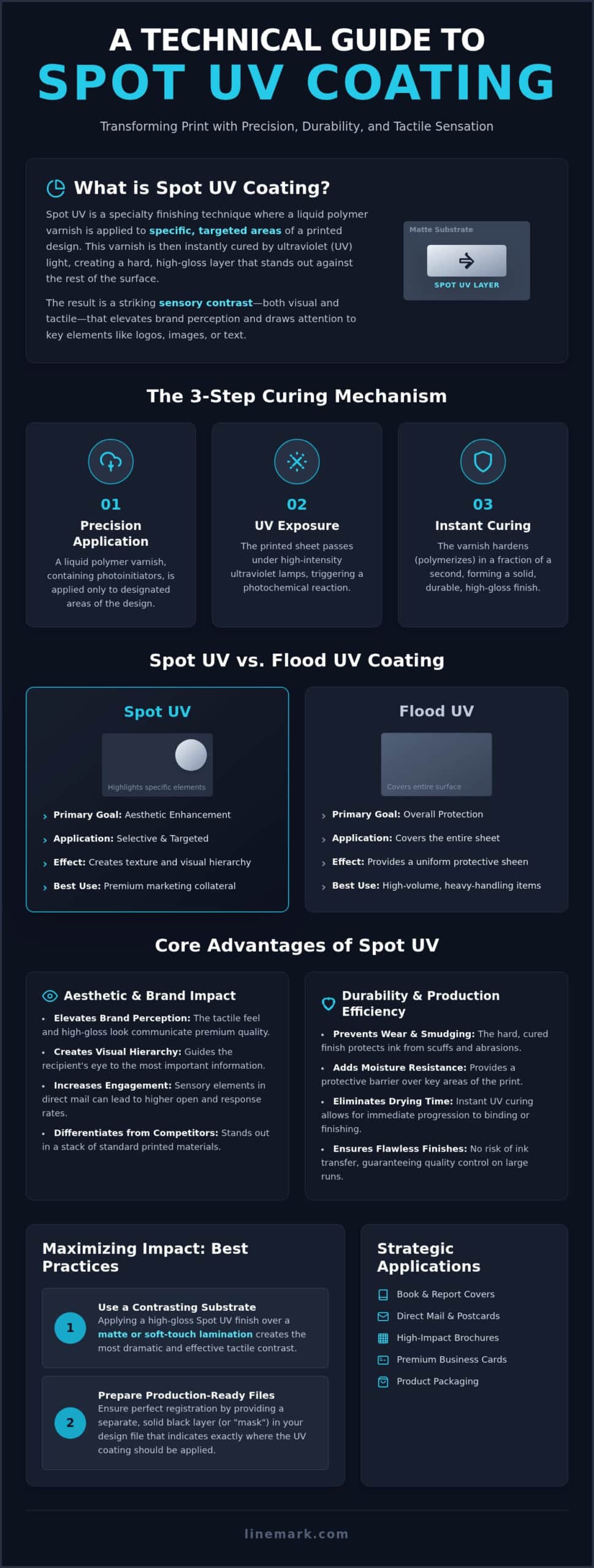
A UV coating is a liquid polymer that undergoes a rapid transformation when exposed to ultraviolet light. Unlike traditional varnishes that rely on evaporation or oxidation, this process creates an instant, hard finish. In the context of spot UV coating, this technique is applied selectively. We apply the varnish only to specific design elements, such as a logo or a product image, rather than the entire surface. This targeted application creates a striking interplay between the untreated substrate and the high-gloss polymer, focusing the recipient’s attention exactly where it matters most.
To visualize how this precision technology operates in a modern production environment, watch this demonstration of digital spot UV application:
The visual depth achieved through this method relies on sensory contrast. When we apply a gloss UV finish over a matte-laminated substrate, the light reflects off the coated areas while the rest of the page remains muted. This creates a tactile experience that guides the viewer’s eye through the layout. The mechanism behind this is polymerization. Inside our industrial equipment, UV lamps trigger a chemical reaction in the varnish, causing it to bond to the paper and harden in a fraction of a second. It’s a precise, high-tech solution for brands that value both speed and sophistication.
Spot UV vs. Traditional Flood Coating
Flood UV serves a primary role of protection. It covers the entire sheet to prevent scuffing and moisture damage, making it an efficient choice for high-volume catalogs or postcards that face heavy handling. Conversely, spot UV coating is a strategic aesthetic tool. It’s used to elevate a brand’s positioning by highlighting intricate details. While flood coating is often more cost-effective for general protection, the selective nature of spot application provides a higher return on investment for premium marketing materials. In commercial runs, we help you determine the best approach based on whether your priority is industrial-grade durability or sophisticated visual impact.
The Science of UV Curing in Industrial Printing
The efficiency of our 90,000-square-foot facility depends on the speed of production. This speed is made possible by photoinitiators within the varnish formula. These chemicals absorb UV energy and immediately convert the liquid coating into a solid film. UV curing is a photochemical process that eliminates drying time and volatile organic compounds. This technology allows for rapid turnaround on complex projects like annual reports and custom books. Because the finish is cured instantly, we can move directly to binding and finishing without the risk of ink transfer or smudging, ensuring end-to-end quality control for every project.
The Business Case for Spot UV: Aesthetics and Durability
Choosing a finish for your commercial print projects involves more than just visual preference. It is a strategic decision that impacts brand equity and operational longevity. Incorporating spot UV coating serves as a powerful differentiator in a crowded market. By isolating specific design elements with a high-gloss polymer, you create a hierarchy of information that guides the viewer’s eye toward your most critical messaging. This level of precision transforms a standard brochure into a high-impact communication tool that commands attention.
The technical execution of this finish mirrors industrial standards found in the OSHA screen printing process, where UV light is utilized to cure and harden materials for maximum stability. In a commercial environment, this translates to a product that doesn’t just look better; it performs better. For marketing executives, the investment in specialty finishing is justified by measurable increases in engagement. Direct mail pieces with textured or high-gloss elements often see higher open rates because they provide a sensory experience that digital channels cannot replicate.
Elevating Brand Perception with Tactile Contrast
The psychology of touch plays a vital role in how clients perceive value. When a recipient feels the raised, smooth texture of a gloss finish against a matte background, their brain registers the item as premium. This tactile sensory experience is essential for corporate annual reports and luxury catalogs where brand positioning is paramount. We use these techniques to highlight fine details in high-end photography, adding a layer of depth that makes images appear three-dimensional. If you are looking to refine your brand’s physical presence, our team can help you integrate these advanced finishing solutions into your next campaign.
Durability for High-Traffic Commercial Materials
Aesthetics are only half of the equation. Industrial-grade durability is a core requirement for high-volume production. Spot UV coating provides a resilient barrier that protects printed surfaces from finger oils, moisture, and scuffing. This is particularly critical for custom book manufacturing, where covers must withstand constant handling and shelf wear without losing their visual integrity. In the direct mail sector, this coating ensures that postcards and envelopes survive the abrasive mechanical sorting processes of the postal service. By reinforcing the most vulnerable areas of your print collateral, you preserve the color and clarity of your graphics for the long term.
Designing for Spot UV: Technical Requirements and Best Practices
Registration remains a hallmark of professional execution. In our 90,000-square-foot facility, we utilize advanced camera registration systems to ensure the coating aligns perfectly with your printed graphics. However, designers must still account for physical tolerances. We recommend maintaining a minimum line weight of at least 0.5pt to 1pt. If lines are too thin, the liquid polymer may not adhere consistently. Conversely, placing small elements too close together can cause the varnish to “fill in,” resulting in a loss of detail. For a sophisticated, subtle look, consider “blind” spot UV. This involves applying the varnish over unprinted areas of the page to create ghosted patterns or textures that only become visible as the reader tilts the piece.
Creating Production-Ready Mask Files
Your production team requires a clear roadmap to execute your vision. We need a separate layer or a dedicated file designated as the UV mask. This mask should utilize 100% K (Solid Black) to indicate exactly where the polymer should be applied. While high-resolution raster files are acceptable, vector paths are the preferred standard. Vector edges remain crisp regardless of the scale, preventing the “fuzziness” or pixelation that can occur with rasterized masks. This ensures the edges of your logos and taglines are sharp and professional. Our experts in Binding & Finishing can review your files to ensure they meet these industrial specifications before the run begins.
Choosing the Ideal Substrates for UV Adhesion
High-performance UV adhesion requires a stable and receptive surface. Heavier stocks, such as 16pt and 19pt, provide the structural integrity needed to prevent the paper from curling during the rapid curing process. It is also vital to consider the chemistry of your inks. Some digital toners contain silicone or wax additives that can repel the coating, leading to “orange peel” textures or flaking. In these instances, we often recommend a specific lamination or primer to ensure a permanent bond. This level of technical oversight is why we have maintained our reputation for operational excellence for over 30 years.
Strategic Applications: From Custom Books to Direct Mail
While many providers focus on entry-level collateral like business cards, the true power of spot UV coating lies in its ability to scale across complex, high-volume commercial projects. Large organizations require a strategic partner capable of maintaining precision across diverse formats; this includes everything from annual reports to sophisticated marketing portals. These high-capacity applications demand more than just a glossy finish. They require an expert understanding of how tactile elements influence stakeholder perception and operational efficiency in a competitive market.
Annual reports serve as a prime example of this strategic positioning. These documents are often the primary physical touchpoint for investors and board members. By applying a selective UV finish to key financial charts or corporate branding, you signal a level of stability and attention to detail that standard printing cannot match. For distributed marketing teams, our MarCom On-Demand portals streamline the ordering of these materials. This ensures every branch or regional office has access to premium, UV-finished collateral without the logistical burden of managing multiple vendors or inconsistent quality across different runs.
Custom Book Printing and Cover Enhancements
Custom book manufacturing requires a meticulous approach to cover design, as the cover is your most critical sales tool. We often use high-build UV to highlight title typography and author names, creating a three-dimensional effect that invites the reader to touch the book. It’s essential to balance this application with binding requirements. For instance, we carefully manage the placement of the coating near score lines and hinges to prevent cracking or adhesion failure during the binding process. You can learn more about our custom book printing capabilities and how we integrate advanced finishing into every professional project.
Increasing Direct Mail ROI with Sensory Texture
Sensory texture is a proven catalyst for engagement in the direct mail sector. Using spot UV coating on postcards or envelopes can significantly increase open rates by providing an unexpected tactile experience. We recommend using the finish to draw immediate attention to Call-to-Action (CTA) buttons or promotional codes. When combined with variable data printing, this allows for a personalized, high-touch experience that resonates with specific customer segments. Explore our direct mail fulfillment solutions to see how we combine technological precision with strategic distribution models.
Ready to elevate your next project? Contact our production team to discuss how our finishing capabilities can support your brand’s growth and market positioning.
Scaling Your Impact with Linemark’s Advanced Finishing
Executing a high-impact campaign requires more than just technical knowledge; it demands a partner with the infrastructure to scale. Our 90,000-square-foot facility is engineered to handle the complexities of high-volume commercial runs while maintaining the precision your brand requires. By centralizing spot UV coating and binding under one roof, we eliminate the risks associated with multi-vendor handoffs. This integrated approach ensures that every piece, from the first to the fifty-thousandth, meets our rigorous standards for quality and registration.
We’ve spent over 30 years refining our production workflows to support national brands that cannot afford inconsistencies. Our team acts as an agile problem-solver, identifying potential production hurdles before they impact your timeline. This proactive spirit, combined with our technological pride, positions us as a strategic communications ally rather than a transactional vendor. We understand that your print collateral is a catalyst for growth, and we treat every project with the meticulous attention to detail it deserves.
Industrial-Scale Finishing for National Brands
National brands face the unique challenge of maintaining visual consistency across diverse geographic regions and marketing channels. We manage these complex orders by leveraging industrial-grade equipment that guarantees perfect registration on even the largest runs. Whether you’re producing premium brochures or large-format graphics, our centralized production model offers several distinct advantages:
- End-to-End Quality Control: In-house finishing means we monitor every stage of the process, from the initial digital or offset print to the final UV cure.
- Shipping Efficiency: Integrated logistics allow us to move directly from the finishing line to national distribution, significantly reducing transit times and overhead.
- Multi-Channel Consistency: We ensure the tactile quality of your UV-finished materials matches the branding across your catalogs, postcards, and annual reports.
A Unified Approach to Marketing Communications
Innovation is at the core of our service model. We offer the ability to integrate spot UV coating directly into your MarCom On-Demand portal. This allows your distributed teams to order high-impact, production-ready materials with the click of a button, ensuring brand compliance across your entire organization. Our experience in kitting and fulfillment further streamlines the journey from the press to the end recipient.
Your next project deserves the precision of a boutique shop backed by the capacity of a world-class facility. Contact our team today for a custom quote and discover how our advanced finishing capabilities can transform your marketing collateral into a powerful, sensory brand experience.
Mastering Your Next High-Impact Production
Integrating spot UV coating into your marketing strategy is more than a design choice; it’s a commitment to professional excellence and sensory engagement. You’ve seen how the interplay of light and texture elevates custom books and direct mail from standard collateral to premium brand assets. Success in these complex applications depends on technical precision and the use of appropriate substrates to ensure industrial-grade durability and visual contrast.
With over 30 years of commercial printing expertise, we provide the operational stability needed for high-volume projects. Our 90,000-square-foot production facility is engineered to manage every detail from precise varnish registration to integrated kitting and nationwide fulfillment. This centralized approach ensures your brand’s vision remains consistent across every delivery point. We don’t just provide a service; we serve as a strategic ally in your growth, ensuring your projects are handled with meticulous care.
Take the next step in your brand’s evolution and Request a Custom Quote for Your Spot UV Project today. We’re ready to transform your technical requirements into a streamlined, high-tech reality that drives measurable results and lasting impressions.
Frequently Asked Questions
What is the difference between spot UV and spot gloss?
Spot UV refers to the specific industrial process of using ultraviolet light to cure a liquid polymer, while spot gloss describes the visual result. While most UV applications are high-gloss, the technology can also produce matte or textured finishes. Spot gloss is a more general term that may include traditional varnishes or aqueous coatings that don’t utilize the same rapid UV curing mechanism.
Can spot UV be applied to both sides of a printed piece?
We can apply this finish to both sides of a project to create a comprehensive sensory experience. This is a common requirement for premium postcards and brochures where brand positioning must be consistent from every angle. Our production team manages the curing passes carefully to ensure the first side remains protected while the second side undergoes the polymerization process.
Does spot UV coating affect the recyclability of paper?
UV-coated paper remains generally recyclable within standard industrial paper streams. During the recycling and de-inking process, the cured polymer is separated from the paper fibers along with the inks. This allows for the recovery of high-quality fiber, making spot UV coating a viable choice for brands that prioritize both high-impact aesthetics and environmental responsibility.
What is the minimum font size recommended for spot UV application?
We recommend a minimum font size of 8pt for sans-serif typefaces and 10pt for serif or script fonts. If the type is too small, the liquid varnish may bridge the gaps between characters, causing the text to appear blurred or filled in. Maintaining these minimums ensures that the edges of your typography remain crisp and legible after the curing process is complete.
Can I use spot UV on thin paper stocks like 80lb text?
We advise against applying UV coatings to thin stocks like 80lb text because the curing process can cause the paper to curl or buckle. For a professional result, we recommend using at least 100lb cover or heavier 16pt and 19pt stocks. These thicker materials provide the structural stability necessary to withstand the rapid application and drying of the polymer.
What is “Raised” or “3D” spot UV compared to standard flat UV?
Standard flat UV provides a thin, smooth layer of gloss that sits flush with the paper surface. Raised or 3D spot UV coating utilizes a high-build application to create a tangible, embossed effect that you can feel. This technique adds significant tactile depth to logos and patterns, creating a more pronounced sensory contrast than the flat version.
How does spot UV interact with metallic inks or foil stamping?
Spot UV can be layered over metallic inks to amplify their reflective properties and add a protective barrier. When used alongside foil stamping, we typically apply the UV as a separate pass to ensure it doesn’t interfere with the foil’s adhesion. This combination of finishes creates a sophisticated, multi-layered appearance that signals high value and attention to detail.
Is spot UV coating cost-effective for short-run digital projects?
Digital finishing technology has made this specialty finish highly accessible for short-run projects. Because modern equipment doesn’t require the expensive plates or screens used in traditional offset printing, we can produce small quantities with minimal setup time. This allows smaller campaigns and personalized projects to benefit from the same premium positioning as high-volume commercial runs.