


 07/15/2026
  Steve Bearden
While digital noise continues to saturate every screen, direct mail delivers a median ROI of 29%, nearly double the return of online display ads. You likely recognize the power of a physical touchpoint, yet scaling that impact through high-volume postcard printing services often reveals deep cracks in fragmented workflows. It’s frustrating to manage separate vendors for production and fulfillment, especially when a lack of personalization or logistical delays prevents your message from hitting the mark. You need a more cohesive approach to maintain control over your brand’s physical presence.
This guide explores how to leverage professional production and integrated logistics to scale your marketing ROI while streamlining national distribution. We’ll show you how a single-source partner can utilize variable data printing to boost response rates by up to 50% and navigate the July 2026 USPS rate changes with precision. From proprietary MarCom portals to advanced kitting, you’ll discover a roadmap for turning complex mailings into a high-tech, high-impact reality that drives measurable growth without the operational headaches. We’re moving beyond simple transactions to create a strategic communications journey that delivers results at scale.
Key Takeaways
- Learn how Variable Data Printing (VDP) transforms static mailers into hyper-personalized assets that can increase response rates by 30-50%.
- Navigate 2026 USPS requirements and material selection by utilizing professional postcard printing services optimized for durability and postage efficiency.
- Centralize brand control across distributed teams through MarCom On-Demand portals that provide customizable templates while maintaining corporate standards.
- Eliminate logistical friction by integrating production, kitting, and nationwide fulfillment under one high-capacity roof to ensure precision delivery at any scale.
The Strategic Advantage of Professional Postcard Printing Services
Digital fatigue is a measurable reality for modern consumers. While screens dominate our attention, they often fail to create the lasting memory markers that physical media provides. Physical mail bypasses the “delete” button reflex by engaging the sense of touch, creating a sensory connection that pixels simply cannot replicate. It’s a strategic move that high-growth brands use to reclaim audience attention in a crowded marketplace. Professional postcard printing services provide the operational backbone required to translate creative vision into physical reality at scale.
Since the early history of postcards, these mailers have evolved from simple correspondences into sophisticated marketing vehicles. Today, direct mail offers a median ROI of 29%, which significantly outperforms paid search and online display ads. The psychological impact of a physical card creates a sense of permanence. While an email can be deleted in a fraction of a second, a high-quality postcard often sits on a desk or kitchen counter, creating multiple impressions over several days.
To better understand how to integrate these physical assets into your broader marketing strategy, watch this helpful video:
Tangible Marketing in a Digital World
The response rate for direct mail sent to house lists is approximately 5.3%, while email often struggles to reach 0.6%. This disparity highlights the immense value of physical touchpoints in consumer decision-making. A postcard isn’t just a piece of paper; it’s a bridge to your digital ecosystem. By integrating QR codes or personalized URLs (PURLs), you can track engagement with the same precision as a digital campaign. It’s about creating a unified journey that begins at the mailbox and ends at a digital conversion, ensuring your brand remains top-of-mind throughout the process.
Cost-Efficiency and Scalability
Postcards offer the most cost-effective entry point for high-volume direct mail campaigns. Their streamlined format leads to lower postage rates and production costs, making them ideal for nationwide saturation or highly targeted local drops. High-volume runs allow for a remarkably low cost-per-acquisition, especially when compared to the volatile pricing of digital ad auctions. Commercial-grade production is essential for professional brand standards, ensuring that every piece reflects your organization’s commitment to quality and precision across thousands of units.
By moving away from transactional printing and toward a strategic partnership, you gain access to industrial-scale efficiency. You aren’t just buying ink on cardstock. You’re leveraging a sophisticated logistics engine that handles everything from variable data personalization to national fulfillment. This holistic approach transforms a simple mailer into a powerful tool for customer retention, event promotion, and brand awareness.
Technical Specifications: Choosing the Right Materials and Finishes
The physical integrity of a mailpiece dictates its reception. When selecting postcard printing services, the technical specifications you choose aren’t just aesthetic preferences; they’re functional requirements. High-volume mailers must survive the industrial sorting equipment of the USPS while maintaining a premium appearance. Understanding the strategic advantage of direct mail involves balancing these technical constraints with your brand’s visual goals.
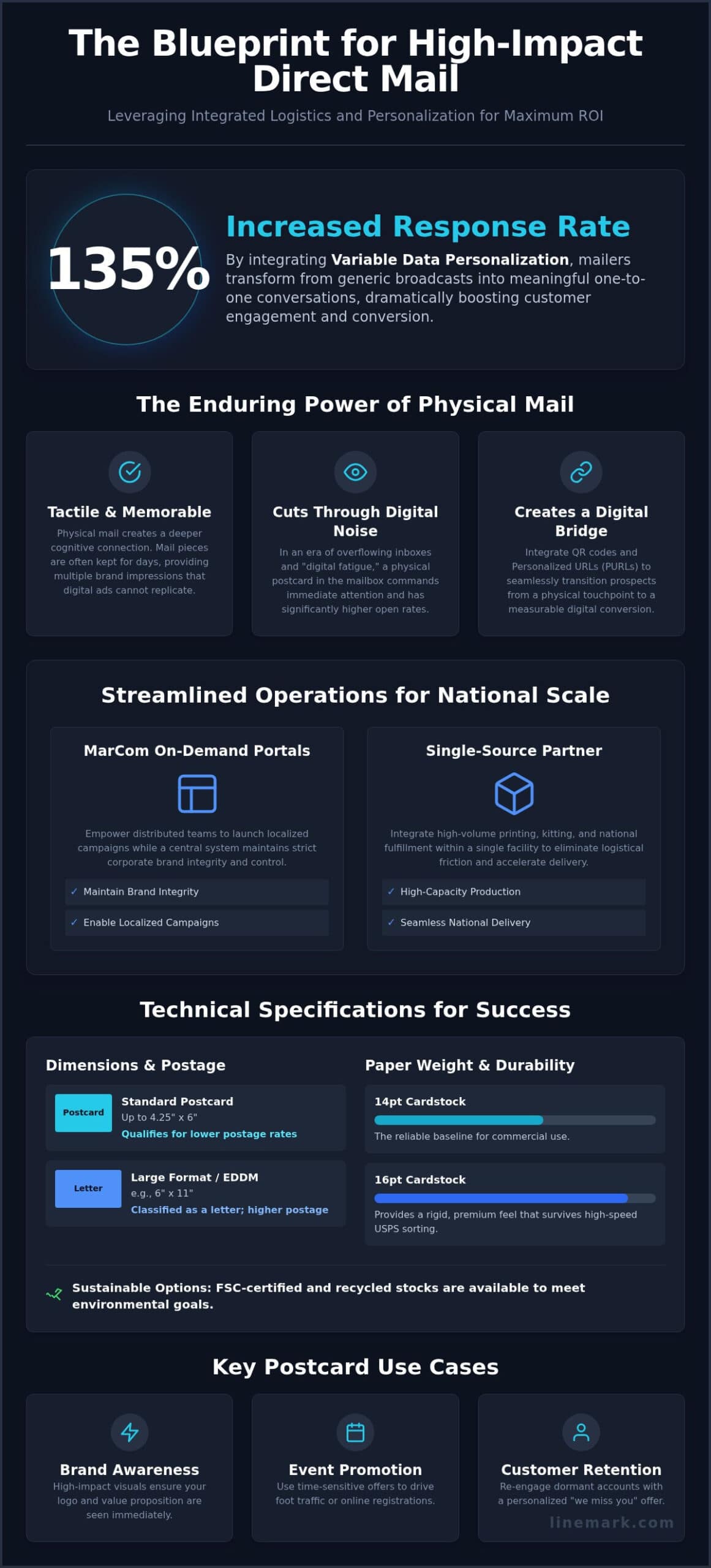
Standard sizes like 4×6 inches are often chosen for their efficiency. However, larger 6×9 formats provide more real estate for complex messaging and variable data. As of July 12, 2026, the USPS postage rate for a standard domestic postcard is $0.65. This investment requires a card that won’t tear or smudge during transit. It’s a technical challenge that demands precision at every stage of the production cycle.
Paper Weight and Durability
Industrial standards for high-capacity mailings typically start at 14pt cardstock. For a more substantial, professional feel, 16pt or premium substrates are preferred. Weight matters because it signals quality to the recipient before they even read the copy. It also ensures the card remains rigid throughout the automated delivery chain, preventing the dog-eared corners that can occur with thinner materials.
Modern production now accommodates rigorous corporate social responsibility goals through sustainable, FSC-certified paper options. Choosing between coated and uncoated stocks depends on your design intent. Coated stocks offer better ink holdout for vibrant photography, while uncoated stocks provide a tactile, organic texture. If you’re planning a complex campaign, reviewing a comprehensive guide to direct mail can help align your material choices with your distribution strategy.
Finishing Techniques for Visual Impact
Protective coatings are essential for preserving the clarity of your message. High-gloss UV coating is a popular choice for its ability to make colors pop and provide a layer of weather resistance. It creates a durable shield that prevents scuffing as cards move through high-speed sorters. Choosing professional postcard printing services allows you to access industrial-scale finishing options that smaller shops simply can’t provide.
For brands targeting a high-end demographic, matte or soft-touch finishes offer a sophisticated, velvet-like texture. These finishes reduce glare and invite the recipient to linger on the card. Specialized techniques like spot UV or foil stamping can be applied to highlight specific elements, such as a call-to-action or a brand logo. These tactile enhancements transform a standard mailer into a premium brand asset that commands attention. Commercial-grade production ensures these finishes are applied with microscopic precision, maintaining consistency across a run of ten thousand or one million pieces.
Maximizing ROI with Variable Data Printing and Direct Mail
Static mailings are a relic of a transactional era. In 2026, the most effective postcard printing services rely on Variable Data Printing (VDP) to bridge the gap between mass production and individual relevance. This technology allows for the simultaneous output of unique content across a high-volume run without compromising industrial speed. It’s the difference between a generic flyer and a personalized invitation that speaks directly to a customer’s past behavior, geographic location, or specific needs. We view data not just as a mailing list, but as a roadmap for strategic engagement.
The Power of Personalization
Personalization is the primary driver of modern direct mail success. Industry data shows that variable data printing can increase response rates by 30% to 50% compared to static campaigns. While competitors often limit their services to basic address printing, a sophisticated approach uses data to swap out imagery, adjust promotional offers, or highlight the nearest physical location for each recipient. For instance, a homeowner in Southwest Florida might be prompted to visit Ultra Air Heating and Cooling for an AC tune-up. Variable data printing enables 100% unique messaging on every card, ensuring that every piece of mail serves as a targeted touchpoint rather than a broad broadcast.
This level of tailoring is especially effective for customer retention and win-back campaigns. For example, a national retailer can send a postcard featuring the exact product a customer left in an abandoned cart, combined with a unique QR code for a personalized discount. This creates a seamless transition from a physical reminder to a digital conversion. Managing these complex data sets requires a partner who prioritizes data security and meticulous list management to protect your brand’s integrity during large-scale distributions.
Seamless Direct Mail Integration
Fragmented workflows between a printer and a mail house often lead to costly delays and data errors. Utilizing a single-source partner for direct mail fulfillment eliminates these friction points by keeping the entire lifecycle under one roof. We handle the technical heavy lifting, including CASS certification and the National Change of Address (NCOA) service, to ensure your list meets strict USPS standards. These steps are critical to qualify for automation discounts and avoid the delivery failures that drain marketing budgets.
The logistics of direct mail have become more complex following the July 12, 2026 USPS structural changes, which eliminated certain rate categories and restructured periodicals pricing. Whether you’re deploying a targeted prospect list or using Every Door Direct Mail for broad geographic saturation, integrated logistics ensure your assets move from the press to the mailbox with industrial precision. By embedding digital markers like PURLs or unique coupon codes, you can track campaign performance in real-time, allowing you to measure ROI with the same clarity as your digital channels.
MarCom On-Demand: Scalable Solutions for Distributed Teams
Managing decentralized marketing efforts often leads to brand erosion and logistical chaos. When individual branches or sales teams source their own postcard printing services, the risk of inconsistent color matching and outdated logo usage increases exponentially. A proprietary MarCom On-Demand portal eliminates these risks by centralizing all physical marketing assets in a secure, cloud-based environment. This technology serves as a single source of truth, ensuring that every piece of mail, regardless of its origin, meets corporate standards for precision and quality.
Maintaining Brand Integrity at Scale
Consistency is the cornerstone of trust in high-volume communications. Our portal allows headquarters to lock down critical design elements such as logos, color palettes, and legal disclaimers. Local teams are then empowered to customize specific fields within pre-approved templates, such as agent contact information or regional event details. For a lending institution like Bond Mortgage Solutions, this balance of control and flexibility ensures that your brand’s visual identity remains cohesive across a national footprint while adhering to industry-specific regulations.
Integrated approval workflows provide another layer of security. Marketing directors can review and approve local orders before they hit the production floor, providing total oversight of marketing spend and messaging. This streamlined process reduces the administrative burden on corporate marketing departments, transforming them from fulfillment coordinators into strategic overseers. By automating these repetitive tasks, your team can focus on high-level strategy while we handle the industrial-scale production.
Efficiency in Distribution
The transition from a digital order to a physical mailbox should be seamless. Our system automates the entire workflow, utilizing real-time tracking to provide status updates from the moment an order is placed through to final fulfillment. This visibility is crucial for coordinated multi-channel campaigns where timing is everything. Automated production triggers reduce lead times, allowing local branches to respond quickly to market shifts or seasonal opportunities without waiting for manual intervention from HQ.
Strategic inventory management further optimizes your marketing budget. By leveraging our 90,000-square-foot facility, organizations can utilize on-demand printing and sophisticated warehousing to eliminate the costs associated with obsolete materials. We also provide specialized kitting services, allowing you to combine postcards with other collateral into complex marketing kits. This holistic approach to logistics ensures that your assets are stored, packed, and distributed with the same meticulous attention to detail as the printing itself.
Ready to centralize your marketing operations? Request a demonstration of our MarCom On-Demand portal to see how we can streamline your distributed marketing efforts.
Full-Service Fulfillment: From Production to National Delivery
The final stage of a strategic direct mail campaign is often the most critical: the transition from a digital file to a physical mailbox. Choosing postcard printing services that offer integrated fulfillment isn’t just a convenience; it’s a safeguard against the logistical friction that often derails high-volume campaigns. When production and distribution happen under one roof, the risk of data misalignment or shipping delays is virtually eliminated. This unified approach transforms a transactional service into a streamlined logistics engine designed for national scale.
Industrial Production Capacity
Selecting the right technology for your volume is essential for maintaining both quality and budget. For massive, nationwide saturation, high-volume offset printing offers superior cost-efficiency and consistent color reproduction across millions of pieces. Conversely, digital printing provides the agility needed for the variable data personalization required for targeted segments. Our 90,000-square-foot facility provides the industrial footprint necessary to manage high-volume postcard production and complex kitting projects with unmatched speed and precision.
This capacity is particularly vital for complex marketing kits that require more than just a single card. We manage the intricate assembly of mixed-media campaigns, ensuring that postcards, catalogs, and personalized brochures are accurately kitted and prepared for distribution. This industrial-scale capability ensures that even the most ambitious projects are handled with the meticulous attention to detail usually reserved for boutique operations. It’s about having the mechanical and technical resources to scale without sacrificing the integrity of the brand.
Nationwide Distribution Logistics
True national distribution requires more than just a mailing permit. It demands a sophisticated understanding of postal entry optimization and strategic drop shipping. By entering the mail stream at regional USPS facilities closer to the final destination, we can significantly reduce transit times and postage costs. This strategy is essential for ensuring simultaneous national arrivals, which is critical for time-sensitive promotions or synchronized multi-channel launches. You need to know that a card sent to Seattle will arrive in the same window as one sent to Miami.
The USPS network modernization effective July 12, 2026, has introduced new structural complexities to mail processing and rate categories. A high-capacity partner navigates these changes by utilizing CASS-certified software and NCOA services to maintain list hygiene and qualify for the best possible rates. The Linemark promise is built on this foundation of precision, scale, and strategic partnership. We don’t just print; we orchestrate a holistic journey that ensures your message reaches its destination with industrial reliability. This level of operational excellence allows your marketing team to focus on growth, knowing the logistics are in capable, steady hands.
Scale Your Vision with Strategic Direct Mail Precision
The future of high-volume marketing lies in the seamless integration of data-driven personalization and industrial-scale execution. We’ve explored how modern postcard printing services have evolved into a complex interplay of variable data technology, brand-controlled portals, and precise national logistics. By centralizing these functions within a single-source partner, you eliminate the operational fragmentation that often leads to brand erosion and missed opportunities. It’s about moving beyond simple transactions to embrace a holistic communications strategy.
Our 90,000-square-foot facility and over 30 years of commercial print expertise provide the reassuring stability your organization requires for complex, time-sensitive projects. We combine this industrial authority with proprietary MarCom On-Demand technology to ensure your distributed teams maintain brand integrity across every touchpoint. It’s a transformative journey that turns a standard mailer into a high-ROI strategic tool, backed by the precision of a well-oiled logistics machine.
Your next campaign deserves the meticulous attention to detail and technological pride that only a seasoned communications ally can provide. Request a Strategic Consultation for Your Postcard Campaign today to streamline your national distribution and maximize your impact. We’re ready to help you turn your marketing vision into a physical reality that drives measurable results and sustainable growth.
Frequently Asked Questions
What are the standard sizes for postcard printing services?
Standard sizes for professional postcard printing services typically include 4″ x 6″, 6″ x 9″, and 6″ x 11″ formats. The 4″ x 6″ card is the most cost-effective choice for high-volume saturation campaigns. Larger formats like 6″ x 9″ or 6″ x 11″ provide additional real estate for complex variable data and striking imagery, helping your message stand out in a crowded mailbox.
How does variable data printing (VDP) work for postcards?
Variable data printing utilizes digital production technology to customize every individual mailpiece within a single high-volume run. Instead of a static message, our systems swap names, specific offers, or regional imagery based on your provided data sets. This one-to-one marketing approach significantly increases engagement by ensuring every recipient receives a postcard that’s personally relevant to their specific needs or past behaviors.
Can you handle mailing and fulfillment as well as printing?
We operate as a single-source strategic ally, managing the entire lifecycle from industrial production to national delivery from our 90,000-square-foot facility. This integrated model includes kitting, fulfillment, and strategic distribution logistics. By keeping everything under one roof, we eliminate the friction and data risks associated with managing multiple vendors, ensuring your time-sensitive campaigns reach their destinations with industrial precision.
What is the best cardstock weight for a professional postcard?
A professional postcard requires a minimum of 14pt cardstock to ensure it survives the rigors of automated USPS sorting equipment. For a more substantial, premium feel that commands attention, 16pt or premium substrates are the preferred industry standard. This weight isn’t just an aesthetic choice; it’s a functional requirement that prevents scuffing and tearing while signaling brand quality through tactile feel.
How long does a high-volume postcard print and mail campaign take?
Timelines for industrial-scale campaigns depend on volume and data complexity, though automated production triggers significantly reduce traditional lead times. Most high-volume projects move from data processing to postal entry within a few business days. Our high-capacity offset and digital production capabilities allow us to handle massive runs without sacrificing quality, ensuring your message arrives during your critical marketing window.
What are the postage requirements for different postcard sizes?
Postage requirements are determined by the dimensions and weight of the mailpiece. As of July 12, 2026, the USPS rate for a standard domestic postcard is $0.65. Larger cards or those with specialized finishes may be categorized differently. We utilize CASS-certified software and NCOA services to standardize your address lists, ensuring your campaign qualifies for the best possible automation discounts and delivery rates.
Do you offer custom finishing options like UV coating or spot gloss?
We provide a full suite of industrial-grade finishing options designed to enhance both the visual and tactile impact of your mailers. Options include high-gloss UV coating for weather resistance, matte finishes for a sophisticated look, and soft-touch lamination for a velvet-like texture. We also offer specialized techniques like spot UV and foil stamping to highlight specific calls-to-action with microscopic precision.
How can a MarCom On-Demand portal help my multi-location business?
A MarCom On-Demand portal centralizes brand control while empowering local branches to order customized postcards through pre-approved templates. This technology prevents brand erosion by locking in corporate logos and colors while allowing local teams to tailor contact information or regional offers. Integrated approval workflows give headquarters total oversight of marketing spend and messaging, transforming a transactional process into a streamlined strategic journey.