

 07/02/2026
  Steve Bearden
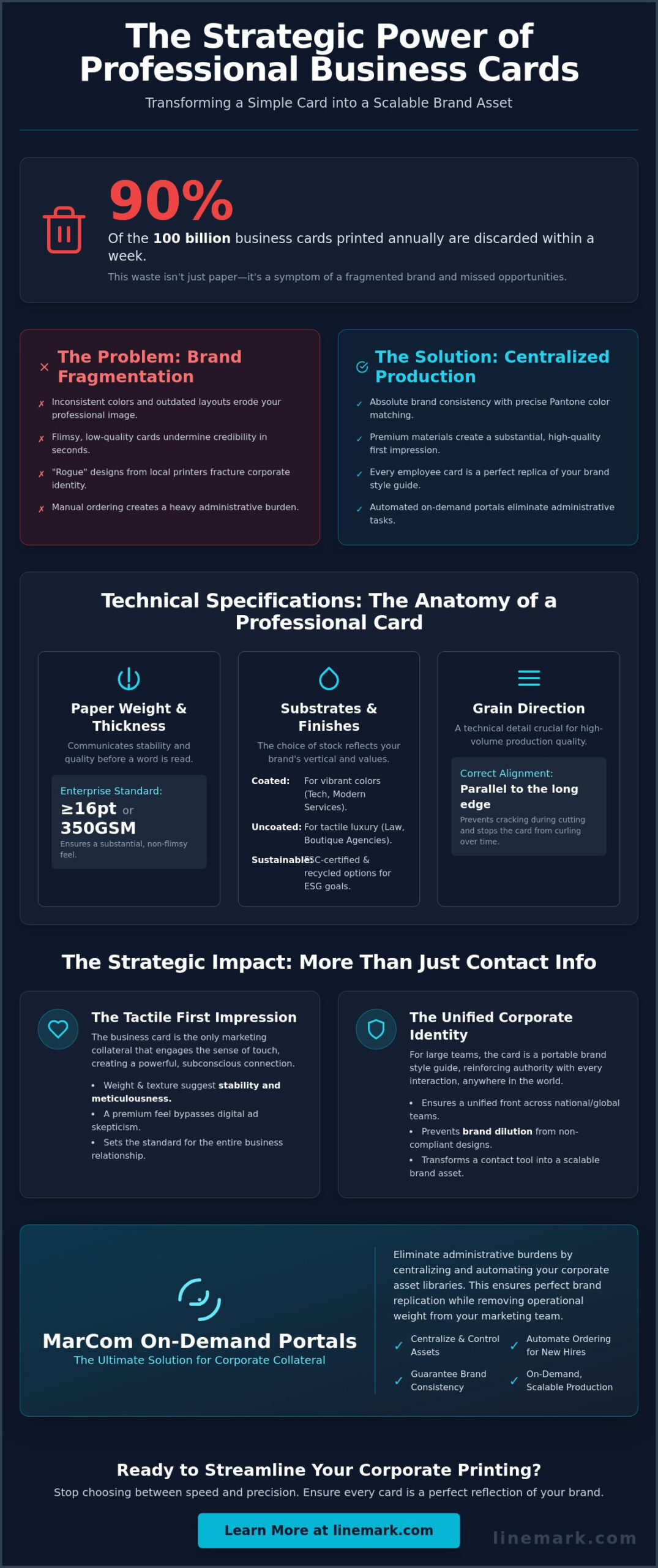
Did you know that 90% of the 100 billion business cards printed every year end up in the trash within seven days? For a large-scale organization, this statistic isn’t just a waste of paper; it’s a symptom of a fragmented brand strategy. When your team hands out cards with inconsistent colors or outdated layouts, it erodes the professional image you’ve worked hard to build. We understand that managing high-volume professional business card printing across multiple departments and locations is a complex logistical challenge that requires more than just a standard print shop.
You shouldn’t have to choose between speed and precision. It’s common to feel the administrative weight of manual ordering for new hires or the frustration of color drift across different print runs. This guide promises to show you how a centralized, automated approach ensures perfect brand replication while removing the operational burden from your marketing team. We’ll examine the technical standards of enterprise-level production, the efficiency of on-demand ordering, and how a strategic partnership transforms your collateral into a scalable engine for growth.
Key Takeaways
- Understand the strategic impact of commercial-grade production on B2B networking and brand perception.
- Master the technical nuances of paper weights and finishes to select the ideal stock for your specific industry.
- Discover how professional business card printing ensures absolute brand consistency through precise Pantone color matching at scale.
- Access a professional checklist for preparing production-ready files that meet strict requirements for bleeds and safety zones.
- Learn how MarCom On-Demand portals eliminate administrative burdens by centralizing and automating your corporate asset libraries.
The Strategic Importance of Professional Business Card Printing
Professional business card printing is a specialized commercial discipline that exists several tiers above standard retail or desktop output. While the history of business cards shows they’ve served as essential networking tools for centuries, modern enterprise requirements demand a level of technical precision that basic printers can’t match. This process involves industrial-grade offset or high-end digital presses, ensuring that every card is a perfect replica of your brand’s digital assets. Relying on “good enough” retail templates often results in thin paper and inconsistent colors that fail to mirror the premium nature of a corporate brand.
To better understand this concept, watch this helpful video:
In a marketing mix dominated by digital signals, the physical business card remains a critical, tangible anchor. It’s the only marketing collateral that engages the sense of touch. When you hand over a card, the recipient immediately registers the paper’s weight and texture. This sensory data bypasses the skepticism often applied to digital ads, creating an immediate, subconscious impression of your organization’s quality and attention to detail.
First Impressions and Brand Authority
Beyond the Individual: The Corporate Identity Perspective
Technical Specifications: Navigating Paper Stocks and Specialized Finishes
Achieving a superior finish requires a deep understanding of the medium. Unlike retail-grade digital output that often uses generic cardstock, professional business card printing utilizes high-performance substrates engineered for industrial presses. The primary metrics of quality are GSM (Grams per Square Meter) and Pt (Points). While GSM measures the density of the paper, Pt indicates its actual thickness. For enterprise applications, we recommend at least 16pt or 350GSM to ensure the card doesn’t feel flimsy during an exchange. A technical detail often overlooked by retail shops is grain direction. In high-volume production, the paper grain must run parallel to the long edge of the card. This prevents the stock from cracking during the precision cutting process and ensures the card remains flat rather than curling over time.
Selecting the Right Substrate
The choice between coated and uncoated stocks depends on your brand’s vertical. Coated stocks, available in matte, silk, or gloss, provide a smooth surface that prevents ink absorption, resulting in vibrant colors and crisp imagery. These are ideal for tech firms or modern service providers. Uncoated stocks offer a tactile, absorbent feel that suggests tradition and high-end luxury, making them a preferred choice for law firms or boutique agencies. For organizations committed to ESG goals, we provide FSC-certified and 100% post-consumer recycled options that maintain premium rigidity without compromising sustainability. Exploring these commercial printing options allows your organization to move from basic contact sharing to high-impact brand reinforcement.
Finishing Techniques That Command Attention
Specialized finishes transform a standard card into a premium asset. Spot UV and raised varnish allow you to apply a glossy or tactile layer to specific design elements, such as a logo or icon, creating a visual and physical contrast against a matte background. If your brand requires a more prestigious aesthetic, foil stamping and embossing provide a three-dimensional quality that digital-only processes cannot replicate. These techniques aren’t just decorative; they increase the card’s durability. Lamination options, such as soft-touch or “velvet” coatings, add a protective layer that resists fingerprints and scuffs, ensuring your team’s cards look pristine even after weeks in a wallet. It’s this level of industrial foresight that separates a standard service from a strategic communications partner.
Scalability and Brand Consistency for Large Organizations
Retail template sites often prioritize low-cost, small-batch transactions, but they fail to meet the rigorous demands of an enterprise identity system. When you’re managing thousands of cards for a global team, “close enough” color is a liability. Maintaining brand integrity at scale requires a sophisticated approach to professional business card printing that treats color management as a science rather than a suggestion. Our systems are built to handle the complexities of high-volume output without sacrificing the meticulous detail your brand deserves.
The Challenge of Color Accuracy
Your logo looks different on every screen because monitors use RGB light, while presses use CMYK ink. This fundamental difference is why a design that looks vibrant on a tablet might appear dull on a standard retail print. To solve this, we utilize Pantone matching for spot colors, ensuring your corporate blue remains identical across every medium. Our facility maintains G7 master printer certification. This is a rigorous technical standard that guarantees visual consistency across different devices and substrates. For a deeper look at how we choose the right technology for your specific volume, see our guide on Offset vs. Digital Printing: What’s the Difference?. This level of calibration ensures that your brand authority remains intact, whether the card is handed out in New York or London.
High-Volume Production Efficiency
Managing collateral for large teams requires an automated approach to prevent administrative bottlenecks. We utilize Variable Data Printing (VDP) to streamline this process. This technology allows us to pull employee names, titles, and contact details directly from a secure data source and integrate them into your approved brand template. It removes the risk of manual entry errors that often plague retail workflows. When your organization reaches a specific volume threshold, we transition from digital to offset printing. This shift isn’t just about speed; it’s about the economics of scale. Offset production allows for a lower per-unit cost on massive runs while maintaining the highest possible image resolution. Our systems are designed to ensure identical quality from the first card to the millionth, providing a reliable foundation for your company’s growth. We don’t just print cards; we manage a critical component of your corporate infrastructure with industrial precision.
Designing for Production: Ensuring Flawless Print Results
The transition from a digital concept to a physical asset requires more than aesthetic talent; it demands technical precision. Professional business card printing relies on files that adhere to industrial pre-press standards to avoid costly delays and production errors. While a design may look perfect on a high-resolution monitor, the mechanical reality of a commercial press involves physical variables like paper movement and ink absorption. High-volume production environments operate with tight tolerances. If your files aren’t prepared correctly, the final product will likely suffer from blurred imagery, color shifts, or improper trimming.
One of the most frequent pre-press errors involves the misuse of raster versus vector graphics. Logos and typography should always be vector-based to ensure they remain crisp at any scale. Raster images, such as employee headshots, must maintain a resolution of at least 300 DPI at their final print size. Anything lower results in pixelation that erodes brand authority. Furthermore, failing to account for the “safety zone” is a common pitfall. While bleeds extend your design to the very edge of the sheet, the safety zone keeps critical text at least 1/8 inch away from the trim line to account for the slight mechanical shifts that occur during high-speed cutting. Ensure your files are production-ready by partnering with our commercial printing experts for a seamless transition from design to delivery.
Pre-Press File Preparation Checklist
To ensure your project moves through our facility without friction, follow these technical requirements:
- Set 1/8 inch bleeds: Extend all background colors and images 0.125 inches beyond the final trim size.
- Verify resolution: Ensure all non-vector elements are 300 DPI or higher.
- CMYK conversion: Convert all files to CMYK color profiles to prevent the unpredictable shifts associated with RGB-to-ink conversion.
- Outline fonts: Convert all text to paths or outlines. This prevents the Raster Image Processor (RIP) from substituting your brand’s custom typography with a generic font if a file link is broken.
Typography and Legibility in Print
Typography behaves differently on paper than it does on a screen. Small text is susceptible to “dot gain,” a phenomenon where ink spreads slightly as it’s absorbed into the paper fibers. On uncoated stocks, this can make fine serif fonts appear muddy. We recommend a minimum font size of 6pt for standard ink and 8pt for specialty finishes like foil stamping or embossing to maintain legibility. For maximum impact and accessibility, always utilize high-contrast color pairings; dark text on a light background remains the industry standard for clarity. By respecting these technical boundaries, you ensure that every card your team distributes is a clean, sharp representation of your corporate identity.
Streamlining Corporate Collateral with MarCom On-Demand
Managing professional business card printing for a distributed workforce shouldn’t be a source of constant administrative friction. When an organization scales, the manual process of collecting data, proofing designs, and coordinating with various local printers becomes unsustainable. This is where MarCom On-Demand portals transform the operational workflow. These web-to-print platforms serve as a centralized hub where your approved brand assets are locked into place. Marketing teams no longer have to police “rogue” designs or inconsistent layouts created by well-meaning but non-compliant employees. Instead, the portal acts as a digital gatekeeper, ensuring that every card ordered across the entire enterprise meets your exact technical and aesthetic standards.
The Power of Centralized Ordering
Automating the procurement process allows local managers to order collateral within pre-approved brand guidelines. This decentralized execution with centralized control reduces administrative overhead significantly. By removing the need for marketing departments to touch every individual order, organizations often see a dramatic reduction in turnaround times and error rates. For a deeper dive into these workflows, consult our MarCom On-Demand: The Strategic Guide. This system doesn’t just save time; it provides a transparent audit trail of all brand activity and spending, making it an essential tool for both HR and Marketing leadership. It’s a high-tech solution that mirrors the operational excellence your clients expect from your brand.
Fulfillment and Nationwide Distribution
The journey doesn’t end when the ink dries on the press. A truly scalable solution integrates professional business card printing with sophisticated inventory management and fulfillment services. We ensure that your collateral moves seamlessly from our facility to your team’s desks, regardless of their geographic location. This integrated approach is particularly vital for onboarding. Through automated workflows, new hires can have their cards waiting for them on day one, which is a small detail that speaks volumes about your company’s stability and attention to detail. Our kitting and fulfillment services ensure that every package arrives in pristine condition, reflecting the premium quality of the contents inside.
Choosing a print partner is about more than just finding a vendor; it’s about securing a strategic communications ally. We combine industrial-scale production with the meticulous attention of a boutique shop to handle your most complex projects with precision. By centralizing your collateral through a high-tech portal, you’re not just buying business cards. You’re investing in a streamlined ecosystem that supports your company’s long-term growth and maintains your brand’s authority in every market you enter. We provide the technological pride and logistical expertise required to turn a simple networking tool into a powerful, scalable asset for your entire organization.
Scaling Your Brand Authority with Precision
Enterprise success depends on the seamless integration of brand identity and operational efficiency. We’ve examined how the tactile impact of premium cardstock and the technical rigor of G7-certified color matching protect your corporate image. Transitioning to a centralized, automated system removes the administrative burden of high-volume orders while ensuring absolute consistency across global teams. Professional business card printing is no longer just a procurement task; it’s a strategic investment in your organization’s daily networking success.
With over 30 years of commercial printing expertise and a 90,000-square-foot high-capacity production facility, we provide the industrial scale and boutique attention your brand requires. Our G7 Master Printer certification ensures your colors remain precise from the first run to the millionth. Streamline your brand collateral with Linemark’s professional printing solutions and transform your physical touchpoints into a scalable engine for growth. Let’s build a partnership that prioritizes your brand’s long-term authority and logistical excellence.
Frequently Asked Questions
What is the standard size for professional business cards in the US?
The standard dimensions for a professional business card in the United States are 3.5 inches by 2 inches. This size is the industry benchmark because it fits universally into standard wallets, cardholders, and digital scanning devices. While non-traditional shapes are available, maintaining these standard dimensions ensures your team’s cards are easily stored and referenced by clients, supporting long-term networking efficiency.
What is the difference between offset and digital business card printing?
Offset printing uses metal plates to transfer ink onto paper, making it the most precise choice for high-volume production runs. Digital printing is a toner-based process that excels at smaller quantities and variable data projects. While digital technology has improved, offset remains the gold standard for absolute color depth and the most economical scaling for large organizations.
How do I ensure my corporate logo colors are exact on every card?
Absolute color replication is achieved through Pantone Matching System (PMS) spot colors and G7 Master Printer certification. Unlike standard CMYK mixes that can vary between presses, PMS colors use specific ink formulas to ensure your logo looks identical on every card. Partnering with a facility that maintains G7 certification guarantees that the technical calibration of the equipment meets the highest global standards for visual consistency.
Can I use special finishes like gold foil on both sides of the card?
You can apply specialty finishes like gold foil to both sides of a business card, provided the paper stock is thick enough to prevent bruising or ghosting. This technique requires meticulous registration and a high-capacity press to ensure the foil adheres perfectly without compromising the design on the reverse side. Utilizing a premium 16pt or 18pt cover stock is recommended to maintain the card’s structural integrity when applying multiple heat-stamped finishes.
What is the best paper weight for a high-end professional business card?
The ideal paper weight for high-end professional business card printing is typically a 16pt (point) or 350GSM cover stock. This thickness provides a substantial, rigid feel that communicates stability and prestige during a physical exchange. For brands seeking an even more significant tactile impact, 18pt or “double-thick” 32pt stocks offer an ultra-premium experience that stands out in high-stakes B2B environments.
How does a MarCom portal simplify business card ordering for large companies?
A MarCom portal simplifies ordering by centralizing your approved brand assets into a single, automated web-to-print interface. Local managers can input their specific details into locked templates, which eliminates the risk of non-compliant designs or inconsistent branding. This system removes the administrative burden from your marketing team and ensures that every card ordered across the enterprise adheres to your global brand standards.
What is ‘bleed’ in business card design and why is it necessary?
Bleed refers to the design area that extends 1/8 inch beyond the final trim line of the card. It’s necessary because industrial cutting blades have a slight mechanical tolerance; without a bleed, even a microscopic shift during the cutting process could result in unsightly white edges. Including a proper bleed ensures your background colors and images reach the very edge of the card for a professional, seamless finish.
How long does a high-volume professional print run typically take?
A high-volume professional business card printing run typically takes between 3 to 7 business days, depending on the complexity of the finishes and the total quantity. While standard digital runs can be faster, specialized techniques like foil stamping, embossing, or custom die-cutting require additional time for plate creation and drying. A well-oiled production machine balances this meticulous attention to detail with efficient logistics to ensure your team receives their collateral without unnecessary delays.