


 05/15/2026
  Steve Bearden
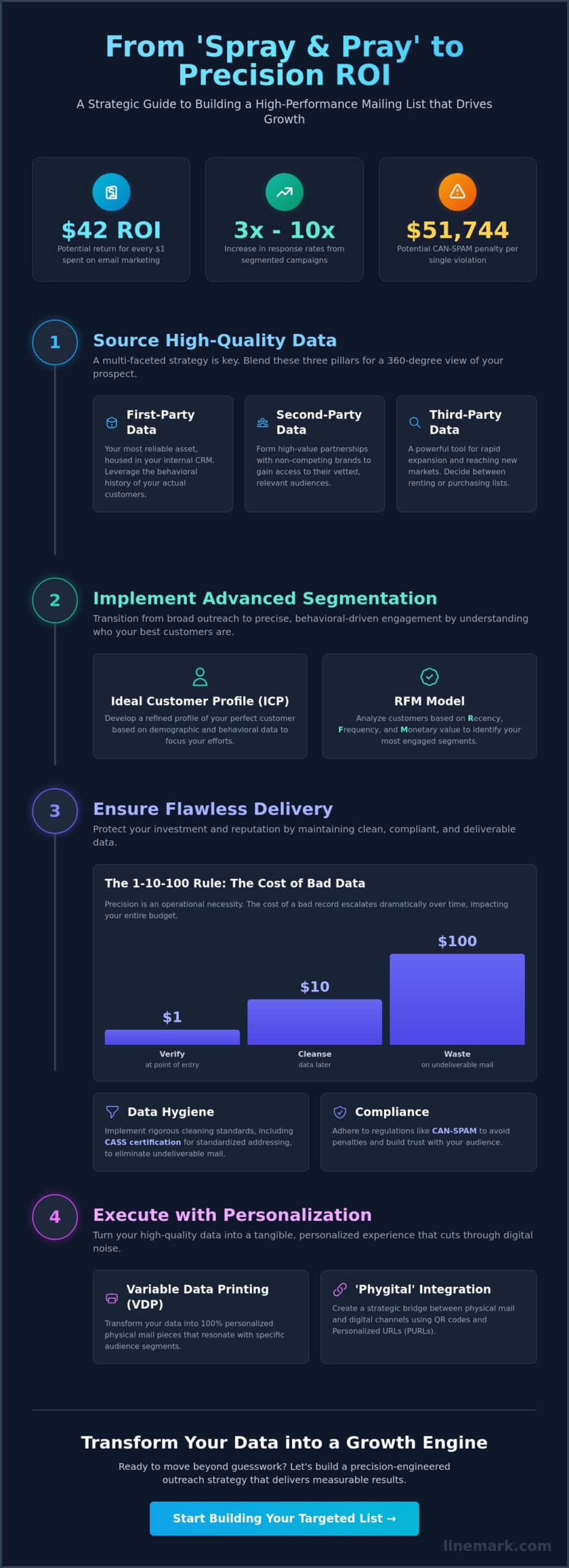
What if your next outreach effort functioned less like a gamble and more like a precision-engineered growth engine? While email marketing offers a potential ROI of $42 for every $1 spent, achieving those results requires moving beyond the “spray and pray” methods that drive up acquisition costs and clutter recycling bins. You likely recognize that a broad, untargeted approach often leads to wasted resources and dismal response rates. This guide details exactly how to build a targeted mailing list that transforms your data into a high-performing asset, ensuring every piece of mail or digital message serves a strategic purpose.
We understand the complexity of balancing audience growth with strict regulatory demands. With CAN-SPAM penalties reaching up to $51,744 per violation as of 2026, compliance is a critical component of your operational strategy rather than a mere hurdle. You’ll gain a repeatable framework for list building that bridges the gap between sophisticated data acquisition and high-volume physical production. We will explore how to source high-quality records, implement technical hygiene to avoid wasted postage, and use advanced segmentation to turn your mailing list into a catalyst for scalable growth.
Key Takeaways
- Identify the strategic distinction between targeted datasets and saturation mailings to optimize your marketing spend for maximum impact.
- Discover how to build a targeted mailing list by unlocking the potential of your internal CRM and forming high-value second-party data partnerships.
- Implement the RFM model and refined Ideal Customer Profiles to transition from broad outreach to precise, behavioral-driven engagement.
- Eliminate the high cost of undeliverable mail by adopting rigorous data hygiene standards, including CASS certification for standardized addressing.
- Leverage Variable Data Printing and versioned content to transform your data into 100% personalized physical mail pieces that resonate with specific audience segments.
What is a Targeted Mailing List and Why Does Precision Matter?
A targeted mailing list is a sophisticated, curated dataset built upon specific behavioral and demographic triggers. It isn’t just a directory; it’s a dynamic asset that identifies prospects based on their likely needs and purchasing history. While saturation mailings like Every Door Direct Mail (EDDM) serve a purpose for local retail with broad appeal, they lack the surgical precision required for high-ROI campaigns. Learning how to build a targeted mailing list allows you to move away from “spray and pray” tactics. This shift reduces postage waste and aligns your outreach with modern sustainability goals by ensuring materials only reach viable prospects.
To better understand the mechanics of data acquisition and how it impacts your strategy, watch this helpful overview:
The financial implications of data precision are best understood through the “1:10:100 Rule.” This framework suggests it costs $1 to verify a record at the point of entry, $10 to clean it later, but $100 in lost revenue and wasted production if you send mail to a “dead” address. When you factor in rising postal rates and the physical cost of materials, the cumulative impact of bad data escalates quickly. Precision isn’t just a marketing preference; it’s an operational necessity. Mastering how to build a targeted mailing list ensures your budget is spent on engagement rather than undeliverable logistics.
The ROI of Relevance: Beyond the Open Rate
Precision targeting does more than just save on postage. Industry data suggests that segmented lists can increase response rates by 3x to 10x compared to non-segmented campaigns. There’s a profound psychological impact when a recipient receives a personalized, physical piece that addresses their specific needs. It signals that the brand understands their unique challenges. By focusing on Customer Lifetime Value (CLV) rather than one-off transactions, you can justify the investment in higher-quality data. This approach turns each mailer into a long-term relationship builder.
Targeted Lists in the Modern Marketing Stack
Your physical mailing list shouldn’t exist in a vacuum. Modern marketers use these lists to fuel social media “lookalike” audiences or trigger digital retargeting ads when a physical piece is delivered. This “phygital” integration often involves QR codes or personalized URLs (PURLs) that drive recipients to online content. This creates a strategic bridge between marketing and sales departments. It marks a shift from transactional mail to relational communications that build long-term brand equity across every channel you use.
Sourcing Your Data: The Three Pillars of List Acquisition
Sourcing high-quality data requires a multi-faceted strategy. You shouldn’t rely on a single source if you want to scale effectively. First-party data, housed within your CRM, is your most reliable asset. It contains the behavioral history of your actual customers. Many organizations overlook this internal gold mine, yet it’s the foundation for any effort regarding how to build a targeted mailing list. Second-party data offers a collaborative alternative. By partnering with non-competing brands that share your audience, you gain access to vetted prospects without the cold start of third-party lists.
Third-party data remains a powerful tool for rapid expansion. You’ll need to decide between renting for a one-time campaign or purchasing for long-term use. Experts suggest that Direct Mail is Hot Again because it cuts through digital noise with physical authority. Blending these three pillars creates a hybrid approach. This 360-degree view of your prospect ensures your direct mail strategy is grounded in both internal truth and external reach. It transforms a simple directory into a strategic communications engine.
Building Your Own: Organic Lead Generation Strategies
Organic acquisition ensures high intent. You can capture physical addresses by offering high-value digital assets like whitepapers or webinars. This exchange qualifies the lead immediately. Postal retargeting is another innovative tactic. It uses technology to identify anonymous website visitors and match them to a physical address for a follow-up postcard. Trade shows and national events also provide a venue for list building that avoids regional bias. These events allow you to gather data from a broad demographic in a single, high-touch setting.
Buying and Renting: Navigating the List Broker Landscape
Working with a list broker requires due diligence. You must ask about data freshness and the specific sources of their records. Reputable brokers offer list hygiene guarantees. These protect you if a certain percentage of the data proves inaccurate or undeliverable. It’s also vital to distinguish between compiled lists and response lists. Compiled lists come from public records like census data or tax filings. Response lists are more valuable. They consist of individuals who have recently made a purchase or inquired about a specific service. This history indicates a higher propensity to act on your offer.
Advanced Segmentation: Designing Your Ideal Customer Profile
Effective segmentation is the pivot point between a generic broadcast and a high-ROI campaign. For B2B organizations, this begins with the Ideal Customer Profile (ICP), which defines the specific types of companies that derive the most value from your service. In contrast, B2C marketers focus on the “Buyer Persona,” a detailed representation of the individual consumer’s lifestyle and motivations. Understanding this distinction is a fundamental step in how to build a targeted mailing list that resonates with your recipients. By aligning your data strategy with these profiles, you ensure every printed piece serves a specific strategic objective.
The “RFM” model remains the gold standard for segmenting your existing database. It evaluates three critical dimensions: Recency (how lately a customer purchased), Frequency (how often they buy), and Monetary value (the total spend). This data allows you to prioritize high-value segments for premium outreach while identifying dormant accounts for re-engagement. Once you’ve identified your top-tier customers, you can utilize “Lookalike Modeling.” This process uses your internal data to find new prospects who mirror the characteristics of your best clients. It effectively clones your success by targeting those most likely to convert.
Precision increases when you layer intent data and life-stage triggers onto your list. For a B2C campaign, targeting new homeowners or parents of newborns can significantly boost relevance. In the B2B sector, triggers like a recent business expansion or a new round of funding signal a readiness to invest. These moments of transition represent the peak of a prospect’s receptivity.
Demographics and Firmographics: The Foundation
For consumer campaigns, filters like household income, age, presence of children, and home value provide a necessary baseline. B2B campaigns require a different lens, focusing on SIC or NAICS codes, annual revenue, and the specific job titles of decision-makers. Firmographic filtering ensures high-volume industrial mailings are directed only to organizations with the operational capacity and budget to utilize your services. This foundational layer prevents the dilution of your message among unqualified leads.
Psychographics and Behavioral Triggers
Psychographics move beyond “who” the customer is to “why” they buy. Segmenting by interests, values, and motivations allows you to tailor your creative approach for eco-conscious buyers or early tech adopters. Using purchase history helps you predict future needs, allowing you to time your mailings to coincide with natural replacement cycles. You can also integrate online behavior, such as cart abandonment or specific page views, into physical mail triggers. This ensures that a prospect who showed interest on your website receives a tangible reminder in their mailbox shortly after.
Data Hygiene and Compliance: Ensuring National Deliverability
“Dead mail” represents more than just a waste of paper; it’s a direct drain on your bottom line. When you’re learning how to build a targeted mailing list, you have to account for the fact that data decays rapidly. People move, businesses restructure, and roles change. Inaccurate records erode your marketing budget through wasted postage and production costs while simultaneously damaging your brand reputation. If a high-value piece arrives at the wrong address, it signals a lack of professional oversight. Precision in delivery is just as critical as precision in targeting.
Technical hygiene begins with Coding Accuracy Support System (CASS) certification. This process standardizes your addresses to meet strict USPS requirements, ensuring they’re recognized by automated sorting systems. National Change of Address (NCOA) processing takes this a step further by cross-referencing your list against the USPS database of relocations from the last 48 months. Compliance is the final, non-negotiable pillar. Whether you’re navigating the California Consumer Privacy Act (CCPA) or the General Data Protection Regulation (GDPR) for international reach, your data acquisition must stand up to legal scrutiny. Partner with our data experts to ensure your next campaign meets every regulatory and deliverability standard.
The Technical Scrub: NCOA and De-Duplication
Running your list against the 48-month NCOA database is essential for maintaining national reach. This technical scrub identifies individuals and businesses that have relocated, allowing you to update your records before the first piece is printed. De-duplication, often called “de-duping,” is equally vital. This process identifies the same person across different datasets, even if there are slight variations in name or address. It prevents the operational inefficiency of sending multiple catalogs to the same recipient. You should view data hygiene as a continuous process, not a one-time event.
Privacy and Security in Data Management
Security is paramount when you’re handling proprietary customer information. You should always use Secure File Transfer Protocol (SFTP) for all data exchanges between your marketing team and your production partner. This ensures that your files are encrypted and protected from unauthorized access during transit. Additionally, you must maintain clear “opt-out” mechanisms. Direct mail has specific legal requirements for suppression lists that you must honor to avoid penalties. Ensuring your acquisition methods are fully compliant with national privacy standards protects your organization from liability. This level of technical rigor is the final step in how to build a targeted mailing list that drives sustainable, high-ROI growth.
Execution: Integrating Lists with High-Volume Production
The strategic value of your data is fully realized only when it meets the precision of high-volume production. Understanding how to build a targeted mailing list is a prerequisite, but the execution phase is where your strategy becomes a tangible growth engine. Modern production facilities don’t just print static images; they use your data to drive complex, multi-channel distribution. By transitioning from a digital file to a nationwide distribution strategy, you ensure that your precision-engineered audience acquisition translates into measurable market share. This integration requires a partner capable of handling the nuances of both data management and industrial-scale logistics.
Tracking and attribution are the final components of a successful execution. By utilizing QR codes and Personalized URLs (PURLs), you can bridge the gap between physical mail and digital analytics. These tools allow you to measure the success of your targeted list in real-time, providing clear data on which segments are converting. This feedback loop is essential for refining your future acquisition strategies. It ensures that your marketing efforts remain agile and data-driven, allowing you to scale what works while identifying areas for optimization.
Personalization at Scale
Variable Data Printing (VDP) is the technology that allows a targeted list to achieve its full potential. VDP utilizes your dataset to change headlines, calls-to-action, and even imagery in real-time during the printing process. This means every recipient receives a piece that feels uniquely tailored to their specific needs. It’s an approach that moves beyond simple name-insertion to true versioned content. Some organizations report that a targeted list paired with VDP can double response rates compared to traditional static mailers. For a deeper look at these evolving tactics, consult our Direct Mail Marketing in 2026: The Comprehensive Strategic Guide.
Centralized Control with MarCom On-Demand
For organizations with distributed teams, maintaining brand consistency while deploying targeted lists can be a challenge. MarCom On-Demand provides a centralized portal where regional managers or sales teams can access approved templates and deploy them to specific segments of your list. This system allows for granular customization without sacrificing the integrity of the corporate brand. It’s a streamlined solution that empowers local teams to act on local data while the home office maintains operational oversight. You can learn more about this unified approach in our guide to MarCom On-Demand: The Strategic Guide to Distributed Marketing in 2026. This centralized destination ensures that your knowledge of how to build a targeted mailing list is applied consistently across your entire organization.
Transforming Data into Industrial Growth
Mastering how to build a targeted mailing list is the first step toward achieving a sustainable competitive advantage. You’ve seen how precision data hygiene and advanced segmentation turn a static directory into a high-performance asset. Success requires more than just gathering names; it demands a seamless transition from digital strategy to physical production. By integrating behavioral triggers with sophisticated logistics, you ensure your message reaches the right door at the exact moment of peak receptivity.
We provide the industrial-scale infrastructure and 30+ years of data-driven marketing expertise needed to power your most complex campaigns. Our 90,000-square-foot high-tech production facility is equipped with advanced Variable Data Printing capabilities designed to deliver 100% personalized content at any volume. We act as your strategic communications ally, handling the nuances of data compliance and nationwide fulfillment with meticulous attention to detail.
Partner with Linemark for Precision-Driven Direct Mail Solutions and transform your audience acquisition into a precision-engineered growth engine. Your next high-ROI campaign starts with a partner who values your results as much as you do.
Frequently Asked Questions
How much does it cost to build a targeted mailing list?
Consumer mailing lists typically range from $50 to $250 per thousand records depending on the depth of demographic targeting. B2B lists are more specialized and can cost between $100 and over $1,000 per thousand records for highly verified data. These external acquisition costs are separate from internal hygiene expenses like NCOA processing, which generally adds $3 to $8 per thousand records to ensure deliverability.
Is it better to buy a mailing list or build one organically?
A hybrid strategy that combines organic acquisition with strategic sourcing is the most effective way regarding how to build a targeted mailing list. Organic methods like whitepaper downloads capture high-intent leads with a proven interest in your brand. Purchasing data from reputable compilers allows for rapid scale and the ability to reach new markets that haven’t yet interacted with your digital channels.
How often should I update or clean my mailing list?
You should clean your mailing list before every major campaign or at least once per quarter to account for rapid data decay. Running your data through NCOA and CASS certification ensures that you aren’t wasting postage on moved or non-existent addresses. Consistent hygiene protects your sender reputation and prevents the high cost of undeliverable mail from eroding your marketing budget.
What is the minimum size for an effective targeted mailing list?
There is no universal minimum, but a list size of 2,500 to 5,000 records is often necessary to achieve statistical significance when testing different offers or creative versions. Smaller, hyper-targeted lists can be highly effective for account-based marketing where the value of a single conversion is high. The focus should always remain on the quality and relevance of the data rather than the sheer volume of records.
How do I ensure my mailing list complies with privacy laws like CCPA?
Compliance requires a combination of secure data management and transparent acquisition practices. You should use Secure File Transfer Protocol (SFTP) for all data exchanges and vet your list sources to ensure they provide clear documentation of consent. Honoring opt-out requests promptly and maintaining a secure suppression list are core requirements for staying compliant with both national and regional privacy standards.
Can I use my email marketing list for a direct mail campaign?
Yes, your email list is a valuable foundation for a multi-channel direct mail campaign. If you haven’t captured physical addresses, you can use data appending services to match email records with verified postal locations. This allows for powerful “phygital” integration, where a physical postcard follows a digital interaction to reinforce your message and drive higher conversion rates.
What is the difference between a compiled list and a response list?
Compiled lists are built from public records like census data or tax filings and are best for targeting broad demographic or firmographic traits. Response lists consist of individuals who have taken a specific action, such as making a recent purchase or subscribing to a specific publication. Because response lists indicate a proven willingness to act, they often deliver significantly higher engagement rates than compiled data.
How do I track the ROI of a targeted mailing list campaign?
Tracking ROI involves using trackable elements like QR codes, Personalized URLs (PURLs), or unique offer codes for each segment. Match-back analysis is another advanced technique where you compare your sales data against your original mailing list to identify which specific recipients converted. These methods provide the granular data needed to refine your strategy for how to build a targeted mailing list in future campaigns.