

 05/14/2026
  Steve Bearden
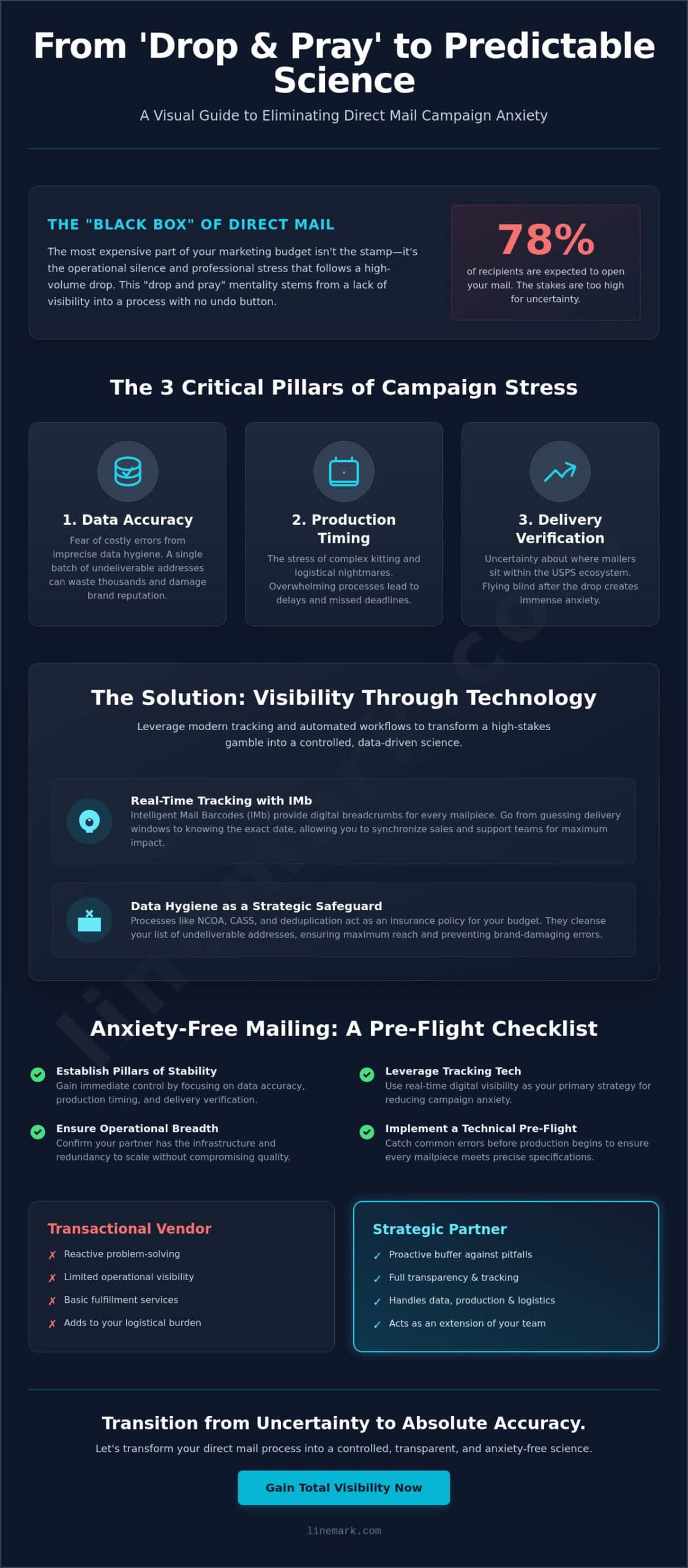
The most expensive part of your marketing budget isn’t the $0.78 First-Class stamp. It’s the operational silence that follows a high-volume drop. You’ve likely felt that familiar tension as thousands of pieces leave the production floor, wondering if the data hygiene was truly precise or where exactly those mailers sit within the USPS ecosystem. This “drop and pray” mentality is a significant source of professional stress, especially when 78% of recipients are expected to open that mail. You deserve a workflow that replaces uncertainty with visibility.
We’re committed to reducing direct mail campaign anxiety by transforming your fulfillment process into a controlled, transparent science. It’s time to move past the fear of costly data errors and the overwhelming logistics of complex kitting. You’ll learn how to eliminate high-stakes stress through rigorous data precision, advanced tracking technology, and a strategic partnership that handles the heavy lifting. This guide explores the transition from transactional mailing to a predictable, trackable journey that ensures your message reaches its destination with absolute accuracy.
Key Takeaways
- Identify the three critical pillars of campaign stability, data accuracy, production timing, and delivery verification, to gain immediate control over your mailing process.
- Leverage modern tracking technology and automated workflows as a primary strategy for reducing direct mail campaign anxiety through real-time digital visibility.
- Understand how operational breadth and facility redundancy provide the necessary infrastructure to scale high-volume campaigns without compromising quality or deadlines.
- Implement a technical pre-flight checklist to catch common errors and ensure every mailpiece meets precise specifications before hitting the production floor.
- Transition from transactional vendor management to a strategic partnership that acts as a proactive buffer against industry pitfalls and logistical challenges.
Understanding the “Black Box” of Direct Mail Campaign Anxiety
Direct mail anxiety isn’t just a nervous feeling before a launch; it’s the logical fear of unrecoverable errors occurring in a physical medium. This psychological weight typically stems from three specific pillars of campaign stress: data accuracy, production timing, and delivery verification. Reducing direct mail campaign anxiety starts with acknowledging that these fears are symptoms of a lack of operational visibility. Unlike digital ads that can be paused or corrected in seconds, a printed mailer is a permanent commitment of capital and brand reputation. When you can’t see what’s happening inside the production cycle, the process feels like a black box.
To better understand the strategic foundation required for a successful drop, watch this breakdown of essential metrics and strategies:
The High Cost of Direct Mail Missteps
The financial stakes of a national rollout are significant. A single error in a postage class or a batch of undeliverable addresses can waste thousands of dollars in a single afternoon. Beyond the immediate loss of funds, poorly executed Direct mail marketing can damage a brand’s standing with its audience. If a customer receives a personalized catalog with the wrong name or irrelevant data, the physical nature of the piece amplifies the mistake. Getting it right the first time is the only option when your campaign is a tangible object in a customer’s hands.
Why Digital Marketers Struggle with Physical Logistics
Digital professionals are accustomed to the “edit and delete” luxury of the web. In the physical world, there is no undo button. The fear of losing control once mail enters the USPS system is a primary driver for those tasked with reducing direct mail campaign anxiety. Once the pallets are loaded, many marketers feel they are flying blind until the first response arrives. Operational transparency is the essential antidote to campaign stress.
Leveraging Technology to Eliminate Execution Fear
Technology has finally bridged the gap between physical production and digital precision. For years, the primary hurdle in direct mail was the lack of real-time feedback. Today, automated workflows and sophisticated data integrations have removed the variability of human touchpoints. Leveraging these tools is the most effective method for reducing direct mail campaign anxiety. By treating the mailing process as a data-driven science, you transform a high-stakes gamble into a controlled execution. This shift allows you to focus on Strategic uses for direct mail rather than worrying about whether the pallets were loaded correctly.
Real-Time Tracking: Following the Mail Trail
Modern mail tracking provides the same level of granularity as a digital marketing dashboard. By utilizing Intelligent Mail Barcodes (IMb), every single piece of mail generates a digital breadcrumb as it moves through USPS sorting facilities. You no longer have to guess when your message will reach its destination. This per-piece visibility allows marketing teams to staff up call centers or prepare sales teams for an influx of leads exactly when the mail hits specific geographic regions. It’s a level of operational synchronization that was impossible a decade ago. When you know the exact date of delivery, the “black box” of the postal system disappears.
Data Hygiene as a Strategic Safeguard
A successful direct mail campaign starts long before the ink hits the paper. Data hygiene processes like NCOA (National Change of Address) and CASS (Coding Accuracy Support System) act as an insurance policy for your budget. These tools ensure that your list is cleansed of undeliverable addresses and updated with current resident information. We also utilize technical deduplication to prevent the brand-damaging experience of a customer receiving two identical mailers. This meticulous attention to detail is a cornerstone of reducing direct mail campaign anxiety. If you are looking to secure your next rollout, our experts can help you audit your data management workflows for maximum efficiency.
Beyond simple delivery, technology now allows for “Phygital” experiences that double your brand’s impressions. Through USPS Informed Delivery, recipients receive a digital preview of their physical mail in their inbox. This integration is vital considering 66% of consumers report that direct mail prompts them to visit a website or make an online purchase. By aligning the physical piece with a digital touchpoint, you create a seamless journey that captures attention twice. This multi-channel approach doesn’t just improve ROI; it provides a verifiable trail of engagement that proves your campaign’s effectiveness.
Scaling Without Stress: The Industrial Advantage
Scaling a direct mail campaign from a local pilot to a national rollout introduces a new set of logistical variables. If your partner lacks the physical capacity to absorb high-volume surges, your project risks being delayed or deprioritized during peak seasons. A critical component of reducing direct mail campaign anxiety is ensuring your production partner possesses the industrial infrastructure to handle millions of impressions without flinching. This means looking beyond the digital interface and evaluating the physical floor space and mechanical redundancy of the facility itself. True operational peace of mind comes from knowing your partner has the room and the machines to grow alongside your brand.
For those new to the complexities of large-scale drops, the Beginner’s Guide to Direct Mail provided by the USPS offers a solid foundation. However, the actual execution of that strategy requires a partner with significant operational breadth. Centralizing your production doesn’t just save time; it protects the integrity of your campaign by keeping every variable under one roof.
The Security of High-Volume Capacity
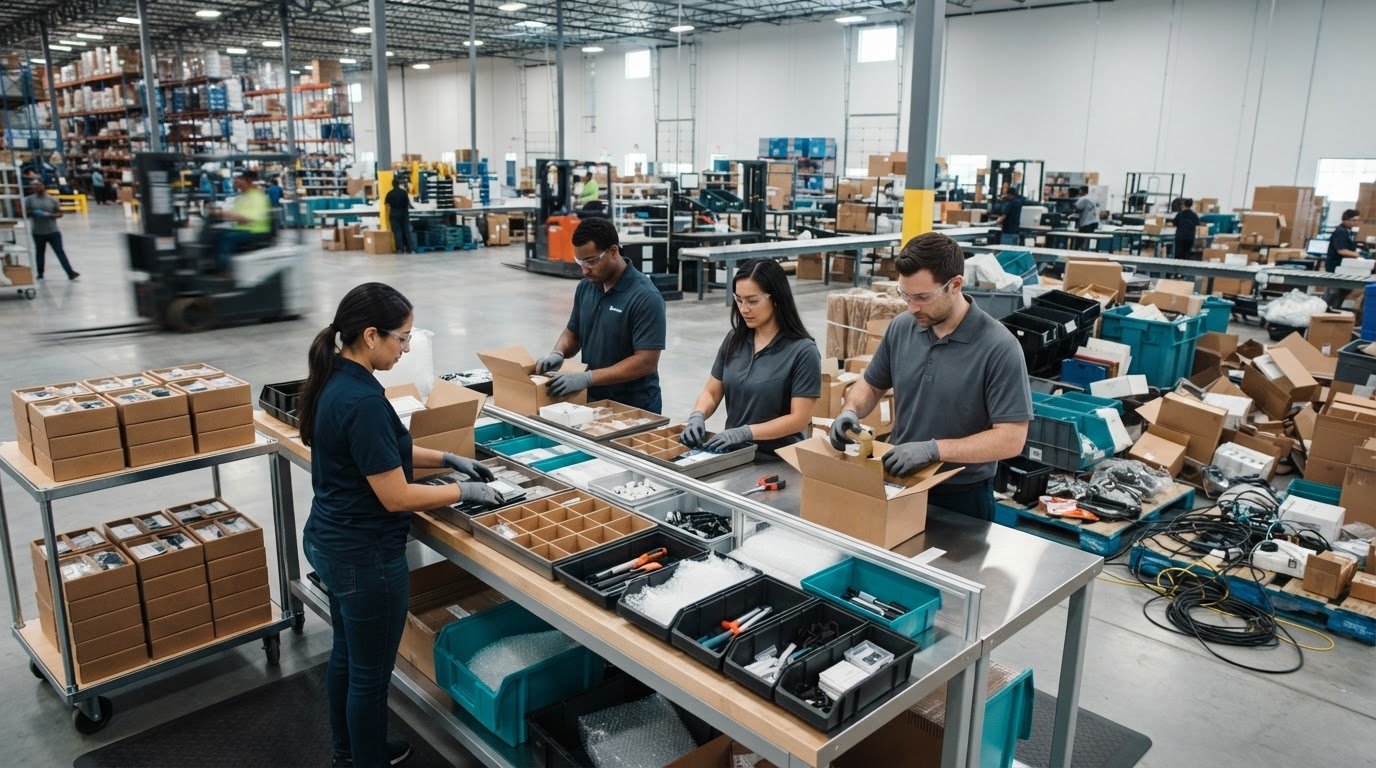
A 90,000-square-foot facility isn’t just a point of pride. It’s a guarantee of priority. This scale allows for dedicated production zones where your project can move through the cycle without competing for limited table space. Machine redundancy is equally vital for disaster recovery. If a single press goes down in a boutique shop, your timeline evaporates. In a high-capacity industrial environment, multiple presses ensure that production never stops. This security extends to end-to-end kitting and fulfillment services, where complex assembly and mailing preparation happen in a single, controlled environment. Since these operations depend on high-uptime technical support, resources such as telxcomputers.com can help you identify service providers who specialize in maintaining critical business infrastructure. When the machines and the experts are in the same building, the risk of delay drops to near zero.
Unified Communication vs. Vendor Fragmentation
Fragmented supply chains are a major source of execution fear. When you move physical assets between separate printing, binding, and mailing houses, you increase the risk of damage, loss, and communication breakdown. Every handoff is a potential point of failure where “finger-pointing” often replaces proactive problem-solving. A centralized production model provides a single point of contact and a unified chain of custody for your materials. This structure transforms the relationship from a transactional vendor to a strategic communications ally that manages the nuances of modern logistics on your behalf. Consolidating your workflow ensures that brand consistency is maintained across every piece, regardless of the volume of the drop.
To maintain that same level of brand consistency across your event or storefront displays, check out Banner 4 Sale for professional sign and banner printing services.
A Pre-Flight Checklist for Anxiety-Free Mailing
Confidence in a national rollout isn’t born from hope. It’s built through a rigorous, systematic pre-flight process. While digital campaigns allow for real-time tweaks, the physical nature of print requires a “get it right the first time” mentality. Establishing a structured verification routine is the most practical step toward reducing direct mail campaign anxiety. By catching technical friction points before the presses start, you replace last-minute panic with operational certainty. This transition from reactive troubleshooting to proactive verification ensures that every dollar of your postage budget is utilized effectively.
Technical Verification Steps
Technical specifications are often where the most costly errors occur. Your checklist must begin with a review of USPS clear zones for barcodes and indices. If a design encroaches on these areas, the mailpiece may be rejected or subject to significant surcharges. Beyond the barcode, you must confirm that your paper stock weight aligns with both your brand’s tactile goals and your postage budget. A slight increase in weight can push a piece into a higher postage tier, impacting the bottom line of a high-volume drop. Finally, you must verify that all tracking elements, such as QR codes and personalized URLs, are live and routing to the correct landing pages. Physical proofs remain essential in this stage. Seeing and feeling the final product allows you to catch layout issues that are easily missed on a digital screen.
If you’re ready to secure your next rollout, contact our production team for a technical file review to ensure your specifications meet every postal requirement.
Personalization and Relevance Safeguards
Generic content is a significant source of ROI anxiety. When a message feels like a mass-produced flyer, engagement rates naturally drop. Utilizing variable data printing (VDP) transforms a standard mailer into a personalized communication that resonates with the individual recipient. This technology allows you to swap names, images, and offers based on your first-party data. However, personalization requires its own set of safeguards. Logic-checking your variable fields is critical to avoid the dreaded “Dear [First_Name]” error that can alienate a customer instantly. We recommend small-batch testing for complex VDP campaigns. By running a representative sample, you can verify that the data logic is firing correctly across different segments before committing to a national rollout. This layer of protection is vital for reducing direct mail campaign anxiety and ensuring your message reaches the right person with the right offer.
95% of marketers report that integrating direct mail with digital channels improves overall performance. This success depends entirely on the accuracy of your execution. A well-vetted campaign doesn’t just reach the mailbox; it drives the 66% of consumers who report that direct mail prompts them to visit a website or make an online purchase. By following a structured pre-flight protocol, you ensure your campaign is a catalyst for growth rather than a source of stress.
Partnership: The Ultimate Anxiety Reducer
Managing a high-volume campaign shouldn’t feel like a battle against your service provider. Many organizations fall into the trap of adversarial vendor management, where tracking is used to “police” errors rather than prevent them. A true strategic partnership serves as the ultimate buffer against industry pitfalls. With over 30 years of experience, we’ve developed the institutional knowledge to anticipate logistical hurdles before they impact your timeline. Reducing direct mail campaign anxiety is a natural byproduct of working with a partner that views your success as a shared objective rather than a transactional exchange. When you trust the hands that hold your data and your brand, the operational silence of a mail drop becomes a period of confident anticipation.
MarCom On-Demand and Brand Control
Operational peace of mind often breaks down when marketing assets are scattered across multiple departments or regions. Utilizing MarCom On-Demand portals allows for decentralized ordering with centralized control. These digital asset libraries ensure that every regional manager or sales rep accesses only the most current, high-resolution graphics. This technology prevents the brand-damaging use of outdated logos or incorrect pricing that often causes last-minute panic. Automated reordering for recurring campaigns further stabilizes your workflow, ensuring you never face a stock-out during a critical promotion. By centralizing your assets in a secure, tech-savvy environment, you eliminate the logistical friction that fuels execution fear.
The Linemark Approach to Precision
Our philosophy is grounded in the belief that large-scale production shouldn’t sacrifice boutique-level attention to detail. We’ve built a well-oiled production machine that integrates advanced data hygiene, real-time tracking, and industrial-scale capacity into a single, unified journey. This holistic approach is the key to reducing direct mail campaign anxiety for marketing professionals who manage complex, national rollouts. We invite you to view your next campaign as a collaborative effort where technical expertise meets creative ambition. Precision is a choice, and our facility is designed to make that choice simple for every partner we serve. If you’re ready to experience a workflow defined by transparency and reliability, contact Linemark to streamline your next direct mail project and reclaim your operational peace of mind.
Securing Your Next National Rollout
Direct mail remains a powerful medium because it’s tangible and memorable. However, its physical nature shouldn’t be a source of operational stress. Success depends on moving from a “drop and pray” mentality to a system defined by visibility and precision. By integrating real-time tracking, rigorous data hygiene, and a centralized production model, you gain the control necessary for reducing direct mail campaign anxiety. You’ve seen how industrial capacity and technical checklists transform complex logistics into a predictable science.
The right partner acts as a proactive buffer between your brand and the variables of the postal system. We combine over 30 years of industrial print expertise with the capacity of a 90,000-square-foot high-tech production facility. As a G7 Master Qualified Printer, we maintain the highest standards of color consistency and technical accuracy across every piece we produce. It’s time to move beyond transactional mailing and embrace a holistic production journey.
Partner with Linemark for stress-free direct mail execution and ensure your next campaign reaches its destination with absolute precision. We’re ready to help you scale with confidence.
Frequently Asked Questions
How can I track my direct mail campaign in real-time?
You track your campaign in real-time by utilizing Intelligent Mail Barcodes (IMb) on every piece. This technology allows each mailer to be scanned as it passes through USPS sorting facilities, providing digital breadcrumbs of its progress. You can access these updates via a dashboard to see exactly when mail hits specific geographic regions, allowing you to synchronize your sales team’s efforts with the delivery date.
What is the most common mistake that leads to direct mail anxiety?
The most common mistake is failing to perform thorough data hygiene before the production phase begins. Sending mail to outdated addresses or duplicate records leads to wasted postage and poor ROI, which is a primary driver for those tasked with reducing direct mail campaign anxiety. Establishing a rigorous pre-flight checklist for both data and technical specifications is the most effective way to prevent these unrecoverable errors.
Is direct mail more difficult to manage than digital marketing?
Direct mail isn’t necessarily more difficult, but it requires a different set of operational controls because it lacks the “undo” button of digital marketing. While you can pause a digital ad in seconds, a physical mailpiece is a permanent commitment of capital. Managing this complexity becomes simple when you partner with a provider that offers end-to-end fulfillment, kitting, and real-time tracking under one roof.
What is data hygiene and why does it matter for my budget?
Data hygiene is the process of cleansing your mailing list through services like NCOA (National Change of Address) and CASS (Coding Accuracy Support System). It matters for your budget because it ensures you aren’t paying for postage and printing on pieces that will never reach their destination. By removing undeliverable addresses and duplicates, you maximize your ROI and ensure your message reaches a valid, active audience.
Can I see a physical proof of my mailer before the full run?
Requesting a physical proof is standard practice and should be completed before authorizing a full production run. While digital proofs are helpful for quick content reviews, a physical sample allows you to verify the paper stock weight, color accuracy, and tactile feel of the piece. This step is a vital component of reducing direct mail campaign anxiety, as it provides a final opportunity to catch layout issues.
How does variable data printing help reduce campaign risk?
Variable data printing (VDP) reduces campaign risk by increasing the relevance of your message to each individual recipient. Instead of sending a generic flyer, you can customize names, images, and offers based on your first-party data. This personalization drives higher engagement rates, as 21% of consumers made a purchase last year due to receiving relevant direct mail, making the investment much more predictable.
What happens if there is an error found after the mail is printed?
If an error is discovered after printing but before mailing, a high-capacity partner can often intercept the project to rectify the issue. The ability to pivot quickly depends on having kitting and fulfillment services in the same facility as the presses. While the goal is to catch errors early, working with an agile partner ensures you’ve got a disaster recovery plan in place to protect your brand.
How do I choose between a local printer and a national fulfillment partner?
Your choice should depend on the scale and complexity of your campaign. A local printer may work for small, simple jobs, but a national fulfillment partner offers the industrial breadth and machine redundancy required for high-volume rollouts. A larger partner provides the technological infrastructure, such as automated workflows and real-time tracking, that a boutique shop can’t match, ensuring your project is handled with precision regardless of its size.