

 05/12/2026
  Steve Bearden
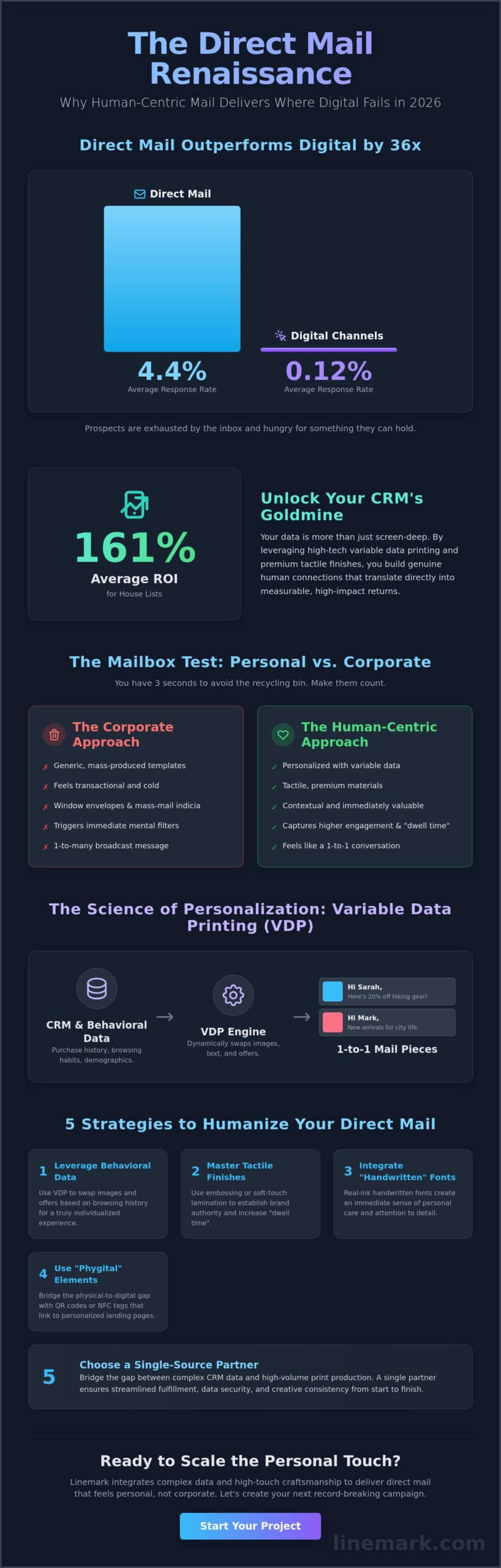
While digital channels struggle with a meager 0.12% response rate, direct mail in May 2026 is delivering a staggering 4.4% average return. It’s a clear signal that prospects are exhausted by the inbox and hungry for something they can actually hold. You know that the secret to breaking through is sending direct mail that feels personal not corporate, yet the challenge remains in scaling that “handwritten” feel across 10,000 pieces without sacrificing operational efficiency. The Linemark experience is built on solving this exact tension between high-volume production and boutique-level detail.
We agree that your CRM is a goldmine of data that shouldn’t be confined to a screen. You’ll learn how to leverage high-tech variable data printing and premium tactile finishes to build genuine human connections that drive a 161% average ROI for house lists. This guide provides a strategic roadmap for synchronizing complex data sets with precision print production. We’ll explore how to achieve record-breaking response rates and streamlined fulfillment while staying ahead of the July 12, 2026, USPS rate changes to ensure your budget remains as optimized as your messaging.
Key Takeaways
- Discover why human-centric mail captures higher engagement and “dwell time” than digital alternatives in the 2026 marketing landscape.
- Learn how Variable Data Printing (VDP) uses behavioral data to dynamically swap images and offers, creating a truly individualized recipient experience.
- Master the use of tactile finishes like embossing and soft-touch lamination to establish immediate brand authority through physical touch.
- Explore five specific strategies to produce direct mail that feels personal not corporate, including the integration of real-ink handwritten fonts and “phygital” elements.
- Understand the operational advantages of using a single-source partner to bridge the gap between complex CRM data and high-volume print production.
The Death of ‘Junk Mail’: Why Human-Centric Direct Mail Wins in 2026
In 2026, the marketing industry has officially declared the death of “junk mail.” It’s been replaced by a sophisticated approach to Advertising mail that prioritizes relevance over reach. This transformation is driven by a simple truth: prospects are overwhelmed by digital noise. While an email is deleted in milliseconds, physical mail enjoys a significantly longer “dwell time” in the home. Personal direct mail isn’t just about a name on an envelope; it’s a physically engaging communication that utilizes first-party data to provide immediate value to the recipient.
To better understand how these strategies translate into measurable success, watch this helpful video:
Corporate mail relies on generic, mass-produced templates that feel transactional and cold. It’s the difference between a generic utility bill and a thoughtfully crafted invitation. To win in 2026, you must deploy direct mail that feels personal not corporate. This requires a strategic shift where every piece of mail is contextual, tactile, and valued. As your single-source partner, we help bridge the gap between your brand’s vision and the consumer’s doorstep by integrating high-tech production with high-touch craftsmanship.
The Psychology of the Mailbox in a Digital-First World
Receiving a physical object triggers a sensory response that digital pixels cannot replicate. This is rooted in the “Endowment Effect,” a psychological phenomenon where people attribute more value to things they can physically touch. When a prospect holds your catalog or brochure, they subconsciously value the message more than a digital ad. This tactile interaction creates a sense of reciprocity; because you’ve invested in a high-quality physical piece, the recipient feels a subtle obligation to spend time with your content.
Breaking the ‘Corporate’ Filter: First Impressions Matter
You have exactly three seconds to pass the “mailbox test.” If a piece looks like a tax document or a generic flyer, it’s headed for the recycling bin. Visual cues like window envelopes or mass-mailing indicia scream “corporate” and trigger immediate mental filters. In 2026, authentic marketing is the standard. Prospects look for premium paper weights and personalized imagery that reflects their specific lifestyle. If the piece doesn’t look like it was created specifically for them, it hasn’t done its job. Authentic engagement starts with a design that feels like a 1-to-1 conversation rather than a 1-to-many broadcast.
The Science of Variable Data Printing: Personalizing at Scale
Achieving direct mail that feels personal not corporate requires more than just high-quality paper; it demands a sophisticated technical foundation. As the U.S. Small Business Administration highlights, Direct Mail is Hot Again because it bridges the gap between digital precision and physical presence. The core engine of this resurgence is Variable Data Printing (VDP). Variable Data Printing is a form of digital printing where elements can be changed from one piece to the next without stopping the press.
Modern marketing professionals have moved past simple name-insertion. In 2026, the most successful campaigns use behavioral data to swap entire sections of content based on a recipient’s previous interactions. A 2024 survey found that 62% of consumers who responded to direct mail in the past three months made a purchase, proving the effectiveness of these individualized touchpoints. If a customer recently browsed a specific product category on your site, their postcard should feature that exact imagery, not a generic corporate stock photo. This level of 1-to-1 mapping is what transforms a standard advertisement into a valued piece of communication.
Levels of Personalization: From Basic to Hyper-Targeted
Effective personalization isn’t a single switch but a spectrum of capabilities. We categorize these into three distinct tiers to help our partners scale their efforts:
- Level 1: Basic Text Fields. This involves standard data points like names, cities, or the date of a last purchase. It’s the entry point for most direct mail campaigns.
- Level 2: Versioning. We create different layouts or offers for specific segments. For example, a nonprofit might send different versions of a newsletter to monthly donors versus one-time contributors to increase relevance and retention.
- Level 3: True 1-to-1 Mapping. This is the pinnacle of the Linemark experience. Each piece is unique, featuring custom imagery and unique QR codes that lead to personalized landing pages based on individual user behavior.
Connecting Your Data to the Press
The success of these campaigns depends on the seamless integration of your CRM with high-speed digital presses. As of May 2, 2026, metered first-class mail rates are $0.74, making production efficiency and data management more critical than ever. Clean data sets are the prerequisite for error-free production. Automated workflows handle the heavy lifting, ensuring that complex logic is applied consistently across thousands of pieces. Security remains a top priority, especially when handling sensitive customer information. As a single-source partner, we maintain rigorous data privacy standards throughout the entire print and fulfillment cycle. If you’re ready to see how your data can drive record-breaking ROI, consider exploring our customized solutions for your next high-volume project.
Tactile Intelligence: Materials That Feel High-Touch, Not Mass-Produced
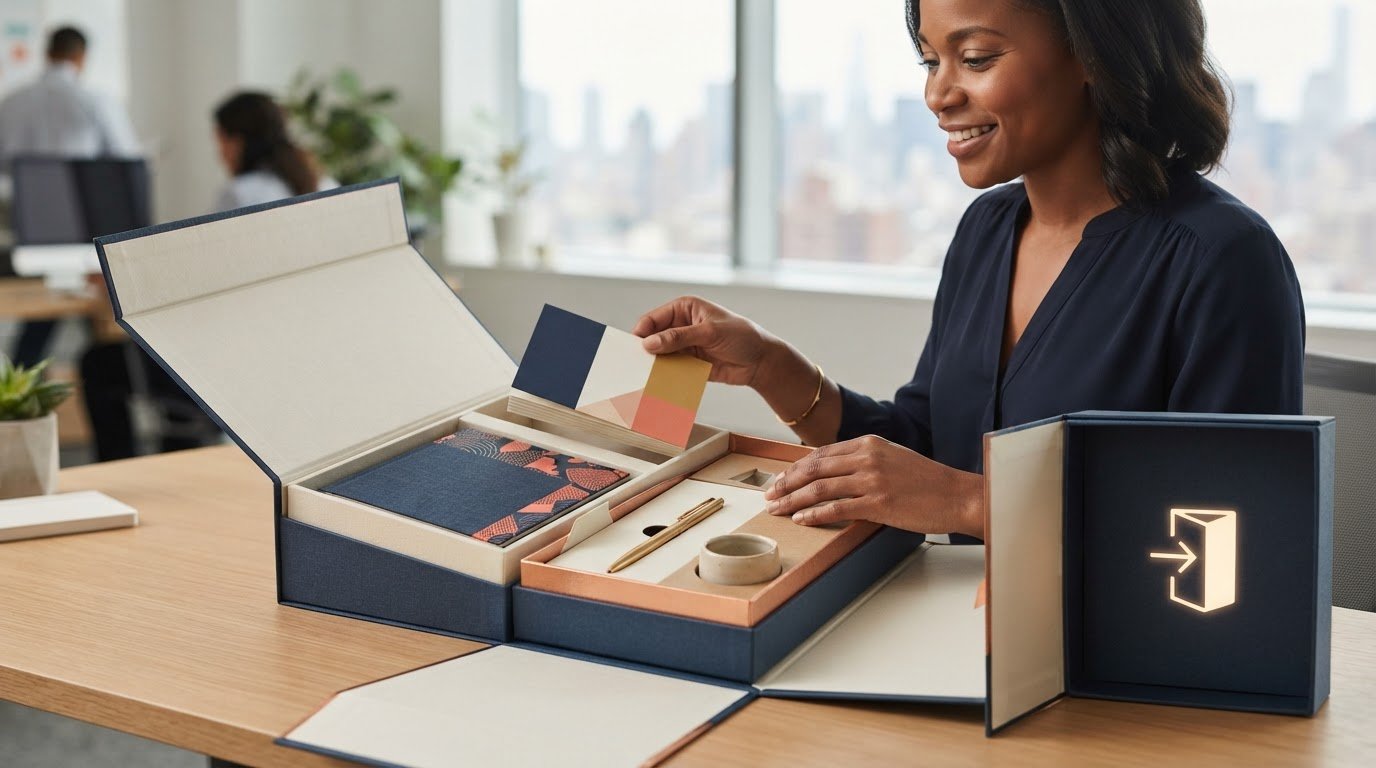
While Variable Data Printing handles the logic of your message, the physical substrate handles the emotional impact. In 2026, the sensory experience of a mail piece is the primary differentiator between a valued communication and a discarded flyer. High-touch materials are the secret to crafting direct mail that feels personal not corporate. When a prospect pulls a dimensional mailer from their mailbox, the “unboxing” experience immediately signals that the contents are important. Our 90,000-square-foot facility serves as the engine room for these diverse finishing options, ensuring the Linemark team maintains meticulous quality even on high-volume runs.
To truly Spark More Engagement, marketers must consider how haptic marketing influences memory retention. The physical weight of your brand in a recipient’s hand communicates authority before they read a single sentence. This is why we operate as a strategic communications ally rather than a simple print vendor. We help you select materials that align with your campaign goals and brand identity.
The ‘Feel’ of Personalization: A Material Comparison
The difference between standard 60lb offset paper and premium 100lb cover stock is immediately apparent to the touch. Standard paper feels like a utility bill; premium stock feels like a curated brand experience. Haptic marketing research proves that people value physical items more than digital ones, a phenomenon known as the Endowment Effect. Choosing a matte finish often provides a sophisticated, modern look that avoids the “cheap” glossy aesthetic of traditional corporate mailers. Soft-touch lamination adds a velvet-like texture that invites the recipient to keep holding the piece, increasing the dwell time of your message.
Finishing Techniques That Elevate the Message
Advanced Binding & Finishing techniques are the hallmark of direct mail that feels personal not corporate. We use specialized finishes like spot UV and embossing to create visual and physical depth. These elements draw the eye to specific calls to action while reinforcing a premium brand image. Die-cuts and unique shapes allow you to break the rectangular monotony of the mail stack, ensuring your piece stands out. For high-impact campaigns, specialized inks like metallic or neon can make a postcard feel like a limited edition collectible. These precision details are what transform a standard mailing into a strategic catalyst for client growth.
5 Strategies to Humanize Your Direct Mail Campaigns
Humanizing your outreach is the definitive step in crafting direct mail that feels personal not corporate. While variable data provides the logic and premium materials provide the prestige, these five strategies ensure your message resonates on a human level. In 2026, 84% of marketers report that direct mail is their highest ROI channel. This success stems from moving beyond transactional delivery toward genuine relationship building. By implementing these specific tactics, you transform a standard marketing piece into a meaningful touchpoint.
- Handwritten Authenticity: Use real-ink technology instead of standard digital fonts. This replicates the pressure and flow of a human hand; it makes a 10,000-piece run feel like a single, private note.
- Phygital Integration: Connect physical mail to digital journeys. A custom QR code that prepopulates a user’s shopping cart bridges the gap between offline discovery and online conversion.
- Dimensional ‘Lumpy’ Mail: Incorporate small items through specialized kitting. For instance, expert providers like Brandme demonstrate how advanced printing for custom apparel can transform your outreach into a premium “unboxing” experience. Recipients are statistically more likely to open a package that feels like a gift rather than a standard envelope.
- Digital Triggers: Send mail based on real-time behavior. An abandoned cart on a Tuesday should trigger a high-quality postcard that arrives by Friday.
- Hyper-Local Social Proof: Use VDP to mention specific neighborhood trends or community events. This makes your brand feel like a local neighbor rather than a distant corporate entity.
The Art of the ‘Phygital’ Bridge
Modern direct mail serves as a gateway to your digital ecosystem. By using unique QR codes or personalized URLs (PURLs), you can lead recipients to landing pages customized specifically for them. This allows you to track offline conversions in a digital dashboard with the same precision as a PPC campaign. For organizations with distributed teams, using MarCom On-Demand portals ensures that local representatives can customize national campaigns with regional data while maintaining brand integrity. This blend of central industrial capacity and local relevance is the hallmark of a sophisticated marketing strategy.
Timing and Triggers: The ‘When’ of Personalization
The traditional monthly blast is being replaced by “just-in-time” mailing. Setting up automated triggers based on customer lifecycle stages ensures your message arrives when it’s most relevant. Whether it’s a purchase anniversary or a re-engagement prompt after 60 days of inactivity, timing is a form of personalization. We implement frequency capping within our fulfillment workflows to ensure you stay top-of-mind without becoming a nuisance. If you’re ready to deploy these human-centric strategies at scale, partner with LineMark to integrate your CRM with our high-speed production facility.
Scaling the Personal Touch: How Linemark Integrates Data and Craftsmanship
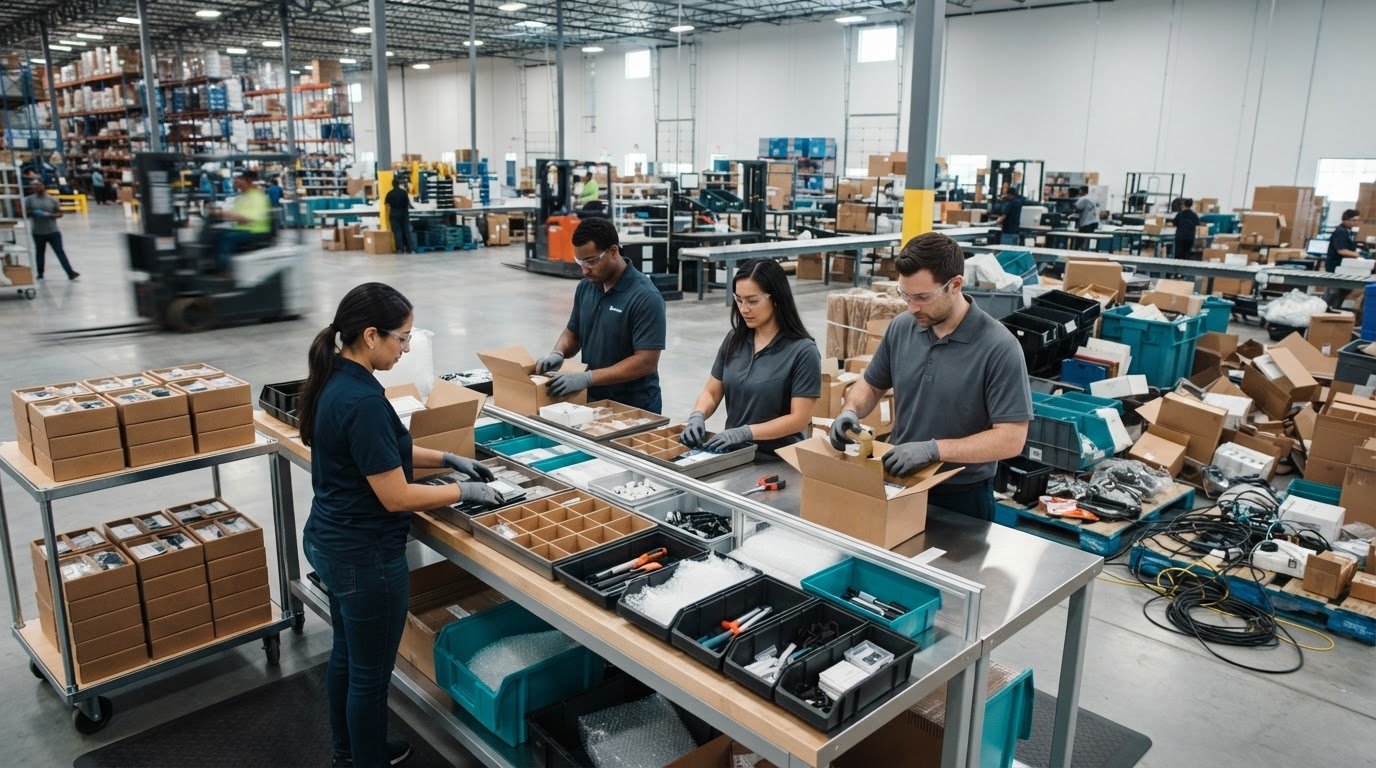
The challenge of scaling direct mail that feels personal not corporate lies in the transition from a creative concept to physical reality. Many marketing platforms act as mere middle-men, but LineMark operates as a single-source partner. We own the technology and the machinery, allowing us to maintain the meticulous attention to detail of a boutique shop while handling the industrial volume of a $73.57 billion market. Our technology stack is specifically engineered to process high-volume variable data without sacrificing production speed. This ensures that a campaign of 50,000 unique pieces is executed with the same precision as a single hand-delivered note.
From Digital Asset to Mailbox: Our Integrated Workflow
Our 90,000-square-foot facility is the foundation of the LineMark experience. By keeping every stage of production under one roof, we eliminate the communication gaps that often lead to errors in personalized runs. Our in-house data team works directly with your CRM exports to optimize mailing lists, ensuring that every behavioral trigger translates accurately to the printed page. This integrated approach supports on-demand production, which is essential for “just-in-time” marketing. Instead of over-printing generic brochures, you can produce highly relevant content that reflects the most current customer data, reducing waste and increasing the perceived value of your brand.
Kitting and Fulfillment: The Final Touch
Kitting and fulfillment are often overlooked, yet they are the final layers of a truly personalized strategy. We transform standard mailings into a “gift” experience by kitting small, relevant items with your printed materials. For instance, to find premium items for a golf-themed promotion, you can visit Golf Ball Monkey to discover high-quality accessories that create a lasting impression. This tactile surprise is what breaks the corporate filter and builds a genuine human connection. Our logistics experts manage nationwide distribution to keep your postage costs optimized, especially as we prepare for the July 12, 2026, USPS rate adjustments. We provide complete transparency through our inventory management and reporting systems, so you always know exactly where your assets are and how they are performing.
Execution is the ultimate differentiator in modern marketing. A brilliant strategy only succeeds if the physical piece reflects the premium quality of your brand. We invite you to see the LineMark difference in action. Our team is ready to provide a custom consultation that lead your next project from complex data sets to a streamlined, high-impact reality. Don’t let your message get lost in the digital noise; let’s build a physical connection that drives record-breaking ROI for your business.
Transforming Industrial Precision into Personal Connection
The resurgence of physical media in 2026 isn’t a return to the past; it’s a high-tech evolution of the customer journey. You’ve seen how Variable Data Printing and haptic materials turn generic outreach into valued brand assets. By prioritizing relevance and tactile quality, you create direct mail that feels personal not corporate, cutting through digital fatigue to drive a 161% average ROI for house lists. The success of these campaigns depends on a partner who can bridge the gap between complex CRM data and high-speed production without losing the “boutique” human touch.
LineMark provides the operational excellence needed to scale these individualized experiences. With over 30 years of industrial print expertise and a 90,000-square-foot high-tech production facility, we serve as your single-source partner for data management, print, and fulfillment. We don’t just print mailers; we engineer strategic catalysts for your growth. Ready to humanize your marketing? Partner with Linemark for high-impact direct mail. Your prospects are waiting for something real in their mailboxes. It’s time to give them a reason to engage with your brand today.
Frequently Asked Questions
How do I make direct mail look handwritten without actually writing it?
You can achieve a 1-to-1 look by using real-ink technology and robotic handwriting systems that replicate the pressure and flow of a human hand. Unlike standard digital fonts, these systems create slight variations in character shape and alignment. This technology is essential for creating direct mail that feels personal not corporate because it avoids the mechanical uniformity that prospects immediately recognize as an advertisement.
What is the best type of direct mail for high response rates in 2026?
Dimensional or “lumpy” mailers currently yield the highest engagement across all industries. While the average direct mail response rate is 4.4%, dimensional pieces often exceed this because they trigger curiosity and provide a physical “unboxing” experience. Combining a dimensional format with highly relevant content ensures your piece is opened and retained rather than discarded with transactional mail.
Can I integrate my Salesforce or HubSpot data with direct mail?
Yes, you can seamlessly integrate your CRM data through automated API workflows that connect your digital assets to our printing facility. We act as a single-source partner to synchronize your Salesforce or HubSpot segments with our high-speed digital presses. This integration allows for “just-in-time” mailing triggered by specific customer actions; such as a lead reaching a new lifecycle stage or abandoning a digital cart.
Is personalized direct mail more expensive than standard mail?
Personalized mail carries a higher production cost per unit but typically delivers a 161% average ROI for house lists. Standard mass mailings often result in higher waste and lower engagement. By focusing on data-driven relevance, you reduce the “cost per acquisition” even if the initial print cost is higher. Our 90,000-square-foot facility optimizes these workflows to keep production efficient at any scale.
What are the most effective tactile finishes for luxury brands?
Soft-touch lamination, embossing, and spot UV are the most effective finishes for establishing a premium brand image. These textures communicate authority and invite the recipient to engage with the piece longer. Utilizing these high-touch finishes is a proven way to produce direct mail that feels personal not corporate by signaling an artisanal attention to detail that standard offset printing cannot match.
How do I track the ROI of a personalized direct mail campaign?
You track ROI by using unique identifiers like personalized URLs (PURLs) and custom QR codes for each recipient. These tools allow you to attribute offline engagement to specific digital conversions in your analytics dashboard. By matching your mailing list against your final sales data, you can calculate your return on investment with the same precision as a digital search campaign.
What is the minimum order size for variable data printing?
Digital printing technology allows for efficient production of smaller, highly targeted batches. While our facility is built for industrial scalability, we handle runs ranging from a few hundred to several thousand pieces with the same level of precision. This flexibility allows marketing teams to test specific segments or regional offers before committing to a high-volume national rollout.
How does ‘phygital’ marketing work with postcards?
Phygital marketing works by placing a scannable trigger, such as a custom QR code, on a physical postcard to bridge the gap to a digital experience. When a recipient scans the code, they are directed to a landing page that is dynamically personalized with their name and specific offers. This creates a frictionless path from the physical mailbox to your digital sales funnel; increasing the likelihood of a conversion.