

 08/11/2026
  Steve Bearden
Choosing the lowest unit price for your next 50,000-unit catalog run might actually be the most expensive mistake your marketing department makes this year. You’ve likely felt the frustration of watching digital printing costs skyrocket on large batches, only to switch to offset and find yourself trapped by rigid lead times and static content that can’t be personalized. The debate of offset vs digital printing is no longer just about choosing a machine; it’s about aligning your production architecture with your specific growth goals and logistical requirements.
We understand that inconsistent color matching across different platforms can erode brand integrity, especially when scaling across national markets. This 2026 commercial guide will help you master the technical and economic nuances of both methods to optimize your high-volume production and maximize marketing ROI. We’ll define the precise break-even points for volume, explore how advanced variable data printing transforms customer engagement, and provide the technical framework you need to choose a national production partner with absolute confidence in their precision and scale.
Key Takeaways
- Understand the mechanical shift from traditional plate-based systems to modern inkjet technology to ensure technical alignment with your project goals.
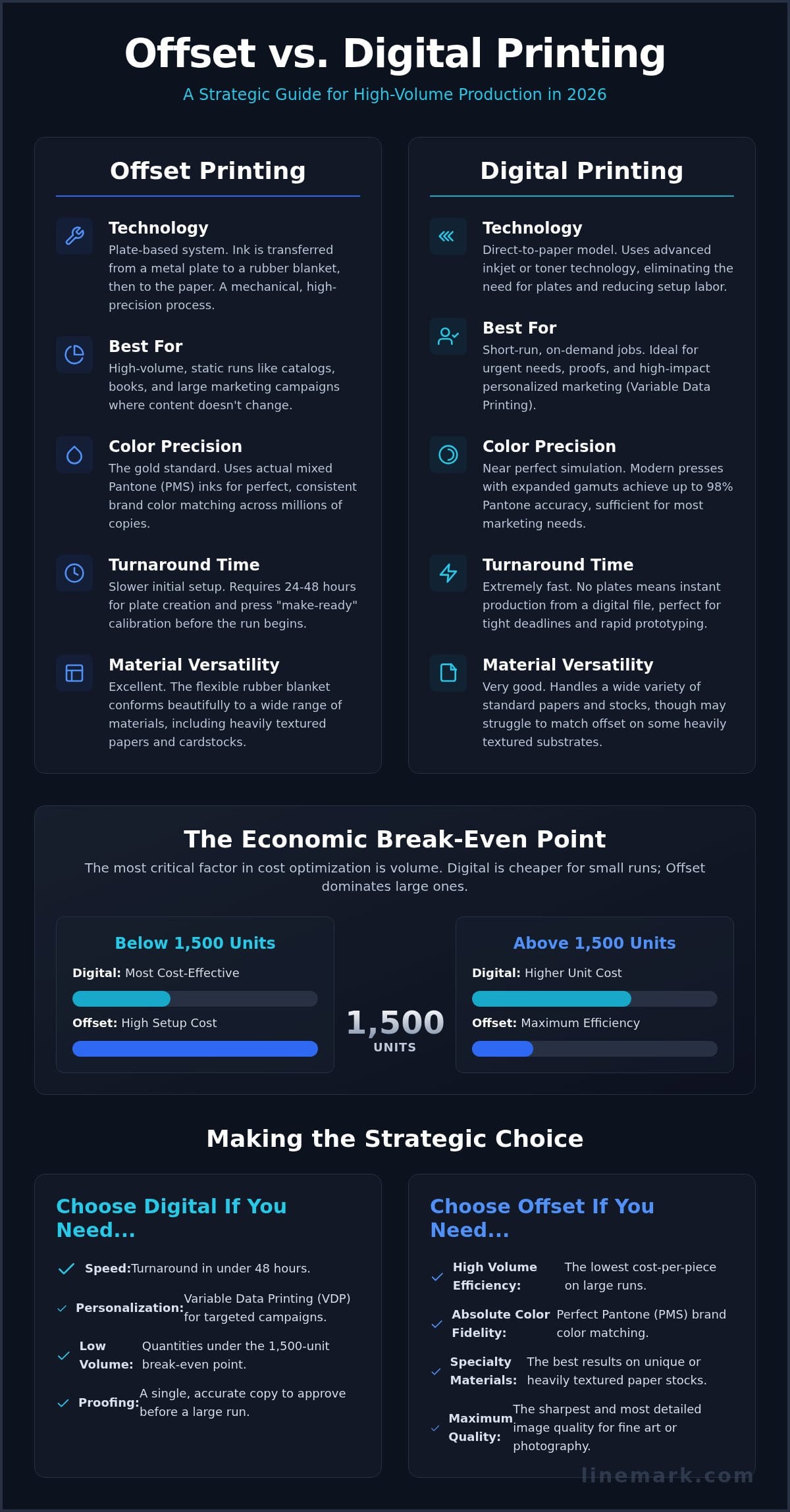
- Pinpoint the 1,500-unit economic break-even point in the offset vs digital printing comparison to secure the best ROI for your production budget.
- Explore how Variable Data Printing (VDP) enables high-impact personalization that static offset methods cannot replicate for targeted campaigns.
- Assess material versatility and color precision requirements to maintain brand standards across diverse substrates like heavy cardstock or textured papers.
- Utilize a streamlined decision framework to choose between the 48-hour agility of digital production and the high-volume efficiency of industrial offset runs.
Understanding the Mechanics: Offset vs. Digital Printing Technology
The fundamental choice between offset vs digital printing dictates your project’s pace, precision, and profit margin. While both methods deliver high-quality results, their mechanical foundations are distinct. Offset remains the industrial workhorse for high-volume catalogs and newsletters. Digital has evolved into an agile, precision tool for on-demand requirements and personalized direct mail. By 2026, technological convergence has narrowed the quality gap, making your decision more about logistics and data integration than visual fidelity.
The term “offset” refers to the indirect transfer of ink. Instead of applying ink directly to the paper, the image is transferred from a metal plate to a rubber blanket, and then onto the printing surface. This indirect method allows for a crisp, clean image across millions of impressions. It’s a sophisticated process that relies on the chemical repulsion of oil and water to ensure ink only adheres to the intended areas of the plate.
The Offset Process: Plates, Blankets, and Precision
Offset production begins with the creation of aluminum plates, which are etched for each color in the CMYK model. This pre-press stage is the most labor-intensive part of the workflow. Once these plates are mounted, the press requires “make-ready” time to calibrate color consistency and alignment. While this setup creates a front-heavy cost structure, it facilitates incredible speed once the run begins. Offset printing technology is particularly effective for diverse substrates, as the flexible rubber blanket can conform to the texture of various papers and stocks, ensuring a uniform ink laydown that digital toner sometimes struggles to match on heavily textured materials.
The Digital Revolution: On-Demand Flexibility
Digital printing operates on a direct-to-paper model, utilizing advanced inkjet or toner-based technology. It eliminates the need for physical plates and the associated setup labor. You can send a complex file to the press and begin production instantly. This agility is what makes digital the preferred choice for short-run brochures or urgent banners and signage. It’s not just about speed; it’s about the lack of waste. There are no “test sheets” required to get the color right, which significantly reduces the environmental footprint for smaller batches.
Modern digital presses handle everything from small-format postcards to large-format wall murals with remarkable precision. This technology also powers marcom on-demand portals, allowing marketing teams to order specific quantities as needed rather than stockpiling inventory. By removing the mechanical barriers of plate-making, digital printing provides a streamlined path from a digital file to a finished physical product.
The Critical Differentiators: Quality, Speed, and Material Versatility
Understanding the technical nuances of offset vs digital printing allows you to select the best path for brand consistency and operational efficiency. While technology has advanced, the physical interaction between ink and substrate remains a primary differentiator. Your choice impacts everything from the tactile feel of a brochure to the long-term durability of large format graphics.
Color Consistency and Brand Integrity
Offset remains the gold standard for corporate color matching because it uses actual Pantone Matching System (PMS) inks mixed to exact specifications. These inks provide a depth and vibrance that is physically consistent across millions of impressions. Modern 2026 digital presses utilize expanded color gamuts to reach 98% Pantone accuracy, providing a near-perfect simulation for most marketing needs. However, the choice of substrate significantly impacts these results. Porous papers absorb more ink, potentially dulling colors, while coated stocks keep the ink on the surface for maximum pop. Offset’s ability to maintain precise ink density ensures that your brand’s signature palette looks identical across every piece in a high-volume run.
Turnaround Times and Production Velocity
Production velocity is where the offset vs digital printing debate meets the reality of your marketing calendar. Offset production involves a setup lag that often spans 24 to 48 hours, accounting for plate etching, press mounting, and ink calibration. If you need a million-piece run, this initial investment in time is quickly recovered by the press’s sheer mechanical speed. Conversely, digital printing supports Just-In-Time (JIT) inventory strategies by eliminating these pre-press steps. This allows for 24-hour turnarounds on complex projects like custom book printing where short-run agility is paramount.
Beyond the ink, consider how your choice impacts the final tactile experience. Specialized finishes require specific environments to cure or adhere correctly:
- Offset Finishing: Best for high-volume inline aqueous coatings, flood UV, and industrial-scale binding.
- Digital Finishing: Ideal for specialized spot UV, soft-touch lamination, and intricate die-cutting on short runs.
Our team can help you evaluate which method supports your specific material needs, whether you are printing on heavy cardstock, plastics, or specialty textured papers. If you are balancing a tight deadline with high-volume requirements, consulting with a strategic communications ally can help you navigate these trade-offs effectively.
Cost Analysis: Finding the Economic Break-Even Point
The financial architecture of offset vs digital printing rests on how costs are distributed across your production run. For offset, the first sheet carries the entire weight of pre-press labor and material. By the 10,000th copy, that initial investment is spread so thin that the unit price drops to pennies. Digital operates on a linear model. Each sheet carries a consistent charge, meaning the first copy and the 500th copy cost roughly the same. Understanding this curve is vital for protecting your marketing margins.
The Price of Plates vs. The Price of Clicks
Pre-press fees in traditional lithography cover the physical creation of aluminum plates and the manual labor of press calibration. These are static, front-end costs that don’t change whether you print one page or one million. Digital production replaces these fixed costs with “click charges,” which are recurring fees for every impression made by the press. This makes digital the clear fiscal winner for short-run brochures or posters where the setup fees of offset would dwarf the actual printing costs.
Complex direct mail campaigns often require a hybrid cost approach. If you’re sending out 50,000 postcards with a static brand message on one side and personalized offers on the other, we can use offset for the high-volume shell and digital for the variable data. This strategy captures the low unit cost of lithography while retaining the high-engagement benefits of personalization. It’s an efficient way to scale without letting the linear costs of digital eat your entire budget.
Inventory Costs and Obsolescence
Many procurement teams fall into the trap of “printing to save.” They order 5,000 units via offset to hit a lower price point, only to eventually discard 2,000 of them when a product specification or phone number changes. This creates a hidden expense that many companies fail to track. Digital printing eliminates this obsolescence by allowing for smaller, more frequent batches. You don’t have to worry about 5,000 wasted offset pieces when you can print 500 digital pieces exactly when you need them.
Strategic warehousing still has its place for core brand assets that remain unchanged for years. However, for dynamic marketing collateral, the agility of digital printing minimizes environmental impact and prevents capital from being tied up in dusty pallets. We help our partners analyze their historical usage data to find the exact break-even point where the transition from digital’s agility to offset’s volume efficiency makes the most sense for their bottom line.
Advanced Applications: Variable Data and MarCom Portals
The strategic evolution of offset vs digital printing has moved beyond simple ink-on-paper mechanics. In 2026, the most successful organizations view their printing method as a data strategy rather than a manufacturing choice. By integrating sophisticated software with industrial-scale hardware, we can now bridge the gap between high-volume efficiency and hyper-personalized engagement. This shift allows marketing executives to treat physical mail with the same precision as a digital ad campaign.
The Power of Personalization at Scale
Variable Data Printing (VDP) is the ability to change text and graphics on every single piece without stopping the press. This digital-only capability transforms a standard postcard or brochure into a highly relevant communication tool tailored to the recipient’s specific history or geographic location. In national direct mail campaigns, VDP drives significantly higher response rates by moving away from “one-size-fits-all” messaging. Beyond simple mailers, we see this technology revolutionizing custom book manufacturing and annual reports, where individualized data visualizations and localized content can be inserted into high-quality, professionally bound volumes.
Streamlining with MarCom On-Demand
Managing brand integrity across a distributed national network requires a centralized solution. Our marcom on-demand portals solve this by automating the choice between production methods based on real-time data. These portals allow local teams to order marketing collateral that is already approved by corporate, while still permitting localized digital customization for their specific market. It removes the logistical friction of managing multiple vendors and ensures that every piece of signage or literature meets the same rigorous standards.
This ecosystem also facilitates “versioned printing,” a hybrid approach that leverages the best of both worlds. We use offset printing to produce high-volume “shells” that contain the static, brand-heavy elements of a catalog or newsletter. These shells are then run through digital presses to add localized content, specific pricing, or personalized offers. This method captures the low unit cost of offset while maintaining the agility of digital production. It also streamlines national distribution, as materials can be kitted and fulfilled from our 90,000-square-foot hub immediately after the digital personalization phase is complete.
If you’re ready to move beyond static production and implement a data-driven strategy, partner with Linemark to scale your marketing logistics with precision and authority.
Making the Strategic Choice: A Decision Framework for 2026
Selecting between offset vs digital printing requires more than a glance at the unit price; it demands a holistic view of your supply chain and marketing objectives. To simplify this decision, we’ve developed a framework based on four critical project pillars: volume, velocity, variability, and visual complexity. By 2026, the 1,500-unit threshold remains a reliable industry benchmark for sheet-fed production, but your specific logistical needs often outweigh simple piece-count math.
- Volume Check: Is your run over 1,500 units? If so, the economies of scale provided by traditional lithography begin to outperform digital’s linear pricing model.
- Timeline Check: Do you need the project in 48 hours or less? Digital is your only viable path. If your schedule allows for a 7-day production cycle, offset becomes a strategic option.
- Content Check: Is every piece identical? Digital is required for any project involving variable data, personalized offers, or localized versioning.
- Quality Check: Does the project require specialized metallic inks or fluorescent spot colors? These high-impact visual elements are best handled by the ink-mixing capabilities of an offset press.
When to Choose Offset Printing
Offset printing remains the definitive choice for high-volume static brochures, catalogs, and newsletters. It’s the industrial solution for projects where brand equity depends on precise PMS color matching across millions of identical units. Beyond traditional paper, offset presses are better equipped to handle large-format graphics on specific industrial substrates that require specialized ink adhesion and long-term durability. When you’re managing a national rollout with a fixed message, the consistency and low unit cost of offset are unmatched.
When to Choose Digital Printing
Digital printing is the preferred method for short-run books, personalized direct mail, and urgent trade show collateral. It’s the ideal tool for projects with tight deadlines requiring same-week distribution across multiple markets. Marketing teams also utilize digital production to test new marketing messages or graphics in small batches before committing to a massive offset run. This minimizes the risk of inventory obsolescence and ensures your capital is only spent on proven, high-performing assets.
The Linemark Advantage: National Hybrid Production
Linemark operates as a hybrid powerhouse, leveraging our 90,000-square-foot facility to remove the friction of choosing between two different vendors. We provide the industrial scale of offset alongside the data-driven agility of digital production, all under one roof. This centralized approach allows us to integrate complex kitting and fulfillment services, moving your project seamlessly from the press to the porch. By serving as a strategic communications ally, we ensure your project’s logistics are as precise as the printing itself. Ready to scale your communications? Consult with a Linemark print expert today to find the optimal path for your next high-volume project.
Optimizing Your Production Architecture for 2026
The choice of offset vs digital printing is no longer a simple matter of choosing a machine. It’s a strategic calculation between high-volume stability and data-driven agility. You now have the technical framework to identify the 1,500-unit break-even point and leverage Variable Data Printing to drive measurable campaign engagement. Navigating these nuances ensures your brand maintains its integrity while optimizing marketing ROI across every channel.
Linemark serves as your strategic communications ally, operating a 90,000-square-foot high-tech facility designed for industrial scale. With our G7 Master Printer Certification and a robust national fulfillment and distribution network, we manage the complexities of your most demanding projects with meticulous attention to detail. We don’t just provide a service; we build a unified partnership to move your materials from the press to the porch with precision. Partner with Linemark for high-volume commercial production and let’s transform your logistics into a catalyst for growth. We are ready to help you scale with absolute confidence.
Frequently Asked Questions
Which is better for high-quality photos, offset or digital?
Both methods produce exceptional photographic results in 2026, but they excel on different surfaces. Offset provides unmatched color depth and smoothness for photos on porous or textured papers. Digital technology delivers incredible sharpness and vibrant contrast on gloss or matte coated stocks. Your choice should depend on the specific tactile experience you want to create for your audience.
What is the standard turnaround time for an offset print run in 2026?
Standard turnaround for offset production is typically 5 to 7 business days. This window allows for pre-press plate creation, mechanical calibration, and necessary ink drying time before binding or finishing. Digital printing can often achieve 24 to 48-hour turnarounds because it bypasses these industrial setup steps, making it the better choice for urgent trade show collateral.
Can I use variable data on an offset press?
Offset presses are designed for static, high-volume production and cannot process variable data directly. To achieve personalization at scale, we utilize a hybrid workflow. We print the high-quality static “shells” on an offset press to capture low unit costs. We then use digital technology to overprint the individualized names, offers, or unique codes for your direct mail campaign.
Is digital printing more environmentally friendly than offset?
Digital printing is often more sustainable for short-run projects because it reduces physical waste. It eliminates the need for aluminum plates and the associated chemical etching process. Additionally, it minimizes paper waste by removing the hundreds of “make-ready” sheets required to calibrate color on an offset press, ensuring a smaller carbon footprint for targeted campaigns.
What is the break-even point where offset becomes cheaper than digital?
The economic break-even point in the offset vs digital printing comparison usually occurs near the 1,500-unit mark for sheet-fed projects. Digital is more cost-effective for smaller quantities due to the absence of setup fees. Once you surpass this threshold, the low per-unit cost of offset begins to provide a superior return on investment for your marketing budget.
Can digital printing match Pantone colors exactly?
Modern digital presses can simulate approximately 98% of the Pantone library using expanded color gamuts. While this is sufficient for most commercial brochures and catalogs, offset remains the only way to achieve a 100% exact match. Offset uses physically mixed inks rather than a four-color simulation, which is essential for maintaining rigid brand standards on signature corporate colors.
What substrates can modern digital presses handle?
Modern digital presses handle an impressive range of substrates beyond standard paper. We routinely print on heavy cardstock, synthetic materials, and specialized plastics for floor graphics or window clings. This versatility allows you to maintain brand consistency across diverse marketing materials without the long lead times or high setup costs traditionally associated with non-paper substrates.
How does a MarCom portal simplify the offset vs. digital decision?
A MarCom portal removes the guesswork from the offset vs digital printing decision by using automated production logic. The system analyzes your order quantity and required delivery date to automatically route the project to the most efficient press. This ensures your distributed teams always receive the best price and fastest turnaround without needing deep technical expertise in printing mechanics.