


 05/11/2026
  Steve Bearden
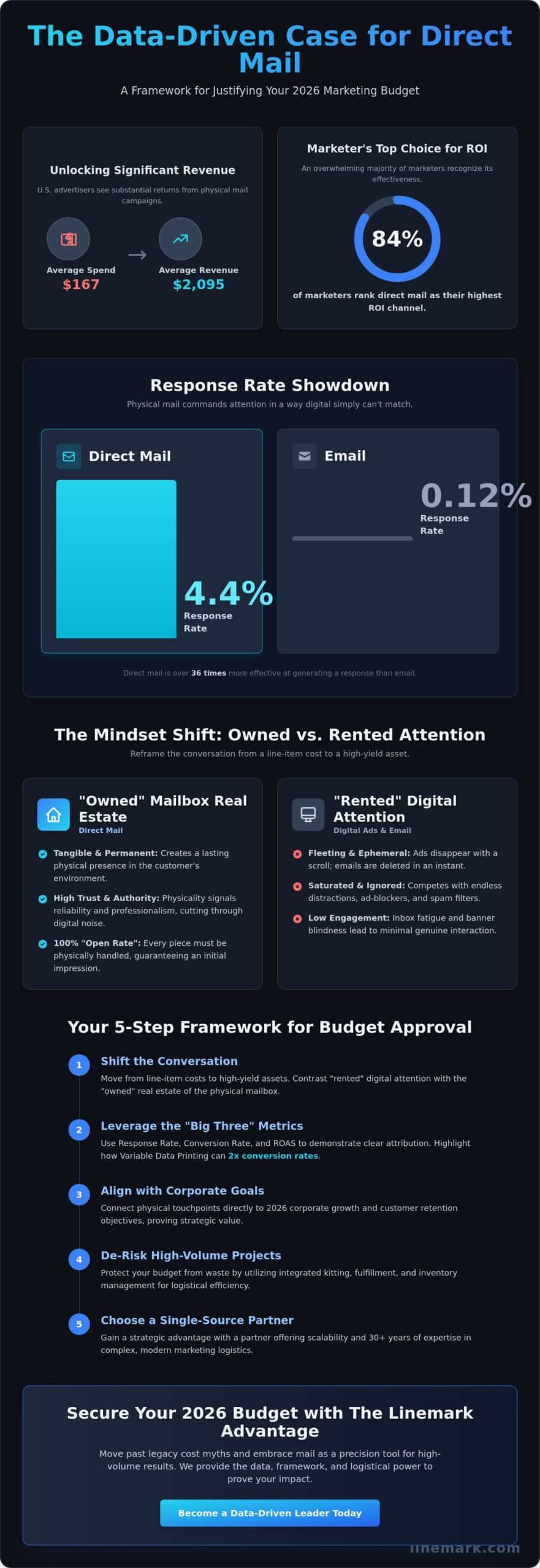
U.S. advertisers generate an average of $2,095 in revenue for every $167 spent on direct mail, proving that physical engagement is a powerhouse for growth. With response rates at 4.4 percent, far outperforming email’s 0.12 percent, the financial logic is undeniable. Still, justifying direct mail budget to your boss remains a hurdle when digital impressions appear cheaper on the surface. You likely recognize that 84 percent of marketers now rank direct mail as their highest ROI channel, but translating that industrial reality into executive approval requires a shift in perspective. The Linemark difference lies in moving past legacy cost myths to embrace mail as a precision tool for high-volume results.
It’s frustrating to see high-performing campaigns sidelined by a bias toward digital saturation. We’ll help you transform these perceptions by providing a 2026 ROI framework that accounts for the July 12 postage rate adjustments, including the new $0.82 First-Class stamp. You’ll learn how to integrate physical touchpoints with digital tracking to prove clear attribution across every channel. This guide outlines the exact data points and strategic positioning needed to secure your 2026 budget while establishing your role as a data-driven leader in your organization.
Key Takeaways
- Shift the conversation from line-item costs to high-yield assets by contrasting “rented” digital attention with the “owned” real estate of the physical mailbox.
- Leverage the “Big Three” metrics and variable data printing to demonstrate clear attribution and a potential 2x increase in conversion rates for your campaigns.
- Master a 5-step framework for justifying direct mail budget to your boss by aligning physical touchpoints with 2026 corporate growth and retention goals.
- Protect your marketing budget from logistical waste by utilizing integrated kitting, fulfillment, and inventory management to de-risk high-volume projects.
- Understand the strategic advantage of a single-source partner with the scalability and 30 years of expertise required to handle complex, modern marketing logistics.
The Mindset Shift: Positioning Direct Mail as a Business Investment
The first step in justifying direct mail budget to your boss is reframing the conversation from a “spend” to a “strategic allocation.” In a fiscal environment where every dollar is scrutinized, viewing Direct Mail as a Business Investment changes the internal narrative. You aren’t just buying paper and postage. You’re acquiring a high-yield physical asset that secures a permanent place in a prospect’s home or office. Unlike digital ads that vanish the moment a user scrolls, physical mail provides a tactile bridge that de-risks your digital strategy by ensuring your message isn’t ignored by saturated filters.
Digital marketing relies on “rented” attention. You pay for a fleeting slot on a social feed or a search result page, competing with a thousand other distractions. Direct mail allows you to “own” the real estate of the mailbox. This distinction is critical for Customer Life Cycle Marketing. By introducing physical touchpoints at key stages of the journey, you create a tangible connection that digital clicks simply can’t replicate. The quality of engagement here consistently beats the quantity of clicks, moving you past the cost-per-impression trap where low-cost digital ads often yield zero-intent traffic.
To better understand how these physical touchpoints function within a broader business strategy, watch this breakdown of the process:
Moving From Cost Center to Revenue Driver
Treating direct mail as a revenue driver means acknowledging its power to trigger high-intent digital actions. Whether it’s a QR code leading to a customized landing page or a personalized offer that drives an in-store visit, physical mail serves as the catalyst. In 2026, the mailbox is the only uncluttered inbox left for high-value prospects. This clarity allows for long-term brand equity that survives long after a browser tab is closed. The Linemark approach frames mail not just as a delivery system, but as a strategic communications ally that amplifies every other channel in your mix.
The Trust Factor in a Saturated Digital World
Trust is the currency of 2026. With digital ad-blocking reaching new heights and inbox fatigue at an all-time peak, the psychological impact of tactile marketing is undeniable. Physical pieces demand a 100 percent “open rate” because someone must touch the mail to sort it. This physical interaction builds brand recall and establishes a sense of permanence that pixels lack. For associations and corporations, this physicality signals reliability and authority. It’s a professional, reassuring way to cut through the noise and build the confidence necessary for high-stakes conversions.
The Data-Driven Case: Metrics That Win the Boardroom
Winning over an executive team requires moving past anecdotal success. When you’re justifying direct mail budget to your boss, you need a data-backed framework for a successful marketing budget that speaks the language of the boardroom. The most persuasive argument lies in the “Big Three” metrics: response rate, conversion rate, and return on ad spend (ROAS). As of May 2026, the average direct mail response rate sits at 4.4 percent. Compare that to email’s 0.12 percent. The physical piece isn’t just a letter; it’s a high-intent trigger that demands action.
Attribution modeling is the key to proving this value in a multi-channel world. Executives often suffer from digital bias because digital clicks are easy to track. However, modern tracking technologies like QR codes and personalized URLs (PURLs) bridge the gap between the mailbox and the browser. By capturing these physical-to-digital journeys, you can demonstrate that direct mail often serves as the primary driver for high-value digital conversions. To win the budget battle, focus on these specific 2026 benchmarks:
- Response Rate: 4.4% for direct mail vs. 0.12% for email.
- House List ROI: 161% average return, the highest of any paid channel.
- Revenue Generation: $2,095 in revenue per person against a $167 average spend.
Precision in your data leads to precision in your results. If you want to refine your strategy, you can explore how our integrated mailing solutions bridge the gap between physical and digital tracking.
Beyond Vanity Metrics: Proving ROAS
Calculating the lifetime value (LTV) of a customer acquired through mail provides a clearer picture of long-term profitability. ROAS in a print-to-web context measures the direct revenue generated from mail-triggered digital actions against the total investment in the physical campaign. While digital ads might offer a lower cost per impression, the 161 percent average ROI for house list mailings proves that quality engagement delivers superior financial outcomes. Tracking these metrics ensures you aren’t just reporting on activity, but on actual business growth that impacts the bottom line—an area where Small Biz Books helps companies maintain the precise records required for such high-level financial analysis.
The Power of Variable Data Personalization
Generic bulk mail is a relic of the past that wastes resources. Utilizing variable data printing allows you to customize every element of a piece, from the recipient’s name to specific product recommendations based on their purchase history. This level of personalization can increase your ROI by 2x by drastically reducing “waste” in your mailing budget. Targeted lists ensure your message reaches the right person at the right time, which is especially effective for securing high-level executive engagement in a saturated market.
Strategic De-Risking: How to Prevent Budget Waste
Precision in marketing is as much about what you don’t spend as what you do. When justifying direct mail budget to your boss, you must address the hidden leaks that drain capital without contributing to your ROI. These leaks often stem from fragmented logistics and outdated data. With the USPS implementing new postage rates on July 12, 2026, including the $0.82 Forever Stamp and $0.74 First-Class metered rate, every undeliverable piece represents a direct hit to your bottom line. Strategic de-risking ensures your budget is spent on engagement, not on paying for errors.
Automated workflows play a vital role in reducing human error costs. When data flows directly from your CRM to the press, the risk of incorrect addressing or mismatched variable data vanishes. This automation preserves the integrity of your campaign and protects your professional reputation. List hygiene is equally essential for avoiding the “Postage Trap.” With the USPS revising its list of rural ZIP codes as of February 23, 2026, outdated lists lead to expensive surcharges and failed deliveries. Cleaning your data isn’t just a best practice; it’s a budget-saving necessity that proves your fiscal responsibility.
Efficiency Through Kitting and Fulfillment
Bundling production and shipping within a single facility reduces the total cost of ownership by eliminating third-party handoffs. A kitting and fulfillment strategy streamlines complex nationwide campaigns, ensuring that brochures, postcards, and personalized letters arrive together and on time. This single-source advantage accelerates your speed-to-market. It removes the friction that often delays high-volume projects, allowing you to hit market windows with industrial precision. By centralizing these tasks, you also mitigate the 8 percent price increase on domestic shipping rates, such as Priority Mail, which remains in effect through January 17, 2027.
Smart Inventory and On-Demand Production
The MarCom On-Demand model is a critical tool for protecting your marketing budget. It prevents the accumulation of obsolete stock that eventually ends up in a landfill. By leveraging digital printing for smaller, high-frequency test runs, you can validate your messaging before committing to a full-scale launch. This approach reduces upfront capital requirements and allows for agile adjustments based on real-time performance data. It’s a scalable solution that aligns your physical output with actual demand. Effective Inventory Management ensures that your materials are always current, high-quality, and ready for immediate distribution, demonstrating to leadership that you are a disciplined steward of company resources.
The 5-Step Pitch: Presenting Your Budget Request
Securing executive approval requires more than just showing high response rates. When you’re justifying direct mail budget to your boss, you must present a cohesive plan that mitigates risk while promising scalable growth. This 5-step pitch framework is designed to bridge the gap between marketing execution and corporate strategy. It moves the conversation away from “what we’re spending” to “how we’re winning” in a market where 95 percent of marketers are already maintaining or increasing their physical mail investments.
- Step 1: Align with 2026 Corporate Goals. Connect your campaign directly to the company’s focus on growth, retention, and trust. With digital trust at an all-time low, physical mail serves as a high-integrity channel for high-value customer segments.
- Step 2: Present the “Digital Fatigue” Evidence. Use the fact that 56 percent of marketers saw improved direct mail results in 2025 to prove that consumers are responding to offline engagement. This data demonstrates that the mailbox is no longer a “legacy” channel, but a modern necessity.
- Step 3: Show the Integrated Campaign Map. Demonstrate how physical mail acts as the entry point for digital funnels. This visualization proves that mail isn’t an island; it’s the anchor for your entire multi-channel strategy.
- Step 4: Detail the Efficiency Plan. Explain how a single-source partner reduces overhead through automated workflows and integrated logistics. This protects the margin and ensures operational excellence from the first print to final fulfillment.
- Step 5: Define the Success Milestones. Set clear 30, 60, and 90-day benchmarks for response rates and ROAS. This transparency builds executive confidence in your data-driven leadership.
Aligning with Executive Priorities
To win over a CFO, you must speak the language of EBITDA and Customer Acquisition Cost (CAC). Frame the $167 average spend per person not as a cost, but as a calculated investment to unlock $2,095 in revenue. If your leadership is still hesitant, suggest a “Pilot Program” approach. Asking for a small, high-intent test budget first allows you to prove the 161 percent average ROI on house lists before scaling to larger prospects. This strategy de-risks the initial investment and provides the concrete data needed for full budget approval. For leaders in the architecture, engineering, and construction sectors looking to align these tactical wins with broader corporate objectives, Significant Business Results offers executive coaching and exit strategy consulting to maximize long-term growth.
Visualizing the Multi-Channel Journey
Executives need to see how physical mail fuels the digital engine. Create a flow chart that positions a high-quality postcard or catalog as the initial high-intent touchpoint that leads to a PURL or QR code scan. This “halo effect” improves the performance of every subsequent digital interaction. Integrating physical mail pieces into your digital funnel increases the effectiveness of social retargeting by providing a tangible touchpoint that reinforces digital impressions. If you’re ready to build this framework, you can contact our strategic team to help map out your integrated campaign logistics.
The Linemark Advantage: Justifying a Single-Source Partner
Justifying direct mail budget to your boss often comes down to the reliability of your execution. Leadership needs to know that the capital they’ve allocated won’t be lost to logistical errors or vendor mismanagement. Choosing a single-source partner is the most effective way to provide that assurance. By integrating every stage of the process, from variable data printing to final fulfillment, you eliminate the friction of multiple handoffs. This approach doesn’t just save time; it provides a level of operational excellence that justifies the investment before the first postcard even hits the mail stream. It’s about moving from a transactional exchange to a premium, holistic journey that secures your ROI.
Fragmented logistics are a primary cause of budget bloat. When you separate your printer from your mail house, you’re paying for extra shipping, extra project management, and a higher risk of data errors. Linemark eliminates these vulnerabilities by housing everything within a single, high-tech ecosystem. This integration is the ultimate risk mitigation strategy for 2026. It ensures that your message remains consistent and your data remains secure from the moment it enters our system until it reaches the prospect’s mailbox. You’re not just buying print; you’re investing in a streamlined, industrial-scale solution that de-risks your entire marketing spend.
Scalability and Technological Pride
Our 90,000-square-foot facility provides the industrial capacity needed for massive scale. We maintain the meticulous attention to detail of a boutique shop, ensuring that high-volume projects never sacrifice quality. This high-capacity operation uses advanced digital and offset printing technology to ensure precision in every piece. Centralizing production and distribution from a single hub helps you bypass the logistical friction that usually plagues nationwide campaigns. The Linemark difference is found in our ability to handle complex kitting and fulfillment with industrial authority. We ensure your materials are processed, packed, and shipped with speed-to-market that fragmented vendors can’t match. This scalability allows your campaigns to grow without the growing pains of searching for new suppliers.
Your Strategic Communications Ally
In a landscape defined by 2026 postal adjustments and shifting rural ZIP codes, you need more than a printer. You need a consultant who understands the nuances of modern marketing and logistics. Linemark provides 30 years of data-driven strategy expertise to help you stay ahead of these regulatory changes. We prioritize data security and logistics, ensuring your high-intent mailings reach the right hands without compromise. Our MarCom On-Demand portal further empowers your team to manage inventory with precision, reducing waste and protecting your capital. This collaborative partnership is the ultimate way to prove you’re a strategic, data-driven leader. Partner with Linemark for your 2026 direct mail strategy to experience the difference firsthand.
Securing Your Strategic Advantage for 2026
We’ve moved past the era of viewing physical marketing as a legacy cost. By adopting an ROI framework that prioritizes precise attribution and logistical efficiency, you position yourself as a leader who understands the high-intent value of the mailbox. Justifying direct mail budget to your boss is ultimately about demonstrating how physical touchpoints cut through digital noise to drive measurable, high-value conversions that digital channels alone cannot secure. You’ve seen how a data-driven approach de-risks your spend while amplifying your brand’s authority.
Success in this evolving landscape requires a partner with the infrastructure to match your ambition. LineMark provides a 90,000-square-foot high-tech facility and over 30 years of industrial printing authority to ensure every project is executed with precision. Our comprehensive MarCom On-Demand portals allow your team to maintain absolute control over inventory while we handle the complex kitting and fulfillment logistics. Secure your 2026 marketing success with Linemark’s integrated direct mail solutions. You have the data and the strategy. It’s time to lead your organization toward a more resilient and profitable marketing future.
Frequently Asked Questions
How do I explain the high cost of postage to my boss?
Frame postage as the necessary cost of securing “owned” real estate in a prospect’s home. While the USPS proposed an increase to $0.82 for Forever Stamps on July 12, 2026, this investment is justified by the $2,095 in average revenue generated per person. You’re paying for a guaranteed physical touchpoint in a channel that isn’t crowded with thousands of daily digital distractions.
Is direct mail still effective in 2026 with all the digital options?
Direct mail remains exceptionally effective, outperforming email response rates by a factor of 36 to 1. As of May 2026, physical mail sees a 4.4 percent response rate compared to the 0.12 percent average for digital messages. The tangible nature of print builds a level of trust and brand recall that fleeting digital impressions simply cannot replicate in a saturated market.
What is the best way to track ROI for a physical mail campaign?
Deploying QR codes and personalized URLs (PURLs) is the most efficient way to capture physical-to-digital conversion data. These tools provide the clear attribution metrics necessary when justifying direct mail budget to your boss. By linking a specific mail piece to a digital action, you can prove exactly how your physical spend is fueling your online sales funnel and total ROAS.
Can direct mail be integrated with our current CRM and digital ads?
Modern direct mail functions as a high-tech extension of your existing digital ecosystem. You can use CRM data to trigger automated mailings based on specific customer behaviors, such as an abandoned cart or a subscription renewal date. This omnichannel integration ensures that your physical touchpoints reinforce your digital ads, creating a seamless and high-touch experience for every prospect in your pipeline.
How does variable data printing actually save us money?
Variable data printing reduces budget waste by allowing for hyper-targeted, high-intent messaging. Instead of sending generic brochures to a broad list, you can customize every element to match the recipient’s specific purchase history or demographic profile. This precision can increase your ROI by 2x, ensuring that your production and postage dollars are only spent on the most relevant and likely-to-convert prospects.
Should we use a boutique agency or a single-source partner for direct mail?
A single-source partner is the superior choice for justifying direct mail budget to your boss because it minimizes logistical risk and handoff costs. By centralizing printing, kitting, and fulfillment in one facility, you eliminate the surcharges and delays associated with multiple vendors. This integrated approach provides the scalability and industrial precision required to handle complex, high-volume projects without sacrificing quality or security.
What is the “digital fatigue” argument and how do I use it?
The digital fatigue argument highlights the psychological advantage of physical mail in an era of inbox overload. Consumers are increasingly ignoring digital ads, but a physical piece requires a 100 percent “touch rate” as it’s sorted by hand. You can use this to show leadership that direct mail is the only channel that guarantees a physical interaction, making it a vital tool for building long-term trust.