


 04/30/2026
  Steve Bearden
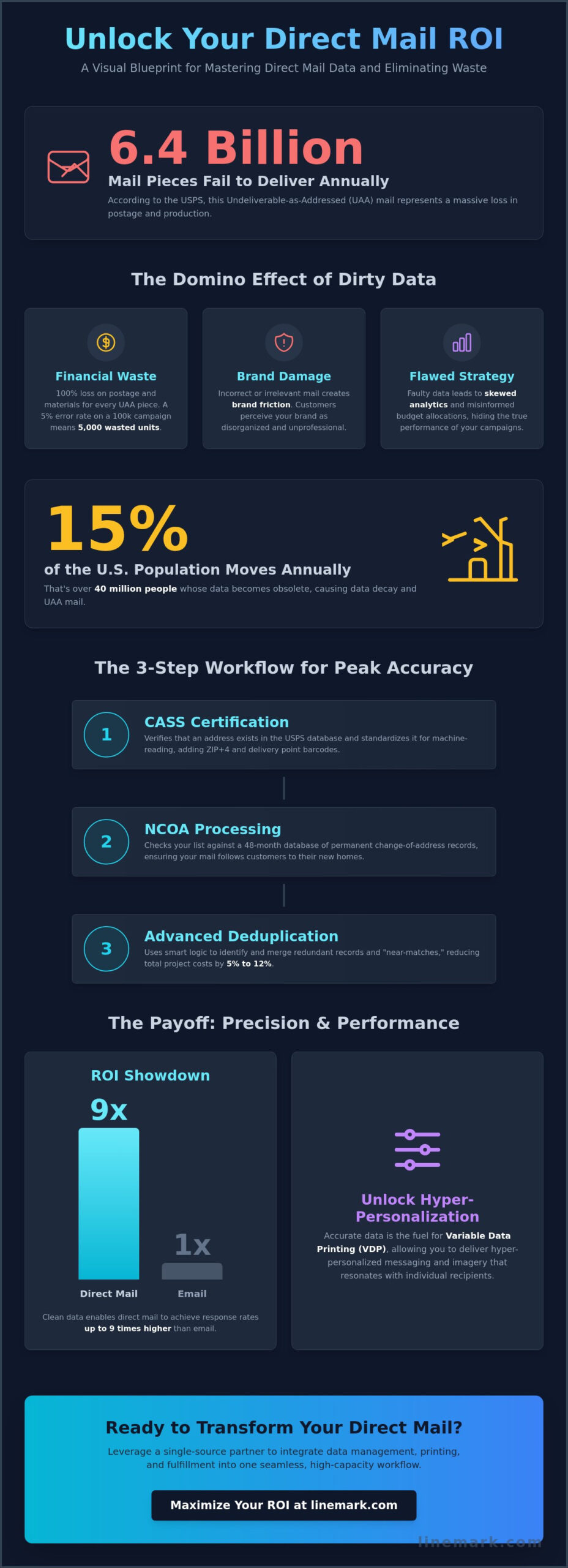
According to the USPS 2023 Household Diary Study, nearly 6.4 billion pieces of mail are classified as Undeliverable-as-Addressed annually. This massive volume of waste represents a significant loss in postage and production costs for high-volume mailers who fail to implement current best practices for direct mail data. You’ve likely felt the frustration of seeing a well-crafted campaign hampered by data silos or generic messaging that fails to resonate with your target audience. As a single-source partner, we know that your campaign is only as strong as the information powering it.
Mastering these technical and strategic standards is the only way to ensure your marketing reaches its intended destination in 2026. We’ll show you how to eliminate “return to sender” waste and maximize your response rates through precision targeting. This guide provides a clear roadmap for building a streamlined data-to-print workflow that leverages hyper-personalization for superior results. You’ll learn how to bridge the gap between your CRM and the pressroom to turn complex data into a catalyst for growth and measurable ROI.
Key Takeaways
- Eliminate postage waste and brand friction by mastering the technical workflows of CASS and NCOA certification for unmatched address accuracy.
- Implement best practices for direct mail data to move beyond basic demographics and utilize predictive look-alike modeling for higher conversion rates.
- Master the integration of Variable Data Printing (VDP) to deliver hyper-personalized messaging and imagery that resonates with individual recipient behaviors.
- Optimize your campaign lifecycle by leveraging a single-source partner to integrate data management, printing, and fulfillment into one seamless, high-capacity workflow.
The Foundation of High-ROI Campaigns: Why Data Quality is Non-Negotiable
Precision is the hallmark of modern logistics and successful outreach. In 2026, Direct mail marketing is no longer a volume game; it’s a data game. High-quality data requires three specific pillars: accuracy in address verification, completeness of recipient profiles, and recency of behavioral triggers. When these elements align, direct mail response rates consistently outperform email by 9 to 1, providing a tangible touchpoint that digital channels cannot replicate.
Implementing best practices for direct mail data ensures every piece reaches a viable prospect, eliminating the “spray and pray” tactics of the past. This shift toward data-driven strategic communications allows brands to treat every mailer as a calculated investment rather than a speculative expense.
To better understand how a mailing list serves as your campaign’s engine, watch this helpful video:
Dirty data creates a cascade of waste. Beyond the immediate loss of postage and production materials, incorrect addressing causes brand friction. A customer receiving a misaddressed or irrelevant mailer views the brand as disorganized. This friction dilutes marketing attribution, as faulty data leads to skewed analytics and misinformed budget allocations.
The Financial Impact of Data Decay
Data decay is the steady erosion of database accuracy caused by the 15% of the U.S. population that moves annually. Each Undeliverable-as-Addressed (UAA) piece represents a 100% loss of investment. In a high-volume campaign of 100,000 pieces, even a 5% error rate results in 5,000 wasted units. This waste inflates your Cost Per Acquisition (CPA) and hides the true performance of your creative assets.
Data as a Strategic Communication Asset
Sophisticated marketers treat data as a dynamic asset rather than a static list. By integrating behavioral and psychographic insights, brands move toward a single-source marketing view that synchronizes physical and digital touchpoints. Linemark serves as a strategic ally in this transition, providing the technical infrastructure to manage complex datasets with precision. Our focus on best practices for direct mail data transforms raw information into a scalable engine for growth, ensuring your message lands with the right person at the right moment.
Technical Standards for Data Hygiene: CASS, NCOA, and Beyond
Preparing a high-volume mailing list isn’t a manual task; it’s a precise engineering workflow. Precision targeting relies entirely on the integrity of your underlying records. If your data is stale, your message never reaches the doorstep. LineMark acts as a single-source partner to ensure every record survives the rigors of USPS automation. Implementing best practices for direct mail data starts with a commitment to technical hygiene that eliminates waste before the first piece of paper is even loaded into the press.
Coding Accuracy Support System (CASS) certification is the first line of defense. This process verifies that an address exists within the USPS database and standardizes it to meet strict delivery requirements. By adding the correct ZIP+4 codes and delivery point barcodes, we ensure your mail is machine-readable. This reduces undeliverable-as-addressed (UAA) mail, a problem that cost the USPS $1.3 billion in 2023. Beyond simple verification, National Change of Address (NCOA) processing tracks the roughly 40 million Americans who move annually. We check your list against a 48-month database of permanent change-of-address records, ensuring your 2026 campaigns follow your audience to their new residences.
Deduplication strategies further refine your investment. Redundant records do more than just waste postage; they annoy recipients and dilute your ROI. We employ advanced matching logic to identify “near-matches” where names or addresses vary slightly. Eliminating these duplicates can reduce total project costs by 5% to 12% depending on the age and source of the list. This level of precision is what separates a generic bulk mailing from a sophisticated logistics operation.
Postal Optimization and Address Standardization
CASS processing transforms raw data into a standardized format by correcting misspellings and filling in missing directional indicators or suffixes. For multi-unit dwellings, apartment and suite number accuracy is vital. Without a secondary designator, mail is frequently returned as undeliverable. Pre-sorting this data allows us to secure maximum postage discounts by grouping mailpieces by destination. This technical alignment streamlines the USPS delivery chain and ensures your timeline remains predictable.
Advanced Scrubbing and Suppression Lists
Maintaining Data privacy and security standards is a core responsibility for modern marketers. We utilize deceased suppression to prevent sensitive mailings from reaching grieving families, which protects your brand reputation and eliminates unnecessary spend. Our team also cross-references the DMA Mail Preference Service (MPS) to honor “Do Not Mail” requests. Internal suppression is equally critical. Removing active customers from acquisition campaigns ensures you aren’t paying to convert someone who is already in your ecosystem. Integrating these best practices for direct mail data turns a raw list into a high-performance asset. You can experience the LineMark difference by letting our data specialists audit your current list health for these critical markers.
Advanced Segmentation and Predictive Targeting Strategies
Precision targeting in 2026 requires a shift from static lists to dynamic data environments. While demographics provide a foundation, they don’t capture the intent necessary for high-conversion campaigns. Implementing best practices for direct mail data involves leveraging life-stage triggers and deep purchase history to understand the “why” behind consumer behavior. Moving beyond basic age and income brackets allows for a more nuanced approach. We focus on specific life events, such as a child reaching driving age or a professional reaching retirement, to ensure the message resonates with the recipient’s current reality.
RFM (Recency, Frequency, Monetary) analysis remains a cornerstone of high-performance mailing. By ranking customers based on how recently they purchased, how often they engage, and their total spend, you can prioritize your budget for the 20% of your audience that typically generates 80% of your revenue. We then use look-alike modeling to identify prospects who mirror these high-value profiles. Integrating third-party behavioral data fills the gaps in your first-party records, adding layers such as credit intent or media consumption habits. This collaborative approach turns your database into a strategic asset.
Trigger-Based Direct Mail
Automating your mail stream ensures your brand arrives exactly when the consumer is most receptive. Trigger-based mailings respond to specific actions, such as an abandoned cart on your site or a subscription nearing its 90-day renewal window. The “New Homeowner” trigger is particularly potent for high-value sectors like home improvement or insurance. Data from 2025 indicates new movers spend an average of $9,000 on goods and services within the first 180 days of relocating. This level of precision is a core component of Direct Mail Marketing in 2026, where timing is just as critical as the creative itself. It’s about being a strategic communications ally rather than just a vendor.
Predictive Analytics and AI in Data Selection
Executing Personalization through Variable Data Printing (VDP)
Variable Data Printing (VDP) transforms a static direct mail piece into a personalized conversation. It’s the technical bridge between your database and the high-speed inkjet press. While early VDP focused on simple name insertion, modern 2026 standards demand hyper-personalized imagery and conditional logic. Adhering to best practices for direct mail data ensures your database translates perfectly to the printed page without technical friction.
Structuring your CSV or Excel files correctly is the foundation of this process. Every column must serve as a specific trigger for the printing software. Beyond basic contact info, you’ll utilize a “Logic Layer” to swap headlines and offers dynamically. For example, a retail brand might use a customer’s 2025 purchase category to trigger a specific discount code. Security remains paramount throughout this exchange. LineMark maintains SOC2 Type II compliance, ensuring that sensitive personally identifiable information (PII) is encrypted and protected during every stage of the high-volume print cycle.
Preparing Your Data for the Press
Precision begins long before the first sheet of paper moves. Follow these three steps to ensure your files are production-ready:
- Step 1: Audit your data fields for consistency. Data hygiene is vital. Convert all-caps records to proper case to maintain a professional aesthetic. Standardize address suffixes to meet USPS requirements.
- Step 2: Map data fields to your creative design templates. Clearly define which spreadsheet columns correspond to specific text boxes or image frames in your InDesign files.
- Step 3: Conduct a soft proof. This digital review checks for character overflows. You’ll identify if a 40-character name or a long street address breaks your layout before the physical run begins.
Beyond the Name: 1:1 Creative Personalization
Moving beyond “Dear [First Name]” is where the LineMark difference becomes visible. We use purchase history to trigger unique product imagery for every recipient. According to a 2024 Epsilon study, 80% of consumers are more likely to make a purchase when brands offer personalized experiences. If a recipient recently bought outdoor gear, their mailer features mountain landscapes; if they bought fitness tech, they see a gym setting.
Dynamic QR codes further bridge the physical and digital gap. These codes don’t just lead to a homepage; they direct users to personalized landing pages (PURLs) pre-populated with their information. LineMark’s technology manages these complex, high-volume workflows with zero-error precision. Integrating these best practices for direct mail data allows your brand to scale sophisticated campaigns without losing the personal touch that drives conversion.
Ready to elevate your next campaign with precision VDP? Partner with LineMark to integrate your data into high-impact print today.
Partnering for Precision: Streamlining Your Direct Mail Data Workflow
Executing a high-impact campaign requires more than just a list of names; it demands a seamless integration of data, print, and logistics. Working with a single-source partner eliminates the friction often found when coordinating between separate data houses and print shops. At Linemark, we manage the entire lifecycle of your project under one roof. This unified approach ensures that a 1,000-piece targeted test or a 1,000,000-piece national rollout maintains 100% data integrity throughout the production cycle.
By consolidating print and fulfillment, you gain real-time visibility into your campaign’s performance. We provide tracking and reporting that closes the loop on delivery, which allows your sales teams to time their follow-ups with surgical precision. Following best practices for direct mail data means ensuring your information doesn’t just sit in a spreadsheet. It must flow directly into a production pipeline optimized for speed. Our systems handle complex versioning and variable data triggers without slowing down the press, ensuring your message reaches the mailbox while the data is still fresh.
The Linemark Difference in Data Processing
Our 90,000-square-foot facility operates as a high-tech hub where sophisticated data processing meets industrial-scale distribution. We don’t simply process lists; we take a consultative approach to identify potential mailing errors before they impact your budget. This proactive stance can reduce return-to-sender rates by up to 15% for uncleaned lists. For distributed teams, our MarCom On-Demand portals simplify data management. These portals allow local branches to access approved templates while corporate maintains strict control over data standards and brand integrity.
Next Steps for Your Next Campaign
Success begins with a clean foundation. You should start by auditing your current list for duplicates and outdated entries today. Adhering to best practices for direct mail data requires a disciplined hand-off process. Use this checklist to prepare for your next project:
- Validate all ZIP+4 codes to ensure maximum postal discounts.
- Ensure clear field mapping for all variable text and personalized images.
- Confirm NCOA (National Change of Address) updates are current within the last 95 days.
- Verify that your suppression lists are scrubbed against the master file.
Precision is the difference between a mailer that gets noticed and one that gets recycled. If you’re ready to improve your delivery rates and campaign ROI, it’s time to speak with a specialist. Consult with a Linemark data expert to refine your 2026 mailing strategy and build a workflow that scales with your growth.
Mastering Precision in Your 2026 Direct Mail Strategy
Success in the modern marketing landscape requires a shift from broad outreach to surgical precision. Implementing best practices for direct mail data means maintaining rigorous CASS and NCOA standards to ensure deliverability while utilizing predictive modeling to reach the right audience at the right time. By integrating advanced Variable Data Printing (VDP), you transform static mailers into personalized touchpoints that drive measurable response rates. This technical approach isn’t just a trend; it’s the standard for high-ROI campaigns in 2026.
Precision requires a strategic communications ally who understands the intersection of data security and industrial scale. Linemark operates a SOC2 Type II Compliant facility, providing the rigorous data protection your organization demands for every record. With over 30 years of high-volume fulfillment expertise and advanced digital integration capabilities, we streamline your workflow from initial segmentation to final delivery. We’re your single-source partner, focused on turning complex data sets into scalable growth opportunities.
Partner with Linemark for high-precision, data-driven direct mail solutions and experience the difference that 30 years of technical excellence makes for your brand. Let’s build your most successful campaign yet.
Frequently Asked Questions
What are the most important direct mail data best practices for 2026?
The most important best practices for direct mail data in 2026 focus on hyper-personalization and real-time hygiene. You must ensure your list is scrubbed against the USPS National Change of Address (NCOA) database every 95 days to maintain precision. We recommend integrating zero-party data directly from your digital channels to create a unified customer profile. This strategy reduces waste by an average of 15% compared to the static lists used in previous years.
How often should I clean my mailing list with NCOA and CASS?
You should clean your mailing list with NCOA and CASS at least every 95 days to meet USPS Move Update requirements. For high-volume mailers, performing these checks monthly is the industry standard to prevent the 3% to 4% monthly decay rate typical of consumer data. CASS certification ensures your addresses are valid and complete. This process helps you qualify for automation discounts and avoids the costs of undeliverable-as-addressed mail.
What is the difference between first-party and third-party data in direct mail?
First-party data is information you’ve collected directly from your customers, while third-party data is purchased from external providers. Your CRM contains your first-party assets, which typically yield 300% higher conversion rates than rented lists. Third-party data allows you to scale by reaching new prospects based on 1,200 unique demographic or psychographic markers. Using a single-source partner helps you blend these sources for a more effective prospecting strategy that balances reach and relevance.
How does Variable Data Printing (VDP) improve response rates?
Variable Data Printing (VDP) increases response rates by allowing you to customize every element of a mailer for the individual recipient. Industry reports from organizations like the DMA show that personalized mail can boost response rates by 135% over generic creative. You can swap images, offers, and headlines based on a recipient’s past purchase history or local weather patterns. This level of precision transforms a standard postcard into a highly relevant, one-to-one communication tool.
Is my data secure when I send it to a commercial printer?
Your data is secure when you partner with a printer that maintains SOC 2 Type II compliance and utilizes 256-bit encryption for all file transfers. We implement rigorous physical and digital security protocols to protect your sensitive information throughout the production lifecycle. Our facility undergoes annual audits to ensure we meet the highest standards for data privacy and integrity. You can trust that your proprietary customer lists are handled with the same precision as your printed materials.
Can I track direct mail delivery in real-time like I do with email?
You can track your direct mail in real-time using USPS Informed Visibility technology. This system provides data pings at every major sorting facility, allowing you to see exactly when your pieces reach the final delivery unit. Real-time tracking enables you to sync your follow-up emails or digital ads with the physical arrival of the mailer. Our dashboard provides a transparent view of your campaign’s progress, ensuring you’re never in the dark about your delivery status.
What is a suppression list and why do I need one?
A suppression list is a file of addresses you want to exclude from your mailing to avoid redundant or inappropriate outreach. You need this to remove current customers from acquisition campaigns or to honor “do not mail” requests from the 2025 DMA Choice list. Using suppression files can reduce your postage and printing costs by 12% on average. It protects your brand reputation by ensuring you don’t send irrelevant offers to people who’ve already converted or opted out.