

 05/01/2026
  Steve Bearden
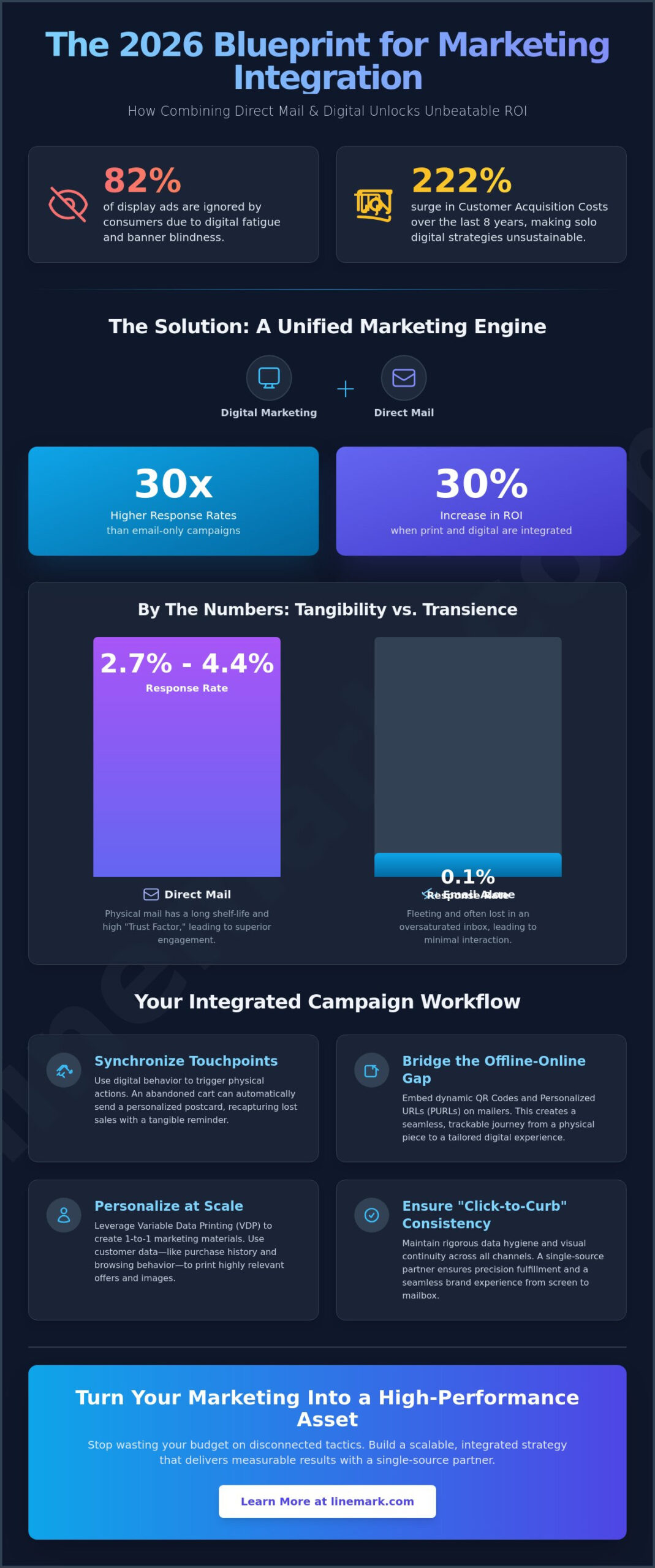
While digital ad spend is projected to reach $740 billion in 2024, the average consumer now ignores 82% of the display ads they encounter. It’s a reality where customer acquisition costs have surged by 222% over the last eight years. This makes integrating direct mail and digital marketing a necessity for any brand seeking scale. You’ve likely felt the frustration of rising costs and diminishing returns as digital fatigue sets in across your target audience. Relying solely on a screen to tell your story is no longer a reliable strategy for high-volume growth.
You will gain a strategic blueprint for building a unified marketing engine where physical and digital touchpoints work in tandem to drive measurable ROI. We’ll show you how to pair automated fulfillment with precise digital triggers. This approach achieves response rates that are often 30 times higher than email alone. This guide outlines the 2026 framework for attribution, synchronization, and the operational precision required to turn your marketing into a scalable, high-performance asset.
Key Takeaways
- Discover the psychology of tangibility and why physical touchpoints achieve response rates significantly higher than digital-only outreach.
- Master the technical tactics for integrating direct mail and digital marketing, including triggered retargeting and the use of Personalized URLs (PURLs) to bridge the offline-to-online gap.
- Learn how Variable Data Printing (VDP) enables sophisticated, 1-to-1 personalization that leverages purchase history and digital behavior at an industrial scale.
- Establish a streamlined “Click-to-Curb” workflow that ensures rigorous data hygiene and visual continuity across your entire omnichannel ecosystem.
- Understand the operational advantages of a single-source partner in scaling complex marketing logistics through MarCom On-Demand portals and precision fulfillment.
The Renaissance of Tangibility: Why Integration Outperforms Digital-Only Strategies
The marketing landscape in 2026 demands a shift from siloed channels to a unified, synchronized ecosystem. Successful brands have moved past the era of treating print and pixels as separate entities. Integrating direct mail and digital marketing creates a cohesive customer journey where every touchpoint reinforces the last. This strategic alignment builds on core direct marketing principles while utilizing modern data precision to drive measurable results. By treating these channels as a single conversation, businesses eliminate friction and guide prospects toward conversion with greater efficiency.
To better understand this concept, watch this helpful video:
The psychology of touch remains a dominant force in consumer behavior. Physical mail consistently achieves response rates between 2.7% and 4.4%, which is a staggering contrast to the 0.1% average typically seen in email marketing. This isn’t just about getting a response; it’s about the quality of the interaction. When you combine these mediums, the results are transformative. Industry data shows that ROI increases by 30% when print and digital are integrated. This performance boost stems from the ability to reach consumers in multiple environments, ensuring your message isn’t just seen, but remembered.
Breaking Through Digital Saturation
Digital fatigue is a reality for the modern consumer. The “always-on” nature of mobile devices has led to widespread banner blindness, where users subconsciously ignore digital advertisements. While a social media ad is fleeting and disappears with a single swipe, physical mailers possess a significant shelf-life. A well-designed piece of mail often sits on a kitchen counter or office desk for several days, providing repeated exposure. High-quality commercial printing also carries a “Trust Factor” that digital formats lack. It signals a level of professional commitment and industrial authority that helps a brand stand out in an over-saturated inbox.
The Omnichannel Advantage
Direct mail serves as a high-impact touchpoint within a complex multi-channel funnel. It functions as a physical anchor for digital offers, reminding the recipient of an item left in a cart or a limited-time promotion seen on Instagram. When a consumer encounters a consistent message across their screen and their mailbox, brand recall improves significantly. LineMark acts as a strategic ally in this process, helping partners deploy direct mail as a catalyst for digital growth. This integrated approach ensures that your marketing spend isn’t wasted on disconnected tactics, but is instead focused on a scalable, high-capacity strategy that delivers a premium experience.
Strategic Tactics for Synchronizing Physical and Digital Touchpoints
Synchronizing physical and digital assets requires more than just matching logos across platforms. It demands a unified data stream that triggers actions across channels in real-time. By integrating direct mail and digital marketing, your brand moves from a series of disjointed messages to a cohesive narrative that follows the customer journey with industrial precision. This synchronization ensures that your message isn’t just seen; it’s felt and acted upon.
Bridging the Gap with QR Codes and PURLs
QR codes have evolved into sophisticated tracking tools that bridge the physical and digital divide. In 2025, successful campaigns utilize dynamic QR codes that direct users to personalized experiences rather than generic homepages. Best practices dictate placing codes in high-visibility areas with a compelling “scan-to-action,” such as a 15% discount or an exclusive technical whitepaper. These codes provide immediate data on scan locations and times, allowing for rapid campaign adjustments.
Personalized URLs take this a step further by creating a dedicated space for every recipient. A Personalized URL (PURL) is a unique web address generated for an individual recipient that links physical mail engagement to a specific digital profile for precise attribution. When a prospect visits their PURL, they’re greeted by name and shown content tailored to their previous purchase history. This level of granularity ensures that your sales team knows exactly which leads are ready for a follow-up call. As a single-source partner, we’ve observed that PURLs can increase response rates by as much as 45% compared to static landing pages.
Digital Retargeting Meets Physical Fulfillment
Automation now allows for sophisticated direct mail retargeting based on online behaviors. If a high-value user abandons a cart or spends more than three minutes on a specific product page, a high-quality postcard can be triggered and mailed within 24 to 48 hours. This physical touchpoint serves as a persistent reminder that an inbox notification simply cannot match. It’s a strategic way to recapture attention when digital fatigue sets in.
The USPS Informed Delivery program offers another layer of integration, currently reaching over 52 million registered users as of 2024. This service provides recipients with a digital grayscale preview of their mail before it arrives. By adding a clickable ride-along image to this preview, you can drive digital traffic before the recipient even checks their physical mailbox. This SBA on Direct Mail Integration guide highlights how combining these channels creates a “halo effect” that boosts overall ROI.
Finally, you can leverage your mailing lists to build Lookalike audiences on platforms like Meta and LinkedIn. This ensures your display ads appear in a prospect’s feed during the same week your mailer lands on their desk. Coordinating these efforts requires a partner who understands the technical nuances of both print logistics and digital data flows to ensure the LineMark experience remains seamless and impactful.
The Engine of Personalization: Variable Data Printing (VDP)
Variable Data Printing (VDP) serves as the technical bridge that makes integrating direct mail and digital marketing a reality. It’s no longer just about changing a name on a postcard. It’s about high-speed digital presses that swap out images, offers, and layouts in real-time based on your CRM data. This technology allows for 1-to-1 marketing at a scale that was once impossible for high-volume campaigns. By treating every printed piece as a unique digital file, we help you speak directly to the individual’s needs without slowing down the production line.
The technical workflow is a streamlined progression from data to delivery. It starts with a secure CRM data export, where we map specific data points to design elements. A customer who abandoned a cart for a specific product sees that exact item on their mailer, while a different lead sees a category they’ve browsed frequently. Our high-speed digital presses process these complex instructions instantly. This ensures every piece in a 10,000 or 100,000 unit run is unique, relevant, and timely. VDP isn’t just a feature; it’s the essential component for any strategy that seeks to turn digital intent into physical action.
Leveraging Data for Hyper-Personalization
Effective campaigns in 2026 segment mailing lists based on digital engagement scores. If a lead clicks on three specific email links but hasn’t converted, VDP triggers a physical piece with a unique, time-sensitive discount code. The impact of this specificity is measurable. Industry data from 2025 shows that personalized imagery, such as a custom map from the recipient’s front door to your nearest storefront, can increase conversion rates by up to 43% compared to static mailers. You’re not just sending mail. You’re sending a relevant, physical follow-up that mirrors their online behavior.
- Custom Recommendations: Use purchase history to suggest the “next best product” visually.
- Unique QR Codes: Track individual response rates by linking every printed piece to a personalized URL (PURL).
- Dynamic Offers: Adjust discount levels based on the customer’s lifetime value (LTV) stored in your database.
Maintaining Brand Consistency Across Formats
Achieving visual harmony between a high-resolution smartphone screen and a printed piece requires technical precision. Color accuracy is vital to brand trust. As a single-source partner, we utilize centralized asset management to ensure your brand’s specific color profiles remain consistent across all formats. This prevents brand drift, where a logo might look vibrant on a screen but appear muted on 100lb gloss cover stock.
The LineMark experience focuses on this meticulous detail. By handling both the digital data integration and the physical production, we eliminate the gaps where brand standards often fail. We treat your brand assets with the industrial authority they deserve, ensuring that your omnichannel presence feels like a single, unified conversation with your customer. This level of consistency builds the confidence your audience needs to move from a physical mailer back to your digital storefront.
Building Your Integrated Campaign Workflow: A Step-by-Step Framework
Execution is where strategy meets reality. Successfully integrating direct mail and digital marketing requires a synchronized workflow that eliminates silos between your digital assets and the physical mailpiece. This process begins with a comprehensive data audit. Before the first press run, you must ensure your CRM is fully synchronized with your mailing list. This synchronization allows for real-time updates, ensuring that a customer who purchased a product online yesterday doesn’t receive a “first-time buyer” postcard tomorrow. Precision in the planning phase prevents brand friction and protects your marketing budget.
Measurement is the final pillar of the framework. Establish attribution models before launching. Use unique tracking phone numbers for different regions and PURLs (Personalized URLs) for individual recipients. These tools allow you to pinpoint exactly which mailpiece triggered a digital action. Data from 2024 shows that campaigns using three or more channels earn a 250% higher engagement rate than single-channel efforts. Tracking these touchpoints ensures you can prove the value of every dollar spent.
Data Integrity and List Management
List hygiene is the systematic process of scrubbing databases to remove duplicates, deceased records, and outdated addresses to ensure campaign ROI isn’t eroded by avoidable postage waste. According to USPS reports, undeliverable-as-addressed mail costs the industry over $1.4 billion annually. Our team utilizes advanced data processing to minimize these losses. By integrating CRM triggers with automated mailing workflows, we enable your system to send physical mail based on digital behaviors, such as a website visit or a cart abandonment event. This creates a responsive, tech-forward approach to integrating direct mail and digital marketing.
Logistics, Kitting, and Fulfillment
The “last mile” of fulfillment often determines the success of high-volume integrated campaigns. It’s not just about printing; it’s about getting the right package to the right door at the exact moment of peak interest. Onsite warehousing is a significant advantage for our partners. It allows for a 24-hour response to digital triggers, ensuring the physical mailpiece arrives while your brand is still top-of-mind. Managing complex kits requires meticulous attention to detail. Whether you’re sending a simple letter or a complex package containing printed collateral and physical products, our scalable systems handle the logistics with industrial precision. We act as your single-source partner to streamline this entire journey from the digital click to the physical curb.
Scaling Strategy with a Single-Source Partner
The LineMark difference is built on 30 years of industrial print authority. We don’t just print paper; we build the infrastructure required for integrating direct mail and digital marketing at scale. Moving from a transactional vendor to a strategic communications ally allows your brand to maintain a steady, confident presence across every channel. Our 90,000-square-foot facility acts as the central hub for your entire campaign, ensuring that high-volume commercial runs receive the same meticulous attention to detail as a boutique project. This scale allows us to process millions of records while maintaining 100% data integrity for personalized mail pieces that mirror your digital triggers.
MarCom On-Demand for National Brands
Managing a national brand requires a delicate balance between corporate oversight and local agility. Our MarCom On-Demand platform empowers local teams to customize materials while keeping brand standards locked. This web-to-print portal automates the connection between your digital asset library and our physical production floor. By utilizing on-demand printing, brands can reduce print obsolescence by 30% or more. This shift eliminates the need for massive inventories that often end up in the recycling bin because of outdated messaging. Lead times are slashed from weeks to days, allowing your physical mail to keep pace with your digital ads.
The Value of a Single-Source Partnership
Efficiency is born from consolidation. When you choose a single-source partner, you remove the logistical friction that usually stalls omnichannel campaigns. LineMark handles design, production, and distribution under one roof. The success of integrating direct mail and digital marketing depends on this level of operational transparency. This integrated approach includes:
- Custom kitting: Handling complex multi-piece mailers that require manual assembly and precision matching.
- Inventory management: Climate-controlled storage for long-term fulfillment needs.
- Nationwide distribution: Strategic logistics channels that guarantee precision timing for coordinated digital drops.
This unified workflow ensures your message is consistent whether it’s in an inbox or a mailbox. Your marketing deserves a partner that understands the nuances of modern logistics and technological integration. We’ve optimized our workflow to handle the complexities of the 2026 market. Contact Linemark to discuss your integrated marketing strategy and see how our operational excellence can drive your brand’s growth.
Future-Proof Your Brand Strategy
The 2026 marketing landscape demands more than just digital impressions; it requires a physical presence that commands attention. By integrating direct mail and digital marketing, businesses can achieve a 40% increase in conversion rates according to industry benchmarks from the Association of National Advertisers. Success in this omnichannel environment relies on the precision of Variable Data Printing and the efficiency of a centralized workflow. You need a strategy that bridges the gap between the screen and the mailbox without adding unnecessary complexity to your operations.
Linemark acts as your single-source partner, offering over 30 years of industrial print expertise to guide your most ambitious projects. Our 90,000-square-foot high-capacity production facility is designed to scale with your needs, ensuring every piece meets rigorous quality standards. We utilize proprietary MarCom On-Demand technology to streamline your fulfillment and maintain brand consistency across every touchpoint. It’s time to move beyond the limitations of digital-only tactics and embrace a more robust, tangible approach to customer engagement.
Partner with Linemark for Your Next Integrated Campaign to experience the reliability of a seasoned communications ally. We’re ready to help you build something that lasts.
Frequently Asked Questions
How do I track the ROI of a direct mail campaign in Google Analytics?
You track direct mail ROI in Google Analytics by embedding UTM parameters into QR codes or Personalized URLs (PURLs). When a recipient scans your code, those UTM tags identify the source as “direct_mail” and the medium as “print” within your traffic reports. This allows you to measure conversion rates and bounce rates specifically for those users. Integrating direct mail and digital marketing becomes seamless when you assign unique tracking IDs to each physical mail piece.
What is the average response rate for integrated direct mail and digital campaigns?
Integrated campaigns typically yield a 9% response rate for house lists, according to the Association of National Advertisers 2023 Response Rate Report. This is significantly higher than the 1% average for email alone. By combining physical touchpoints with digital retargeting, brands often see a 28% increase in conversion rates. This multi-channel approach ensures your message reaches the recipient through their preferred medium, which drives higher engagement and better performance.
Can I trigger a direct mail piece to be sent automatically when someone leaves my website?
You can trigger an automated direct mail piece through API integrations between your CRM and our fulfillment systems. When a user abandons a cart or exits a high-value page, a signal is sent to print and mail a personalized postcard within 24 hours. This bridge between online behavior and offline response creates a 40% higher chance of conversion compared to digital-only retargeting. It’s a precise way to re-engage prospects who’ve already shown interest in your services.
What is the difference between VDP and standard digital printing?
Variable Data Printing (VDP) allows every printed piece in a single run to feature unique text, images, or codes, whereas standard digital printing produces identical copies. Our high-speed inkjet presses use VDP to swap names or localized offers on the fly without slowing down production. This customization is essential for integrating direct mail and digital marketing strategies that require 1-to-1 personalization. Standard printing works for broad awareness, but VDP drives specific individual action.
How does a PURL (Personalized URL) differ from a standard landing page?
A PURL is a unique web address created specifically for one recipient, such as JohnDoe.YourBrand.com, while a standard landing page is a generic URL for all visitors. PURLs pre-populate web forms with the user’s data, which typically increases form completion rates by 15% or more. This creates a high-touch experience that feels tailored to the individual. Standard pages lack this data-driven connection, making them less effective for high-conversion omnichannel campaigns where personalization is expected.
Is integrated marketing cost-effective for smaller, targeted lists?
How do I ensure my print colors match my digital brand guidelines?
We ensure color consistency by utilizing G7 Master Qualification standards and precise Pantone matching systems across all digital presses. Digital screens use RGB light, while print uses CMYK ink, so we calibrate our equipment to bridge that gap. This technical precision maintains your brand integrity across every physical and digital touchpoint. Our team monitors color density in real time to ensure your printed collateral looks exactly like your digital guidelines, preserving your visual identity.
What is the typical lead time for a high-volume integrated campaign?
A high-volume integrated campaign typically requires a lead time of 5 to 10 business days from the moment final art is approved. This window allows for data processing, VDP setup, high-speed printing, and entry into the USPS mail stream. Sophisticated projects involving custom die-cuts or complex kits might extend this to 15 days. Our streamlined fulfillment process ensures that your digital triggers and physical mail stay synchronized for maximum impact and operational excellence.