


 04/28/2026
  Steve Bearden
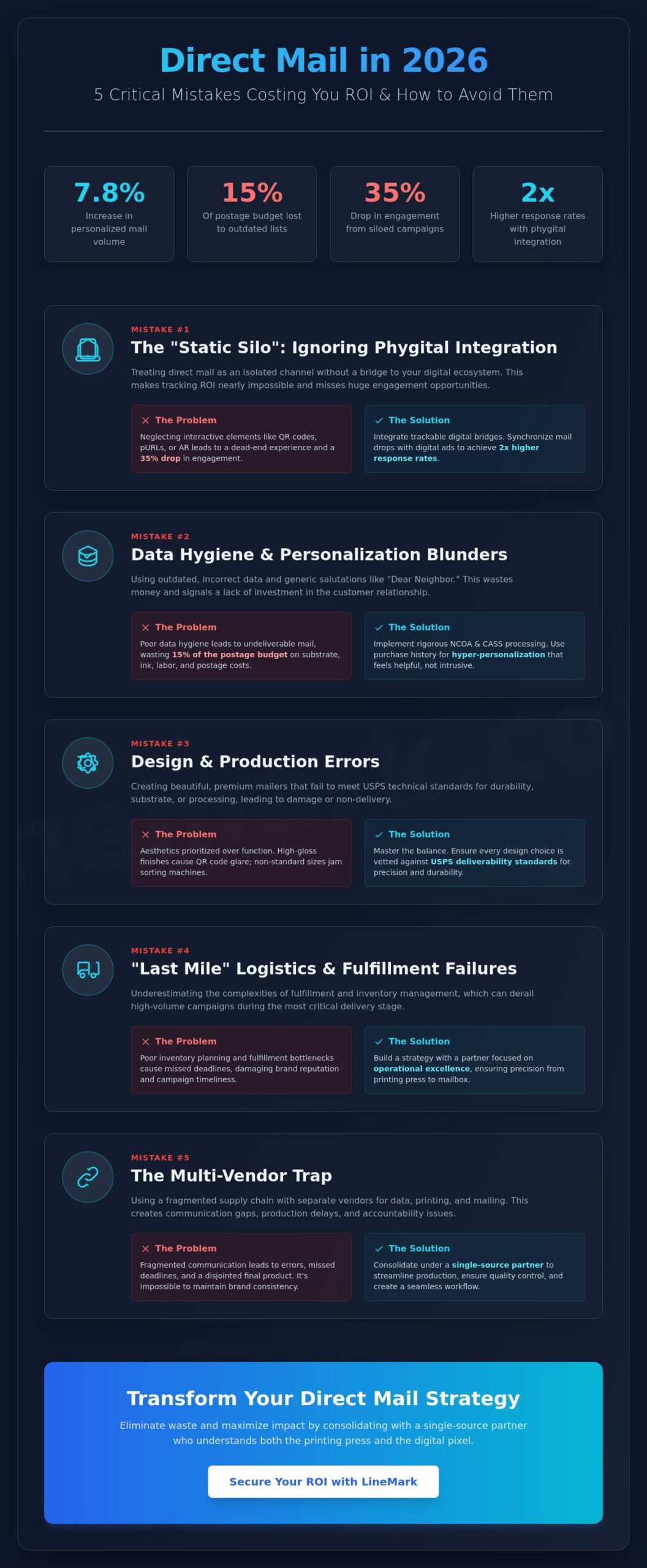
Is your direct mail strategy still operating on 2022 logic while your competitors are leveraging 2026 technology? With industry reports showing a 7.8 percent increase in mail volume for personalized marketing segments over the last twelve months, the physical mailbox has become the most valuable real estate in your marketing mix. You likely recognize that generic, mass-produced mailers no longer cut through the noise, yet many brands still lose 15 percent of their postage budget to outdated lists and fragmented vendor management. Understanding the specific direct mail mistakes to avoid 2026 is the first step toward reclaiming that lost ROI and ensuring your message actually reaches its destination.
We’ll show you how to eliminate the technical and logistical errors that threaten your performance, providing a strategic roadmap for high-impact, personalized campaigns. As your single-source partner, we understand that precision in fulfillment is just as critical as the creative itself. This guide explores how to integrate data-driven insights with scalable logistics to ensure your messaging arrives with the operational excellence the LineMark experience provides, turning your mailers into a reliable catalyst for growth.
Key Takeaways
- Learn how to bridge the gap between physical mail and digital interactivity to meet the sophisticated demands of the 2026 phygital consumer.
- Discover why hyper-personalization and rigorous data hygiene are critical for bypassing common direct mail mistakes to avoid 2026 and securing high-ROI results.
- Master the balance between premium design aesthetics and technical USPS deliverability standards to ensure your campaign arrives with precision and durability.
- Identify the fulfillment and inventory management risks that often derail high-volume campaigns during the critical “last mile” of delivery.
- Understand the strategic value of consolidating your supply chain under a single-source partner to eliminate production delays and fragmented communication.
The “Static Silo” Mistake: Ignoring Phygital Integration in 2026
In the current marketing environment, treating print as an isolated channel is a recipe for wasted budget. The “Static Silo” occurs when a brand sends a high-quality mailer that lacks a functional bridge to its digital ecosystem. By 2026, consumers expect a seamless transition between physical touchpoints and online engagement. High-volume campaigns that treat direct mail as a standalone tactic often see a 35% drop in measurable engagement compared to integrated efforts. This isolation makes it impossible to verify which creative assets drove the final purchase, leaving marketers in the dark.
Modern consumers don’t just read mail; they interact with it. Failing to provide a digital path is one of the primary direct mail mistakes to avoid 2026 if you want to capture data-driven insights. Phygital integration is the mandatory 2026 standard that bridges tactile mail with digital experiences. As a strategic communications ally, we’ve observed that campaigns utilizing these bridges achieve 2x higher response rates than those remaining in a silo.
To better understand how these physical and digital worlds collide, watch this strategic overview:
Neglecting Interactive Elements and Tracking
Errors like placing QR codes on high-gloss finishes that cause scanner glare or linking to non-responsive landing pages can ruin conversion rates. In 2026, every mail piece must function as a sophisticated data collection tool. Without unique pURLs for each recipient, your attribution model becomes expensive guesswork. Many brands lose up to 40% of their attribution data simply because they didn’t implement tracking mechanisms like NFC tags or Augmented Reality (AR) during the fulfillment process. These tools turn a passive piece of paper into an active portal for your brand.
The Failure of Cross-Channel Timing
A “one-and-done” mailing is an industrial-scale oversight that ignores the power of the multi-touch journey. Strategic partners now use mail drops as a primary trigger for automated digital retargeting. If a prospect receives a high-impact mailer in the afternoon, they should see a matching programmatic display ad by evening. This precise coordination ensures brand consistency across large-format graphics and mailers, reinforcing the message through deliberate repetition. Failing to synchronize these channels results in a fragmented brand identity that confuses the recipient and diminishes the overall return on investment. Avoiding these direct mail mistakes to avoid 2026 requires a single-source partner who understands both the printing press and the digital pixel.
Data Hygiene and Hyper-Personalization Blunders
In 2026, your audience sees through superficial tactics instantly. Generic salutations like “Dear Neighbor” or “Current Resident” are among the primary direct mail mistakes to avoid 2026, as they signal a lack of investment in the recipient relationship. Modern consumers expect hyper-relevance, yet many brands still struggle with the technical foundations of data hygiene. Precision is the baseline for success in a high-volume environment. If your data is fragmented, your message becomes noise.
The technical price of poor data is steep. Failing to utilize National Change of Address (NCOA) and Coding Accuracy Support System (CASS) processing leads to immediate budget hemorrhaging. When mail is undeliverable, you lose the cost of the substrate, the ink, the labor, and the postage. This SBA direct mail guide emphasizes that effective targeting is what makes mail “hot” again, but targeting only works if the address is valid. Personalization must also respect privacy boundaries. Using highly sensitive personal data can cross the line from helpful to intrusive. Aim for a concierge-style experience that utilizes purchase history or geographic relevance without making the recipient feel monitored.
The Hidden Costs of Outdated Mailing Lists
Return-to-sender mail is a silent ROI killer. In a high-volume run of 100,000 pieces, even a 4% error rate means 4,000 units of wasted capital. Regular list scrubbing and data enrichment ensure that your message reaches the intended hands rather than a post office recycling bin. We recommend a “clean once, verify twice” approach to maintain campaign integrity. For a deeper dive into building a robust database, explore our direct mail strategy resources.
Variable Data Printing (VDP) Implementation Errors
Variable Data Printing is a powerful tool, but it requires meticulous technical oversight. Common production blunders include:
- Logic Breakdowns: If-then statements in your design software that fail when a data field is null or contains unexpected characters.
- Character Overflow: Failing to test how long names or addresses interact with the design layout, often resulting in text overlapping key visuals.
- Mismatched Assets: Mapping the wrong image to a specific demographic segment, which destroys the illusion of personalization.
When executed with precision, VDP increases response rates by 20% or more compared to static mailers. It transforms a standard postcard into a customized solution that speaks directly to the individual’s needs. If you’re looking to scale your next campaign without the technical headaches, consider how a single-source partner can streamline your VDP workflow from data audit to final drop.
Design and Production Errors That Compromise Deliverability
A visually stunning mailer is worthless if it never reaches the recipient’s hands. In 2026, the intersection of high-end creative and rigid postal regulations is where many campaigns fail. One of the most common direct mail mistakes to avoid 2026 involves prioritizing “pretty” design over USPS machinability. If your piece doesn’t meet specific aspect ratios or thickness requirements, it gets diverted to manual sorting. This increases your postage costs by up to $0.40 per piece and delays delivery by several days. At LineMark, we view design as a technical blueprint that must balance brand aesthetics with operational reality.
Violating USPS Physical Mail Standards
Precision is non-negotiable. USPS automated equipment requires an aspect ratio between 1.3 and 2.5 for letter-rate postage. Pieces outside these dimensions trigger non-machinable surcharges that erode your margin. Another frequent error is ignoring the Address Block and Barcode Clear Zone. You must leave a 5/8-inch tall space at the bottom of the piece for the Intelligent Mail Barcode. When designs bleed into this area, the scanners fail; your mail is either rejected or hand-processed at a premium rate. For 2026, ensure your fold lines and tabs comply with the latest sorting standards to prevent high-speed sorting jams. These technical details are why choosing a single-source partner is vital for campaign scalability.
Substrate and Finish Mismatches
The tactile experience is a core part of the LineMark difference. However, choosing the wrong substrate creates friction. Cheap 60lb paper stock might save initial costs, but it lacks the durability to survive high-speed digital presses. It often arrives torn or wrinkled, which reflects poorly on your brand positioning. Conversely, certain high-gloss UV finishes can cause ink smudging during the sorting process if not properly cured. This is a critical direct mail mistake to avoid 2026 because it renders the address unreadable. When your offer requires a premium feel, consider custom book-style binding or soft-touch lamination. These choices provide a sophisticated weight that commands attention without compromising the integrity of the delivery path. We align substrate weight with the specific mechanical requirements of the fulfillment cycle to ensure your message arrives in pristine condition.
- Weight Requirements: Postcards should utilize at least 7pt or 9pt stock to meet USPS thickness standards.
- Finish Selection: Matte finishes often provide better readability for OCR scanners than high-gloss coatings.
- Press Optimization: Design layouts must account for the specific gripper margins of offset presses to avoid clipped graphics.
Logistics and Fulfillment: The “Last Mile” of Direct Mail Failure
Kitting and Multi-Component Errors
Manual assembly is a relic that invites human error and slows down speed-to-market. When you’re managing a 50,000-piece drop with personalized inserts, a 1% error rate means 500 prospects receive the wrong offer or a mismatched name. This is where professional kitting and fulfillment becomes a non-negotiable asset for precision. Automated intelligent inserting systems use 2D barcodes to verify that every personalized letter matches its specific envelope. This level of technological oversight eliminates the assembly-line blunders that occur when mismatched components confuse your audience and waste your postage budget. Accuracy isn’t just a goal; it’s a requirement for maintaining brand integrity in a competitive market.
Inventory and Warehousing Oversights
Relying on “just-in-time” printing is a gamble that rarely pays off during peak seasonal surges or supply chain shifts. Data from 2024 logistics reports showed that paper supply chain disruptions can still cause 3 to 4-week delays if materials aren’t secured in advance. Avoiding these inventory-related direct mail mistakes to avoid 2026 requires a move toward digital inventory management. We recommend maintaining a 15% buffer stock for evergreen materials to ensure continuity during unexpected demand spikes.
By utilizing MarCom portals, brands can monitor stock levels in real-time and trigger automated reorders before a shortage occurs. Strategic warehousing also plays a critical role in cost control. Distributing from a centralized hub reduces the “zone” distance for nationwide shipping. This approach can lower distribution costs by up to 12% while ensuring your message reaches the mailbox on time, every time. The LineMark experience focuses on removing these logistical hurdles, allowing your team to focus on strategy while we handle the heavy lifting of distribution.
Ready to secure your supply chain and optimize your 2026 distribution? Explore the LineMark difference in logistics and fulfillment.
The Multi-Vendor Trap: Why Fragmented Supply Chains Fail
The Hidden Costs of Vendor Fragmentation
Managing three vendors demands significant internal resources. You’re paying “soft costs” in the form of employee hours spent on endless emails, file transfers, and status calls. In a 2024 operational study, businesses using fragmented chains reported 30% more project delays than those using integrated partners. You can eliminate this inefficiency by using a MarCom On-Demand portal. This centralized hub streamlines the workflow and ensures brand consistency. It also enhances security. Centralized data processing ensures that sensitive customer information stays within one secured environment, reducing the risk of privacy compliance breaches that often occur during file handoffs between multiple parties.
Leveraging the LineMark Difference
Choosing a single-source partner changes the ROI equation. Our integrated approach, spanning from initial design to final distribution, typically saves clients 15-20% on total project costs. We achieve this through operational synergy. We operate 90,000 square feet of production capacity, giving us the scale to handle massive national drops while maintaining the meticulous attention to detail of a boutique shop. This scale allows us to pivot quickly between technologies.
- Accountability: One point of contact manages the entire lifecycle of your project.
- Versatility: We handle both high-volume offset printing and personalized digital printing in-house.
- Speed: Eliminating shipping times between vendors can shave days off your production schedule.
This accountability ensures that your message reaches the mailbox on time, every time. Don’t let logistical gaps undermine your strategy. The LineMark experience is built on the idea that your printer should be a strategic ally, not just a service provider. Partner with Linemark for your 2026 direct mail success.
Future-Proof Your 2026 Direct Mail Strategy
Success in the upcoming marketing landscape requires moving beyond isolated mailers. You’ve seen how fragmented supply chains and poor data hygiene can quickly erode your ROI. To navigate the specific direct mail mistakes to avoid 2026, your strategy must prioritize phygital integration and precise logistics. Managing multiple vendors often leads to communication gaps that compromise campaign deliverability. You need a single-source partner who transforms these complex variables into a streamlined, high-performance workflow.
LineMark provides the industrial authority and technical precision your high-volume projects demand. We operate a 90,000-square-foot high-capacity production facility designed to handle every stage of your campaign under one roof. With over 30 years of commercial printing and fulfillment expertise, we ensure your message reaches its destination without friction. We combine sophisticated design with nationwide distribution to deliver results that scale. Don’t let technical errors or logistical hurdles stall your brand’s growth.
Consult with a Linemark Direct Mail Expert Today to secure your competitive advantage. Your next high-impact campaign starts with a partner who understands the nuances of modern marketing.
Frequently Asked Questions
Is direct mail still effective in 2026 compared to digital ads?
Direct mail remains a cornerstone of high-performing marketing mixes because it yields a 9% response rate for house lists compared to less than 1% for most digital display ads. Understanding direct mail mistakes to avoid 2026 is critical as digital channels now suffer from 40% ad-blocking rates. Physical mail guarantees 100% at-home visibility. It’s a tangible touchpoint that cuts through the digital noise. This physical presence builds a level of trust that pixels simply cannot replicate.
What are the most common USPS mistakes that increase postage costs?
The most frequent errors involve non-machinable dimensions and outdated address data. Mailpieces that exceed the 1.3 to 2.5 aspect ratio trigger surcharges that can increase per-piece costs by $0.20 or more based on current USPS standards. Failing to use NCOA updates leads to undeliverable mail, wasting both production and postage capital. We ensure every design meets automation standards to capture the lowest possible rates for our partners.
How much personalization is too much in a 2026 direct mail campaign?
Personalization is effective until it compromises privacy; 63% of consumers stop buying from brands that use personal data in a way that feels intrusive. Stick to relevant variables like past purchase history or localized event triggers. Over-personalizing with sensitive health or financial data can alienate your audience. To avoid direct mail mistakes to avoid 2026, focus on providing value through curated offers rather than displaying every data point you’ve collected.
What is the “phygital” approach and why does it matter now?
The phygital approach integrates physical mail with digital experiences through technologies like QR codes, NFC tags, or Augmented Reality. This matters because 72% of consumers prefer an omnichannel experience when interacting with brands. By bridging the gap, you track offline engagement in your digital CRM. This strategy transforms a static postcard into a portal for immediate online conversion, maximizing the utility of the LineMark experience.
How do I track the ROI of my direct mail campaign accurately?
Accurate tracking requires unique identifiers such as personalized URLs, custom QR codes, or dedicated phone numbers for each segment. Match-back analysis compares your mailing list against your sales data over a 90-day window to attribute conversions correctly. This data-driven approach allows you to calculate the exact cost per acquisition. We provide the integrated reporting tools necessary to visualize these results in real-time without the guesswork.
Should I use a single-source partner for printing and fulfillment?
Yes, utilizing a single-source partner eliminates the communication gaps and shipping delays that occur when using multiple vendors. This consolidated model reduces the risk of errors during the hand-off from print to fulfillment. You benefit from a streamlined workflow that speeds up your time-to-market. It’s a strategic move that ensures brand consistency across every piece while providing a one-stop solution for complex logistics.
What is the best way to handle data hygiene for large mailing lists?
The gold standard for data hygiene involves running your lists through CASS and NCOA processing every 45 days. This process validates addresses and updates entries for the 15% of Americans who move annually. Keeping your data clean prevents the waste of printing and postage on undeliverable addresses. This meticulous attention to detail is a core component of the LineMark difference, ensuring maximum deliverability for every campaign.
How does variable data printing (VDP) affect production time?
Modern high-speed digital presses allow VDP to occur at the same speed as static printing, so it doesn’t extend your production timeline. While the initial data setup might add 24 to 48 hours to the pre-press phase, the actual print run remains highly efficient. This technology enables you to customize every piece for a segment of one without sacrificing speed. It’s an agile solution for brands that value both precision and scalability.