


 04/27/2026
  Steve Bearden
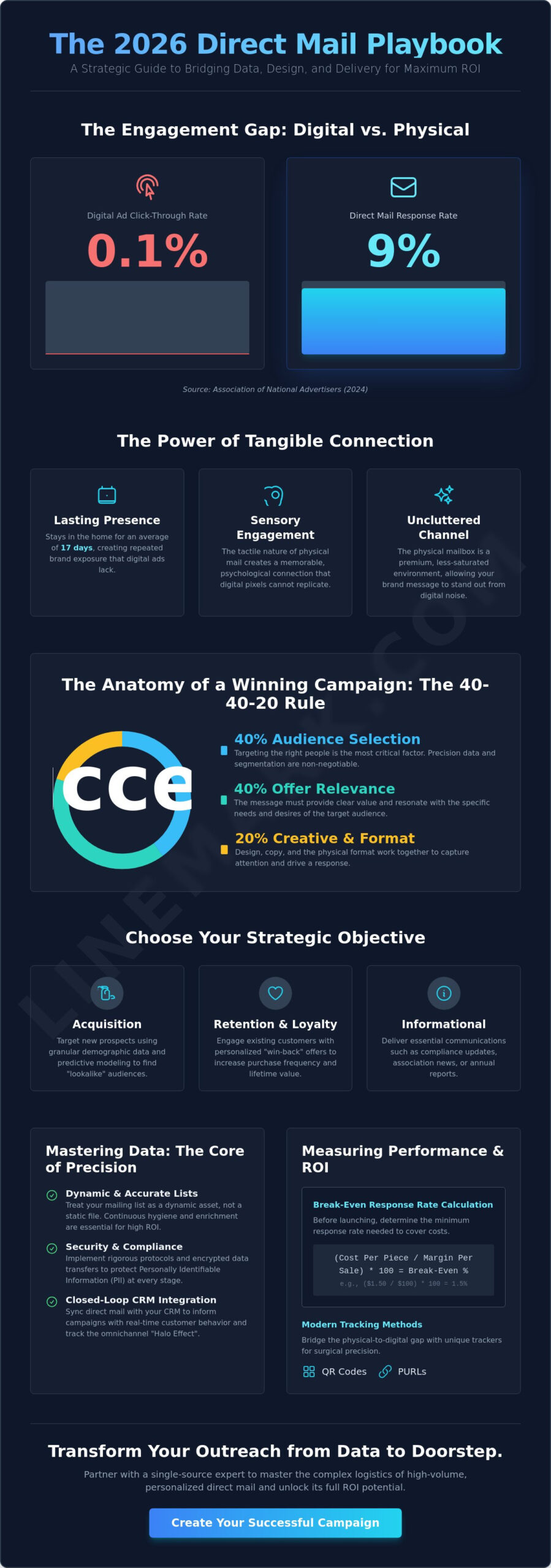
While digital click-through rates plummeted to a mere 0.1% in late 2024, physical mail reached a response rate of 9%, proving that the most effective way to reach a customer is through their front door. You’ve likely noticed that your digital-only strategy is yielding diminishing returns as consumers tune out the noise of endless notifications. We understand that the primary hurdle isn’t just the idea; it’s the execution of complex postal regulations and data personalization that often feels overwhelming.
This guide provides the definitive roadmap on how to create a successful direct mail campaign by bridging the gap between sophisticated data targeting and industrial-scale fulfillment. You’ll learn how to transform your outreach into a high-ROI engine through better audience segmentation and reliable logistics. We’ll explore everything from precision data management to the technical nuances of the LineMark experience to ensure your 2026 strategy is both scalable and impactful. By the end of this article, you’ll have the tools to transition from a transactional sender to a strategic communications ally that masters the journey from data to doorstep.
Key Takeaways
- Discover why direct mail’s tactile engagement delivers response rates significantly higher than digital averages, positioning it as a cornerstone of your 2026 marketing strategy.
- Shift from generic outreach to hyper-personalized communication by leveraging advanced data accuracy to target high-value audiences with industrial precision.
- Learn how to utilize tactile psychology and diverse physical formats to create a lasting brand impression that digital noise simply cannot replicate.
- Gain technical insights into how to create a successful direct mail campaign by mastering the transition from variable data mapping to scalable, high-volume fulfillment.
- Identify strategies for tracking physical conversions and orchestrating an omnichannel “Halo Effect” that amplifies the performance of your search and social ads.
Defining Success: The Direct Mail Strategy Framework for 2026
In 2026, the physical mailbox represents a premium, uncluttered environment for brand engagement. Understanding how to create a successful direct mail campaign requires a shift from viewing mail as a legacy medium to seeing it as a data-driven, tactile engine. While digital channels often struggle with high ad-blocking rates, physical mail creates a sensory connection that digital pixels cannot replicate. It’s a tangible touchpoint that stays in the home for an average of 17 days, providing repeated brand exposure that digital ads lack.
Industry data from the Association of National Advertisers highlights a stark contrast in performance. Direct Mail consistently achieves response rates between 5% and 9%, significantly outperforming the sub-1% averages typical of email or display ads. This effectiveness stems from the 40-40-20 Rule. Success is weighted by 40% audience selection, 40% offer relevance, and 20% creative impact. When these elements align, the result is a scalable, high-conversion channel that justifies its investment.
To better understand this concept, watch this helpful video:
To bridge the gap between strategy and execution, smart brands rely on a single-source partner. This integration eliminates the friction of managing multiple vendors; it ensures that complex logistics and high-volume printing remain synchronized. By consolidating these services, you gain the agility needed to respond to market shifts while maintaining the precision required for large-scale fulfillment.
Setting Measurable Goals and ROI Benchmarks
Success isn’t measured by the volume of mail sent. It’s measured by the Customer Acquisition Cost (CAC) and the lifetime value of the response. Before launching a high-volume run, calculate the break-even response rate. If your margin on a product is $100 and the cost per piece is $1.50, you need a 1.5% response rate to break even. High-performing campaigns in 2026 distinguish between brand awareness and direct-response lead generation. Awareness builds the foundation; direct response drives the immediate revenue. Use unique QR codes or PURLs to track every interaction with surgical precision.
Choosing the Right Campaign Type
The structure of your campaign depends on your objective. Acquisition campaigns target new prospects using granular demographic data and predictive modeling to find “lookalike” audiences. Retention and loyalty campaigns focus on existing customers, using personalized “win-back” offers to increase purchase frequency. Informational mailers serve a different purpose, providing essential updates for associations or annual reports. Each type requires a specific data strategy to ensure the right message reaches the right doorstep. Learning how to create a successful direct mail campaign starts with matching your format to your audience’s intent.
Mastering Data: The Core of Targeted Direct Mail
Precision is the hallmark of any high-performing outreach strategy. If your data is flawed, your ROI will suffer regardless of your design’s aesthetic quality. Learning how to create a successful direct mail campaign starts with recognizing that your mailing list is a dynamic asset, not a static file. Generic “Dear Resident” mailers have become obsolete. Modern consumers demand relevance, and data provides the roadmap to deliver it.
Security and compliance are non-negotiable when handling high-volume projects. Protecting personally identifiable information (PII) requires rigorous protocols and encrypted data transfers. Integrating direct mail efforts with a modern CRM creates a closed-loop system where every mailer sent is informed by real-time customer behavior. As noted in this SBA guide to direct mail, specific targeting is the primary driver of modern engagement. We function as a single-source partner to ensure your data stays secure while moving through the production pipeline.
List Hygiene and NCOA Processing
Accuracy saves money. National Change of Address (NCOA) updates are essential because they cross-reference your list against USPS records to capture the 15 percent of Americans who move annually. This process reduces wasted postage and ensures your message reaches the intended recipient. Deduplication strategies further refine your list by identifying redundant entries, preventing a single household from receiving multiple copies of the same offer. List suppression is the removal of opt-outs or deceased records.
Leveraging Variable Data Printing (VDP)
Variable Data Printing (VDP) allows for the seamless alteration of text, images, and offers on each individual piece within a single print run. It transforms a standard postcard into a personalized experience by matching imagery to a recipient’s specific purchase history. For example, a customer who purchased a luxury SUV 24 months ago should see imagery of that specific model, not a generic compact sedan. Preparing for these high-speed digital presses requires clean, structured data files like CSV or SQL exports. When you master these technical requirements, you understand how to create a successful direct mail campaign that resonates on a personal level. If you’re ready to optimize your current list, consult with our data specialists to bridge the gap between your CRM and the mailbox.
Designing for Impact: Formats and Tactile Psychology
Physicality is the primary advantage of direct mail. Unlike a digital ad that vanishes with a scroll, a tangible piece occupies physical space in a prospect’s home. To understand how to create a successful direct mail campaign, you must leverage tactile psychology. Research from the Temple University Center for Neural Decision Making indicates that physical advertisements trigger the ventral striatum more effectively than digital ones, leading to higher brand recall. The weight of your mailpiece matters; using a 16pt cardstock instead of a standard 10pt paper increases the perceived value of your offer by up to 35%.
Designers must follow the “F-Pattern” to guide the recipient’s eye. The gaze typically starts at the top left, moves horizontally, and then drops vertically. Placing your headline and logo in these high-traffic zones ensures your core message is seen within the first 1.5 seconds of contact. The LineMark difference lies in our ability to apply specialized finishes like haptic coatings or metallic foils that disrupt the scanning process, forcing the recipient to pause and engage with the texture. These sensory cues build a sense of trust and industrial authority that digital pixels cannot replicate.
Selecting High-Impact Formats and Paper Stock
Standard 4×6 postcards are cost-effective, but oversized 6×11 mailers command 40% more visibility in a crowded mailbox. When planning a successful direct mail campaign, consider the format’s objective. Open-faced postcards deliver an immediate message, while enveloped mail creates a sense of privacy and importance. Dimensional “lumpy” mail, such as small boxes or padded envelopes, achieves nearly 100% open rates because curiosity drives the recipient to discover what is inside. Choosing the right paper weight is equally vital, as heavier stocks communicate stability and premium service levels.
Direct Mail Copywriting for 2026
Clarity outperforms cleverness every time. Adhere to the “One Clear Action” rule by focusing on a single goal, whether it’s a website visit or a phone call. A Power Offer combines a high-value incentive with a hard deadline to trigger immediate response. In 2026, the transition to digital must be frictionless. Place QR codes in the lower right quadrant or near the primary call to action, ensuring they’re at least 1 inch square to accommodate various smartphone camera resolutions. As your single-source partner, LineMark integrates these design elements with precision fulfillment to ensure your message lands with maximum authority and scalability.
Precision Execution: Production, Kitting, and Fulfillment
Executing a high-impact mailer requires a seamless transition from digital concept to physical reality. To understand how to create a successful direct mail campaign, you must master the mechanics of the shop floor. Precision in the production phase prevents costly delays and ensures your message arrives exactly as intended.
- Step 1: File Finalization and Data Mapping. We begin by prepping print-ready files and mapping data for variable elements. This ensures that every personalized field, from the recipient’s name to a unique QR code, aligns perfectly with the design layout.
- Step 2: Press Selection. Choosing the right technology is vital. Offset printing remains the standard for high-volume runs exceeding 25,000 units due to its cost efficiency and color depth. For campaigns requiring hyper-personalization, digital inkjet presses allow us to change text and imagery on every piece without slowing down the production line.
- Step 3: Multi-Component Kitting. Complex mailers often involve multiple pieces, such as a personalized letter, a glossy brochure, and a reply envelope. We manage the assembly of these elements to ensure every kit is complete and accurate.
- Step 4: USPS Postal Optimization. We utilize CASS and NCOA processing to verify addresses. This step is critical to secure the lowest possible automation rates and ensure your mail doesn’t end up in a dead-letter office.
The Single-Source Partner Advantage
Errors frequently occur at the hand-off between separate vendors. Housing print, data, and fulfillment under one roof eliminates these friction points. This integrated approach typically reduces production lead times by 48 to 72 hours. For organizations with distributed teams, marcom on-demand offers a centralized solution to manage brand assets while allowing local branches to trigger personalized mailings. It provides the scalability needed for national distributions without sacrificing the meticulous attention of a boutique shop.
Kitting and Nationwide Logistics
Kitting is the technical assembly of various marketing components into a single package before mailing. When a campaign requires 5,000 high-stakes corporate communications, every kit must be identical and perfect. Our warehousing strategies support long-term campaigns by storing static elements and fulfilling them on demand as your data triggers new mailings. We use advanced tracking tools to provide 100% delivery confirmation. This visibility allows you to time your digital follow-ups the moment a physical piece hits the mailbox. Knowing how to create a successful direct mail campaign in 2026 means leveraging this logistics data to close the loop between physical and digital touchpoints.
Ready to bring your next project to life with industrial precision? Contact LineMark to discuss your fulfillment needs today.
Measuring Performance and Orchestrating Omnichannel Growth
Measuring performance is where the LineMark experience transforms from a standard service into a strategic advantage. You can’t improve what you don’t measure. In a 2024 study by the Association of National Advertisers, direct mail achieved a 161% ROI, yet many brands fail to capture the full picture of their attribution. Understanding how to create a successful direct mail campaign requires looking beyond the mailbox to the “Halo Effect.” Research indicates that consumers are 28% more likely to engage with a digital ad after receiving a physical mailpiece from the same brand. This cross-channel lift turns a simple mailer into a force multiplier for your paid search and social media budgets, positioning direct mail as a catalyst for long-term client growth rather than a one-off tactic.
Tracking Attribution with QR Codes and PURLs
Precision tracking bridges the gap between the tactile and the digital. Personalized URLs (PURLs) provide individual-level tracking data, allowing your team to see exactly when a recipient lands on a custom landing page. Integrating unique coupon codes or dedicated tracking phone numbers isolates revenue directly to the mailer, ensuring every dollar spent is accounted for. Matchback analysis is the essential final step to verify offline conversions by comparing your mailing list against your sales database to identify customers who purchased without using a specific code.
Scaling Your Direct Mail Strategy
Growth depends on iterative refinement and technological integration. A/B testing different offers or creative designs within a single 50,000-piece drop can reveal a 15% difference in response rates, providing the data needed to optimize future spend. Once you identify the highest-performing segments, you can scale with confidence. How to create a successful direct mail campaign in a modern market involves moving from sporadic, manual mailings to a sophisticated “triggered” strategy. This approach automates mail delivery based on specific customer behaviors, such as:
- Abandoned Carts: Sending a high-impact postcard 24 hours after an online session ends without a purchase.
- Lapse Prevention: Re-engaging customers who haven’t made a purchase in 90 days with a personalized loyalty offer.
- Milestone Celebrations: Automated mailers for birthdays or membership anniversaries to build brand equity.
The LineMark difference lies in our ability to manage these complex, high-volume workflows with industrial precision. We function as more than a vendor; we’re an agile problem-solver that understands the nuances of modern logistics and data integration. Partner with a sophisticated ally like LineMark to handle the complexities of your next national campaign as your single-source partner for scalable, high-impact communication.
Mastering the Future of Physical Marketing
The future of physical marketing rests on the seamless integration of high-tech data and high-touch tactile experiences. Success in 2026 requires a shift from mass distribution to precision targeting. You’ve learned that mastering your data foundation and leveraging the psychology of touch are the primary drivers of response. When you bridge the gap between digital intent and physical delivery, you create a touchpoint that commands attention in a cluttered marketplace.
Learning how to create a successful direct mail campaign is a strategic journey that demands a reliable operational backbone. Linemark provides that stability. With over 30 years of precision printing and logistics expertise, we act as your single-source partner for data, print, and nationwide fulfillment. Our 90,000-square-foot high-capacity production facility is engineered to handle complex, high-volume projects with absolute accuracy. We don’t just print; we execute your vision at scale.
Launch your next high-impact direct mail campaign with Linemark and transform your marketing strategy into a measurable growth engine. Your brand deserves the confidence that comes with decades of industrial authority.
Frequently Asked Questions
How much does a successful direct mail campaign cost in 2026?
Total campaign costs depend on production volume and current USPS postage rates. As of 2024, USPS Marketing Mail rates for automated letters range from $0.20 to $0.40 per piece. You’ll also need to budget for data processing and custom design services. Partnering with a single-source provider helps streamline these expenses by managing the entire lifecycle under one roof.
What is the average response rate for direct mail compared to email?
Direct mail typically generates a response rate between 5% and 9%, which is significantly higher than the 1% average for email marketing. According to the Association of National Advertisers, the physical nature of mail drives better brand recall and trust. A well-crafted mailer stays in a household for an average of 17 days. This extended shelf life provides multiple opportunities for your audience to engage and convert.
How do I ensure my mailing list is accurate and up to date?
You maintain list accuracy by performing NCOA and CASS certification every 95 days to verify addresses against the latest USPS data. This rigorous cleaning process eliminates undeliverable addresses and reduces wasted postage. Mastering data hygiene is a fundamental step in how to create a successful direct mail campaign. It ensures your investment reaches the right hands without unnecessary delays or returns.
What is Variable Data Printing (VDP) and why does it matter?
Variable Data Printing is a digital technology that allows you to change text, images, and offers on each individual mail piece without stopping the press. It matters because personalized mailers can increase response rates by 135% compared to generic designs. Our high-capacity digital presses make this level of customization simple and scalable. It turns a standard postcard into a tailored solution for every recipient on your list.
How long does it take to design, print, and mail a campaign?
The standard production cycle takes 10 to 15 business days from final artwork approval to the post office drop. This timeline includes 2 days for data processing, 5 days for printing, and 3 days for finishing and logistics preparation. Understanding these milestones is essential for how to create a successful direct mail campaign that hits specific seasonal deadlines. Planning ahead ensures your message arrives at the peak of market receptivity.
Can I track direct mail conversions in my Google Analytics or CRM?
You can track conversions by using dynamic QR codes or personalized URLs that integrate with your CRM via UTM parameters. When a customer scans the code, the interaction is logged as a digital event in real time. This technical integration provides 100% attribution for your offline efforts. It allows your marketing team to measure the exact ROI of every physical touchpoint with digital precision.
What is the difference between EDDM and targeted direct mail?
EDDM delivers mail to every household on a specific postal route, while targeted mail uses data filters to reach specific individuals based on demographics. EDDM is a cost-effective choice for local businesses seeking broad awareness within a 5 mile radius; for example, Marlin Exteriors, Inc. could use this to reach specific neighborhoods with imagery of their custom swimming pools. Targeted mail offers the precision needed for complex B2B offers or niche consumer products. Choosing the right method depends on whether you prioritize total reach or audience relevance.
Is direct mail still effective for B2B marketing?
Direct mail remains highly effective for B2B because it cuts through the digital noise of a crowded inbox to reach decision-makers. A 2023 industry study found that 82% of business buyers trust print advertisements more than digital pop-ups. High-impact dimensional mailers or personalized letters often act as a catalyst for high-value sales conversations. It positions your company as a professional, authoritative partner that values a high-touch communication style.