

 06/12/2026
  Steve Bearden
Did you know you have exactly three seconds to capture a prospect’s attention before they walk past your booth? That’s a razor-thin margin for error when your brand’s physical presence is on the line. We understand the frustration of opening a shipping crate only to find color-mismatched panels or graphics that can’t survive a single convention cycle. Coordinating trade show booth graphics printing across different vendors often leads to logistical headaches and missed deadlines that jeopardize your entire event ROI.
You deserve a strategic partner who treats your display as a high-stakes communication asset rather than a simple transaction. We agree that consistency and durability aren’t just preferences; they’re operational requirements for any organization scaling its presence. This guide will help you master the technical and strategic nuances of large-format production so your displays command attention and achieve maximum ROI at every show. We’ll examine high-performance materials like silicone edge graphics, the industry shift toward sustainability, and the logistical precision required to manage complex national event schedules with total confidence.
Key Takeaways
- Discover how professional trade show booth graphics printing serves as a strategic branding solution to establish immediate industrial authority and capture attendee attention in seconds.
- Compare tension fabrics, vinyl, and rigid substrates to select the optimal material for your specific booth configuration and durability needs.
- Maximize your event ROI by utilizing graphic reprints to refresh your visual messaging while maintaining existing hardware and supporting corporate sustainability goals.
- Implement a “Right First Time” pre-press protocol to ensure large-format files are technically perfect, avoiding costly reprints and shipping delays.
- Leverage centralized, high-capacity production to maintain brand consistency across national event schedules and complex logistical requirements.
The Strategic Role of Trade Show Booth Graphics in 2026
Trade show booth graphics are no longer just decorative backdrops; they are integrated environmental branding solutions that define your space. In a crowded exhibition hall, your visuals act as the skin of your brand’s physical presence. High-resolution imagery establishes immediate industrial authority, signaling to every attendee that your organization operates with precision and scale. When you are understanding trade shows as high-stakes competitive arenas, it becomes clear that your visuals are your first and most influential point of contact.
In 2026, the industry has shifted toward immersive, high-contrast large format designs that demand attention from across the convention floor. This evolution reflects a deeper need for a unified brand journey, where every physical touchpoint reinforces your strategic position. Achieving this level of impact requires a sophisticated approach to trade show booth graphics printing that prioritizes color accuracy, material integrity, and logistical reliability. Your display should be a catalyst for growth, not a source of technical friction.
To better understand how these high-impact visuals are brought to life, watch this helpful video on the production process:
Beyond Aesthetics: Graphics as a Lead Generation Tool
Effective graphics function as lead generation tools by employing a deliberate visual hierarchy. You have approximately three seconds to communicate your core value proposition before a prospect moves on to the next booth. Large format signage must be direct and purposeful. It should guide the attendee’s eye from a bold, high-level headline down to specific digital engagement triggers, such as touchscreens or tailored QR codes. This creates a holistic experience that bridges the gap between physical presence and digital follow-up, ensuring no lead is left behind.
The Importance of Brand Consistency Across National Circuits
Consistency is a significant hurdle for organizations managing national event circuits. Many brands face the “color drift” trap when they utilize different local printers for various shows. This results in mismatched panels and off-brand hues that undermine your professional credibility. Centralized production is the only reliable way to ensure your corporate identity remains identical nationwide. By partnering with a high-capacity provider, you guarantee that your trade show booth graphics printing maintains its integrity regardless of the venue. For a deeper dive into technical execution, explore the ultimate guide to large format graphics for high-impact solutions.
Substrates and Materials for Professional-Grade Displays
Selecting the right material is the foundation of high-impact trade show booth graphics printing. Your choice of substrate dictates not only the visual quality but also the logistical efficiency and longevity of your display. While vinyl remains a versatile option for traditional banners, the industry has seen a massive shift toward tension fabrics and specialized rigid boards that offer a more sophisticated, industrial finish. These materials are chosen for their ability to hold deep, saturated colors while remaining durable enough to withstand the rigors of frequent shipping and installation.
Dye-sublimation printing has become the gold standard for fabric displays. This process doesn’t just layer ink on the surface. It bonds the ink directly into the polyester fibers using heat and pressure. This results in incredibly vibrant colors that won’t crack or peel over time. These graphics are also wash-safe, allowing you to refresh them between events. To ensure your brand remains visible under harsh convention hall lighting, we utilize light-blocking layers. These “blockout” liners prevent hardware or backlighting from showing through the fabric, maintaining a clean, professional appearance. Safety is another critical factor. We prioritize flame-retardant materials that meet NFPA 701 standards, ensuring your booth remains compliant with strict national convention center regulations.
Tension Fabric and Silicone Edge Graphics (SEG)
SEG is the premium choice for brands seeking a seamless, drum-tight aesthetic. By sewing a silicone strip around the edge of a dye-sublimated fabric graphic, the display can be tucked into a recessed groove on the frame. This removes wrinkles and creates a perfectly flat surface. Logistically, tension fabrics are a game-changer. They fold down into small packages, significantly reducing shipping costs and drayage fees compared to bulky rigid panels. Their elasticity ensures they bounce back to a smooth finish even after being packed for long periods. If you are planning a busy event season, investing in high-quality large format graphics ensures your hardware stays relevant for years.
Rigid Boards and Specialty Signage
Rigid substrates still play a vital role in structural booth design. Coroplast is an excellent, cost-effective choice for short-term directional signage, while expanded PVC boards offer a smoother, more durable surface for semi-permanent wall panels. For brands looking to maximize every inch of their footprint, custom floor graphics and high-impact wall murals turn unused real estate into active marketing zones. We also recommend specific laminates based on your environment. A matte laminate is often preferred to reduce glare from overhead lights, ensuring your graphics look perfect in professional photography and attendee social media posts.
Graphic Reprints vs. Full Display Overhauls: A Strategic ROI Comparison
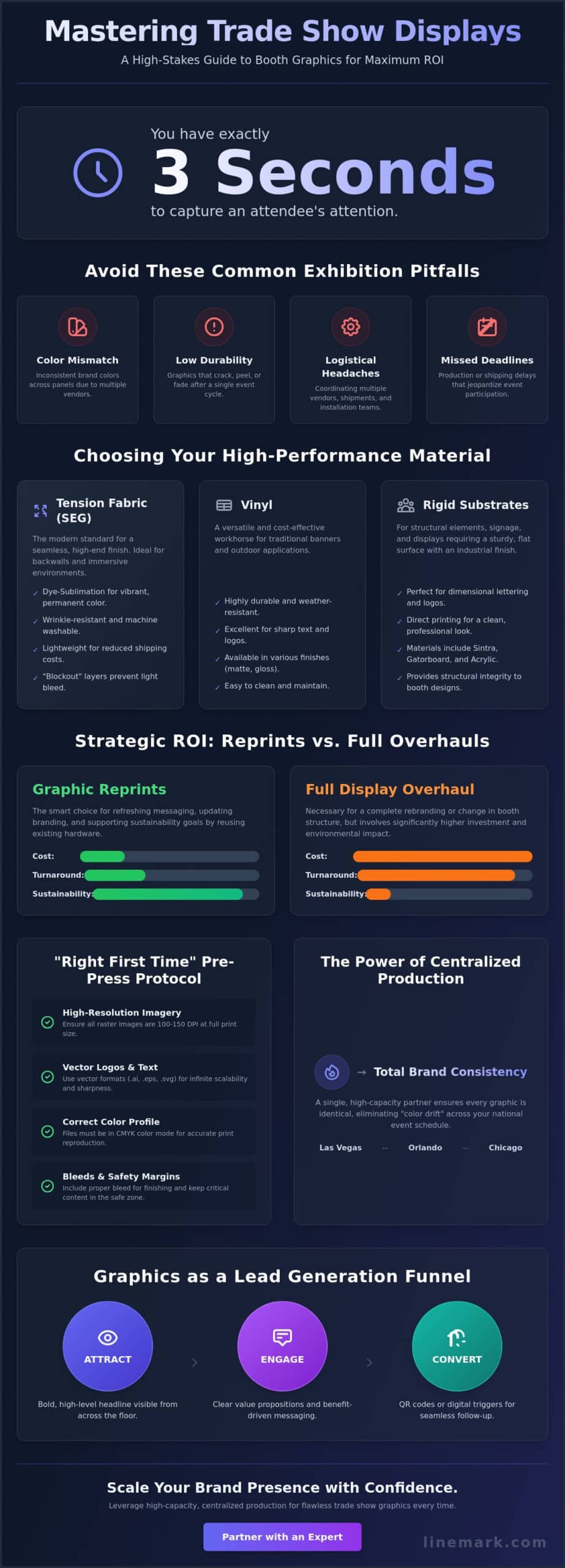
Strategic budget management requires a clear understanding of when to refresh your message and when to replace your infrastructure. For many high-volume exhibitors, trade show booth graphics printing represents a recurring investment that can be optimized by retaining high-quality aluminum frames. This approach aligns perfectly with corporate ESG frameworks by reducing material waste and extending the lifecycle of booth hardware. However, a full overhaul becomes necessary when hardware fatigue compromises safety or when your brand’s physical footprint no longer matches your market position. We help you analyze these variables to ensure your capital is deployed where it generates the most impact.
Versioning your graphics is a sophisticated way to increase relevance without the cost of a new booth. You can produce tailored visual sets for specific industries or product launches, swapping them out as your event calendar dictates. This agility ensures your messaging remains sharp and targeted while maximizing the ROI of your initial hardware investment. It transforms your booth from a static piece of equipment into a dynamic communication platform that evolves with your business goals.
Calculating the Real Cost of Event Graphics
Determining the true budget for your display requires looking far beyond the initial print quote. You must factor in logistical variables like shipping, storage, and the labor required for onsite installation. High-quality materials like tension fabric are lighter than rigid panels, which significantly lowers drayage fees. These fees are often based on weight in major cities like Chicago or New York and can quickly inflate your total spend. By choosing durable substrates that withstand multiple shows, you lower your “cost per show” and avoid the “cheap print trap.” Low-cost alternatives often lead to onsite failures, requiring emergency reprints and overnight shipping that erase any initial savings. Precision in the production phase is the best insurance against these hidden costs.
Maximizing Versatility with Modular Graphic Systems
Pre-Press Checklist for Large Format Graphic Success
Operational excellence in trade show booth graphics printing begins long before the first drop of ink hits the substrate. We implement a “Right First Time” protocol for file preparation to eliminate the risk of pixelation, color shifts, or alignment errors that can derail an event schedule. High-stakes environments leave no room for technical oversights. When you are scaling a brand presence across oversized displays, the precision of your digital assets determines the authority of your physical presence. Our pre-press experts act as a strategic filter, ensuring every file is optimized for industrial-grade output.
The distinction between vector and raster files is critical for large-format success. Logos, typography, and line art must remain in vector format to ensure infinite scalability without loss of clarity. High-resolution raster images are necessary for photography, but they require a sophisticated understanding of color profiles. We utilize the Pantone Matching System (PMS) alongside CMYK workflows to maintain absolute brand consistency. This rigorous approach prevents the visual disconnect that occurs when your corporate colors don’t match your marketing collateral. It’s about ensuring your brand looks as professional on a twenty-foot wall as it does on a business card.
Technical Specifications for Large Format
Managing massive file sizes requires a strategic approach to scale. While we prefer 1:1 scale for most projects, extremely large murals may require a 1:10 scale setup to prevent design software from crashing. It’s essential to include specific bleed and safety margins, particularly for Silicone Edge Graphics (SEG) and wrap-around fabric displays where the material must tuck into a frame or wrap around a corner. For a 10-foot banner intended for viewing from 3 feet away, an effective resolution of 100 to 150 DPI at final size is the optimal balance between visual clarity and manageable file size. If you have questions about your specific file setup, our team provides the large format graphics expertise needed to ensure a flawless result.
The Proofing Process: Digital vs. Physical
A disciplined proofing process is your final line of defense against production errors. PDF soft proofs are excellent for verifying layout, text accuracy, and general placement. However, they cannot accurately represent how colors will behave on specific substrates like tension fabric or vinyl. When brand-critical colors are involved, we recommend a physical strike-off. This is a small-scale print on the actual material that allows you to verify color saturation and accuracy under real-world lighting. Our tech-savvy pre-press team meticulously reviews every project, catching potential issues like low-resolution images or missing fonts before they reach the production floor. This collaborative partnership ensures that your final display is a perfect reflection of your strategic vision.
Scaling Your Brand Presence with Linemark’s Production Capacity
Success on a national event circuit requires more than just high-quality files; it demands a partner with the infrastructure to execute at scale. We operate a 90,000 square foot production facility designed to handle the most complex, high-volume requirements with industrial precision. This centralized approach to trade show booth graphics printing ensures that whether you are exhibiting in Las Vegas or Orlando, your brand’s visual integrity remains absolute. We position ourselves as a strategic communications ally, providing the operational breadth needed to support national organizations and large-scale associations that cannot afford logistical friction.
Our MarCom On-Demand portals transform how distributed marketing teams manage their assets. These customized interfaces streamline the ordering process, allowing regional managers to deploy approved booth graphics while maintaining strict corporate oversight. This level of purposeful technology integration removes the administrative burden from your internal team, moving the relationship from a simple transaction to a premium, holistic journey. For environments requiring complex environmental graphics, we also facilitate professional on-site installation services to ensure your vision is realized exactly as intended.
Integrated Logistics and Nationwide Distribution
Managing a national event calendar is a logistical challenge that extends far beyond the printing press. We bridge this gap through integrated kitting and fulfillment services that deliver your booth graphics directly to convention centers exactly when they are needed. Our inventory management systems track your assets across multiple shows, ensuring every component is inspected and ready for deployment. This centralized logistics model is a core component of MarCom On-Demand, providing a streamlined solution for distributed marketing in 2026. It ensures your team focuses on lead generation while we handle the operational excellence of your physical presence.
The Linemark Advantage: Precision and Partnership
The personality of our organization is defined by a blend of large-scale capacity and the meticulous attention to detail typically found in a boutique shop. We take technological pride in our large format production capabilities, constantly investing in the next advancement to benefit our partners. This forward-thinking spirit ensures your trade show booth graphics printing projects are handled by seasoned experts who value efficiency and high-touch service. We don’t just provide a service; we act as a catalyst for your growth by ensuring your brand commands attention at every event. Partner with Linemark for your next high-impact trade show project.
Command the Convention Floor with Strategic Precision
Capturing attendee attention in a crowded hall requires a fusion of technical mastery and logistical precision. We have explored how selecting high-performance substrates like silicone edge graphics reduces drayage costs while simultaneously enhancing your brand’s visual impact. A disciplined pre-press protocol is equally vital; it ensures your corporate identity remains consistent across every venue on your national circuit. When you transition from transactional vendors to a strategic partnership, you secure a unified brand journey that drives measurable ROI at every event.
Our 90,000-square-foot high-capacity facility is equipped to handle complex, large-scale trade show booth graphics printing with the meticulous care your brand deserves. With over 30 years of industrial printing expertise, we provide the robust infrastructure needed for nationwide distribution and professional on-site installation support. We are ready to help you scale your event presence with confidence and operational excellence. Request a Quote for Your Large Format Trade Show Graphics today and let’s ensure your brand commands the attention it earned. Your next successful show starts with a partner who understands the stakes.
Frequently Asked Questions
What is the best material for trade show booth graphics?
Tension fabric is widely considered the optimal material for modern displays due to its wrinkle resistance and high-impact color absorption via dye-sublimation. It is lightweight, which significantly reduces drayage costs at major convention centers compared to heavy rigid panels. Rigid substrates like expanded PVC or Coroplast are better suited for structural elements or short-term directional signage where structural integrity is the primary concern.
How far in advance should I order my trade show graphics?
You should begin the ordering process at least 8 weeks before your event date to ensure a smooth logistical flow. Production for complex booth elements typically requires 3 to 4 weeks, and you must account for shipping times and potential on-site drayage windows. Finalizing handouts and promotional materials at least 6 weeks out ensures everything arrives at the loading dock well before the convention begins.
Can I reuse my trade show graphics for multiple events?
High-quality graphics are designed for long-term reuse across multiple event cycles. Durable tension fabrics and laminated rigid boards can withstand the rigors of shipping and repeated installation if handled with professional care. Investing in trade show booth graphics printing that utilizes dye-sublimation ensures your visuals won’t crack or peel, allowing you to maximize your ROI over several years of use.
What file resolution is required for large format printing?
For large format displays viewed from a distance of three feet or more, an effective resolution of 100 to 150 DPI at the final output size is required. While smaller marketing collateral needs 300 DPI, oversized graphics don’t require that density to appear sharp to the human eye. Using vector files for logos and typography is the most reliable way to ensure your branding remains crisp and professional at any scale.
How do I ensure my brand colors match exactly on fabric graphics?
Exact color matching is achieved by utilizing the Pantone Matching System (PMS) and providing specific CMYK values for your brand assets. Because different fabrics absorb ink differently, you should request a physical strike-off, which is a small-scale print on the actual substrate. This allows our pre-press team to calibrate our industrial printers to your specific brand standards before the full trade show booth graphics printing run begins.
Do you offer installation services for large booth displays?
Yes, we provide professional on-site installation support for complex environmental graphics and large-scale booth configurations. This service is particularly valuable for national organizations managing high-stakes exhibits where technical precision is non-negotiable. Our team ensures that every panel is perfectly aligned and every tension fabric graphic is drum-tight, removing the operational burden from your internal marketing staff.
What is the difference between SEG and standard fabric graphics?
Silicone Edge Graphics (SEG) feature a thin silicone strip sewn into the perimeter that tucks into a recessed groove on the booth frame for a seamless, borderless look. Standard fabric graphics often use pillowcase designs or pole pockets, which may show visible seams or hardware. SEG is the preferred choice for premium displays because it creates a perfectly flat, tensioned surface that mimics the look of a solid, rigid wall.
How do I clean and store my fabric booth graphics?
Most dye-sublimated fabric graphics can be machine washed on a gentle, cold cycle using a mild detergent. It’s essential to air dry them to prevent shrinkage and maintain the elasticity required for a proper fit on your frame. For storage, fold the graphics neatly with the image side facing inward and keep them in a cool, dry place to prevent moisture damage or color transfer between events.