

 09/19/2026
  Steve Bearden
Your choice of binding is a structural engineering decision that either secures your brand’s reputation or literally lets it fall apart in a client’s hands. Learning how to choose the right print binding is about more than just aesthetics; it’s about matching the lifecycle of your project to the physics of its construction. You’ve likely felt the frustration of a premium catalog that feels flimsy or a high-volume report where the spine cracks after the first few reads. It’s a common fear that overpaying for heavy-duty finishing might waste your budget, while choosing a binding that looks cheap for a premium brand risks your credibility.
This 2026 guide will help you master the technical nuances of binding to ensure your catalogs and books deliver maximum professional impact. We’ll explore the critical thresholds for page counts, the superior durability of PUR adhesives, and the specific finishing methods that align with your volume and budget requirements. From understanding the 64-page limit of saddle stitching to the flat-lay capability of Wire-O, you’ll gain the clarity needed to scale your projects with precision and confidence.
Key Takeaways
- Understand why binding serves as the structural foundation of your document and how it directly influences brand perception through tactile user experience.
- Learn how to choose the right print binding by applying a strategic decision matrix that balances page count, budget, and the intended project lifecycle.
- Compare the primary commercial methods, including saddle stitching, perfect binding, and mechanical options, to identify the technical fit for your specific page count.
- Discover why PUR adhesive has become the 2026 industrial standard for creating durable, lay-flat books that withstand environmental stress and heavy use.
- Explore the benefits of centralized, high-capacity production facilities that eliminate subcontractor delays and provide scalable solutions for complex finishing needs.
The Strategic Importance of Selecting the Right Print Binding
Binding serves as the structural foundation of any multi-page document, acting as the skeleton that supports every page and image you print. It is the final stage of production where a collection of loose sheets transforms into a cohesive, professional tool. By selecting from various commercial bookbinding methods, you determine how your project handles, how long it lasts, and how it communicates your brand’s value. Strategic finishing ensures that the mechanical assembly of your document aligns with its intended lifecycle. Understanding how to choose the right print binding is essential for optimizing both the tactile brand perception and the long-term ROI of your collateral.
To better understand how structural differences impact your final product, watch this helpful comparison:
Why Binding Dictates Your Project’s First Impression
The psychological impact of a printed piece begins the moment it is touched. A book that resists being opened or snaps shut when laid on a desk creates a barrier between the information and the reader. Conversely, a document that opens smoothly and stays flat signals accessibility and high value. This tactile feedback directly influences how a client perceives your brand’s attention to detail. If the binding feels flimsy, the information inside may be dismissed as temporary or secondary. Professional finishing is the intersection of durability and aesthetics. By matching the finish to the brand’s position, you reinforce the quality of the content before a single word is even read.
The Functional Role of Binding in High-Volume Logistics
Operational efficiency in 2026 requires a “fit-for-purpose” approach to finishing. Binding choice isn’t just about looks; it significantly affects shipping weight, kitting efficiency, and distribution costs. A heavy mechanical coil might be perfect for a training manual used in the field, but it could be bulky and expensive for high-volume direct mail. Linemark’s 90,000-square-foot facility is designed to handle these complexities under one roof, ensuring that your choice of binding supports nationwide distribution without unnecessary weight or cost. Whether you are producing annual reports for the boardroom or thousands of catalogs for a national campaign, the right binding ensures the product survives the journey and the heavy use that follows.
The Core Four: Common Commercial Binding Methods
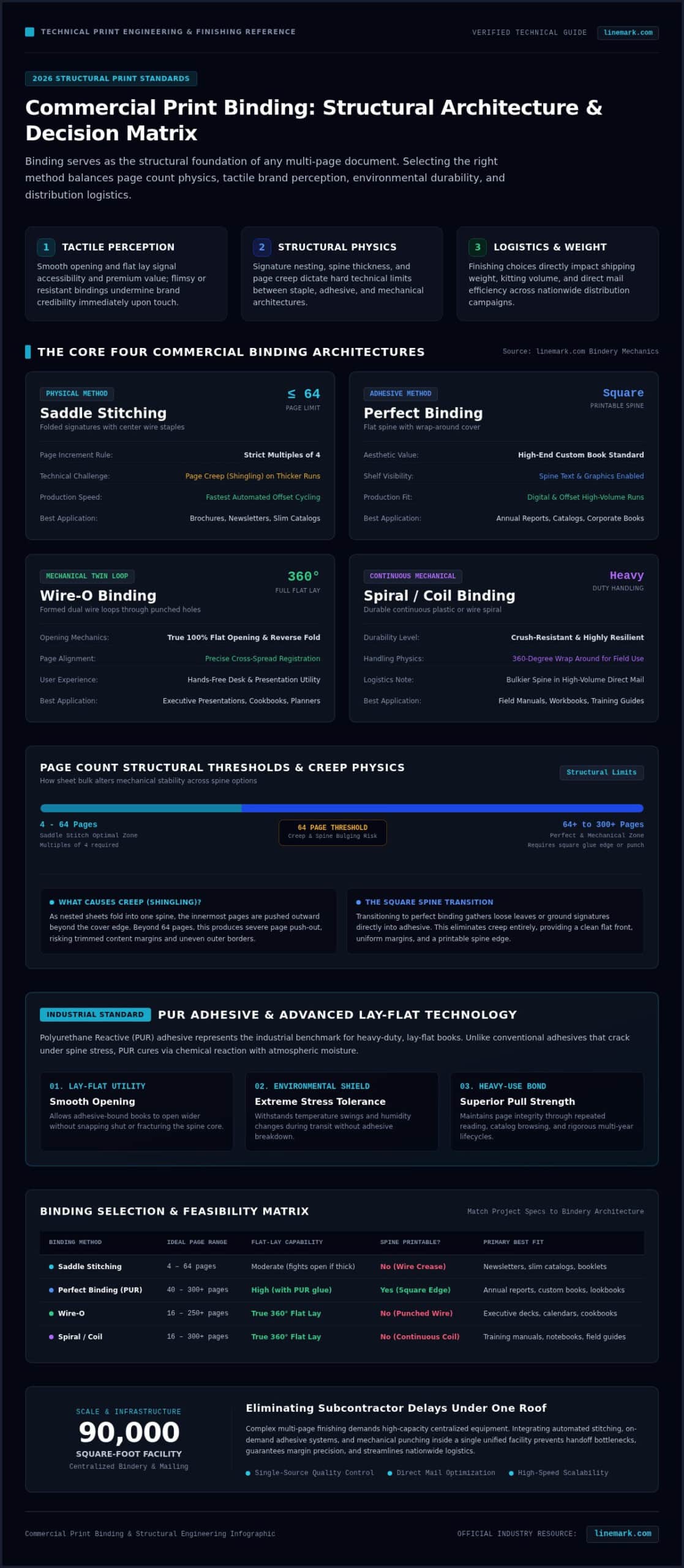
Commercial production utilizes four primary architectures to secure pages. These are categorized into physical (saddle stitching), adhesive (perfect binding), and mechanical (Spiral and Wire-O). Each serves a distinct purpose depending on whether you are running a high-volume offset catalog or a targeted digital print run. Offset projects often favor the speed of automated stitchers, while digital runs benefit from the flexibility of on-demand adhesive systems. Understanding these mechanics is the first step in learning how to choose the right print binding for your specific project goals and technical requirements.
Saddle Stitching: Efficiency for Low Page Counts
This method involves driving wire staples through the center fold of nested signatures. It is the most economical choice for brochures, newsletters, and slim catalogs. Because sheets are folded in half, saddle stitching requires page counts in multiples of four. Designers must account for “creep,” or shingling, which occurs when inner pages protrude further than the outer ones as the document grows thicker. For projects exceeding 64 pages, the spine begins to bulge, compromising the professional finish and risking uneven margins after the final trim. It remains the fastest option for high-speed production cycles.
Perfect Binding: The Professional Standard for Books
Perfect binding uses a strong adhesive to attach a wrap-around cover to the flat edge of a gathered page block. This creates a square, printable spine that allows for shelf visibility and a high-end aesthetic. It is the industry standard for annual reports and custom book manufacturing. To achieve a secure bond that meets Book Manufacturers Institute binding standards, the document typically requires a minimum spine thickness of 0.125 inches. Unlike stitched methods, perfect binding accommodates single-leaf increments in multiples of two, providing more flexibility for complex layouts.
Mechanical Binding: Spiral and Wire-O Solutions
Mechanical options utilize a series of holes punched through the gutter margin. Spiral binding uses a continuous plastic coil, while Wire-O employs a sophisticated twin-loop metal wire. For 2026 corporate projects, Wire-O is often preferred for its premium, industrial aesthetic and its ability to keep pages perfectly aligned when open. Both offer a 360-degree flat-lay advantage, making them ideal for training manuals or workbooks that must remain open during use. If you need a partner to help scale these solutions for complex distributions, our team at Linemark can provide the technical guidance to ensure a flawless finish.
A Decision Matrix for Choosing Your Binding Method
Strategic project planning in 2026 requires a framework that balances technical constraints with business objectives. When determining how to choose the right print binding, you must evaluate three foundational pillars: page count, budget, and the intended use case. Page count acts as the primary technical gatekeeper, dictating which methods are physically viable. However, the volume of your run also shifts the cost-benefit analysis. While digital printing offers flexibility for short runs, high-volume offset projects allow for sophisticated, automated finishing that drives down per-unit costs. Finally, the user experience, specifically the “lay-flat” requirement, determines if a reader can easily interact with your content.
Evaluating Binding by Page Count and Spine Width
Technical limitations are non-negotiable in the bindery. Saddle stitching is the most efficient solution for documents between 8 and 64 pages. Pushing beyond this limit creates significant “creep,” where inner sheets protrude and risk being trimmed off, or the spine becomes too bulky to stay closed. For larger projects, perfect binding becomes the standard once the page count reaches a minimum spine width of 0.125 inches, typically around 40 pages depending on the paper caliper. Choosing a method that ignores these thresholds leads to spine cracking or page loss. The thickness of your chosen paper stock, or its caliper, directly impacts this total spine width and must be calculated during the prepress phase to ensure a secure bond.
Durability vs. Cost: Finding the Sweet Spot
Your budget should reflect the intended lifecycle of the printed piece. Saddle stitching offers the lowest per-unit cost, making it ideal for high-volume distributions of temporary materials like newsletters or event brochures. Mechanical binding, such as Wire-O or plastic coil, carries a higher per-unit price but provides the durability required for reference materials that face heavy daily use. Investing in a more robust binding method often yields a higher long-term ROI by preventing the “cheap” perception of a falling-apart brand asset. At Linemark, our 90,000-square-foot facility utilizes advanced automation to maintain high-volume production efficiency, allowing us to offer project-based pricing that scales with your needs. By centralizing production and finishing under one roof, we eliminate the logistics delays and markups associated with third-party binderies.
The decision matrix ultimately comes down to the environment where the document will live. A boardroom report needs the clean, professional spine of a perfect-bound book, while a technical field manual requires the 360-degree rotation of a mechanical coil. Aligning these functional needs with your budget ensures a final product that is both fiscally responsible and structurally sound.
Industrial Innovations: PUR Glue and Lay-Flat Technology
Adhesive technology has advanced significantly, moving beyond simple hot-melt solutions to molecular-level bonding. In 2026, Polyurethane Reactive (PUR) adhesive is the gold standard for high-end commercial projects. While traditional Ethylene Vinyl Acetate (EVA) glue relies on a physical mechanical hold, PUR creates an irreversible chemical cross-linking bond with moisture in the paper fibers. This structural shift is a critical factor in how to choose the right print binding for projects that require maximum durability. PUR is specifically engineered to handle the slick silicones and fuser oils found in modern digital toners, which often cause standard adhesives to fail and pages to fall out.
The flexibility of PUR eliminates the common “book bounce” where a thick volume resists staying open. Because PUR can be applied up to 50% thinner than EVA, typically between 0.010 and 0.015 inches, the spine remains pliable rather than brittle. This prevents the spine from cracking when forced flat, ensuring the document maintains its integrity over years of use without losing its shape.
The PUR Advantage for Premium Custom Books
Pull-strength tests indicate that PUR delivers 40% to 60% higher page retention compared to traditional EVA. This makes it essential for catalogs and corporate reports that will be opened repeatedly or stored in varying environments. It also offers superior thermal resistance, maintaining its bond in extreme temperatures ranging from -40°F to over 200°F. Linemark has invested in advanced finishing technology, including high-speed PUR binders, within our 90,000-square-foot facility to ensure this level of precision for every client. This technology allows us to scale from short digital runs to massive offset projects without sacrificing structural quality.
Substrate Compatibility and Finishing Synergy
Modern branding often utilizes UV coatings and laminations that can interfere with traditional glue. PUR penetrates these coatings to create a secure bond that EVA simply cannot match. To further protect the piece, we utilize a “hinge score” on the cover. This secondary score line prevents the cover from cracking at the spine edge when it’s opened. Designers should follow this brief checklist to optimize their files for these advanced methods:
- Ensure a minimum 0.125-inch spine width for all perfect-bound projects.
- Keep critical text and images at least 0.25 inches away from the gutter to account for the glue line.
- Specify a hinge score for heavy cover stocks to ensure a clean, professional opening.
To see how our advanced bindery can transform your next project, explore our Binding & Finishing services today.
Partnering with Linemark for Professional Finishing
Linemark isn’t merely a service provider; we serve as a strategic communications ally for organizations managing complex, high-volume requirements. Our 90,000-square-foot facility operates as a centralized hub where 30+ years of industrial expertise meets the latest in production technology. By maintaining all printing and bindery capabilities under one roof, we eliminate the logistical friction and potential for error associated with third-party subcontractors. This unified approach is a critical advantage when you are deciding how to choose the right print binding, as our team provides expert guidance from the initial design consultation through to nationwide distribution and kitting. For variable data projects, our data-driven strategies ensure that every personalized catalog or report is constructed with meticulous precision, maintaining brand integrity across every individual unit.
Scalable Solutions from Digital to Offset
We recognize that modern business needs require extreme flexibility. Our infrastructure is designed to scale seamlessly, whether you’re launching a short-run digital batch of 100 training manuals or a massive offset run of 250,000 catalogs. We utilize high-speed PUR binders and automated stitching lines that deliver identical structural quality regardless of the production scale. For a more detailed analysis of achieving high-end outcomes in your manufacturing process, explore our comprehensive guide on Custom Book Printing. This versatility ensures that your chosen binding method remains consistent across your entire collateral suite, protecting the tactile experience your customers expect from a premium brand.
Streamlining Your Supply Chain with MarCom On-Demand
Operational efficiency in 2026 relies on the power of automation and centralized control. By standardizing your binding and finishing specifications within a MarCom On-Demand portal, you ensure that every piece of distributed marketing collateral adheres to your exact brand standards. This system eliminates the guesswork for regional teams and streamlines your inventory management, allowing for rapid reordering of recurring corporate materials. Our automated workflows move your projects from the digital storefront directly to our high-capacity bindery, ensuring that your field teams always have access to durable, professionally finished assets without the burden of manual oversight.
Selecting the right finishing partner is just as important as the binding method itself. Our team acts as an agile problem-solver, helping you navigate the technical nuances of page counts, adhesive chemistry, and logistics. We invite you to consult with a Linemark expert today to audit your current print specifications and ensure your 2026 projects are optimized for both maximum impact and structural longevity.
Securing Your Brand’s Structural Future
Your choice of finishing is the final handshake between your brand and your audience. We’ve explored the technical thresholds of page counts and the chemical superiority of modern PUR adhesives. Understanding how to choose the right print binding ensures your catalogs and annual reports don’t just look professional on day one; they remain intact after months of heavy use. Strategic binding transforms a collection of pages into a durable, functional tool that reflects your organization’s commitment to quality in 2026 and beyond.
Success in high-volume production requires a partner that combines industrial capacity with boutique precision. Linemark offers 30+ years of commercial printing expertise and operates a 90,000-square-foot facility designed for rapid, under-one-roof turnaround. As a G7 Master Colorspace Qualified provider, we guarantee color accuracy alongside structural integrity. Connect with a Linemark print expert to find the perfect binding for your high-volume project. We’re ready to help you build collateral that lasts and delivers the professional impact your brand deserves.
Frequently Asked Questions
What is the minimum page count for perfect binding?
Perfect binding requires a minimum spine thickness of 0.125 inches to ensure a secure and durable bond. For standard paper weights, this threshold is typically reached at 40 to 60 pages. If a document is too thin, there isn’t enough surface area for the adhesive to grip the page block effectively. This leads to structural instability and a high risk of pages falling out under normal handling or during the shipping process.
Can I use saddle stitching for a 100-page catalog?
We don’t recommend saddle stitching for a 100-page catalog because it exceeds the practical limits of the method. At this thickness, the document will experience extreme creep, where inner pages protrude significantly beyond the cover. The spine will also bulge, preventing the book from laying flat and putting excessive stress on the staples. Perfect binding is the superior alternative for projects of this size, providing a clean, square, and professional spine.
What is the difference between spiral binding and Wire-O?
The primary difference between these mechanical methods is the material and the final aesthetic. Spiral binding uses a continuous plastic coil that is highly resilient and recovers its shape if crushed. Wire-O utilizes a twin-loop metal wire that offers a more sophisticated, premium appearance for 2026 corporate reports. While both allow for 360-degree rotation, Wire-O keeps the pages in perfect alignment, making it the preferred choice for high-end professional presentations and workbooks.
How does PUR glue improve the durability of my printed books?
PUR glue utilizes a chemical cross-linking process to create a bond that is significantly stronger and more flexible than traditional EVA adhesives. This moisture-reactive chemistry allows the glue to penetrate paper fibers deeply, ensuring pages remain secure even with heavy ink coverage or slick coated stocks. Understanding how to choose the right print binding often comes down to this adhesive choice, as PUR prevents the spine from becoming brittle or cracking over time.
What is ‘creep’ in print binding and how do I fix it?
Creep is the incremental shifting of inner pages outward when multiple sheets are folded together in a saddle-stitched signature. As the page count increases, the thickness of the fold pushes the center pages further toward the face trim. We correct this during the prepress phase by digitally adjusting the gutter margins for each page. This compensation ensures that your margins and page numbers appear perfectly consistent across the entire document after the final trim is complete.
Which binding method is best for a document that needs to lay completely flat?
Mechanical binding methods like Wire-O and spiral coil are the most effective solutions for documents that must lay completely flat. These methods allow pages to turn 360 degrees without any tension on the spine, which is essential for manuals and cookbooks. For a more traditional book look, PUR perfect binding offers significantly better lay-flat properties than standard glues. Our technicians can help you evaluate these options based on how your audience will interact with the piece.
Does the choice of binding affect the cost of direct mail?
Binding choice significantly impacts direct mail costs by affecting the weight, thickness, and dimensions of your mailer. Saddle stitching is often the most cost-effective for mailing because it keeps the piece lightweight and thin, potentially qualifying for lower postage rates. Heavier perfect-bound books or bulky mechanical coils can increase the cost per unit and may require specialized kitting. When determining how to choose the right print binding, we always consider these logistical factors to optimize your total campaign ROI.
How do I choose between digital and offset printing for my bound project?
Choosing between digital and offset printing depends primarily on your total volume and the need for personalization. Digital printing is the agile solution for short runs and projects requiring variable data printing, such as personalized annual reports. Offset printing provides the best economy of scale for high-volume commercial projects. At Linemark, we integrate both technologies with our in-house bindery to ensure consistent, professional finishing regardless of the press used to produce your pages.