

 10/07/2026
  Steve Bearden
What if brand control across every location came from a better workflow, not another round of approvals? Maintaining brand control across locations can feel like a trade-off: central teams need consistent, current materials, while local teams need room to speak to their audiences. When approved files are hard to find or updates don’t reach every location, outdated signs and inconsistent print assets can quickly follow.
The answer is controlled flexibility. Give teams one reliable place to access approved assets, define what they can customize, and set clear steps for review, production, distribution, and replenishment. Local marketing can stay relevant without letting core brand elements drift, while central teams can focus approvals where they matter most.
This guide explains how to set practical brand boundaries, organize print and signage assets, and create a repeatable process for getting materials to locations. It also covers how online ordering, digital asset libraries, and workflow integration can support consistent execution at scale. With more than 30 years of experience in commercial printing and communications, Linemark brings production, inventory management, and fulfillment capabilities together to support distributed programs.
Key Takeaways
- Define which brand elements must remain consistent and where locations can adapt materials for local relevance.
- Turn guidelines into practical templates, specifications, and permissions so teams can make approved choices with confidence.
- Choose the right balance of central production and local customization based on each material’s purpose and brand risk.
- Make maintaining brand control across locations a repeatable process by auditing assets, setting standards, piloting workflows, and refining them before rollout.
- Connect approved files with production, inventory, and fulfillment so locations can access current materials when they need them.
Why Maintaining Brand Control Across Locations Matters
A customer may encounter a brand through a brochure, a window graphic, a banner, or a conversation with local staff. If the logo, colors, message, or print quality shifts from one location to another, those touchpoints can feel disconnected. The issue isn’t just visual: inconsistent materials can make it harder for customers to recognize the brand and feel confident they’re dealing with the same organization.
Brand consistency means every location expresses the same core identity; it doesn’t mean every location must use identical materials in every situation. Maintaining brand control across locations means protecting approved identity and content while allowing relevant local details within clear boundaries. Brand management involves controlling how a brand is perceived and maintaining consistency across various elements. In practice, consistency depends not only on written standards, but also on how materials are prepared, produced, and used.
What does brand control across locations include?
Brand control covers visible elements such as logos, colors, typography, photography, and messaging, along with approved templates and print specifications. Standards explain what should stay consistent. The systems that make those standards accessible, current, and practical help teams apply them in daily work.
Printed materials and environmental graphics are part of the customer experience, not background details. A brochure, window graphic, or sign represents the brand in a physical setting. Specifications for color, layout, and finished format help an approved design translate consistently from file to finished piece, including when materials are produced or distributed for multiple locations.
Why do multi-location brand standards break down?
Standards can be sound and still fail in practice. A location may have an outdated file saved locally, while the latest version sits somewhere staff can’t easily access. Different production approaches can also create visible variation, and unclear ownership can leave teams unsure who approves an update or retires an old asset.
When the approved option is difficult to find or use, local teams may recreate a flyer, reuse an older sign, or adapt a file themselves to meet an immediate need. That’s often a workflow gap, not deliberate noncompliance. The practical lesson is clear: brand standards need a dependable path from central approval to location-level use. Without that connection, even well-defined guidelines can be difficult to follow consistently.
Build Brand Standards Into Location-Level Marketing Workflows
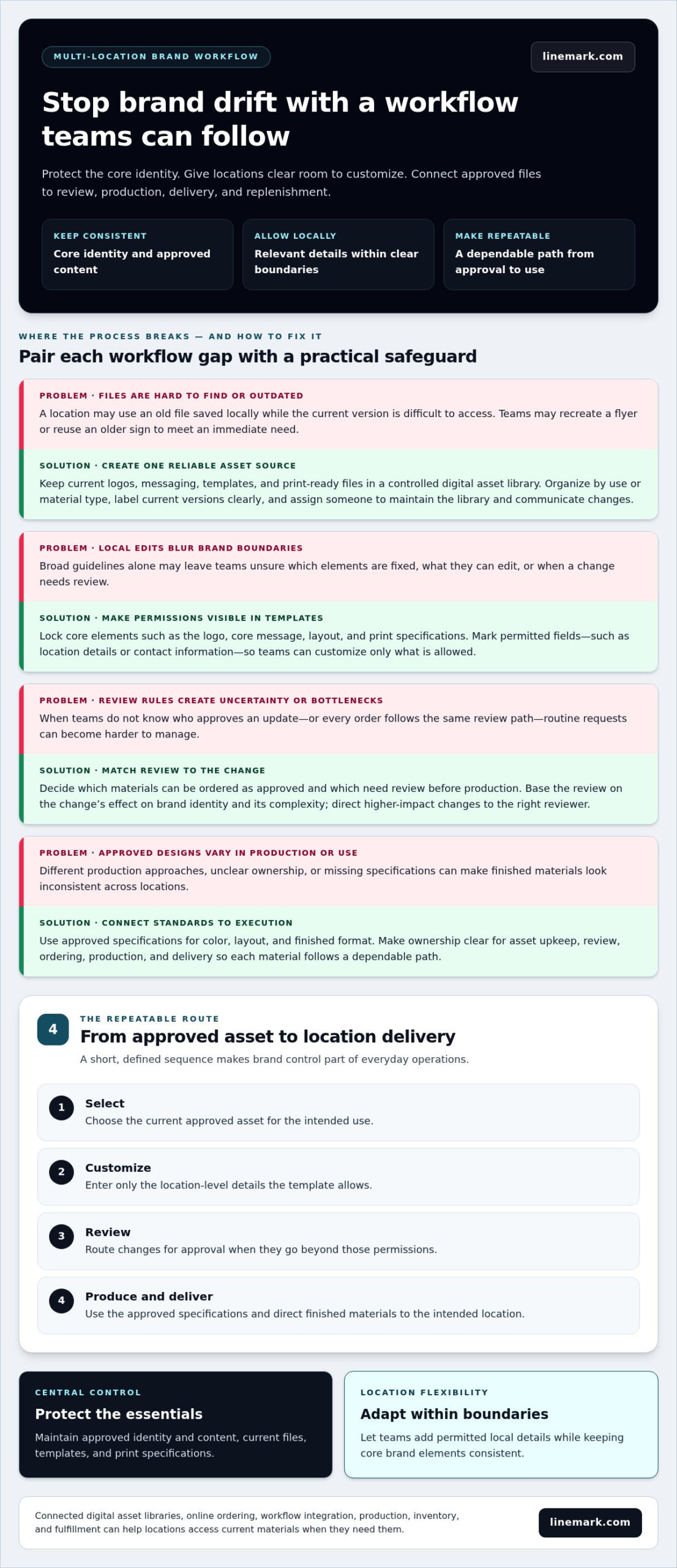
Guidelines only help if location teams can put them to work. Translate broad rules into approved templates, production specifications, and clear permissions: which elements are fixed, which fields can be edited, and when a request needs review. For example, a centrally approved flyer might let a location update contact details while keeping the logo, core message, layout, and print specifications unchanged.
Then map the request from start to finish. A location selects an approved asset, enters permitted details, submits any required review, and places an order for production and delivery. Make ownership clear at each step so teams know where to direct questions and who communicates updates. A defined route makes maintaining brand control across locations part of everyday operations, rather than a separate task staff have to remember.
Create one reliable source for approved brand assets
Keep current logos, messaging, templates, and print-ready files in a controlled digital asset library. Organize assets by use or material type, label current versions clearly, and assign someone to maintain the library and tell location teams when files change. MarCom On-Demand brings together digital asset libraries, online ordering platforms, and workflow integration to support a more connected process. For more detail, explore the MarCom On-Demand distributed marketing guide.
Set approval rules without creating unnecessary bottlenecks
Not every order needs the same level of review. Decide which materials can be ordered as approved and which need review before production, based on how much they affect brand identity and how complex the changes are. Lock core elements such as logos and key messaging; identify editable fields such as location details or contact information. Clear rules let routine requests move smoothly while directing higher-impact changes to the right reviewer.
A practical workflow can be written as a short sequence:
- Select: Choose the current approved asset for the intended use.
- Customize: Enter only the location-level details the template allows.
- Review: Route changes for approval when they go beyond those permissions.
- Produce and deliver: Use the approved specifications and direct the finished materials to the intended location.
Assign clear roles for asset upkeep, review, and ordering to close gaps between a standard and its execution. MarCom On-Demand supports distributed marketing by connecting approved assets with location-level ordering and workflow integration.
Centralized Control vs. Location Flexibility: Choose the Right Balance
Central control and local relevance aren’t opposites. The practical question is how much freedom each material needs, based on its visibility, complexity, and potential to affect the brand. Centrally produced pieces offer tight control; approved customization gives locations room to adapt; fully location-created materials offer the most flexibility but carry the greatest risk of inconsistent identity, content, or production.
| Approach | Suitable use | Operational trade-off |
|---|---|---|
| Centrally produced | Core campaign materials, key brand messaging, and highly visible signage | Strong control over design and specifications, with less room for local changes |
| Controlled customization | Materials that need local contact details, location information, or relevant calls to action | Balances local relevance with approved layouts and fixed brand elements |
| Location-created | Low-risk, immediate local communications where teams have clear standards | Fast and flexible, but requires more oversight to prevent inconsistent design or claims |
For many materials, controlled customization is the useful middle ground. Governance doesn’t have to slow teams down: when approved templates, editable fields, and ordering rules are straightforward, locations can handle routine needs without sending every request through central review. Reserve additional review for changes that affect core identity, prominent messaging, or production requirements.
Which brand elements should remain consistent everywhere?
Keep logos, color treatment, typography, and approved claims consistent. Set clear specifications for print quality, format, and required brand marks so the approved design carries through production. Direct mail benefits from coordinated standards for layout and messaging, while large-format graphics need defined dimensions and brand treatments to present a unified identity across physical spaces.
Where can locations customize materials safely?
Allow local teams to update designated fields such as contact details, location information, and calls to action that reflect a local need. Keep those edits within an approved template rather than opening the entire design to change. Variable data printing can support personalized content within centrally approved parameters, helping tailor direct mail while preserving shared design and messaging standards.
For more on coordinating personalized mail with a broader campaign, read Linemark’s direct mail marketing strategy guide. Across formats, centralize what protects recognition and production consistency, then define local flexibility where it improves relevance.
Implement a Repeatable Brand-Control Process Across Locations
A reliable process turns brand standards into everyday steps for selecting, approving, producing, and replenishing materials. Treat it as an operating cycle, not a one-time cleanup. That makes maintaining brand control across locations easier to monitor and adjust as assets, campaigns, and location needs change.
Audit current materials and prioritize brand risks
Start with an inventory of recurring brochures, direct mail, signage, and location-specific materials. For each item, record who owns it, where the source file lives, how teams order it, where stock is stored, and how often it’s updated. Prioritize materials with outdated identity elements, frequent reprints, unclear approval ownership, or storage conditions that could affect their usability.
Pilot, measure, and refine the operating process
Test the process with a small, representative group of locations and a mix of material types, such as a recurring print piece and a large-format graphic. Include central marketing, location users, and operations teams in the review. Their feedback can reveal whether instructions are clear, approvals are practical, and orders reach the right locations as expected.
Use this rollout sequence:
- Audit materials: Map current files, owners, ordering paths, and stock.
- Define standards: Set approved versions, specifications, permissions, and review responsibilities.
- Configure workflows: Establish how teams select, customize, approve, order, and receive each material type.
- Pilot the process: Test it across representative locations and materials before expanding.
- Review and refine: Correct friction points, update instructions, and repeat the review as materials change.
Before an order moves to production, use a compact review checklist:
- Is the asset current, accurate, and approved for its intended use?
- Do the print specifications and required brand elements match the standard?
- Have any required approvals been completed?
- Is the inventory status clear, including whether existing stock needs to be used or replaced?
- Are quantities and delivery destinations aligned with location needs?
Track operational indicators that show where the system needs attention: reprints, outdated stock, approval delays, and exception requests. A rise in exceptions for one material may point to a template that doesn’t meet local needs; repeated reprints may signal a file or specification issue. Use pilot feedback and these indicators to improve the process before rolling it out more broadly.
Details about Linemark’s print production, inventory, and fulfillment capabilities are available at Linemark’s website.
Scale Brand Control With Connected Print, Inventory, and Fulfillment
Approved files create consistency at the point of design. To sustain it across a network of locations, connect those files to production specifications, inventory planning, and distribution. When teams order from current assets and materials follow shared production standards, each location is better positioned to use the right version without managing a separate process for every format.
This approach turns brand control into an operational system. Commercial printing can support recurring collateral, while large-format graphics cover signage and other prominent physical displays. Inventory management helps coordinate stocked materials and replenishment needs; kitting and fulfillment connect production with delivery to intended destinations. Each capability supports a different step, but shared standards help keep the complete flow aligned.
Coordinate recurring print materials and inventory
Brochures, catalogs, and other recurring collateral benefit from approved files and consistent specifications. With those elements defined, reorders can follow the established production approach rather than rely on a location’s saved copy or recreated file. Inventory management adds visibility into what materials are stocked and where replenishment may be needed, helping teams plan around existing inventory and reduce the risk of outdated pieces remaining in circulation.
Centralized production processes also support more consistent output across locations. That matters when the same piece is ordered at different times or in quantities suited to local needs. The asset, specifications, and ordering path work together to provide a repeatable foundation for print and large-format materials.
Connect brand standards to production and distribution
Direct mail, signage, and printed collateral don’t need to operate as separate programs. A shared process can link approved materials and specifications to production, then coordinate kitting and fulfillment for distribution to multiple locations. For example, campaign collateral and location-specific mail can use centrally approved files, while delivery is organized around the intended recipients or destinations.
Linemark brings commercial printing, large-format graphics, inventory management, kitting, and fulfillment capabilities together as a production and communications partner. A connected system helps locations receive current materials while keeping execution aligned with central standards. Learn more about Linemark’s print and fulfillment capabilities.
Build a Brand System That Can Grow With You
Strong brand control doesn’t mean every location has to communicate in exactly the same way. It means protecting core identity while giving local teams clear, practical ways to meet local needs. Maintaining brand control across locations starts with accessible approved assets, defined customization rules, and workflows that connect approval to production and delivery.
A repeatable process also needs regular review. Audit materials, test the workflow with representative locations, and use reprints, outdated inventory, approval delays, and exception requests to identify where the system needs refinement. Connecting print production with inventory management, kitting, and fulfillment helps make consistent execution part of the operation, not an extra burden for location teams.
Linemark brings more than 30 years of experience, a 90,000-square-foot production facility, and integrated printing, inventory management, kitting, and fulfillment capabilities to distributed communications programs. Discuss a coordinated print and fulfillment program with Linemark and take a practical next step toward a system that keeps every location aligned and responsive.
Frequently Asked Questions
How do you maintain brand consistency across multiple locations?
Maintain consistency by giving every location easy access to current, approved assets and clear rules for using them. Set standards for core identity elements, print specifications, and messaging, then define which details local teams can adapt. A shared ordering and approval process helps those standards carry through production and delivery. Review materials regularly and track issues such as outdated stock, reprints, and recurring requests for exceptions.
What is the difference between brand consistency and brand control?
Brand consistency is the result: customers encounter a recognizable identity across locations and channels. Brand control is the governance that supports that result, including approved assets, usage rules, ownership, and review processes. Control doesn’t have to mean that every location uses identical materials. A sound system protects core brand elements while allowing defined local adaptations, such as location details or a relevant call to action.
How can local teams customize marketing materials without going off brand?
Give local teams approved templates with clearly identified fields they can edit, such as contact information, location details, and designated calls to action. Keep logos, core messaging, typography, and other essential elements fixed. Specify which changes can be made without review and which need approval before production. This gives locations room to address local needs while keeping customization within a consistent, manageable framework.
What should a multi-location brand guidelines document include?
Include rules for logos, colors, typography, photography, tone, approved messaging, and claims, plus examples of correct and incorrect use. For print and signage, document production specifications and required brand marks. Explain which elements locations can customize, who approves exceptions, and where teams can access current templates and files. Assign an owner to update the guidelines and communicate changes so old versions don’t remain in circulation.
How can a company keep printed materials consistent across locations?
Use centrally approved files and shared production specifications for recurring materials such as brochures, catalogs, direct mail, and signage. Give locations a clear ordering path so teams don’t have to recreate assets or rely on saved copies. Connect production with inventory management and fulfillment to coordinate stocked materials, replenishment, and distribution. Review finished pieces and monitor reprints or outdated stock to find gaps in the process.
Can variable data printing personalize materials while protecting brand standards?
Yes. Variable data printing can change selected content, such as recipient or location information, while keeping the overall design and approved brand elements consistent. Define in advance which fields can vary and what content is permitted. For example, a direct mail piece can use centrally approved layouts and messaging while incorporating location-specific details. The process should include checks to confirm personalized information is accurate and within the established parameters.
How often should a company review brand materials across locations?
Set a regular review schedule, then review materials whenever a brand update, campaign change, or production specification change makes current files potentially outdated. Also use operational signals to decide when a closer check is needed. Reprints, excess outdated stock, approval delays, and repeated exception requests can reveal problems between reviews. Assign an owner to record updates and ensure locations have a clear route to current assets.
How do you balance central brand control with location needs?
Centralize the elements that protect recognition and reliable production, such as logos, approved claims, core messaging, and print specifications. Let locations adapt defined details that support local relevance, including contact information and suitable calls to action. Match the level of review to the material’s visibility and the scale of the changes. Easy-to-use templates and clear ordering rules help preserve local speed without leaving brand standards open to interpretation.