

 06/27/2026
  Steve Bearden
The most expensive component of your next high-volume campaign isn’t the ink or the paper; it’s the inefficiency hidden within your design and distribution chain. With the price of a First-Class Mail Forever stamp set to reach 82 cents on July 12, 2026, and paper costs facing steady increases, traditional bidding wars are no longer enough to protect your margins. You likely feel the sting of rising postage fees and the frustration of over-ordering materials that eventually become obsolete. Learning how to reduce commercial printing costs in this climate requires moving beyond simple price-per-piece metrics toward a model of total operational optimization.
We understand that maintaining brand prestige while managing a scalable budget is a delicate balance. This guide provides a roadmap to slash expenses through design-phase adjustments, technological integration, and smarter logistics without sacrificing the quality your audience expects. We’ll examine how standardizing formats and utilizing variable data printing can eliminate waste and drive a higher ROI on every piece of marketing collateral you produce. By the end, you’ll have the tools to transform your print workflow into a streamlined, high-performance engine.
Key Takeaways
- Identify the “Big Three” cost drivers: material, machine time, and labor. This helps you pinpoint where your production budget is actually being spent.
- Implement “Design for Manufacturing” principles early in the creative process to minimize paper waste through standard trim sizes and efficient layouts.
- Discover how to reduce commercial printing costs by leveraging postage optimization and centralized fulfillment to eliminate unnecessary logistical expenses.
- Deploy MarCom On-Demand portals to centralize brand assets, preventing the high overhead of rogue printing and repetitive design setup fees.
- Align your production volume with the correct technology, choosing between digital and offset printing to ensure the lowest per-unit cost for every run.
The True Drivers of Commercial Printing Costs in 2026
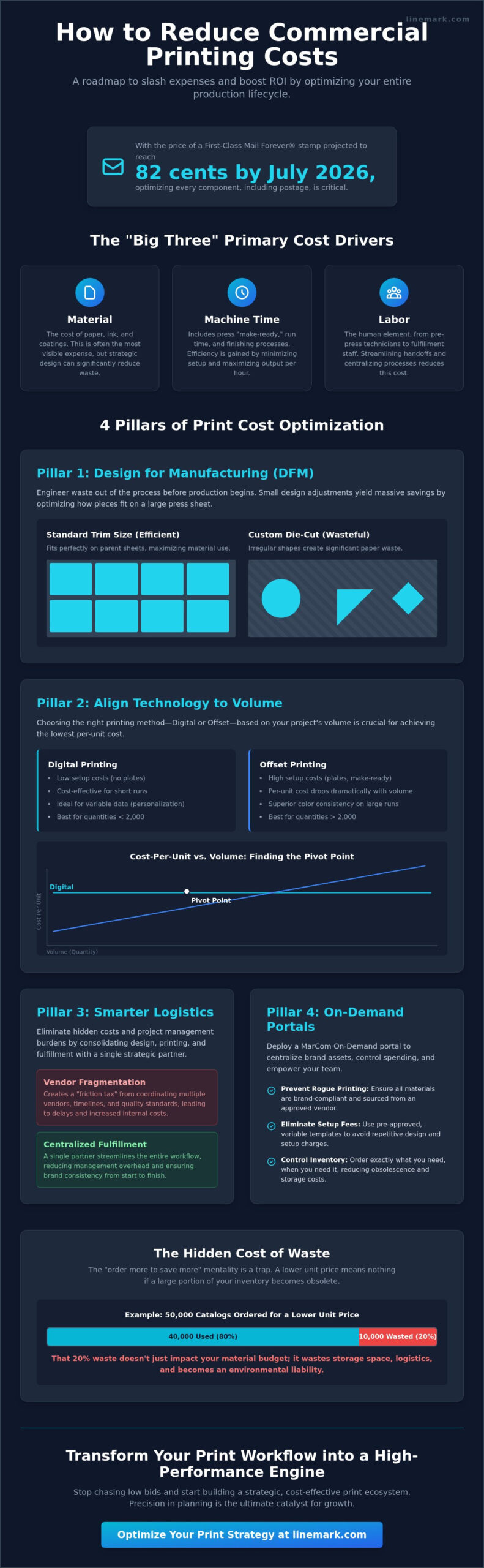
Understanding how to reduce commercial printing costs requires looking beyond the desktop printer in your office. While office overhead focuses on toner and paper reams, industrial-scale production involves complex variables like ink viscosity, plate-making, and logistical handoffs. High-volume printing is a technical operation where the primary drivers are material, machine time, and labor. These “Big Three” account for the bulk of your invoice, yet many organizations focus only on the price-per-piece without considering the total cost of ownership. True efficiency is found in the optimization of the entire production lifecycle.
A low bid might seem attractive on paper, but it often masks hidden expenses that erode your ROI. Vendor fragmentation, where design, printing, and fulfillment are handled by different entities, creates a project management burden that drains your internal resources. Every handoff is a potential point of failure. By consolidating these steps with a strategic partner, you reduce the friction tax of coordinating multiple timelines and disparate quality standards. We believe that precision in the planning phase is the most effective way to protect your margins.
To better understand the mechanics of production expenses, watch this helpful video:
Fixed vs. Variable Costs in High-Volume Print
To optimize your budget, you must distinguish between fixed and variable costs. Offset printing relies on significant upfront investment in plate-making and make-ready time. These are fixed costs; once the press starts, the per-unit price drops as volume increases. Conversely, digital printing methods typically utilize click charges, which are variable. This means digital is often more cost-effective for short runs or variable data projects where plate changes would be prohibitively expensive. There’s always a point of diminishing returns in volume pricing where the risk of over-ordering outweighs the marginal savings of a larger run. Finding that pivot point is essential for maintaining a predictable, scalable print budget.
The Cost of Obsolescence and Waste
The “order more to save more” mentality is a common trap in commercial production. If you print 50,000 catalogs to get a lower unit price but only mail 40,000 before the product specs change, you haven’t saved money. You’ve paid for 10,000 pieces of expensive trash. A 10% waste factor doesn’t just impact your material budget; it wastes storage space and increases your environmental liability under evolving state regulations. Strategic planning involves calculating the true cost of stored inventory. In many cases, a slightly higher per-unit price for a smaller, more accurate run results in a much lower total project cost. Precision is the ultimate catalyst for growth in your marketing budget, ensuring every dollar spent reaches a customer’s hands rather than a recycling bin.
Optimizing Project Design for Production Efficiency
Design is often viewed through the lens of aesthetics, but in high-volume production, it’s a financial blueprint. Implementing “Design for Manufacturing” (DFM) principles is one of the most effective ways to address how to reduce commercial printing costs before a single drop of ink hits the paper. When a project is designed with the technical limitations and strengths of the press in mind, waste is engineered out of the process. This proactive approach ensures that your brand prestige remains high while your production expenses stay lean.
The choice between a standard trim size and a custom die-cut has a massive impact on your bottom line. Custom shapes require physical dies and additional machine passes, which adds both time and labor. Conversely, standard sizes are optimized for the “parent sheets” that run through industrial presses. Even a minor adjustment to margins or bleed requirements can drastically improve sheet utilization. If your design allows for more units to fit on a single sheet, your per-piece cost drops instantly. We often find that a strategic partner can help you refine these dimensions during the mockup stage to maximize every square inch of material.
Thoughtful use of white space does more than create a modern, clean aesthetic; it reduces total ink coverage. While modern presses are highly efficient, heavy ink loads require more drying time and can occasionally lead to set-off issues, where ink transfers between sheets. By optimizing your design to use ink only where it adds the most value, you ensure a faster, cleaner production run. This level of precision is exactly what we provide through our integrated MarCom On-Demand solutions, which help you maintain brand consistency while managing costs.
Standard Sizes and Sheet Optimization
In the United States, the 8.5×11 format remains the “golden ratio” for commercial press sheets. It’s the standard for a reason: it minimizes off-cut waste. Sometimes, reducing a brochure’s width by just 1/4 inch allows an extra row of units on the sheet, potentially doubling your production efficiency. Another powerful tool is “ganging,” where we combine multiple small projects with similar paper and ink requirements onto a single large sheet. This shared setup cost provides high-quality results at a fraction of the traditional price.
Ink and Specialty Finish Strategies
Controlling ink coverage is another lever for cost management. While 4-color process (CMYK) is standard, adding specific Spot (PMS) colors can increase setup time and wash-up fees on an offset press. For those seeking premium textures, aqueous coatings offer a cost-effective alternative to expensive UV or soft-touch laminates. Modern technology now allows for digital spot varnishes that mimic the look of traditional embossing or foil stamping without the high cost of custom plates. These innovative solutions allow you to maintain a luxury feel while staying within a predictable, scalable budget.
Strategic Material Selection and Volume Planning
Material selection is the bridge between a digital concept and a physical reality. In a market where coated freesheet prices increased by approximately $20 per ton in May 2026, staying informed on substrate availability is essential for your bottom line. One of the primary answers to how to reduce commercial printing costs lies in consolidating your annual orders. By grouping projects that share the same paper specifications, you gain access to bulk purchasing power that isn’t available for one-off runs. This approach transforms your print procurement from a transactional task into a strategic advantage.
Beyond volume, the technology used to apply ink to that paper determines your ultimate cost efficiency. We focus on matching your specific run length to the most economical press to ensure precision at every scale. Integrating variable data printing into your strategy ensures that every piece is tailored to its recipient. This level of personalization reduces the need for massive, generic print runs that often result in waste, allowing for a more agile and targeted marketing approach that maximizes ROI.
Choosing the Right Paper Stock
Choosing the right stock is a technical decision with significant financial implications. House stocks are our high-quality, pre-tested materials that offer the best value because they’re purchased in industrial quantities. Shifting from a 100lb stock to an 80lb stock can reduce your material costs and, more importantly, lower your postage expenses. With postage rates rising, even a fractional decrease in paper weight can result in thousands of dollars in annual savings. Sustainable options in 2026 have also reached a point of cost-parity, allowing you to meet environmental goals without inflating your budget.
Digital vs. Offset Pricing Framework
The decision between digital and offset production hinges on the “break-even” point where setup fees are offset by volume. Digital printing is the preferred method for localized or personalized campaigns where speed and customization are paramount. For high-volume custom book printing or large-scale catalog runs, offset remains the most cost-effective choice. We often employ hybrid models, using offset for the static components and digital for the variable sections, to provide the best of both worlds in a single, streamlined journey. This flexibility ensures your project is produced using the most efficient technology available.
Reducing Hidden Costs through Logistics and Fulfillment
The total investment in a marketing campaign doesn’t end when the press stops. In many high-volume projects, the expense of moving the product from the facility to the end user exceeds the cost of the printing itself. Realizing how to reduce commercial printing costs requires a holistic view of the supply chain, specifically focusing on postage and logistical handoffs. When production and distribution are treated as separate silos, you invite inefficiency. By integrating these stages into a unified journey, you eliminate the “shipping touches” that inflate budgets and delay speed-to-market.
Data hygiene is your first line of defense against logistical waste. Producing 50,000 high-quality pieces is a wasted effort if 5% of your mailing list contains undeliverable addresses. We utilize advanced list cleansing and NCOA (National Change of Address) updates to ensure every printed unit has a valid destination. This precision prevents the double loss of production expenses and wasted postage. Implementing just-in-time (JIT) production further refines this process by aligning printing schedules with actual distribution needs, significantly lowering the warehousing fees associated with long-term inventory storage.
To further optimize your distribution workflow, you can learn more about OEM Materials & Supplies for professional packaging resources that help protect your high-volume shipments during transit.
Postage Optimization Strategies
Postage is the single largest lever in direct mail cost reduction. With the price of a First-Class Mail Forever stamp increasing to 82 cents on July 12, 2026, and a temporary 8% price increase on domestic shipping services effective through early 2027, strategic mailing is mandatory. We leverage commingling and drop-shipping to bypass unnecessary postal zones, moving your mail closer to its final destination before it enters the USPS system. Designing your pieces specifically for automation rates, by adhering to strict shape and weight requirements, can shift a project from a “flat” designation to a “letter” rate, potentially reducing your postage budget by 40%.
Integrated Kitting and Fulfillment
Centralizing your kitting and fulfillment within a single 90,000-square-foot facility offers a level of control that fragmented vendors cannot match. This proximity reduces the risk of damage during transit between separate print and mail houses. Professional inventory management ensures that your materials are tracked with boutique-level attention to detail, even at an industrial scale. For decentralized organizations, automating the distribution of brochures or newsletters through a central hub removes the burden of administrative labor from your local teams. To see how these efficiencies can protect your margins, explore our comprehensive direct mail and fulfillment services today.
Leveraging MarCom On-Demand for Long-Term Scalability
Achieving sustainable efficiency in 2026 requires a shift from manual procurement to a centralized technological ecosystem. One of the most sophisticated strategies for how to reduce commercial printing costs is the implementation of marcom on-demand portals. These platforms act as a single source of truth for your brand assets, ensuring that every brochure, catalog, or newsletter meets corporate standards before it ever reaches a press. By centralizing these files, you eliminate the repetitive design and setup fees that typically occur when local teams or different departments initiate projects in isolation.
These portals effectively eliminate “rogue printing,” which often results in brand dilution and high per-unit costs from small, uncoordinated runs. Instead of local branches sourcing their own low-volume materials, they access a pre-approved library of templates. This empowers your regional teams to customize content for their specific markets while you maintain strict corporate budget controls. Real-time inventory tracking within the portal triggers production only when stock levels reach a specific threshold, preventing the over-ordering and obsolescence issues we identified in earlier sections. This level of control transforms your print spend from a variable headache into a predictable, scalable asset.
Eliminating Administrative Overhead
The traditional “quote-order-approve” cycle is a significant drain on internal productivity. Web-to-print portals simplify this journey by automating the procurement and billing processes, allowing your marketing team to focus on strategy rather than paperwork. We’ve seen this approach yield transformative results; in one specific case study, a partner reduced their marketing operations labor by 30% after implementing a custom portal. By removing the friction from the ordering process, you don’t just save on the physical print; you reclaim hundreds of hours of high-value administrative time across your entire organization.
Future-Proofing with Data-Driven Printing
A sophisticated portal does more than facilitate orders; it captures the data necessary to forecast future print needs. By analyzing usage patterns, you can make smarter bulk material buys and schedule production during off-peak windows to further drive down expenses. Integrating this portal data with your CRM allows for highly targeted, low-waste campaigns that speak directly to your customers’ needs. Ultimately, the most effective way to manage how to reduce commercial printing costs is to move beyond transactional vendor relationships. A strategic partnership grounded in technological innovation is the ultimate tool for navigating the complexities of the 2026 landscape, ensuring your communications remain both high-impact and fiscally responsible.
Mastering Your Production Lifecycle for 2026
Success in high-volume production requires a shift from transactional purchasing to a unified, strategic partnership. We’ve explored how design-phase optimization and precise material selection can eliminate the waste that often erodes marketing budgets. By integrating logistics and leveraging advanced MarCom On-Demand technology, you don’t just save on unit costs; you gain a predictable, scalable framework for all your communication needs. Understanding how to reduce commercial printing costs is ultimately about looking at the total cost of ownership across every stage of the journey.
With over 30 years of industrial print expertise and a 90,000-square-foot high-capacity production facility, we’re prepared to handle your most complex projects with precision and care. Our team focuses on transforming business challenges into streamlined, high-tech solutions that drive growth and protect your brand prestige. Let’s work together to refine your distribution chain and maximize your ROI. Request a Strategic Print Consultation and Quote to begin your journey toward operational excellence. Your vision is in capable, steady hands.
Frequently Asked Questions
How much can I save by switching from offset to digital printing?
Savings depend entirely on the total volume and complexity of your project. Digital printing eliminates the fixed costs associated with plate-making and press setup, making it the most economical choice for short-run or variable data campaigns. For high-volume projects, however, offset printing remains the standard for achieving the lowest per-unit price. We analyze your specific run length to determine the exact pivot point where switching technologies protects your margins and optimizes your budget.
Does paper weight really affect my commercial printing costs?
Paper weight is a primary driver of total project expenditure. Heavier stocks generally carry a higher material price, but the more significant impact often appears in your distribution budget. A slight reduction from 100lb to 80lb stock can lower postage fees significantly, especially for national direct mail campaigns. Choosing the right substrate is a technical decision that balances brand prestige with operational efficiency and weight-based shipping rates to ensure a predictable budget.
What is the most expensive mistake in commercial print design?
The most costly error is designing collateral in non-standard sizes that don’t align with industrial press sheets. Custom dimensions often result in significant off-cut waste and require specialized finishing labor, which inflates the total budget. Implementing “Design for Manufacturing” principles early in the creative process ensures your project maximizes sheet utilization. This simple adjustment is a fundamental strategy for how to reduce commercial printing costs without sacrificing the aesthetic quality your brand requires.
How can I reduce postage costs for my direct mail campaigns?
You can lower postage expenses by leveraging commingling and drop-shipping services to move mail closer to its final destination before it enters the USPS system. Additionally, designing your pieces to meet automation standards for shape and weight ensures you qualify for the lowest possible rates. With First-Class Mail Forever stamps set to reach 82 cents on July 12, 2026, these logistical optimizations are essential for maintaining a high ROI on every high-volume mailing you produce.
Is it cheaper to print in-house or outsource to a commercial printer?
Outsourcing is typically more cost-effective for high-volume production due to the industrial-scale efficiencies of a 90,000-square-foot facility. Commercial printers possess specialized technology, such as high-speed offset presses and automated binding equipment, that office-grade machines cannot match. This scale allows for lower per-unit material costs and professional quality control. By partnering with an expert, you also eliminate the hidden expenses of internal labor, equipment maintenance, and the waste associated with smaller operations. However, if your strategy requires high-quality in-house label production, OptiMediaLabs Canada offers professional color label printers and finishing equipment to support those specific internal needs.
What are the benefits of a web-to-print portal for cost control?
A web-to-print portal, such as a MarCom On-Demand platform, centralizes your assets to prevent rogue printing and repetitive setup fees. These portals streamline the procurement process by allowing local teams to order pre-approved templates while corporate maintains strict budget oversight. This automation reduces administrative labor and prevents the over-ordering of materials that eventually become obsolete. It’s a tech-savvy solution that ensures brand consistency while providing real-time visibility into your total 2026 print spend.
How do I calculate the ROI of my commercial print projects?
ROI calculation involves comparing the total cost of ownership against the conversion rate or revenue generated by the campaign. To get an accurate figure, you must include all production, kitting, and fulfillment expenses alongside postage fees. Using variable data printing allows you to track individual responses through personalized codes, providing concrete data on campaign performance. This data-driven approach helps you refine future strategies and identify how to reduce commercial printing costs over the long term.
Can I save money by using a single vendor for printing and fulfillment?
Consolidating your printing and fulfillment with a single partner eliminates the logistics tax of moving products between separate vendors. This unified approach reduces the risk of transit damage and shortens the overall production timeline. It also simplifies your administrative burden by providing a single point of contact and a streamlined billing process. Centralizing these services ensures that your project moves seamlessly from the press to the end user with maximum efficiency and meticulous attention to detail.