


 05/20/2026
  Steve Bearden
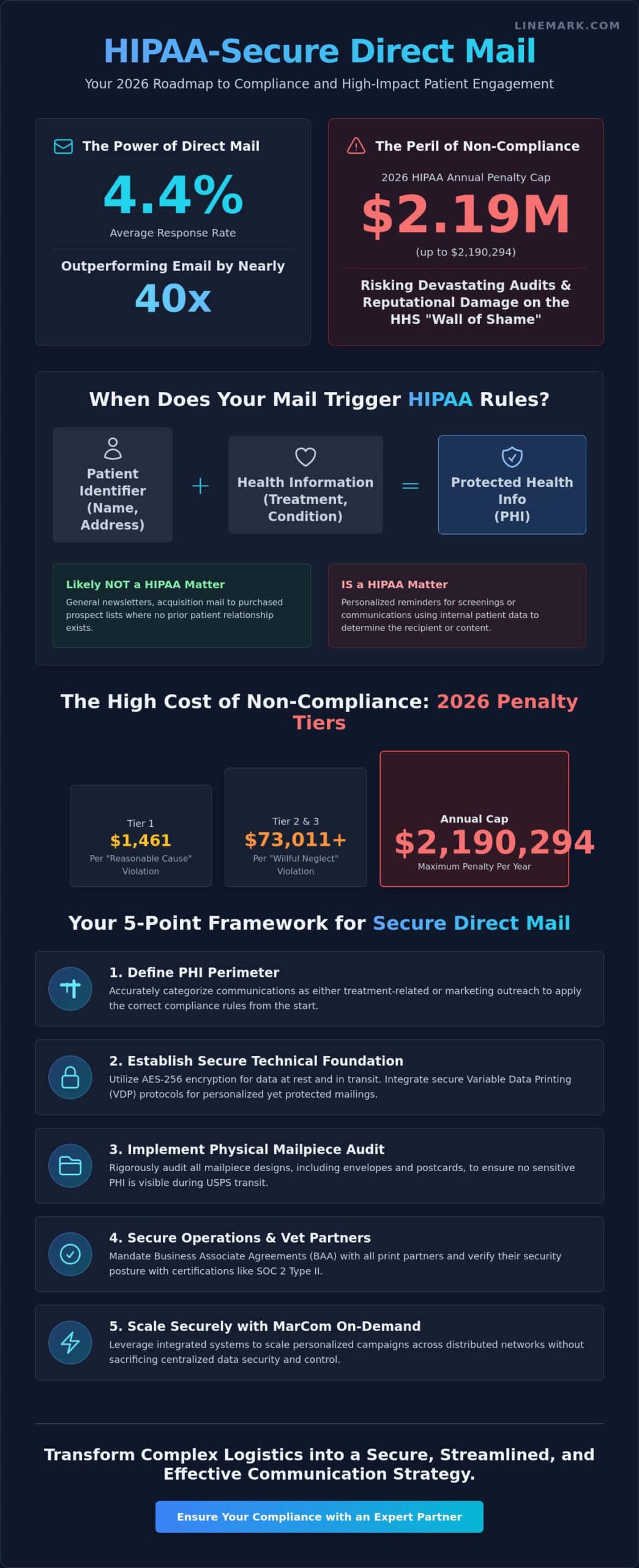
Did you know that healthcare direct mail currently commands a 4.4% response rate, outperforming email by nearly 40 times? It’s a powerful tool for patient engagement, yet the stakes are higher than ever. With the 2026 HIPAA penalty cap now reaching $2,190,294 per year for violations, the anxiety surrounding healthcare direct mail compliance is both real and justified. You shouldn’t have to choose between reaching your patients and risking a devastating audit.
We believe that compliance isn’t a marketing restriction, but a precision framework for better patient care. This guide provides the definitive roadmap to master HIPAA-secure printing while leveraging variable data printing for high-impact results. You’ll learn how to navigate the latest 2026 Security Rule changes, vet partners for essential Business Associate Agreements, and execute scalable national campaigns that maintain 100% data integrity from the server to the mailbox. We’re here to help you transform complex logistics into a streamlined, secure, and highly effective communication strategy.
Key Takeaways
- Define the perimeter of Protected Health Information to accurately categorize your communications as either treatment or marketing outreach.
- Establish a secure technical foundation for healthcare direct mail compliance using AES-256 encryption and Variable Data Printing protocols.
- Implement a rigorous physical audit of mailpiece design to ensure sensitive data never becomes visible during the USPS transit process.
- Secure your operations by identifying the necessary components of a Business Associate Agreement and verifying partner certifications like SOC 2 Type II.
- Leverage MarCom On-Demand systems to scale personalized healthcare campaigns across distributed networks without sacrificing centralized data security.
Quantifying the HIPAA Perimeter in Direct Mail Marketing
The perimeter of healthcare direct mail compliance begins the moment a patient’s identity is linked to their medical history or future care. Under the Health Insurance Portability and Accountability Act (HIPAA), Protected Health Information (PHI) isn’t restricted to social security numbers or clinical notes. It includes any combination of identifiers, such as a name or address, paired with health status, treatment dates, or even the specific department of the clinic sending the mail. If an envelope suggests the recipient is seeking treatment for a specific condition, that envelope itself carries PHI.
Understanding where these boundaries lie is vital for operational efficiency. Acquisition mail sent to purchased prospect lists generally falls under standard privacy laws because no prior patient relationship exists. However, as soon as you use internal patient records to drive Variable Data Printing for a campaign, you’ve entered the HIPAA perimeter. In this ecosystem, your healthcare organization is the Covered Entity, and your print partner acts as the Business Associate. This relationship requires a formal Business Associate Agreement (BAA) to ensure the printer maintains the same rigorous data standards as your own facility.
To better understand these regulatory boundaries, watch this helpful video:
When Does Your Mailing Become a HIPAA Matter?
A mailing triggers HIPAA requirements whenever PHI is used to determine the recipient or the content. If you’re sending a general newsletter to a broad zip code, it’s likely not a HIPAA matter. If you’re sending a personalized reminder for a specific screening based on a patient’s history, it is. The “Minimum Necessary” standard requires that you only share the specific data points required for the mailer to reach its destination. Furthermore, the updated Notice of Privacy Practices (NPP) deadline on February 16, 2026, requires organizations to be even more transparent about how patient data is utilized in these outreach efforts.
The Consequences of Non-Compliance in 2026
The HHS Office for Civil Rights has significantly increased enforcement for 2026. The updated penalty tiers reflect inflation and a more aggressive stance on data governance. As of January 28, 2026, the minimum fine for “Reasonable Cause” violations is $1,461 per instance, while “Willful Neglect” that remains uncorrected can cost at least $73,011 per violation. With an annual cap of $2,190,294, the financial risk is substantial. Beyond the money, breaches land organizations on the HHS “Wall of Shame,” a public breach portal that can cause lasting reputational damage. This makes third-party audits and secure production workflows a non-negotiable part of your strategy.
The Technical Infrastructure of Secure Direct Mail Production
Maintaining healthcare direct mail compliance in 2026 requires a shift from manual oversight to an industrial-grade technical infrastructure. It’s no longer enough to rely on legacy file transfer protocols or basic password protection. The updates to the HIPAA Security Rule finalized this year make several previously addressable safeguards mandatory for all partners. This includes end-to-end AES-256 encryption for all Protected Health Information (PHI) both at rest and in transit. A modern print partner must utilize these high-level encryption standards to protect data from the moment it leaves your server until the final piece is injected into the USPS stream.
This technical rigor is the backbone of healthcare direct mail compliance. It allows for the sophisticated application of direct mail marketing in 2026, where personalization and security coexist. By integrating secure data protocols with Variable Data Printing (VDP), organizations deliver tailored patient journeys without compromising privacy. Adhering to the HIPAA Privacy Rule for marketing ensures that every personalized element is authorized and necessary for the intended recipient.
Data Ingestion and Encryption Protocols
Secure portals have replaced encrypted email as the standard for list management. These portals provide a controlled environment where multi-factor authentication (MFA) is required for all users, a standard that became a mandatory requirement in early 2026. We implement “least privilege” access controls, ensuring that only the specific personnel required for production can interact with sensitive files. Once the campaign is complete, automated data scrubbing and file destruction protocols remove the PHI from the production environment, minimizing the window of risk.
Precision Kitting and Variable Data Integrity
The most critical compliance failures often happen on the factory floor, not in the cloud. To prevent the accidental insertion of one patient’s letter into another’s envelope, we utilize automated file-to-finish workflows. Every sheet of paper carries a unique 2D barcode. High-speed cameras at the point of insertion read these codes in real-time, matching the document to the specific envelope. If a mismatch occurs, the machine stops instantly. This “camera-match” technology ensures total data integrity for high-volume Kitting & Fulfillment projects. This level of precision eliminates the human error that leads to costly breach notifications and reputational damage.
Physical Piece Security: The HIPAA Envelope and Design Audit
The physical construction of a mailpiece is the final gatekeeper of patient privacy. Even with a secure digital handoff and encrypted data processing, a poorly designed envelope can trigger a HIPAA violation the moment it enters the postal stream. High-stakes healthcare direct mail compliance depends on a rigorous “Window Audit” and material selection that prevents sensitive data from being exposed to unauthorized eyes. Every element, from paper weight to the placement of the indicia, must be calculated to protect the Protected Health Information (PHI) contained within.
USPS sorting machines are high-speed environments where inserts naturally shift. We apply a strict 1/8-inch safety margin around all address windows to ensure this movement doesn’t reveal internal patient codes or health status. Beyond alignment, the opacity of your paper substrate is critical. We utilize high-opacity stocks for our Commercial Printing and mailing projects to eliminate “show-through.” This prevents anyone from reading sensitive text by holding the envelope up to a light source. We also advise on the strategic use of return addresses. A return address that explicitly names a “Substance Use Clinic” can inadvertently disclose a patient’s health status. Using a neutral corporate name or a simple street address maintains branding while upholding the highest privacy standards.
The HIPAA-Compliant Mail Piece Checklist
Precision in design is the only way to mitigate the risk of a physical data breach. This proactive approach to healthcare direct mail compliance reduces the risk of accidental disclosure during the delivery process. Use the following checklist for every campaign:
- External Data Scrub: Verify that no diagnosis, specific procedure, or medical condition is visible on the exterior of the piece.
- Window Alignment: Check that a 1/8-inch safety margin exists to account for insert shifting during USPS transit.
- Security Tints: Ensure the use of security tints on envelopes for benefit guides, financial statements, and clinical results to prevent transparency.
- Neutral Indicia: Use permit imprints that don’t reveal the specific nature of the healthcare service being provided.
Postcards vs. Enveloped Mail: A Risk Assessment
Postcards are highly effective for generic wellness reminders, but they are inherently high-risk for campaigns involving specific patient data. If the message identifies a medical condition or a specific treatment plan, it must be enclosed in an envelope. This protects the recipient’s privacy from postal workers and even other household members who aren’t authorized to see the information. The “Household Member” rule is a vital consideration in design; just because mail is delivered to a home doesn’t mean every person in that home has a right to see the patient’s medical business. For high-impact, personalized outreach, enveloped letters or secure Newsletters are the preferred vehicle for maintaining 100% data integrity.
Operationalizing Compliance: Workflows and Audit Trails
The gold standard for vetting these operations is the SOC 2 Type II audit. Unlike a one-time assessment, this report proves that a printer’s security controls have functioned effectively over a sustained period. When combined with dedicated HIPAA audits, it provides the industrial authority needed to handle sensitive patient data at scale. Every step of the production journey, from the initial file upload to the final USPS drop, must generate a verifiable documentation trail. This ensures that if a regulatory inspection occurs, you can account for the lifecycle of every individual piece of Protected Health Information (PHI).
Selecting a Compliant Print and Fulfillment Partner
A physical site audit is an essential step in your due diligence. During this process, verify that the facility utilizes restricted production zones where only authorized personnel can enter. Look for comprehensive CCTV coverage and badge-access entry points. It’s also vital to confirm that every employee who interacts with PHI has undergone rigorous background checks and continuous training. At our 90,000-square-foot facility, we foster a culture of compliance where every team member understands their role as a strategic ally in protecting patient privacy. Learn how our Direct Mail solutions integrate these high-security workflows into your next campaign.
Mail Tracking and Delivery Confirmation
Compliance doesn’t end when the mail leaves the facility. We utilize Intelligent Mail Barcodes (IMb) to provide real-time monitoring of your campaign as it moves through the postal network. This granular tracking allows you to confirm delivery without exposing sensitive data. Managing “Return to Sender” mail is equally critical for healthcare direct mail compliance. These pieces must be handled through secure, HIPAA-compliant destruction protocols rather than standard recycling. By maintaining a 2026-ready audit log that includes these disposal records, you ensure your organization remains protected against the updated penalty tiers and more aggressive OCR enforcement.
Scaling Secure Communications with MarCom On-Demand
Scaling personalized communications across a national network often creates a tension between brand agility and corporate oversight. Local offices need the flexibility to reach their specific patient populations, but any deviation from approved protocols can compromise healthcare direct mail compliance. This is where MarCom On-Demand becomes a transformative asset. By utilizing distributed marketing strategies, organizations provide local teams with the tools they need while maintaining a centralized “HIPAA lock” on all data and creative assets. It’s a system designed to empower growth without increasing the surface area for risk.
Centralizing these assets ensures that only pre-approved, legally vetted templates are available for use. This eliminates the risk of a local branch inadvertently including PHI on a postcard or using a non-compliant return address. For high-volume periods like open enrollment, this system dramatically reduces speed-to-market. Automated Kitting & Fulfillment workflows allow for the rapid production of complex enrollment kits. Every patient receives accurate, personalized information without the delays associated with manual corporate approvals for every single piece. This efficiency is a catalyst for client growth, turning a complex regulatory hurdle into a streamlined operational advantage.
The Role of Portals in Regulatory Control
The core of a secure MarCom system is the digital portal, which acts as a gatekeeper for data integrity. These portals allow administrators to lock down variable fields, preventing local users from entering non-compliant PHI into a layout. Role-based permissions ensure that only authorized users can upload patient lists or trigger mailings. This creates a clear separation of duties and an immutable audit trail. Leadership gains real-time visibility into national spend and compliance posture, ensuring that every piece of Digital Printing or direct mail meets the organization’s rigorous standards.
The Linemark Approach: Industrial Authority Meets Tech Innovation
We leverage over 30 years of experience in complex, high-volume healthcare kitting to serve as your strategic communications ally. Our 90,000-square-foot facility is designed to handle the nuances of healthcare direct mail compliance with the meticulous attention to detail of a boutique shop. We don’t just provide a service; we offer a unified partnership that prioritizes your data integrity. Our forward-thinking production capabilities are built to scale with your organization’s needs. If you’re ready to secure your patient outreach, we invite you to start with a comprehensive healthcare mail security audit. This proactive spirit ensures your logistics are as robust as your care models.
Securing Your Patient Communications for 2026 and Beyond
Mastering healthcare direct mail compliance is no longer just about avoiding penalties. It’s about building a foundation of trust with your patients through meticulous data stewardship. By integrating end-to-end encryption with advanced Variable Data Printing, you transform a complex regulatory burden into a high-performance marketing asset. Centralizing your outreach through a secure MarCom portal ensures that every piece of mail remains fully protected and brand-consistent. This strategic approach allows you to scale without compromising privacy.
Success in this high-stakes environment requires a partner who treats your data with industrial-grade precision. We bring 30+ years of experience in precision commercial printing to every project. Operating from our 90,000-square-foot high-security production facility, we utilize automated kitting and camera-match technology to ensure 100% data integrity. You don’t have to navigate these complexities alone. Partner with Linemark for your next HIPAA-compliant direct mail campaign. We’re ready to help you execute secure, high-impact communications that drive results while keeping your patient data safe.
Frequently Asked Questions
Is direct mail inherently HIPAA compliant?
Direct mail isn’t compliant by default; it only reaches that status through a combination of secure data ingestion, encrypted processing, and specific physical piece engineering. Every step of the production cycle must adhere to the Privacy and Security Rules to ensure the final product meets federal standards. Compliance is achieved through the rigorous application of technical and physical safeguards throughout the entire print journey.
What is a Business Associate Agreement (BAA) and why does my printer need one?
A BAA is a legally binding contract that establishes the printer’s responsibility for protecting Protected Health Information (PHI). Since your printer handles patient names, addresses, and potentially health data, they are considered a Business Associate under federal law. Without this agreement, any transfer of patient records to a third party constitutes a violation, even if a breach doesn’t occur.
Can I include a patient’s diagnosis on a postcard if it is inside an envelope?
You can include sensitive information like a diagnosis inside an enveloped mailer, but never on the exterior or through a window. The envelope acts as a critical privacy barrier. Using high-opacity paper and security tints prevents unauthorized individuals from viewing the content through the substrate, which is a foundational element of healthcare direct mail compliance.
What are the most common HIPAA violations in healthcare direct mail?
The most frequent violations include “show-through” where PHI is visible through envelope windows and “mismatch errors” where one patient’s data is mailed to another. These errors often stem from manual workflows or outdated equipment. Failing to have a signed BAA in place before sharing patient lists is another common oversight that leads to significant regulatory penalties.
How does Variable Data Printing (VDP) affect healthcare compliance?
Variable Data Printing is the engine that allows for personalized patient communications, but it also expands the compliance perimeter. Because VDP draws from data sets containing PHI, the entire print stream must be managed within a secure, encrypted environment. This technology requires automated “file-to-finish” checks to maintain 100% data integrity and prevent the accidental disclosure of patient information.
Does HIPAA apply to healthcare marketing mail sent to prospective patients?
HIPAA typically doesn’t apply to acquisition mail sent to general, non-patient prospect lists. However, if your outreach uses existing patient records to determine who receives the mail, you must follow the healthcare direct mail compliance framework. This includes obtaining patient authorization for communications that fall under the specific definition of marketing as outlined by federal guidelines.
What security certifications should I look for in a healthcare print partner?
Look for a partner that maintains SOC 2 Type II and independent HIPAA audit reports. These certifications prove the facility maintains rigorous, long-term controls over data access and physical security. You should also verify that the facility utilizes encrypted transmission methods and has a documented history of handling high-volume, complex healthcare kitting and fulfillment projects.
How long should a printer retain my patient data after a campaign?
Printers should retain patient data only for the duration of the project and a brief post-campaign audit period. Once the mailing is injected into the USPS stream, the data must be securely scrubbed from all servers and production logs. Your Business Associate Agreement should clearly specify the timeline and the industrial-grade methods used for this permanent data destruction.