

 05/17/2026
  Steve Bearden
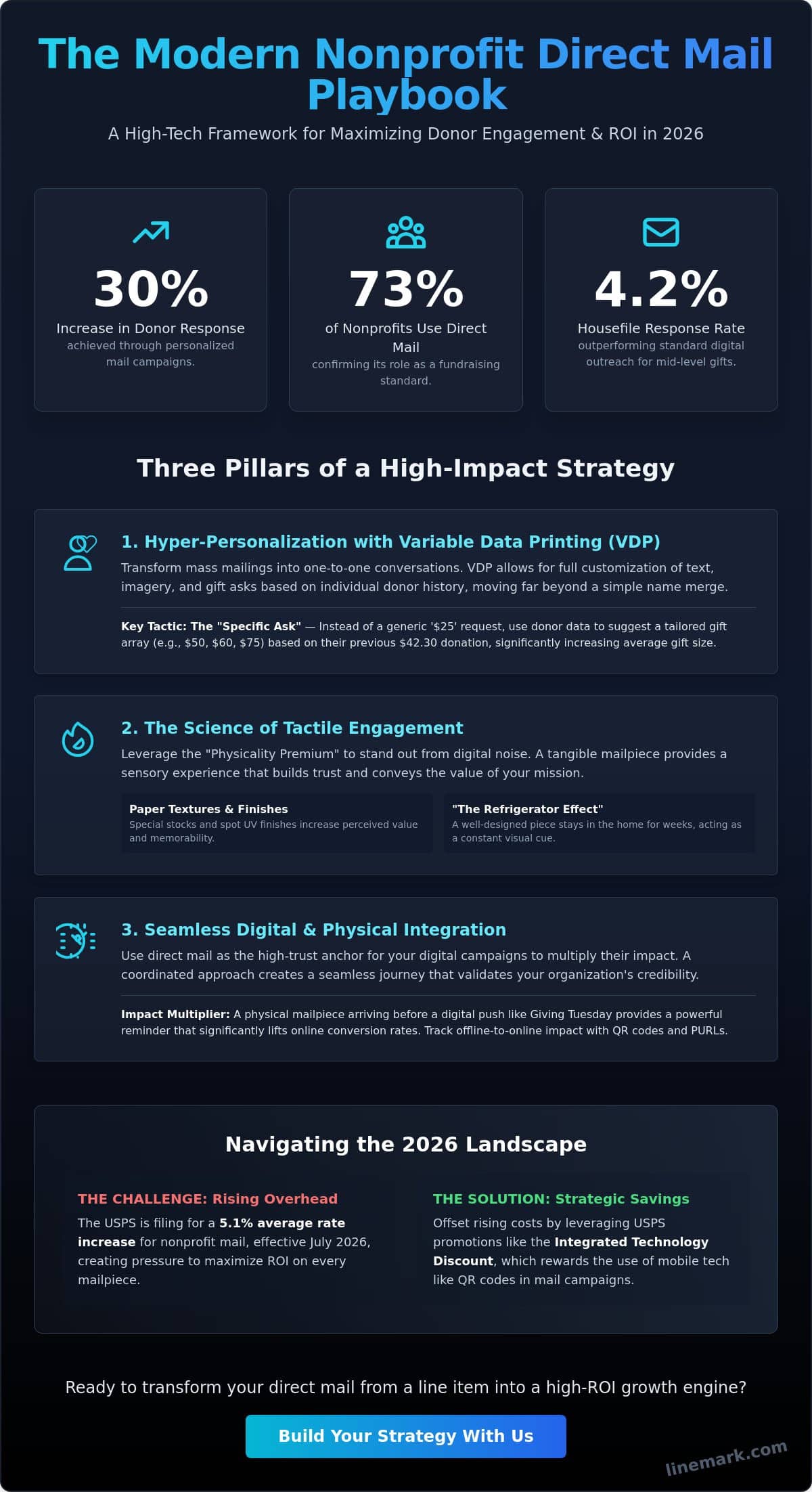
Did you know that personalized mail can increase donor response rates by up to 30%? Even with heavy digital competition, a physical touchpoint remains a powerhouse for engagement. You’re likely managing the reality of rising overhead, especially with the USPS filing for a 5.1% average increase in nonprofit marketing mail rates effective July 12, 2026. It’s a challenge to balance these costs against donor fatigue and the difficulty of tracking offline-to-online conversions. Refining your nonprofit direct mail fundraising strategy is no longer just about sending letters; it’s about industrial-scale precision and technical innovation.
We’re here to help you master the science of high-ROI mail to deepen loyalty and maximize your 2026 goals. This comprehensive guide provides a scalable framework to increase retention through variable data printing and seamless digital integration. You’ll learn how to leverage 2026 USPS promotions, like the Integrated Technology discount, to offset costs and drive higher response rates. We’ll move from identifying common logistical hurdles to presenting a streamlined, tech-forward solution for your organization.
Key Takeaways
- Learn why a modern nonprofit direct mail fundraising strategy serves as the high-tech, tactile anchor of your multi-channel donor stewardship.
- Discover how Variable Data Printing (VDP) transforms static mailers into dynamic, personalized experiences that tailor asks based on specific donor history.
- Understand the production science behind paper textures and specialized finishes like spot UV to increase the perceived value of your mission.
- Streamline complex national campaigns by integrating centralized kitting, fulfillment, and inventory management into your operational workflow.
- Transition from transactional vendor relationships to a unified partnership that leverages industrial-scale precision for boutique-level detail.
The Strategic Role of Direct Mail in a 2026 Digital-First World
In a world saturated by AI-generated emails and social media noise, a sophisticated nonprofit direct mail fundraising strategy serves as a tangible anchor for donor stewardship. It’s no longer a standalone broadcast tool. Instead, it’s a data-driven component of a multi-channel journey that prioritizes precision and trust. While digital channels are efficient for quick updates, the history of direct mail fundraising proves its enduring ability to build deep, lasting connections between a mission and its supporters. This approach ensures that every piece of mail is a purposeful extension of your brand’s authority and commitment to the cause.
By 2026, the “Physicality Premium” has become a vital asset for development teams. Tangible mail bypasses the friction of digital inbox fatigue by providing a sensory experience that pixels cannot replicate. As digital spaces become increasingly crowded with automated content, a physical piece signals that an organization values the relationship enough to invest in a premium touchpoint. With 73% of nonprofits currently using direct mail, it remains a standard for a reason: it works. This isn’t just about sending a letter; it’s about creating a high-trust foundation that establishes your organization as a reliable, human-centric entity in an automated world.
To better understand how these physical touchpoints boost engagement, watch this helpful overview:
Why Direct Mail Outperforms Digital for Donor Retention
Donor loyalty often hinges on visibility and perceived value. Direct mail benefits from the “refrigerator effect,” where a well-designed piece stays in a home for days or weeks, serving as a constant visual cue. Industry data indicates that housefile response rates for mid-level gifts reached 4.2% in recent benchmarks, significantly outperforming standard digital outreach. For planned giving and major gifts, the permanence of print conveys a level of gravity that encourages serious consideration. It’s the difference between a fleeting notification and a meaningful invitation to partner in a long-term mission.
The ROI of a Multi-Channel Approach
Integrating print with digital channels doesn’t just add a touchpoint; it multiplies impact. When donors receive a physical reminder before a digital push like Giving Tuesday, conversion rates often see a significant lift. Utilizing direct mail as the high-trust foundation of a 2026 campaign allows your organization to reinforce its message across every platform. A sophisticated nonprofit direct mail fundraising strategy creates a seamless donor journey where the physical and digital worlds work together to validate your organization’s credibility and operational excellence.
Hyper-Personalization: Leveraging Variable Data Printing (VDP)
Variable Data Printing (VDP) is the high-performance engine that drives a modern nonprofit direct mail fundraising strategy. It transforms the traditional “broadcast” mailer into a sophisticated, one-to-one dialogue. By 2026, donors expect organizations to recognize their history and individual contributions. VDP allows you to automate this recognition at scale without losing the meticulous attention to detail that defines a premium appeal. It moves your outreach beyond simple name insertion, allowing for the total customization of the donor’s visual and narrative experience.
The psychology of the “Specific Ask” is where this technology proves its industrial value. Data-driven gift strings, tailored to a donor’s past behavior, are essential for increasing average gift sizes. If a supporter’s last gift was $42.30, your next appeal shouldn’t ask for a generic $10. It should present a ladder of options like $50, $60, and $75. This level of precision requires a commitment to clean data management. Before initiating a high-volume run, your database must be validated to ensure every personalized field is accurate. When executed correctly, Variable Data Printing ensures your message is both relevant and respectful of the donor’s history.
Segmenting for Maximum Impact
Strategic segmentation ensures that your message resonates with different donor tiers. New donors require a welcome journey that validates their first gift and introduces the mission’s depth. Recurring monthly sustainers, however, need content that emphasizes long-term impact and community status. You can use past giving behavior to trigger specific content blocks, such as localized impact reports. A national campaign can feel like a local update by inserting specific statistics relevant to the donor’s geographic region. This localized approach builds immediate credibility and reinforces the donor’s personal connection to the cause.
Dynamic Content: The Future of Donor Appeals
Dynamic content allows you to swap entire paragraphs or photos based on documented donor interests. If your first-party data indicates a preference for animal welfare over education, the imagery and copy should automatically shift to reflect that passion. This relevance is why personalized mail has been shown to increase response rates by up to 30%. QR codes further enhance this journey by bridging the gap between physical print and custom digital landing pages. This integrated approach reduces operational “waste” by ensuring that every piece of mail delivered is highly relevant to the recipient, making your fundraising efforts more efficient and your ROI more predictable.
The Science of Tactile Engagement: Production as Strategy
Production is the physical manifestation of your mission. In a sophisticated nonprofit direct mail fundraising strategy, the choice of materials isn’t a secondary detail; it’s a strategic decision that dictates how a donor perceives your organization’s importance. A heavier paper stock or a unique texture can subconsciously signal stability and operational excellence. When a supporter holds a substantial, well-crafted piece of mail, the sensory experience creates a neurological connection that digital screens cannot replicate. This tactile engagement is a critical component in moving a donor from curiosity to commitment.
Specialized finishes serve as the “visual hook” in a crowded mailbox. Utilizing techniques like spot UV, foil stamping, or embossing adds a layer of sophistication that distinguishes your appeal from standard correspondence. These finishes don’t just look premium; they guide the donor’s touch and attention toward key message points. The goal is to create a piece that feels like a gift rather than a request. By investing in these industrial-grade production values, you reinforce the idea that your cause is worthy of high-level stewardship and meticulous attention to detail.
Choosing the right printing method is equally vital for balancing scale and impact. Offset printing remains the gold standard for high-volume, cost-effective runs where color consistency across thousands of pieces is paramount. However, digital printing is the essential partner for the hyper-personalization discussed in previous sections. By 2026, the most successful campaigns often utilize a hybrid approach, combining the efficiency of offset for base components with the agility of digital for personalized inserts. This operational flexibility allows you to maintain a high-capacity operation while delivering the personalized touch of a boutique shop.
Choosing the Right Format for Your Appeal
Format selection should follow the specific goals of your campaign. Postcards are highly effective for quick updates or event reminders, while traditional #10 envelope packages remain the staple for complex appeals that require multiple inserts. For high-level stewardship, such as annual impact reports, utilizing custom book printing provides a sense of permanence and prestige. These larger formats act as “anchor” pieces in a donor’s home, serving as a long-term reminder of their partnership with your mission.
Design Principles for the Physical Mailbox
The outer envelope is the gatekeeper of your entire campaign. Its primary job is to be opened first, which requires a strategic use of “teaser” copy or intriguing visuals that spark immediate interest. Once inside, the visual hierarchy must guide the donor’s eye seamlessly from the headline to the response card. Every element should feel cohesive, ensuring brand consistency whether the donor is looking at your small-scale mailers or your large-format graphics at a gala. This unified visual language builds a sense of security and professional reliability.
Logistics and Fulfillment: The Invisible Strategy
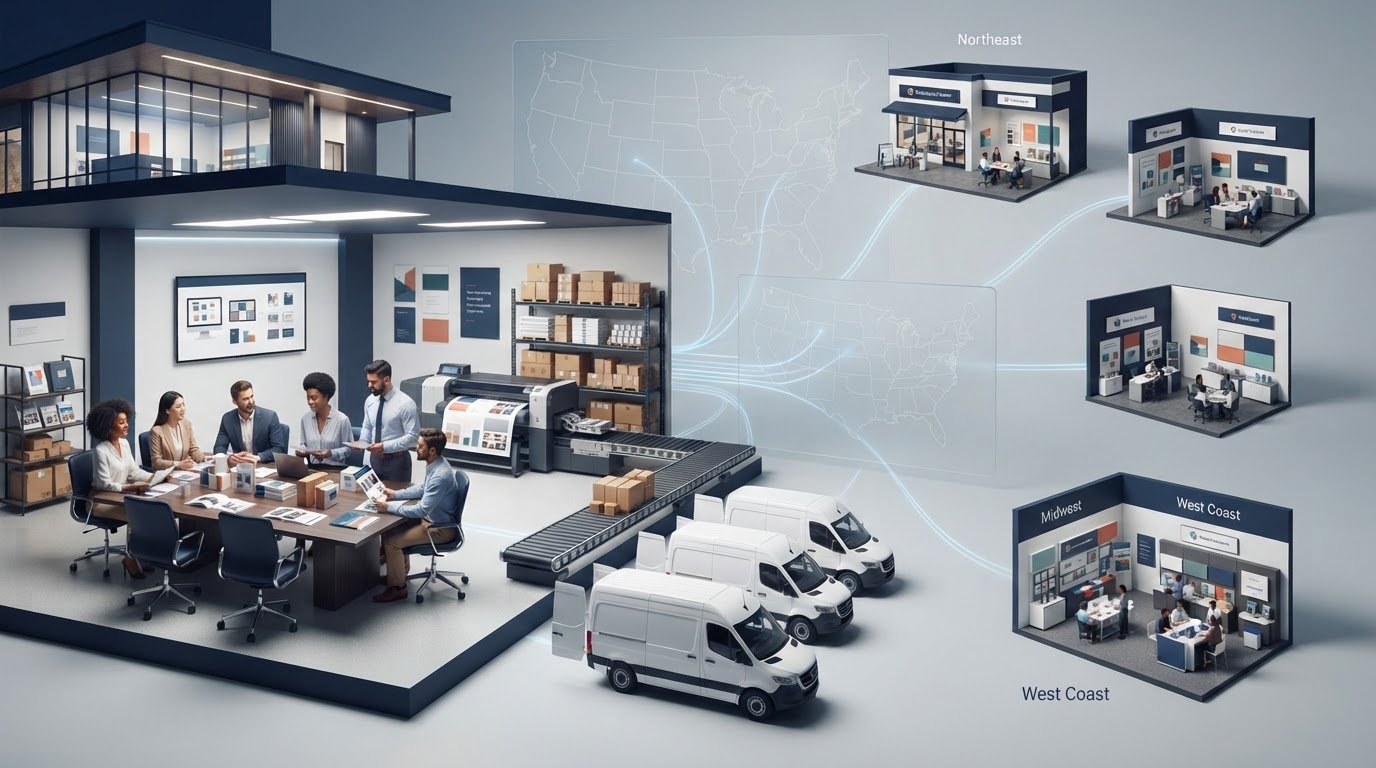
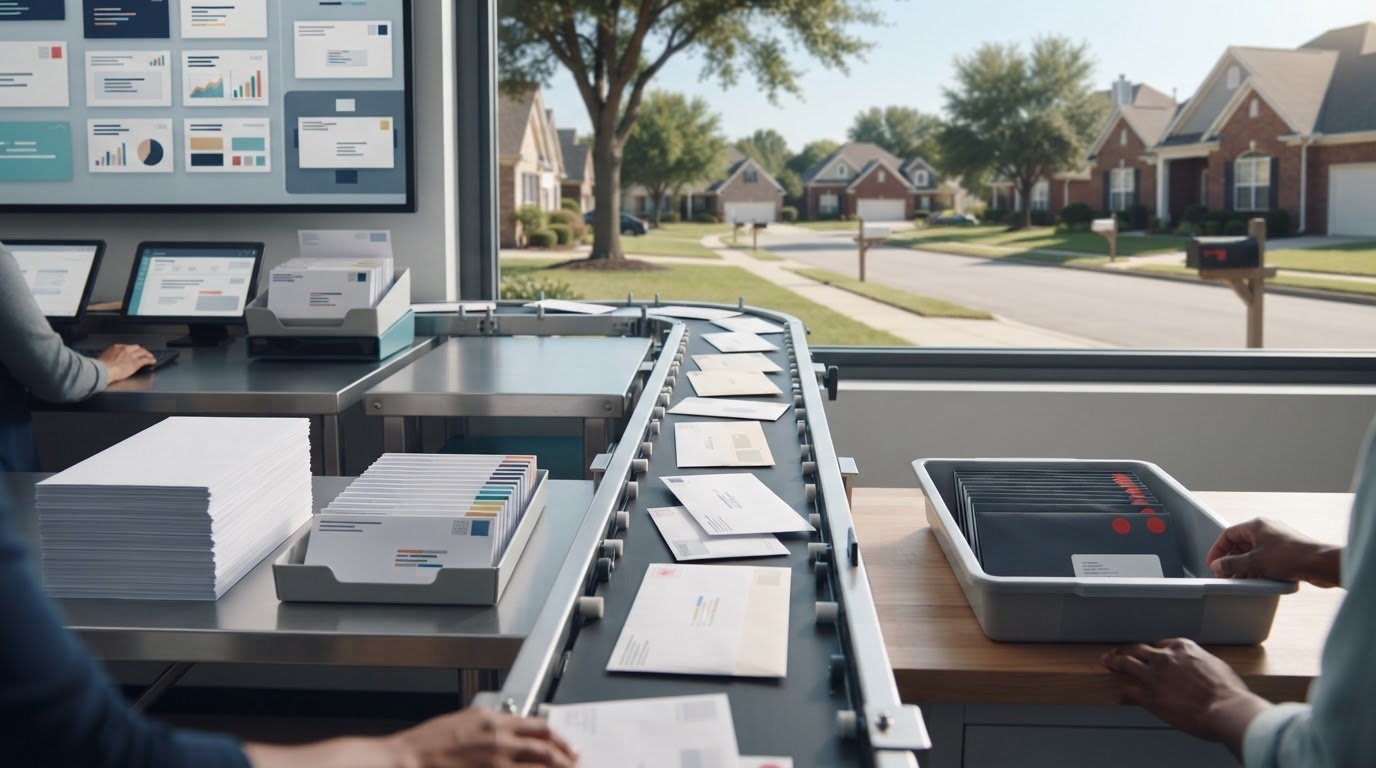
Logistics is the silent engine of a successful nonprofit direct mail fundraising strategy. While creative design captures the initial attention, fulfillment ensures the right message reaches the right mailbox at the precise moment it is needed. For national campaigns, the complexity of managing thousands of personalized inserts requires an industrial level of precision. A single error in kitting can undermine months of strategic planning and donor segmentation. Centralized warehousing and proactive inventory management provide the infrastructure necessary to handle high-volume appeals without sacrificing the meticulous detail of a boutique operation.
Postage optimization is a critical lever for protecting your ROI in 2026. With the USPS filing for rate increases effective July 12, 2026, organizations must remain agile to control overhead. While nonprofit Marketing Mail Auto Letter rates are set to increase by approximately 5.1%, sophisticated mailers can mitigate these costs by utilizing DSCF 5D rates, which are only seeing a 1.9% increase. Tracking these pieces through Intelligent Mail Barcodes (IMb) allows your team to predict delivery dates with high accuracy. This data enables you to sync digital follow-ups, such as emails or social media ads, to land exactly when the physical mailer is in the donor’s hands. To ensure your campaign reaches its destination with this level of precision, consider partnering for professional kitting and fulfillment.
The Fulfillment Checklist for Nonprofits
Operational excellence in fulfillment begins with verifying kitting accuracy. This ensures that every donor receives the correct personalized insert, ask string, and response envelope. Managing inventory for “on-demand” stewardship mailers, such as welcome kits for new sustainers, requires a system that triggers automatically based on donor data. Utilizing a 90,000-square-foot facility provides the physical scale needed to house materials for multiple recurring appeals, allowing for rapid deployment as soon as a fundraising window opens.
MarCom On-Demand: Streamlining Distributed Fundraising
A MarCom On-Demand portal allows regional chapters to order brand-compliant mailers without the need for local design expertise. This centralized digital asset management system reduces overhead by utilizing automated workflows that move projects directly from the order screen to the production floor. By adopting this model, organizations prevent “print and languish” inventory waste, ensuring that funds are directed toward the mission rather than unused paper sitting in a warehouse. This approach transforms your nonprofit direct mail fundraising strategy into a streamlined, high-tech operation that scales effortlessly across diverse regional needs.
Scaling Your Impact with a Strategic Communications Ally
Transitioning from a transactional vendor relationship to a unified partnership is the final evolution of a mature nonprofit direct mail fundraising strategy. A strategic communications ally does not merely execute a print order; they integrate into your operational workflow to identify efficiencies and growth potential. By utilizing a centralized design-to-distribution model, your organization eliminates the friction caused by fragmented service providers. This holistic approach ensures that your message remains consistent across all touchpoints, from high-volume postcards to detailed annual reports, all while maintaining the industrial-scale precision required for national campaigns.
Evaluating a production partner requires a focus on three critical pillars: capacity, technology, and data security. A high-capacity operation with a 90,000-square-foot facility and advanced Variable Data Printing capabilities can handle complex projects that boutique shops might struggle to manage. This infrastructure allows your organization to pivot quickly in response to shifting market conditions or new USPS regulations, such as the rate changes effective July 12, 2026. Choosing a partner that views itself as a catalyst for your growth allows your development team to focus on donor stewardship while the industrial execution remains in steady, expert hands.
Data Security and Compliance
In 2026, donor data privacy is a non-negotiable component of trust. Handling Personally Identifiable Information (PII) for thousands of supporters requires rigorous security protocols and industry-standard certifications. A strategic ally ensures that every step of the kitting and fulfillment process is secure, protecting your organization from the reputational risks associated with data breaches. This commitment to security is a defining characteristic of a professional partnership, reinforcing the donor’s belief that their personal information is handled with the same care as their financial contributions.
Measuring Success and Iterating for 2027
Continuous improvement relies on tracking specific, results-oriented metrics. While acquisition mailings had an average ROI of 1.2:1 in recent cycles, housefile response rates for mid-level gifts reached 4.2%, highlighting the importance of long-term donor retention. You should work with your partner to analyze the lifetime value (LTV) of your donors, which averaged $156 in 2022 benchmarks. Use this data to drive A/B testing in your next print run by experimenting with different paper stocks, ask amounts, or visual hierarchies. This iterative process allows you to scale what works and refine your nonprofit direct mail fundraising strategy for even greater impact in the coming year. When you are ready to elevate your donor outreach through professional execution, our team is here to serve as your high-capacity strategic communications ally.
Elevating Your Mission Through Strategic Production
Success in 2026 requires a shift from transactional mailings to integrated, data-driven stewardship. You’ve seen how Variable Data Printing transforms donor appeals and how tactile production choices reinforce your organization’s credibility. A high-performing nonprofit direct mail fundraising strategy depends on the seamless coordination of technology, logistics, and industrial-scale precision. By prioritizing these elements, you ensure that every piece of mail delivered is a catalyst for donor loyalty and mission growth.
Managing national campaigns demands a partner with the infrastructure to scale without losing boutique-level detail. Linemark offers over 30 years of industrial print and logistics experience, supported by a 90,000-square-foot high-tech production facility. Our advanced Variable Data Printing and MarCom On-Demand capabilities provide the operational excellence your organization needs to thrive. Partner with Linemark for your next national fundraising campaign and focus on your donors while we handle the technical execution. Your mission deserves a strategic ally that values precision as much as you do.
Frequently Asked Questions
Is direct mail fundraising still effective in 2026?
Direct mail remains a cornerstone of donor stewardship, with 73% of nonprofits continuing to utilize the channel. It bypasses the saturation of digital inboxes by providing a tangible touchpoint that donors can physically hold. Recent benchmarks show that housefile response rates for mid-level gifts reached 4.2%, proving that physical mail continues to outperform most digital-only outreach for long-term retention.
How do I integrate direct mail with my digital fundraising campaigns?
Successful integration relies on syncing your physical and digital touchpoints through tools like QR codes and USPS Informed Delivery. You can use Intelligent Mail Barcodes to predict exactly when a piece lands, allowing you to trigger a follow-up email within 24 hours. This multi-channel approach reinforces your message and has been shown to lift overall conversion rates significantly.
What is the best time of year to send a nonprofit direct mail appeal?
The fourth quarter remains the most productive window due to year-end giving cycles and Giving Tuesday. However, a modern nonprofit direct mail fundraising strategy should also include “anchor” appeals during mission-specific months or mid-year anniversaries. Spreading appeals throughout the year prevents donor fatigue and ensures your organization maintains a consistent presence in the supporter’s home.
How can I reduce the cost of my direct mail fundraising campaigns?
Utilizing USPS promotions is the most effective way to lower overhead, such as the Integrated Technology Promotion which offers up to a 5% discount. You can also reduce expenses by using centralized inventory management to prevent “print and languish” waste. Moving your mailings to nonprofit marketing mail rates, which are roughly 40 to 50% less than standard commercial rates, is essential for any high-volume campaign.
What is Variable Data Printing and how does it help nonprofits?
Variable Data Printing (VDP) is a digital production process that allows you to customize every piece of mail in a single run. You can swap donor names, specific gift strings, and even localized impact stories based on your database. This level of hyper-personalization is a key driver of engagement, often increasing response rates by up to 30% compared to generic appeals.
How do I track the ROI of a direct mail campaign?
Tracking ROI requires a combination of unique vanity URLs, dedicated QR codes, and source codes on response devices. These tools allow you to attribute offline donations to specific mail segments with high accuracy. By comparing the total gift revenue against your production and postage costs, you can determine the precise cost per dollar raised for every segment of your nonprofit direct mail fundraising strategy.
Should I use a postcard or a letter for my fundraising appeal?
Postcards are ideal for high-visibility reminders, event invitations, or brief impact updates. Traditional letter packages are better suited for complex appeals that require deep storytelling and multiple inserts, such as a response card and a return envelope. Most high-performing campaigns use a mix of both formats to maintain variety in the donor’s mailbox.
How does fulfillment and kitting affect my campaign timeline?
Fulfillment and kitting are the final logistical phases where your personalized inserts are matched and inserted into envelopes. Complex packages with multiple variable components require additional lead time for quality control and verification. Partnering with a high-capacity facility ensures these technical steps are completed with precision, preventing delays in your scheduled drop dates.