


 05/18/2026
  Steve Bearden
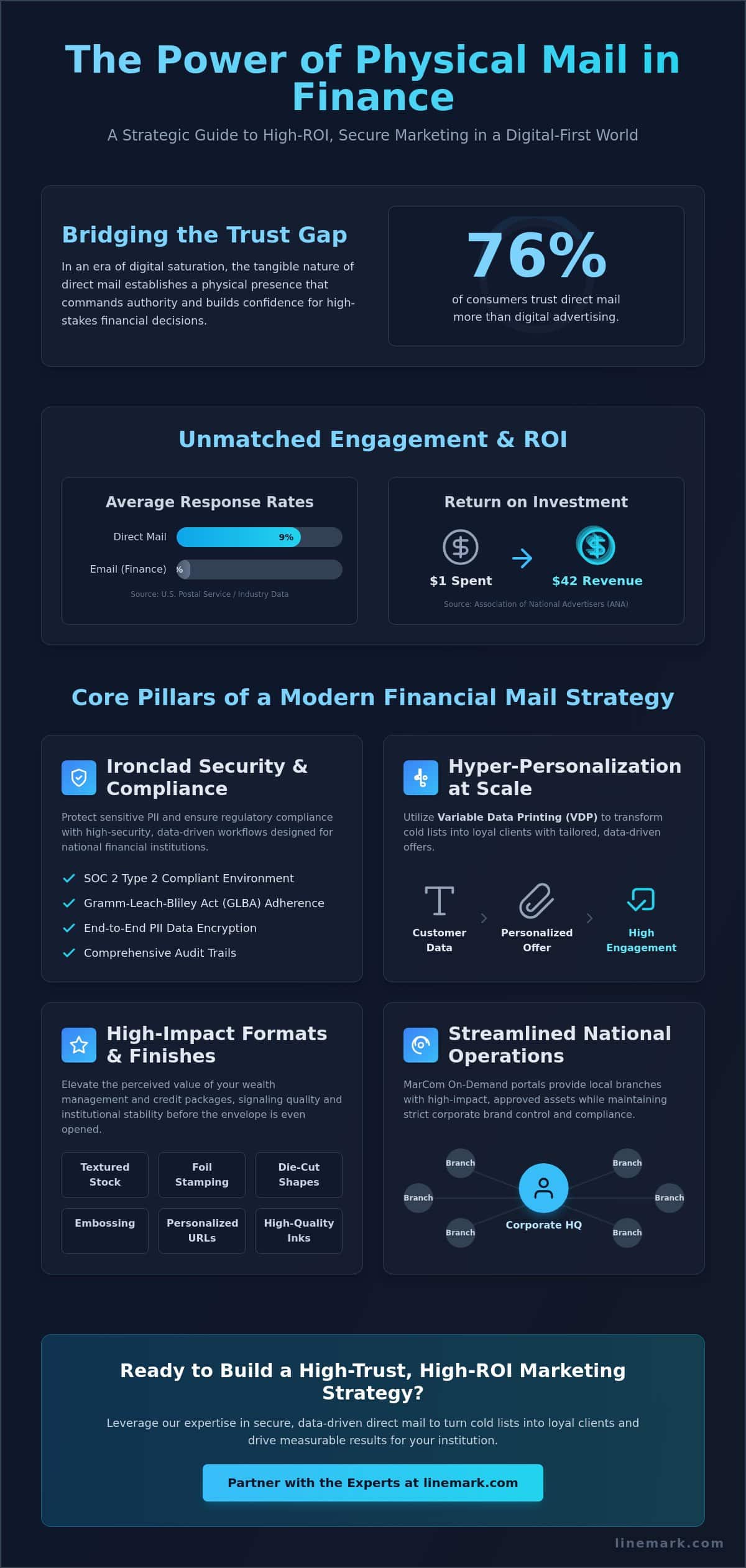
While digital channels struggle with oversaturation, 76% of consumers report that they trust physical mail more than digital advertisements. You’ve likely noticed that rising digital ad fatigue is making it harder to capture the attention of high-net-worth prospects. Implementing a sophisticated strategy for financial services direct mail marketing isn’t just about sending postcards. It’s about establishing a physical presence that commands authority in a crowded marketplace.
We understand that your team faces the dual pressure of driving high-ROI acquisition and adhering to strict regulatory frameworks. You’ll discover how high-security, data-driven workflows drive trust for national financial institutions while streamlining complex logistics. This 2026 strategic guide previews the latest USPS rate optimizations, California Senate Bill 1096 compliance, and the technological advancements in variable data printing that turn cold lists into loyal clients. We’ll move from identifying your core business challenges to presenting a scalable, high-tech solution that protects your brand and your data.
Key Takeaways
- Understand why the tangible nature of physical mail remains the most trusted channel for high-stakes financial decisions in an era of digital ad fatigue.
- Identify the critical security protocols required to protect sensitive PII and ensure regulatory compliance during high-volume print production.
- Learn how to utilize Variable Data Printing to scale hyper-personalized financial services direct mail marketing campaigns that trigger specific, data-driven offers.
- Discover the high-impact formats and specialized finishes that elevate the perceived value of your wealth management and credit acquisition packages.
- Explore how MarCom On-Demand portals streamline national operations, providing local branches with high-impact assets while maintaining strict corporate brand control.
Why Direct Mail Remains a High-ROI Channel for Financial Services
Digital saturation has reached a tipping point for high-net-worth individuals. In 2026, the direct mail market reached $73.57 billion because physical touchpoints bypass the noise of overflowing inboxes and intrusive ad-blockers. While digital ads are often dismissed in milliseconds, a well-executed strategy for financial services direct mail marketing secures a place on the prospect’s desk or kitchen table. This physical presence is particularly critical for financial institutions where the perceived risk of an offer is high.
To better understand how this channel impacts the advisor-client relationship, watch this helpful video:
Bridging the Trust Gap in a Digital-First World
The psychology of tactile marketing is rooted in the concept of permanence. A digital ad is ephemeral; a high-quality physical brochure suggests a brand that’s established and secure. Research shows that 76% of consumers trust direct mail more than digital advertising when making significant life decisions. For a national financial institution, sending a physical piece isn’t just a marketing tactic. It’s a demonstration of operational excellence and attention to detail. In 2026, the tangible weight of a high-quality mailer serves as a proxy for the institutional stability and reliability of the financial firm it represents.
Analyzing Open Rates and Engagement Metrics
The performance data for 2026 confirms that physical mail continues to outperform digital alternatives by a wide margin. The U.S. Postal Service reports average response rates for direct mail near 9%, while email response rates in the financial services sector hover around 1%. This disparity is even more pronounced for existing house files, where response rates can reach up to 12%.
The Association of National Advertisers (ANA) reports that direct mail marketing generates an average of $42 in revenue for every $1 spent, representing a 161% return on investment. This ROI is sustained by the “kitchen table effect,” where financial mailers often remain in a household for days or weeks, prompting multiple impressions. Modern campaigns bridge the gap between physical and digital by using integrated tracking codes and personalized URLs (PURLs). This allows your team to measure engagement with the same precision as a digital campaign while benefiting from the superior trust and response rates of a physical format.
Ensuring Data Security and Compliance in Financial Mail Production
Security in financial services direct mail marketing is a prerequisite, not an option. National institutions manage vast amounts of Personally Identifiable Information (PII), and any breach during the production cycle carries heavy penalties and severe reputational damage. We view data handling as a technical partnership where precision meets protection. This involves more than just software; it requires a physical and digital environment designed to withstand the scrutiny of the most rigorous audit.
The Importance of Secure Data Processing
Data encryption begins with high-security file transfers and continues through every stage of the print cycle. Every mailing list containing Social Security numbers or account details must be processed within a SOC 2 Type 2 compliant environment. This ensures that your customer data is never exposed to unauthorized personnel or external threats. High-capacity facilities provide a controlled setting that smaller, decentralized shops cannot replicate. Comprehensive audit trails track the movement of financial collateral from digital processing to final postage, providing compliance officers with the documentation required by the Gramm-Leach-Bliley Act (GLBA).
Industry data confirms that Direct Mail Remains a High-ROI Channel because of its controlled, verifiable delivery. Unlike digital channels that are vulnerable to phishing and spoofing, a secure physical mail stream provides a level of integrity that high-net-worth clients expect from their financial partners.
Maintaining Brand Consistency Across National Campaigns
Managing a national branch network requires a balance between local relevance and corporate oversight. Centralized execution in a high-capacity facility is essential for financial services direct mail marketing at scale. It prevents the brand drift often seen in decentralized models and ensures that critical legal disclaimers are applied uniformly. For example, California Senate Bill 1096 mandates specific disclosures, such as a 16-point bold statement on envelopes and an 18-point bold statement inside solicitations. A centralized partner ensures these regulatory requirements are met every time without exception.
When you integrate your direct mail strategies with a centralized production partner, you eliminate the risk of a local branch inadvertently bypassing compliance protocols. This unified approach protects your high-impact physical brand presence while simplifying complex logistics for your marketing team. If your organization is looking to modernize its workflow, exploring a centralized kitting and fulfillment model can provide the operational excellence needed to support national growth.
Leveraging Variable Data Printing for Hyper-Personalized Financial Offers
Variable Data Printing (VDP) is the technical engine that transforms generic mailings into high-conversion assets. In the context of high-volume production, VDP isn’t a simple mail merge. It’s a sophisticated digital printing process where every element of a mailer, from the imagery to the specific financial offer, changes based on the recipient’s data profile. This level of precision ensures that a national bank can send a hundred thousand unique letters in a single batch, each addressing the specific needs of the individual consumer.
By utilizing advanced digital printing technology alongside traditional offset printing for static elements, firms can achieve a balance of scale and hyper-personalization. This approach significantly reduces waste. Instead of broad-based “spray and pray” tactics, financial services direct mail marketing allows you to target only the most relevant prospects with offers they’re statistically likely to accept. This efficiency protects your budget and respects the prospect’s attention.
Data-Driven Offer Customization
Integrating Direct Mail with Digital Portals
The most effective financial campaigns don’t exist in a vacuum. They serve as a bridge to your digital ecosystem. By integrating QR codes or personalized URLs (PURLs), you can drive prospects directly to secure online applications or educational landing pages. When a recipient scans a code on a physical postcard, your team can receive a real-time delivery notification, triggering an automated email or phone follow-up. This integrated workflow is most efficient when managed through marcom on-demand portals. These systems allow your marketing department to maintain centralized control over the high-tech production process while giving local agents the agility to launch triggered mailings based on real-time customer behavior. This unified partnership between physical and digital channels is what defines a modern, high-performance financial services direct mail marketing strategy.
High-Performance Formats for Financial Products
The success of financial services direct mail marketing depends heavily on matching the physical format to the specific product offering. Acquisition campaigns for credit cards or mortgage refinances often require high-volume, cost-effective solutions like postcards or #10 window envelopes. Conversely, wealth management and private banking services demand a more substantial presence. Tactile quality matters. In these cases, the physical weight of the piece communicates the level of service the client can expect. Using a heavier 100lb cover stock or a soft-touch aqueous coating immediately elevates the perceived value of the offer.
Operational excellence also means designing with the USPS in mind. Optimizing your mail piece dimensions leads to significant postage savings. For instance, moving from a flat to a letter-sized format reduces costs significantly; First-Class metered letters currently sit at $0.74 while flats start at $1.63. We work as a strategic ally to ensure your creative vision aligns with these logistical realities. This balance maximizes your reach without inflating the budget.
Effective Postcards and Self-Mailers
For acquisition, you have roughly three seconds to capture a prospect’s attention. This “3-second rule” requires a punchy headline and a clear value proposition. Oversized postcards, such as 6×11 formats, provide high-impact visibility in a crowded mailbox. These pieces are ideal for time-sensitive offers like limited-time interest rates or local branch openings. Every postcard must include a compliant, prominent call-to-action that guides the reader to the next step. If you’re ready to scale your outreach, our high-capacity direct mail services handle millions of pieces with meticulous precision.
Producing High-Stakes Financial Collateral
Annual reports and investor prospectuses require a different level of technical production. These documents aren’t just informational; they’re reflections of institutional integrity. High-precision binding and finishing are non-negotiable for these multi-page assets. For premium investor guides or retirement planning manuals, utilizing custom book printing techniques can distinguish your firm from competitors. Specialized finishes like foil stamping or embossing denote a sense of luxury and security that digital-only brands can’t replicate. Managing the kitting and fulfillment of these complex kits requires a partner who understands the nuances of modern marketing and logistics, ensuring every component arrives in pristine condition.
Streamlining National Operations with Linemark’s Integrated Solutions
National scale requires more than just high-volume machinery. It demands a centralized operational hub that eliminates the friction between a corporate marketing strategy and local branch execution. Our 90,000-square-foot facility serves as this hub, providing the capacity to handle complex financial services direct mail marketing campaigns with the meticulous detail of a boutique shop. We don’t just act as a transactional vendor. We position ourselves as a strategic communications ally that understands the high-stakes nature of your logistics and brand integrity.
Centralizing Logistics for Distributed Networks
Managing inventory for thousands of agents across a national network often leads to brand drift and wasted materials. Our MarCom On-Demand portals solve this by empowering local agents to order approved materials while corporate teams maintain total control over design and compliance. This is especially vital in fluctuating interest rate environments. Just-in-time printing allows you to update rate sheets or loan offers in real-time, ensuring that no agent is ever distributing obsolete information. You gain total visibility. Through real-time tracking of mail delivery and inventory levels, your team can reduce the risk of stockouts or overproduction while maintaining a lean, efficient supply chain.
Scalable Production for National Campaigns
High-performance campaigns require a rhythmic balance between digital speed and offset volume. We utilize digital printing for hyper-personalized, data-driven mailers while leveraging offset printing for massive, static runs that require maximum cost-efficiency. This hybrid approach ensures your professional presentation remains consistent across every piece, regardless of the run size. Sophisticated binding and finishing happen in-house, ensuring that your annual reports and welcome kits meet the highest standards of quality before they ever reach the mail stream. Integrating your financial services direct mail marketing with our kitting and fulfillment services creates a streamlined, high-tech solution that supports your growth. Your project is in capable, steady hands from the first data upload to final delivery.
Partner with Linemark for your next financial mail campaign.
Securing the Future of Your Financial Outreach
Success in 2026 requires a shift from transactional mailing to a unified, strategic partnership. You’ve seen how the physical mailbox remains the premier channel for building trust and bypassing digital fatigue. By leveraging high-security production and hyper-personalized data, your organization can drive meaningful acquisition while maintaining absolute compliance. The integration of tactile quality with digital precision ensures your brand commands attention in a crowded marketplace.
Our 90,000-square-foot high-security production facility and over 30 years of industrial printing expertise provide the foundation your brand needs to scale with confidence. With advanced MarCom On-Demand technology, we empower your national network to act locally while you maintain total corporate control over every disclaimer and design element. It’s time to transform your financial services direct mail marketing into a streamlined, high-ROI engine that protects your reputation and fuels your growth.
Streamline Your Financial Marketing with Linemark. We’re ready to help you navigate the complexities of modern logistics and precision production to achieve your most ambitious goals.
Frequently Asked Questions
Is direct mail still effective for financial services in 2026?
Direct mail remains highly effective because it provides a tangible touchpoint that cuts through digital oversaturation. While email response rates in the financial sector hover around 1%, physical mail consistently delivers response rates near 9%. This disparity occurs because 76% of consumers trust physical mail more than digital ads for significant financial decisions. It’s a reliable method for reaching high-net-worth individuals who often use ad-blockers or ignore unsolicited emails.
How do you ensure data security when printing financial mailers?
We ensure data security through a combination of SOC 2 Type 2 compliant environments and end-to-end encryption for all file transfers. Every financial services direct mail marketing project undergoes a rigorous process where PII is handled within restricted-access production zones. Comprehensive audit trails document the movement of every piece of collateral. This level of oversight provides the verifiable security required by the Gramm-Leach-Bliley Act (GLBA) and other federal regulations.
What is Variable Data Printing (VDP) and how does it help financial marketing?
Variable Data Printing (VDP) is a digital printing technology that allows for the customization of every element on a mailer during a single production run. It helps financial marketing by allowing firms to trigger specific offers, interest rates, and imagery based on individual recipient data. This precision reduces budget waste by targeting only the most qualified prospects. It transforms a generic solicitation into a personalized consultation that resonates with the consumer’s specific life stage.
Can direct mail be integrated with our digital marketing funnel?
Direct mail integrates seamlessly with digital funnels through the use of QR codes and personalized URLs (PURLs) that drive prospects to secure landing pages. When a recipient interacts with a physical piece, your CRM can trigger automated follow-up emails or phone calls based on delivery notifications. This omnichannel approach ensures that your physical brand presence reinforces your digital touchpoints. It creates a unified journey that increases the likelihood of conversion across all platforms.
What are the most effective mail formats for credit card or loan offers?
The most effective formats depend on your specific goal; #10 envelopes with inserts convey institutional authority for loan offers, while oversized 6×11 postcards drive high-impact visibility for credit card acquisition. Letters often see higher response rates for complex financial products because they provide space for detailed disclosures. Postcards are excellent for time-sensitive rate updates. Choosing the right format involves balancing postage costs with the level of detail required for compliance.
How does Linemark handle national distribution for financial institutions?
Linemark handles national distribution through a centralized 90,000-square-foot facility that manages kitting and fulfillment for thousands of branch locations. Our MarCom On-Demand portals allow local agents to order approved materials while the corporate office maintains strict brand control. This centralized model reduces logistics friction and ensures that every branch receives high-quality collateral simultaneously. We manage your entire inventory, providing real-time tracking from production to the final mail stream.
What compliance standards should a financial printing partner meet?
A financial printing partner must maintain SOC 2 Type 2 compliance to ensure the highest level of data security and operational integrity. They should also demonstrate a deep understanding of FINRA Rule 2210 and the SEC Marketing Rule regarding performance claims. In 2026, compliance also requires adherence to state-specific laws like California Senate Bill 1096. This includes meeting exact font size and placement requirements for mandatory disclaimers on every physical mail piece.
How is the ROI of a financial direct mail campaign measured?
ROI is measured through integrated tracking mechanisms like unique QR codes, PURLs, and dedicated phone lines that attribute conversions directly to the mail piece. Match-back analysis also allows your team to compare mailing lists against new account openings to determine the long-term value of the campaign. The Association of National Advertisers (ANA) reports that financial services direct mail marketing generates an average of $42 in revenue for every $1 spent. This verifiable data allows for precise budget optimization.