

 11/22/2026
 Steve Bearden
Print doesn’t need to compete with digital to earn a place in the marketing mix. To convince your team to invest in print, connect the format to organizational goals and explain how it can support focused reading, communicate value, and produce measurable outcomes. Shared priorities, a clear purpose, and realistic expectations help secure buy-in for a campaign.
Colleagues may reasonably ask how print contributes alongside digital channels. Position it as part of an integrated strategy, then define success before committing resources. Make the case by connecting print to organizational outcomes, explaining its role in focused reading, showing how physical quality can reinforce value, and building financial projections from relevant data. This gives your team a framework for treating print as a deliberate marketing investment, not just a production choice.
Key Takeaways
- Start with an organizational goal, then show how a print initiative supports it and how progress will be reported.
- Position print as a complementary format that can give readers space to focus on longer-form content.
- Connect the physical design and production choices to the value your audience should perceive.
- Build a credible investment case by grounding projections in clear assumptions, relevant data, and measurable outcomes.
1. Connecting marketing activity to organizational outcomes
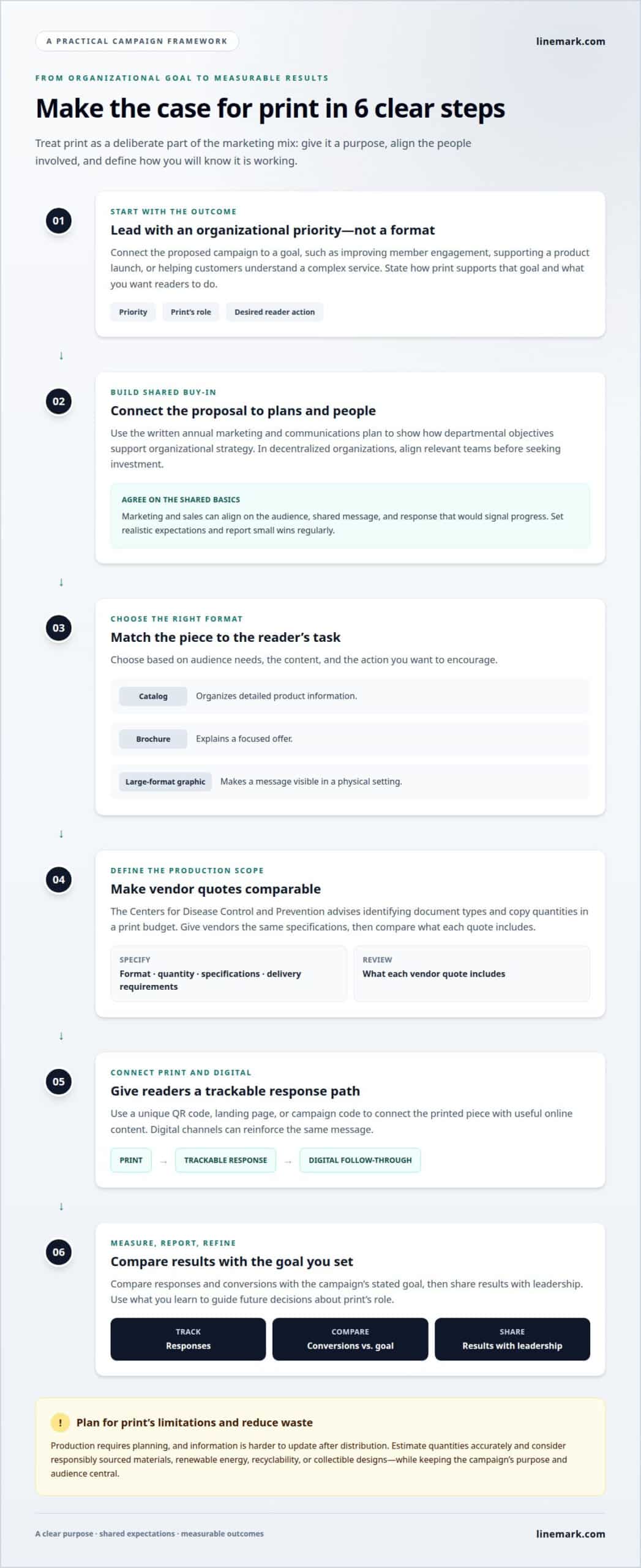
A sound case for convincing your team to invest in print starts with an organizational priority, not a preferred format. Connect the proposed campaign to a goal, such as improving member engagement, supporting a product launch, or helping customers understand a complex service. Explain how the printed piece advances that goal and what action you want readers to take.
Use a written annual marketing and communications plan to show how departmental objectives support organizational strategy. In a decentralized organization, align the proposal with relevant teams before requesting investment. For example, marketing and sales can agree on the audience, shared message, and response that would signal progress. Set realistic expectations and report small wins regularly rather than waiting for an annual review.
Match the format to the audience and goal. A catalog can organize detailed product information, while a brochure can explain a focused offer. A large-format graphic can make a message visible in a physical setting. Choose based on readers’ needs, the content, and the action you want to encourage.
According to the Centers for Disease Control and Prevention, a print budget should identify document types and copy quantities. Use those details to compare vendor quotes consistently: specify the same format, quantity, specifications, and delivery requirements, then review what each quote includes.
Measure campaign performance by creating a trackable response path, such as a unique QR code, landing page, or campaign code. Compare responses and conversions with the campaign’s stated goal, then share the results with leadership. Print and digital can work together when the printed piece directs readers to useful online content and digital channels reinforce the same message.
Print has limitations: production requires planning, and information is harder to update after distribution. Reduce waste by estimating quantities accurately and considering responsibly sourced materials, renewable energy, recyclability, or collectible designs. These choices can support environmental priorities while keeping the campaign’s purpose and audience central.
2. Digital fatigue and distraction-free reading
A screen competes with notifications, open tabs, and messages for attention. Print offers a different reading environment: a magazine or booklet can present a curated sequence without on-screen interruptions. An organization explaining a complex service, for example, can use a printed guide to help readers work through the information at their own pace.
A May 2025 research finding reported that 47% of young people aged 16 to 21 would prefer to be young in a world without the internet. That result doesn’t mean every audience wants less digital content. It does give teams a concrete reason to consider whether a physical format could serve readers seeking a break from screens.
Make print part of the content strategy, not a separate publishing track. Select a useful digital resource, such as a detailed article or product guide, and adapt its strongest material for print. Keep the core message consistent while shaping the printed version for sequential reading, marking a page, or returning to a section later.
Print and digital can guide readers through different stages of engagement. A printed publication can introduce a topic and make room for long-form storytelling; a related digital experience can provide updates, interactive details, or a next step. The formats complement each other when each has a clear role and the transition feels purposeful.
Choose a format based on the reader’s task. A member reviewing an association’s annual priorities may value a publication they can revisit, while a customer comparing product details may need a focused guide. Test a small, well-defined campaign, then use reader feedback and response data to decide whether print belongs in the broader strategy.
For a print piece designed to work alongside digital content, explore digital printing as one production option.
Print magazines can offer a curated, distraction-free alternative to digital media, giving readers a focused way to engage with selected material. Their value lies in creating an intentional reading experience, rather than competing for attention in the same digital environment.
Print can complement digital publishing by making room for long-form storytelling and letting readers pause and resume at their own pace. These qualities make it useful for material that benefits from sustained attention, while digital publishing can provide a complementary experience.
3. Premium positioning and perceived value
A printed piece communicates value through more than its message. Readers experience its weight, page count, and design as part of the publication. An organization presenting research, for example, can use considered typography, clear structure, and durable-feeling pages to convey care. These choices work best when they support the content rather than distract from it.
Premium positioning starts with a specific audience and a clear reason to keep the piece. Publishing commentator Bo Sacks described a strong future magazine as focused, profitable, subscription-led, and indispensable to its audience. Apply that principle by defining the publication’s distinct purpose, then align its content, format, and production choices with what the audience values.
Collectability can strengthen the relationship between a publication and its readers. A magazine publisher might create a series of subscriber-only covers, making each issue part of a continuing set. The idea needs a consistent editorial purpose, not just a decorative variation. A cover series can communicate belonging when it reflects the publication’s subject and reader community.
James Hewes has argued that higher production values, more content, and collectability matter to the future of printed magazines. Treat this as a strategic direction, not a reason to add features without purpose. For instance, a carefully edited feature package in an association’s annual publication may reinforce expertise better than extra pages that dilute the central story.
Premium value also depends on operational discipline. A magazine can manage production costs and set prices that reflect its quality while maintaining a clear promise to its audience. Mary Hogarth has emphasized thoughtful, curated content, sustainability, and audience focus in future print titles. Apply those principles by choosing materials and design that fit the editorial purpose. Explain how each choice communicates relevance, distinction, and lasting value to readers.
A LinkedIn post quoted a claim that consumers, including a demographic assumed to be digital-only, consider physical formats more trustworthy than digital formats. That perception can support print’s role as a considered, enduring medium.
4. Supporting financial projections with data
Compare print and digital marketing using the same business outcome, audience, and measurement window. A channel’s return depends on campaign goals, response tracking, and the value of resulting conversions. Rather than claim that print always outperforms digital, show how each channel supports the opportunity and where their results overlap.
No single recall or response statistic establishes that print will outperform digital for every audience and campaign. Build a useful comparison with campaign-specific measures, such as responses, qualified leads, conversions, and follow-up actions. Give print a unique response path, then compare its results with equivalent measures from the digital campaign against the same organizational objective.
Build projections from explicit assumptions. A hypothetical customer-acquisition example compares a $250 acquisition cost with $1,000 in gross profit per transaction. The figures illustrate how to structure a model, not a guaranteed print result. Likewise, a separate hypothetical marketing example projects that its investment will be returned within six months of spending. Label projections clearly and explain the evidence behind each input.
Shape the business case around a decision your leadership team can evaluate. Define the organizational opportunity and audience, then describe the print activity, intended response, and resources required. Model conservative, expected, and stronger outcomes using historical performance or market research. State your assumptions, measurement methods, and milestones so finance and marketing can assess the same proposal.
Keep the numbers internally consistent. Separate projected revenue from profit, and distinguish attributed responses from conversions that may have come through other channels. Report early indicators alongside final outcomes, then update the model as campaign data arrives. This gives the team a more disciplined basis for future investment decisions than a single return figure.
To connect campaign goals with production planning, plan a data-backed print campaign.
Linemark
Linemark helps organizations put print investments into production with Commercial Printing, Direct Mail, Custom Book Printing, and Large Format Graphics. These services support different campaign needs, from distributing a targeted message to producing a substantial publication or visible display. Turn to Linemark when your team has defined its audience, objectives, and measures of success and is ready to plan the print execution. A clear brief connects the business case to practical decisions about format, quantity, and how the printed piece supports other marketing channels. Contact Linemark to discuss your print project and its role in your marketing strategy.
Turn the proposal into a practical next step
A marketing proposal becomes actionable when someone owns the next decision. Identify the colleague who can approve the direction, the team responsible for delivering it, and the audience whose response will guide future investment. Shared ownership can move the conversation from whether print belongs in the plan to how a specific project should proceed.
If you’re convincing your team to invest in print, keep the discussion focused on a clear brief and a defined purpose. Linemark’s Custom Book Printing, Direct Mail, and Large Format Graphics can support different communication needs. Bring your campaign objective and audience into the conversation, then consider which format fits the job. A focused discussion can turn internal agreement into a coordinated production plan without overstating what the campaign will achieve.
Give your team room to make a measured decision, learn from the result, and refine the next project. Discuss your print plans with Linemark and take the next step with a clear purpose. Your strongest investment case starts with a shared goal and a plan your team can put into action.
Frequently Asked Questions
Why Is Employee Buy-In Important?
Employee buy-in helps turn an approved print project into consistent action across teams. Sales staff, for example, can introduce a campaign brochure during relevant customer conversations, while service teams can direct customers to the same information. Involving employees early clarifies how to use the material and who owns distribution, making the campaign easier to execute as intended.
What are the business benefits of investing in print marketing?
Print gives an organization a physical communication tool that employees and customers can use beyond a single digital interaction. For example, a company can provide a printed guide at an event for attendees to reference in later discussions. Print can also support brand affinity, engagement, and audience support, especially when the content is useful and relevant to readers.