

 10/31/2026
 Steve Bearden
A 111lb-to-GSM conversion for cover paper gives 300 gsm, but that number alone won’t tell you whether it’s the right stock for your project. Paper-pound labels can be confusing because the weight depends on the paper category, not just the number of pounds.
If you’re comparing cardstock options for a brochure, cover, or other printed piece, you need more than a direct conversion. This article explains how cover-paper pounds translate to GSM, why pound weights can differ across paper types, and how weight influences the feel and performance of printed products. You’ll come away with a clearer basis for choosing a stock that fits your project.
Key Takeaways
- For cover stock, 111 lb is commonly shown as approximately 300 gsm; conversion charts may vary slightly by rounding.
- Compare paper weights within the same category. A pound rating can represent different weights for cover, text, and other paper types.
- Use weight as one factor in choosing stock: it helps indicate how substantial a printed piece may feel, but the right choice depends on its intended use.
- Recognize the broad cardstock tiers, from medium-weight options to heavier cover stock, to narrow choices for your project.
Common GSM-to-pound conversions for cover paper
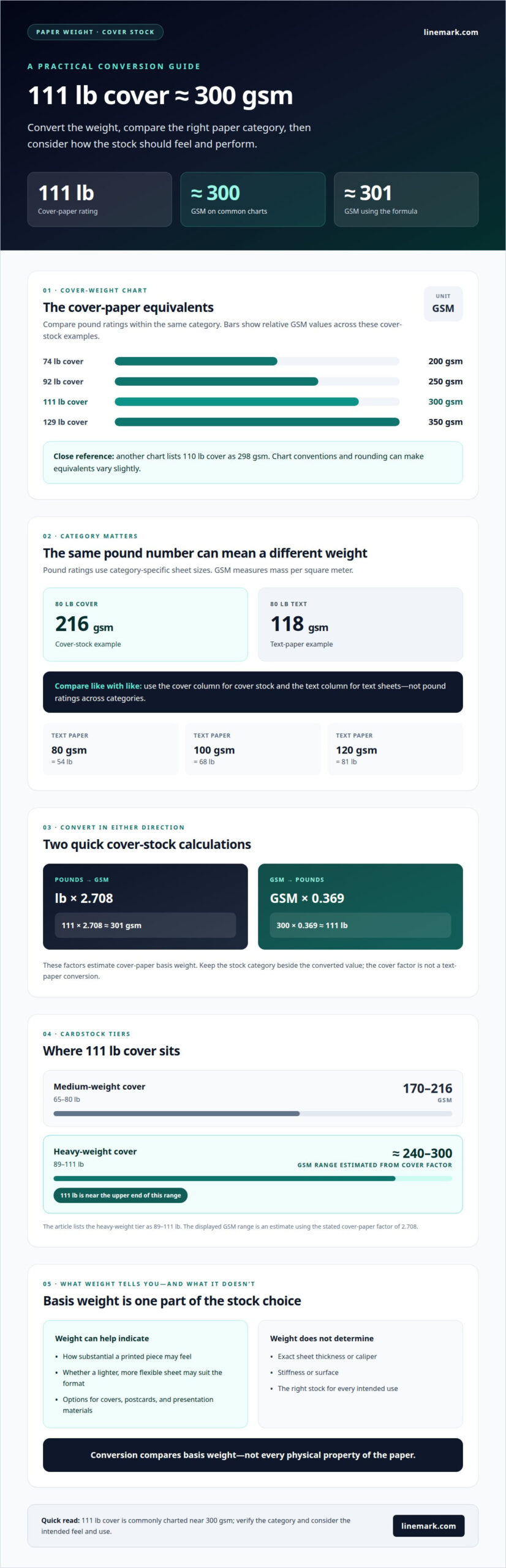
Common paper weights similar to 111 lb cover stock include 92 lb and 129 lb, while charts place 111 lb near 300 gsm. For text paper, compare the text category: 80 lb text paper is 118 gsm, not the same as 80 lb cover.
Cover-Paper Pound Equivalents
A cover-paper conversion matches a cover pound rating with its approximate grams-per-square-meter weight. This matters because pound ratings use paper categories, so the same number of pounds can mean different weights across cover and text paper. Common chart equivalents include 200 gsm at 74 lb cover, 250 gsm at 92 lb, 300 gsm at 111 lb, and 350 gsm at 129 lb. Conversion charts can vary slightly in how they present equivalent paper weights. Heavier cover cardstock can suit booklet covers, postcards, and other printed pieces that need a more substantial feel.
Reading Paper-Weight Charts
A paper-weight chart organizes pound and GSM equivalents by paper type, making comparisons easier when specifications use different units. Check the category before comparing figures: 80 lb cover equals 216 gsm, while 80 lb text equals 118 gsm. Text-paper conversions also show 100 gsm at 68 lb and 120 gsm at 81 lb. These examples demonstrate why a conversion chart must match the stock category. Use the cover column for cover stock and the text column for text sheets, rather than treating pound weights as interchangeable.
Weights Similar to a Given Cover Weight
Weights near 111 lb cover give a practical comparison range when selecting cardstock. On common charts, 92 lb cover corresponds to 250 gsm, and 129 lb cover corresponds to 350 gsm. The 111 lb option sits between those values, at approximately 300 gsm. A separate paper-weight chart lists 110 lb as 298 gsm, another close reference. These equivalents help narrow choices for covers, postcards, and presentation materials. Compare the exact stock category and intended use, since a similar pound number in text paper describes a different weight.
How paper weight affects printed products
Paper weight affects how a printed piece feels, handles, and suits its purpose. To compare stocks accurately, distinguish basis weight from thickness and compare pound ratings within the same paper category.
Measuring US Paper Weight
In the United States, paper pound weight is based on a ream of 500 sheets measured at that paper’s uncut size. The standard sheet size changes by category, so the pound figure alone doesn’t compare every stock consistently. The U.S. Environmental Protection Agency describes paper basis weight in pounds per square yard or grams per square meter. GSM gives mass per area, making it easier to compare different paper types.
GSM Examples by Paper Use
GSM examples help connect paper weight to familiar uses. Office copy paper is listed at 90-120 gsm, while text-paper charts show 80 gsm as 54 lb, 100 gsm as 68 lb, and 120 gsm as 81 lb. Those examples describe text paper, not cover stock. For printing, a heavier sheet can feel more substantial, while a lighter one may suit pages that need flexibility.
Converting Cover Weight to GSM
For cover paper, multiply the pound weight by 2.708 to estimate GSM. Using that conversion, 111 lb is about 301 gsm; cover-weight charts also list this stock around 298-300 gsm. Small differences come from chart conventions and rounding. GSM and pounds describe basis weight, not a sheet’s exact thickness, so use the category-specific conversion when comparing cover stocks.
Distinguishing Text and Cover Paper
A 111 lb rating refers to cover paper when the specification identifies it as cover; the number alone doesn’t identify the category. The difference is that pounds use a ream’s category-specific sheet size, while GSM measures mass per square meter. Standard uncut sizes include 25 × 38 inches for text, 20 × 26 inches for cover, and 22.5 × 28.5 inches for Bristol. A 111 lb rating also doesn’t set one fixed thickness; sheet caliper depends on the stock itself. For projects where stock and production need to work together, commercial printing is a natural next step.
Cover-weight conversion between pounds and GSM
Cover-weight conversion translates a paper’s basis weight between pounds and grams per square meter. The U.S. Environmental Protection Agency identifies pounds per square yard and grams per square meter as ways to express paper basis weight. For cover stock, the conversion factor is approximately 2.708 gsm per pound. Use a cover-paper factor, not a text-paper conversion, because paper categories use different basis-weight conventions.
To convert cover pounds to GSM, multiply the pound rating by 2.708. For 111 lb, the calculation gives approximately 301 gsm before rounding. Cover-paper charts may use different conventions, so equivalents can vary slightly. Treat the conversion as a comparison aid, and retain the paper category when recording a specification.
For the reverse calculation, multiply GSM by 0.369 to estimate cover pounds. At 300 gsm, that calculation gives about 111 lb. This two-way method helps translate a stock specification when a printer, designer, or packaging plan uses different units. Keep the original unit beside the converted value, especially when passing a paper specification between teams.
Weight measures mass per area, not the sheet’s overall physical properties. Two cover papers with similar basis weights can still differ in thickness, stiffness, and surface because those characteristics depend on the paper’s construction. A heavier cover stock may create a more rigid feel, while a lighter option may suit a flexible format. Conversion shows comparable basis weight, but it cannot determine the right stock for every use.
Cardstock weight categories
Cardstock categories group cover papers by basis weight, helping compare lighter and heavier options. A 111 lb cover stock sits near the upper end of the heavy-weight range, but category labels describe weight, not every physical property. GSM expresses mass per square meter; pound ratings depend on paper category. Use both measures to understand a stock’s weight before comparing samples.
- Medium-weight cover: 65-80 lb, equivalent to 170-216 gsm.
- Heavy-weight cover: 89-111 lb, equivalent to 241-300 gsm.
- Ultra-thick cardstock: 115 lb, or 311 gsm, and above.
These ranges place 111 lb cover at the top of the heavy-weight category. A chart may show it at 300 gsm, while individual conversion tables can use slightly different rounded values. Read the category and GSM together rather than comparing a cover rating directly with a text-paper pound weight.
Start with the printed piece’s purpose. Medium-weight cover stock can provide more support than text paper without moving into the heavy range. Heavy cardstock gives brochures, postcards, or presentation covers a more substantial feel. Ultra-thick stock suits projects where a board-like feel is part of the format. These categories compare weight, not guaranteed thickness: paper construction affects how each sheet feels.
Before finalizing a specification, compare a physical sample in the intended format. See how it bends, stacks, and handles, then match its paper category and GSM to your production needs. GSM measures weight per square meter, while U.S. pound categories are based on different uncut sheet sizes. That’s why comparisons need to account for paper category.
For a printed project that needs the right stock category and a coordinated production plan, plan your print project with the specifications in view.
Linemark: Custom Book Printing
Linemark’s Custom Book Printing brings paper specifications and finished format together. Use a pound-to-GSM conversion as a planning reference, then consider how the stock will work for the book’s cover and interior pages.
The distinction matters for brochures and other commercial print materials, too, because cover and text papers serve different roles. Linemark’s Custom Book Printing and Commercial Printing support organizations producing materials for specific project needs.
Bring your preferred paper specification into the production conversation so it can inform the project plan. To discuss a print project, contact Linemark or visit the website.
Turn the paper specification into a production decision
A paper-weight comparison becomes valuable when it helps shape the finished piece, not just fill in a specification sheet. Use the 111 lb-to-GSM comparison as one input alongside the format, intended handling, and role of each sheet. That gives your production team a clearer starting point for aligning stock choices with the project’s purpose.
Linemark supports printed communications with Custom Book Printing, Direct Mail, and Large Format Graphics. Each format has different production considerations, so a clear project brief helps connect paper requirements to the finished application. Whether you’re planning a publication, a mailed piece, or a graphic display, base your choice on the intended function and presentation.
Ready to discuss how paper choices fit your next project? Contact Linemark about your paper needs, and take the next step with a focused production plan.
Frequently Asked Questions
Unsure Which Weight to Use?
Choose paper for the finished piece’s purpose, handling, and format, and compare options within the same category. A flexible interior page and a firm cover serve different roles, even when their weight labels look similar. If two stocks seem suitable, compare physical samples in the intended format to see how they handle beyond the weight specification.
What is GSM?
GSM means grams per square meter, a measure of paper weight based on a square meter of material. It helps compare paper categories using a shared area unit. For example, cover stock listed at 250 gsm is lighter by basis weight than cover stock at 300 gsm. GSM describes weight, not a sheet’s exact thickness or stiffness.
What is LBS (lb or #)?
In paper specifications, lb and the pound sign (#) indicate a paper’s U.S. basis weight. That figure is based on a ream of 500 sheets at the category’s uncut sheet size. So a pound rating needs its paper type to make sense. For instance, 80 lb text and 80 lb cover represent different basis weights.
What is Lbs?
Lbs is the plural abbreviation for pounds; lb is the singular abbreviation. In a paper listing, a number followed by lb or # gives the stock’s basis-weight rating, not its thickness measurement. Read the paper category alongside the number. A specification such as 111 lb cover identifies a different stock basis than 111 lb text.
What does 111 lb mean in paper weight?
111 lb means the cover-paper basis-weight rating when the specification identifies the stock as cover. It’s a category-based measure, not a direct statement of how thick every individual sheet will feel. For a finished piece, consider the role of the stock, such as a book cover or postcard, and assess the physical sample as well as its weight label.
How many gsm is 111 lb paper?
A 111 lb-to-GSM conversion for cover paper is commonly shown as about 300 gsm. Paper-weight charts may use different conventions, so check that the value is for cover paper. Use the value that matches the chart’s convention, and keep “cover” attached to the specification so it isn’t mistaken for text paper.