

 11/04/2026
 Steve Bearden
The lowest-postage option isn’t automatically the right fit for a business mailing. Business mail covers USPS mailing and shipping services, and the classes differ by purpose, piece type, mailing volume, and delivery speed. For example, USPS Marketing Mail requires at least 200 individual pieces or 50 lbs. of mail, so understanding mail classes for business means matching the class to both your mailing goals and its eligibility rules.
Postage matters, but the mail class can also affect preparation requirements and delivery timing. This guide explains the main USPS options for businesses, their eligibility and cost considerations, and how to choose based on your audience, format, volume, and schedule. Use these factors together rather than assuming one class suits every mailing.
Key Takeaways
- Match the mailing format and purpose to the USPS class before planning postage and preparation.
- For catalogues, align mailing frequency and the customer list with the publication and delivery goals.
- Compare Marketing Mail’s eligibility requirements and delivery timeframe with the urgency of your campaign.
- Use Linemark Direct Mail to coordinate printed pieces with a mailing plan suited to your audience and volume.
What is business mail?
Business mail includes correspondence, promotional campaigns, catalogs, and publications sent to customers or other audiences. A mailing’s purpose, volume, format, and preparation determine which USPS options and postage rules apply.
Address errors, incorrect postage, and mailpiece designs that miss USPS requirements can cause delays, surcharges, or rejection. USPS business-mail resources help locate a local Business Mail Entry Unit, while USPS Business Mail 101 explains mailing preparation and postage.
Mailing Size Minimums
Mailing minimums are piece-count or weight thresholds that a mailing must meet to qualify for certain USPS rates. Campaign volume can therefore determine whether a commercial mailing option is available.
For USPS Marketing Mail, the minimum is 200 individual pieces or 50 lbs. of mail. Regular First-Class Mail sent with postal indicia requires at least 200 pieces, while First-Class Mail mailings at automation prices require at least 500. Bulk mailing can offer postage savings compared with single-piece prices, so volume is one factor in planning a mailing.
Catalogs are often produced periodically, such as each season, and sent to a customer list. A retailer might use one to present products in a consistent format, with an order form for customers to mail back or details for ordering by phone. The mailing list connects the printed piece with its intended audience, while the catalog’s purpose and format help shape the mailing plan.
Preparing business mail may involve preparing the pieces, securing permits, paying annual fees, and purchasing presorting equipment and software. Those tasks affect the work behind a mailing, not just the postage. USPS Business Mail 101 introduces the process in the order of mailing preparation steps.
Periodicals Mailing
Periodicals is a USPS postage option for qualifying publications. To qualify for Periodicals rates, a publication must have at least four publication intervals per year.
Content also matters: a publication applying for Periodicals rates cannot contain more than 75% advertisements. A regularly issued publication with editorial material may fit this model, while a seasonal product catalogue is not automatically a Periodicals mailing. These criteria help businesses distinguish publication mail from promotional catalogue mail before planning postage.
What are Mail Classes, Anyway?
USPS mail classes group letters, marketing pieces, and packages according to purpose, eligibility, and service. UPS and FedEx business shipping services focus on packages, while USPS also offers options for correspondence and high-volume marketing mailings.
Marketing Mail Eligibility and Discounts
USPS Marketing Mail is a lower-cost option for eligible advertising and other marketing mailings that meet volume and format rules. A mailing qualifies with at least 200 individual pieces or 50 lbs. of mail, and each piece must weigh less than 16 ounces.
Marketing Mail is described as about 30% less expensive than First-Class Mail. That potential savings can suit campaigns where postage efficiency matters more than rapid delivery. Delivery can take as long as three weeks, so the class is less suited to time-sensitive correspondence or announcements with a firm arrival date.
First-Class Mail Limits and Service
First-Class Mail serves letters and other eligible pieces, with weight limits varying by format. Shipments must weigh less than 13 ounces; letters have a 3.5-ounce limit, while flats can weigh up to 13 ounces.
First-Class Mail typically takes one to five business days for national delivery. It can suit business correspondence, invoices, or other pieces where timely delivery matters more than the lower postage available with Marketing Mail. First-Class Presort and automation pricing have separate minimum mailing volumes, which affect whether larger mailings qualify for those rates.
Delivery Estimates and Service Standards
USPS delivery estimates vary by class: First-Class Mail typically takes one to five business days, Marketing Mail can take as long as three weeks, and Priority Mail is expected to arrive in three business days. Priority Mail may take longer depending on the destination.
Priority Mail can suit urgent shipments. It is a faster package option, though delivery expectations depend on the destination. Pricing also varies according to shipment characteristics and destination, so weight, dimensions, and route all inform postage.
In practice, choose based on what you’re sending and when it needs to arrive. Marketing Mail prioritizes lower postage for eligible campaigns; First-Class Mail suits correspondence, while Priority options address package delivery speed.
Choosing a mail class for business needs
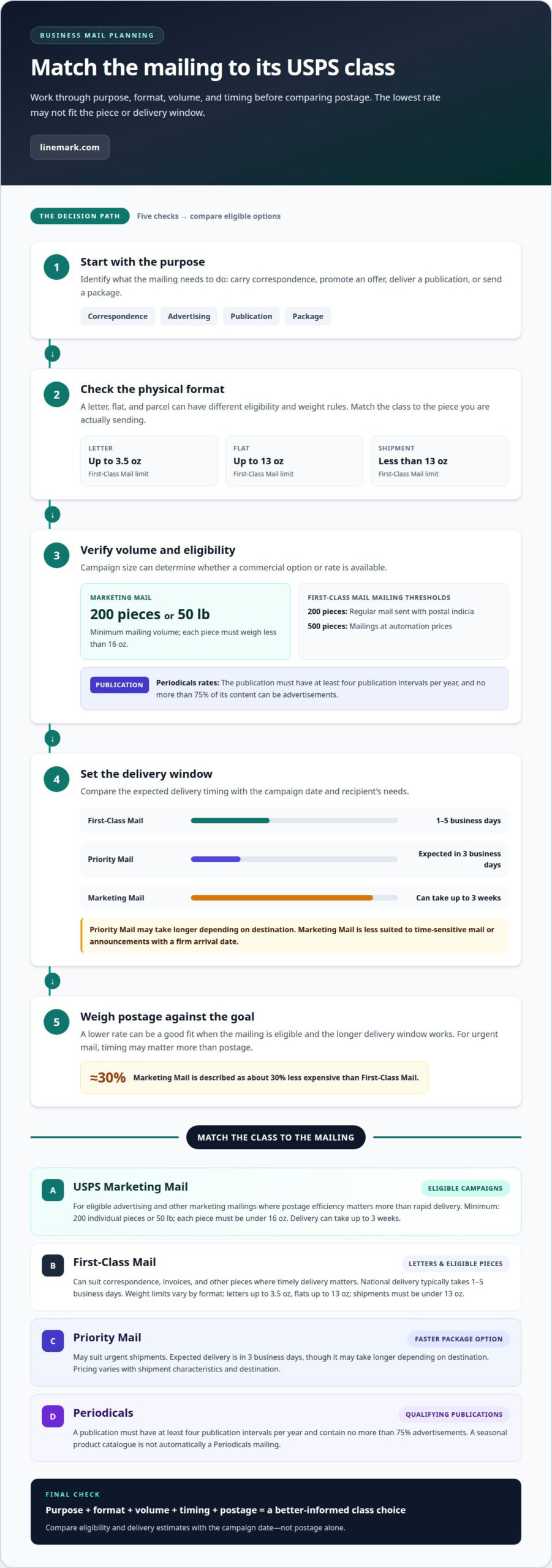
Choose a class by matching the mailing’s purpose, format, volume, and timing. A letter with an invoice has different requirements from a promotional flat or a package. To understand mail classes for business, assess these factors together. The lowest-postage option may not suit the campaign’s delivery window or the piece’s physical format.
Start with the piece and its recipient. A time-sensitive letter may point to First-Class Mail, while a broad advertising campaign may suit Marketing Mail if it meets the eligibility rules. A package requiring expedited delivery may call for Priority Mail or Priority Mail Express. For each option, weigh:
- Purpose: Is it correspondence, advertising, or a package?
- Format: Is the piece a letter, flat, or parcel?
- Volume: Does the mailing meet a class’s minimum?
- Timing: How soon does the recipient need it?
- Postage: Does a lower rate outweigh a longer delivery estimate?
These factors help determine whether a faster class is worth the added expense. A seasonal promotion, for example, may allow a longer delivery window, while an invoice or event notice may need to arrive sooner. Compare each class’s eligibility and delivery estimate with the campaign date, not postage alone. Understanding mail classes for business also means matching mailing decisions to the outcome the communication needs to support.
Physical mail can be useful when email isn’t the best channel. For complex or sensitive business topics, a phone call or video conference may communicate more clearly. A printed letter can support the conversation with a formal record or document. Use it when the recipient needs a physical copy or a communication that stands apart from an inbox.
For visual communication at a larger scale, consider formats beyond envelopes and parcels. A storefront message or event display may call for Large Format Graphics rather than a mailed piece. Choose the channel first, then select a USPS class for any accompanying correspondence so each part serves its purpose.
USPS mail class options for businesses
First-Class Mail serves correspondence, Marketing Mail supports advertising, and Periodicals is for qualifying recurring publications. USPS postage depends on class, weight, size, and preparation, so calculating current rates requires details about the specific mailpiece.
Differences Among First-Class, Marketing, and Periodicals
These three USPS classes distinguish personal correspondence, promotional materials, and qualifying publications. The right fit matters because purpose and eligibility shape how an organization prepares and sends each mailing.
First-Class Mail can carry business letters, while Marketing Mail suits eligible advertising campaigns. Periodicals applies to publications with at least four publication intervals per year and no more than 75% advertisements. A seasonal catalogue is not automatically a Periodical; its content and publication schedule matter. That distinction helps experts plan materials around the intended audience and mailing purpose.
Business Mail Prices by Class and Format
USPS business postage is calculated using the class and physical characteristics of each piece. Weight, dimensions, shape, and mailing preparation all affect the applicable rate.
For an exact amount, match the package or mailpiece to the current USPS rate structure. A letter, flat, and parcel may be treated differently, while presorting and mailing volume can affect eligibility for commercial prices. For example, First-Class automation prices require at least 500 pieces. Consider postage alongside preparation requirements, rather than comparing class names alone.
Other USPS options serve more specific mailing needs. Every Door Direct Mail is designed for delivery to selected postal routes; a mailing can cover up to five 5-digit ZIP codes, with a maximum of 5,000 pieces per post office and a maximum piece weight of 3.3 oz. This approach can suit a local campaign that does not rely on an individual customer list.
Printed materials and packages also have specialized options. Non-profit mail may have specific eligibility and preparation requirements. Match each option’s purpose and preparation criteria to the mailing before selecting its USPS class.
Linemark: Direct Mail
Linemark provides Direct Mail for organizations planning printed campaigns alongside their USPS mailing strategy. Turn to this service when you need a coordinated approach to campaign materials, audience, and mailing purpose, rather than treating print and postage as separate decisions.
For campaigns built around tailored pieces, Variable Data Printing can support personalized communications. Commercial Printing, Digital Printing, and Offset Printing offer additional production options, while Custom Book Printing suits projects centered on bound publications. The right combination depends on your mailing’s format and goals.
Share your campaign objectives and planned mailpiece with Linemark to discuss a practical direction for your Direct Mail project. Contact Linemark to get started.
Turn Your Mailing Plan Into a Clear Next Step
A well-planned mailing can do more than deliver information. It can make a campaign feel intentional, from the first printed piece to its arrival with the audience. Put your understanding of mail classes for business into practice by defining what the mailing needs to accomplish, who it should reach, and the role print should play.
Linemark’s Direct Mail can support campaign planning, with Custom Book Printing for bound materials and Large Format Graphics for communication beyond the mailbox. These offerings serve different formats, but each can bring a message into the physical world with purpose. Connect the mailing’s format and audience with your broader communication goals to determine the next step.
Share the project you’re planning and explore how Linemark can support its print and mailing needs. Contact Linemark to discuss your mailing project, and move forward with a plan shaped around your audience and objectives.
Frequently Asked Questions
How do I start preparing and shipping bulk mailings?
Start by defining the mailing’s purpose, piece format, audience, and planned volume. Then organize the address list and match the mailing to a class whose eligibility fits. For First-Class Mail automation rates, the list must be checked with CASS-certified software within 180 days of mailing. USPS Business Mail 101 presents preparation information in mailing-step order, including commercial pricing, postage, and mailpiece design.
What Are USPS Classes?
USPS classes group mail into service categories according to purpose and handling. First-Class Mail, for example, serves correspondence, while Marketing Mail covers eligible promotional mailings. Periodicals is for qualifying publications. Package options include Priority Mail and Priority Mail Express, while Bound Printed Matter applies to qualifying bound materials. A class helps determine eligibility, preparation requirements, postage, and delivery expectations.
What Does Presorting Mean?
Presorting means grouping mailpieces by shared delivery-area information before mailing. A 5-Digit presort groups pieces with the same 5-digit ZIP Code, creating an organized batch for processing. For example, a company mailing to recipients across several ZIP Codes would separate the pieces into matching ZIP Code groups. Presorting can affect commercial mailing eligibility and postage, so list accuracy and the mailing’s preparation plan matter.
What Makes First-Class Letters Machinable?
A First-Class letter is generally machinable when its shape and dimensions fit the letter format used for processing. The standard letter range runs from 3 1/2 inches high, 5 inches long, and 0.007 inches thick to no more than 6 1/8 inches high, 11 1/2 inches long, and 1/4 inch thick. A piece outside those limits may be categorized as a flat instead.
What are the main USPS mail classes available to businesses?
Businesses can use First-Class Mail, Marketing Mail, Periodicals, Priority Mail, and Priority Mail Express, among other USPS options. Specialized choices include Non-Profit Mail, Every Door Direct Mail, Bound Printed Matter, Library Mail, and Package Services. The appropriate class depends on the material and its purpose: a qualifying bound publication and a time-sensitive package, for example, involve different mailing considerations.
What are the eligibility rules for USPS Marketing Mail and bulk business mail?
USPS Marketing Mail requires at least 200 individual pieces or 50 lbs. of mail, and each piece must weigh less than 16 ounces. Other business-mail options have their own thresholds. For example, First-Class Mail automation prices require at least 500 pieces, while Non-Profit Mail requires at least 200. These thresholds help determine whether a planned mailing qualifies for a particular rate category.