


 10/27/2026
 Steve Bearden
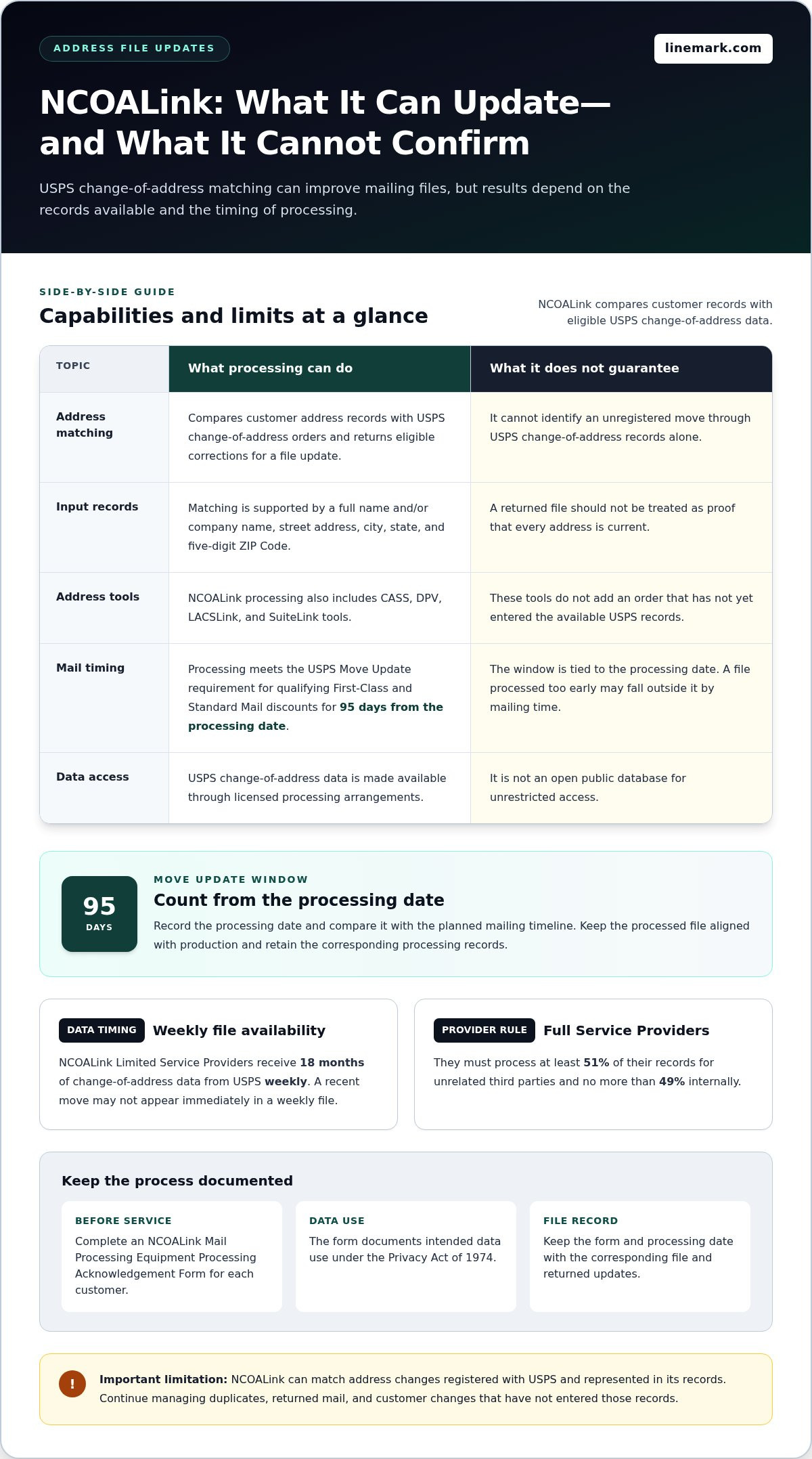
An address update can affect both whether a mailing reaches its recipient and whether it qualifies for a postal discount. A National Change of Address (NCOA) service compares customer address files with USPS change-of-address records and identifies eligible updates. NCOALink processing meets the USPS Move Update requirement for 95 days from the processing date to qualify for First-Class and Standard Mail discounts.
That makes NCOA relevant for organizations maintaining mailing lists for recurring campaigns, statements, catalogs, and other customer communications. The records come from change-of-address orders consumers submit online, by mail, or at a USPS Post Office retail counter. This article explains how those records support file updates, what the Move Update window means for mailings, and how address processing relates to consumer choices and privacy. It also shows how accurate, well-managed customer files fit into a coordinated direct-mail operation.
Key Takeaways
- Prepare customer records with a full name or company name, street address, city, state, and five-digit ZIP Code to support address matching.
- Understand how NCOALink processing combines change-of-address matching with CASS, DPV, LACSLink, and SuiteLink address tools.
- Use the processing date to assess whether a mailing falls within the 95-day Move Update window for qualifying First-Class and Standard Mail discounts.
- Consumers can submit change-of-address orders online, by mail, or at a U.S. Post Office retail counter, while processing forms document how address data will be used.
Customer address file updates
NCOALink compares customer records with USPS change-of-address data and returns eligible corrections for a file update. Matching quality, data timing, and careful handling of customer information all matter.
Address Update Process
A National Change of Address (NCOA) service standardizes address records and matches them against USPS change-of-address orders. Businesses can apply the returned updates before preparing a mailing, reducing the chance that outdated records lead to undeliverable mail.
Useful input fields include a full name and/or company name, street address, city, state, and five-digit ZIP Code. NCOALink processing also includes CASS, DPV, LACSLink, and SuiteLink tools. USPS licenses its data to Full Service Providers, which make it available to others. Businesses seeking authorization apply for one of USPS’s six NCOALink license types. Full Service Providers must process at least 51% of their records for unrelated third parties and no more than 49% internally.
Update Frequency and Data Lag
Data frequency affects how current a match can be. NCOALink Limited Service Providers receive 18 months of change-of-address data weekly from USPS, so a recent move may not appear immediately in a weekly file.
Timing matters when a mailing list is refreshed close to production. A business can record the processing date, retain the returned updates, and schedule another file review before a future campaign. Software can support consistent matching, but it cannot include an order that has not yet entered the available records.
Move Update Guidance and Validity
NCOALink processing meets the USPS Move Update requirement for 95 days from the processing date to qualify for First-Class and Standard Mail discounts. The date therefore helps determine whether a processed file is within that window for a planned mailing.
USPS requires a completed NCOALink Mail Processing Equipment Processing Acknowledgement Form for each customer before service. The form documents intended data use under the Privacy Act of 1974. Keep the form and processing date with the corresponding file so the mailing record reflects what was processed and when.
Detectable Moves and Data Limitations
NCOALink can match address changes registered with USPS and represented in its records. It cannot identify an unregistered move through those records alone, so a returned file should not be treated as proof that every address is current. When organizations or property managers need more rigorous identity verification or locating services—such as tenant screening or background checks—they often turn to professional investigative agencies like HubHound instead of standard postal databases.
An audit found that security controls over manual change-of-address processes and NCOALink data were insufficient to protect confidentiality and integrity. It also found no enterprise plan to automate acknowledgement forms and recommended upgrading the outdated hash algorithm. These risks make controlled access, documented use, and careful file handling important for any organization processing customer data.
Move Update requirements and mail discounts
For eligible First-Class and Standard Mail discounts, NCOALink processing meets the USPS Move Update requirement for 95 days from the processing date. This window ties mailing eligibility to when a customer file was processed, not simply when an address was first collected. Mailers should align processing dates with production schedules, especially when campaigns depend on qualifying postal rates.
Move Update supports mail deliverability by helping businesses correct eligible address records before mailing. A match can reduce avoidable undelivered pieces, such as a catalog sent to a customer’s previous residence. It does not replace sound list maintenance: businesses still need to manage duplicates, returned mail, and customer changes that have not entered USPS records.
For a planned mailing, record the processing date and compare it with the mailing timeline. Then ensure the file used for production reflects the processed records. A list updated too early may fall outside the 95-day window by mailing time. A list processed close to production gives teams a clearer basis for tracking Move Update timing and preparing documentation.
Bulk mail rates depend on meeting applicable USPS requirements. NCOALink processing addresses the Move Update component for the stated mail classes. USPS requires a completed processing acknowledgement form for each customer before service. The form describes intended data use, while processing reports connect a mailing file to its update activity. Businesses submit the required documentation through the applicable licensed processing arrangement.
How much does USPS NCOA service cost for businesses and mailers? Pricing depends on the case and is provided after a quote request; factors include license type, record volume, and processing arrangement. For organizations preparing annual report mailings, annual report printing can bring production planning into the same communications workflow.
Change-of-address records
USPS change-of-address orders create records that can support updates to customer mailing lists. Access is controlled through licensing, so businesses generally use authorized processing channels rather than treating the database as open public data.
Change-of-Address Record Access
USPS provides change-of-address information through NCOALink to licensees for a fee. Full Service Provider licensees make the database available to other users through approved processing arrangements.
This structure matters because a business can use matching without directly holding the underlying records. The current U.S. program was established in 1986, and its data covers address changes registered with USPS across the United States. More than 40 million Americans submit change-of-address orders annually, creating records that can help update a mailing list.
Eligibility for NCOA Data
Eligibility depends on the licensing route and documented use, not an unrestricted download. USPS offers six NCOALink licenses, each defining an authorized processing arrangement.
Businesses commonly access the service through a licensee or Full Service Provider. The provider and customer must complete a Processing Acknowledgement Form that documents intended data use under the Privacy Act of 1974. A developer building mailing software should account for that licensed access and documentation instead of assuming the records can be copied into an unrestricted database.
Full Service Providers must process at least 51% of their NCOALink records for unrelated third parties and no more than 49% internally. That requirement distinguishes their role from internal-only use. For a business, the practical step is to identify whether it will process its own records through a licensed setup or use an authorized provider’s service.
Registered records have limits. A move appears only after a customer submits an order to USPS and the information enters the available NCOALink data. A mailing list may still show an old address if someone moves without filing an order or if the record cannot be matched to the supplied customer details. Treat the returned file as a targeted update, not a complete record of every move.
Consumer change-of-address options
Consumers can submit a change-of-address order online, by mail, or at a U.S. Post Office retail counter. A National Change of Address (NCOA) service uses submitted change information to help update mailing records at scale. The distinction matters: one action records a consumer’s move; the other helps mailers match customer files with available COA data.
How does NCOA compare with USPS Change of Address and other address verification services? USPS Change of Address is the consumer-facing process for submitting a move order; NCOALink is the licensed data channel used to match address records for mailings. Other verification services may assess address formatting or deliverability, but they do not record a consumer’s USPS move order. Choose the process that fits the task: report a move, refresh a mailing list, or validate address fields.
Online submission gives consumers a direct digital route; a paper order by mail or a visit to a Post Office retail counter offers alternatives. Whichever route a household uses, the details should accurately reflect the intended move. Inconsistent names or addresses can make later matching harder when a provider processes records. Consumers should distinguish submitting their own order from enabling business use of licensed change-of-address data.
Consumers submit move orders, while USPS licenses change-of-address information to NCOALink providers. A provider or licensee uses these records through an authorized processing arrangement, not as a public directory for general searches. For mailers, the practical approach is to maintain a documented workflow and use matching to update customer files, rather than treating the database as a way to discover where someone moved. Developers integrating address tools can distinguish consumer-submitted orders from business matching functions in software. For example, a household reports its own move through a consumer channel, while a mailer matches its list through licensed NCOALink processing.
Linemark: Custom Book Printing
Linemark helps organizations turn prepared customer files into coordinated print communications. Once address records are updated, Direct Mail can bring a campaign to its intended audience, while Custom Book Printing supports programs that need a bound publication. Commercial Printing is another option for producing business materials within the same print partnership.
Bring Linemark in when your mailing list is ready for production planning or when a printed book is part of a broader customer communication. Clear file preparation and a defined print objective help align the format with the audience and campaign. Linemark handles the print and communications work, while NCOA processing remains a separate address-data function.
To discuss a print project, contact Linemark.
Turn Better Data Into Thoughtful Communications
Address information is only one part of a successful customer communication. The next step is to make each planned mailing fit its audience, purpose, and production needs. Treat the National Change of Address (NCOA) service as an address-data function, then coordinate the print decisions that follow: format, message, and how each piece supports the relationship.
Linemark supports that production stage with Direct Mail, Custom Book Printing, and Large Format Graphics. For example, an organization may pair a targeted mailing with a printed publication or supporting display graphics, bringing distinct materials into a more unified communications plan. The right mix depends on the campaign and the materials your audience needs.
With your mailing strategy and production goals in view, contact Linemark to discuss your print project. A clear next step can help turn prepared customer information into purposeful communications.
Frequently Asked Questions
What is USPS NCOALink?
The USPS National Change of Address (NCOA) service is a licensed system that helps organizations match customer address files with USPS change-of-address records. It differs from a consumer move order: individuals report a move, while authorized providers use NCOALink data to process mailing lists. For example, a mailer can use a match to correct a recipient record before preparing a campaign, rather than searching for an individual’s new address.
How do I submit a change of address directly to USPS?
Submit a change-of-address order directly to USPS online, by mail, or at a Post Office retail counter. Choose the channel that suits you and provide accurate information about the move. This consumer order reports your own address change; it is not the same as a business using the National Change of Address (NCOA) service to process a customer list. For instance, a household moving to a new home submits its order through one of these consumer channels.