

 10/17/2026
 Steve Bearden
A polished manuscript can still become a disappointing book if production checks happen too late. Knowing how to avoid self-publishing mistakes means looking beyond the writing and treating publication as a coordinated workflow. Editorial review, file preparation, print planning, and proof approval all shape the reader’s experience.
It’s easy to focus on finishing the manuscript and feel unsure what to inspect before approving production. A practical pre-publication process helps you catch avoidable issues in the text, layout, and printed proof before they reach readers. It also helps you compare print options against your goals, planned quantity, and distribution needs.
This guide walks through a clear review checklist, from final editorial and formatting checks to assessing the physical book before release. You’ll also learn how production volume can inform your print approach: digital printing is optimal for short runs of 1-500 units and supports personalization, while offset printing is optimal for runs of 500 or more. With the checks completed in sequence, you can give production a clear brief and move toward a professional-quality book with greater confidence.
Key Takeaways
- To learn how to avoid self-publishing mistakes, treat publication as a sequence of editorial, production, and delivery checks, not a final manuscript upload.
- Use fresh editorial feedback to assess structure, sentence-level accuracy, and lingering proofing errors before release.
- Check that trim size, margins, images, color, and bleed align with the selected production specifications.
- Compare print-on-demand and planned print runs based on flexibility, inventory needs, and intended distribution.
- Before production, align approved files, book specifications, proof, quantity, and delivery plan for a smoother handoff.
Start with the self-publishing plan: prevent avoidable mistakes before production
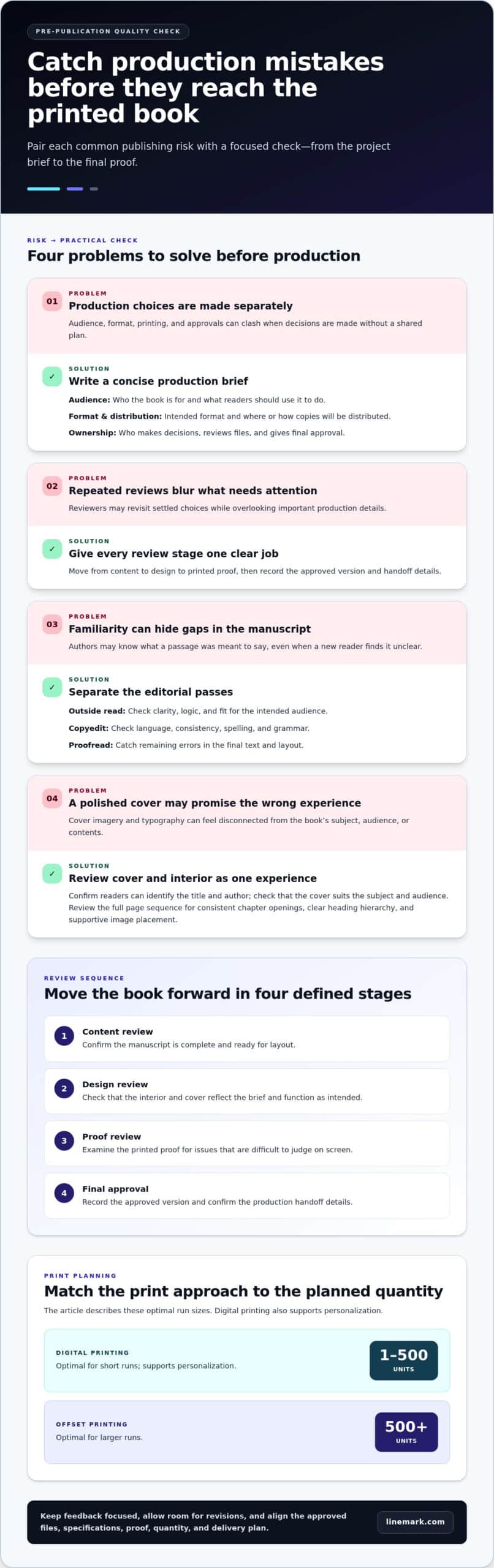
First-time authors face a chain of connected decisions: who the book is for, what format suits it, how it will be printed, and what needs approval before production. Treating these choices separately can lead to late changes, mismatched expectations, or files that aren’t ready to print. A simple plan gives each decision a place and makes it easier to spot conflicts early.
This section focuses on practical checks for authors preparing a printed book, rather than broad advice about building an author platform or planning a marketing campaign. If you’re still mapping the publishing process, Self-publishing on Wikipedia offers a general overview of its methods and history. For production planning, start by documenting your book’s requirements.
For a helpful overview of launch planning, watch this video:
Set the project brief before choosing production details
Record the audience, book category, intended format, and likely use. A reference book readers will consult regularly may call for different choices than a novel for personal reading or copies prepared for an event. Separate essential requirements, such as readable type and a format suited to the content, from preferences like a particular visual treatment or optional finish. This keeps production choices tied to the book’s purpose.
- State who the book is for and what readers should use it to do.
- Note the intended format and where or how printed copies will be distributed.
- Identify who owns decisions, reviews files, and gives final approval.
A written production brief helps align creative decisions with print requirements. It also gives collaborators a shared reference when a design preference affects a practical production choice. Keep it concise, but include enough detail to resolve questions without relying on memory.
Build a review sequence instead of relying on memory
Give each review stage a defined purpose. When the same file is checked repeatedly without clear roles, reviewers may revisit settled choices while overlooking production details. A staged process moves the book from content review to design review, physical proof, and final approval. Set a release plan with room for review and revisions, and treat dates as planning estimates rather than production guarantees.
- Content review: Confirm the manuscript is complete and ready for layout.
- Design review: Check that the interior and cover reflect the brief and function as intended.
- Proof review: Examine the printed proof for issues that are difficult to judge on screen.
- Final approval: Record the approved version and confirm the production handoff details.
Keep feedback focused at each stage. Content reviewers should flag clarity and completeness; design reviewers should assess presentation; proof reviewers should look for errors in the printed result. This structure is a practical first step in how to avoid self-publishing mistakes before they become production problems.
Catch editing, cover, and reader-experience mistakes before publication
Authors know their manuscripts so well that familiar passages can become difficult to assess objectively. A sentence may feel clear because the writer remembers what it was meant to say, while a new reader encounters a gap in logic or an unexplained idea. Fresh editorial eyes can reveal those blind spots before they’re locked into the printed book.
Editing and design checks serve different purposes. Keep them distinct so each review can focus on the problems it’s best equipped to catch.
Use independent readers and focused editorial passes
Start with an outside reader who can respond to the book’s logic, clarity, and fit for its intended audience. Developmental feedback considers broader elements such as structure, pacing, and whether ideas are developed clearly. Copyediting focuses on language and consistency, including spelling, grammar, and recurring style choices. It can improve the text, but it won’t replace substantial rewriting when the structure needs work.
Proofreading belongs near the end, after revisions and layout changes are complete. It checks the final text and pages for remaining errors, rather than reopening every earlier decision. If you change the manuscript after proofreading, review the affected pages again. Separate review passes make it easier to spot different kinds of problems.
- Outside read: Look for confusing passages, gaps in reasoning, or mismatches with reader expectations.
- Copyedit: Check language, consistency, and editorial conventions.
- Proofread: Catch remaining errors in the final text and layout.
Review cover and interior as one complete reading experience
A cover has a practical job as well as a visual one: readers should be able to identify the title and author, and the imagery and typography should suit the book’s subject and audience. Consider genre expectations without treating them as a rigid template. A cover that looks polished on its own may still send the wrong signal if it doesn’t match the book’s contents.
Review the interior across the full sequence of pages. Look for consistent chapter openings, a clear hierarchy between headings and body text, and image placement that supports rather than interrupts the reading. Check that visual choices remain consistent from the opening pages through the end, not just on a few attractive sample spreads.
- Read the cover at a glance, checking title and author-name legibility.
- Review chapter starts, headings, page numbers, and image placement across the book.
- Ask readers to assess the complete design and note where the experience feels confusing or uneven.
When preparing the approved design for custom book printing, carry those review decisions into the production files. Knowing how to avoid self-publishing mistakes means checking that the book works as a whole, not merely correcting isolated details.
Prevent print-file and proofing errors before approving the book
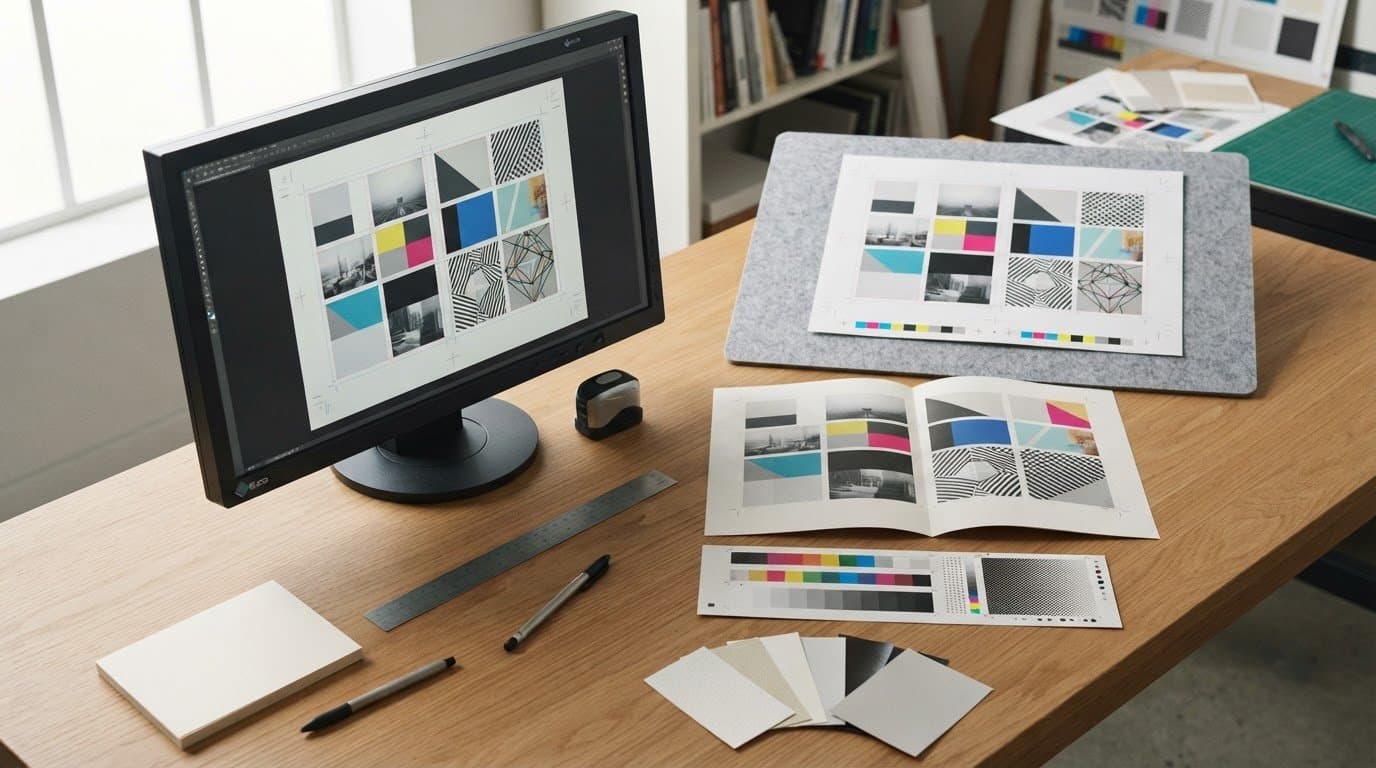
A manuscript can read cleanly on screen and still produce layout problems in print. Page size, margins, image placement, color, and bleed all need to match the specifications for the selected production method. Treat file preparation as a quality-control step, not a technical task to rush through after the creative work is finished.
Keep the setup review focused on the essentials. If you have a separate manuscript-preparation guide, use it for detailed file instructions. The checklist below helps confirm that the prepared file is ready to move through proofing.
Check the production file against the chosen book specifications
Compare the production file with the specifications for the book format and printing process. A file prepared for one trim size or format shouldn’t be assumed to fit another without adjustment. Even a small change in page dimensions can affect line breaks, image placement, and the position of content near the edge.
- Confirm page size, page order, margins, and any required bleed against the selected specifications.
- Check that images appear in the intended locations and meet production requirements for resolution and color.
- Verify that fonts are embedded or otherwise prepared as required, and review how color is expected to reproduce.
- Make sure the cover and interior files correspond to the same book format and approved design.
These checks are especially useful after a late edit. Adding or removing text can shift page breaks, move an image, or change the total page count. Review the exported production file itself, not only the editable document used to create it.
Make proof approval a deliberate quality-control step
A proof gives you a chance to inspect the book as a production piece before approving it. Review a physical proof for details that can be hard to judge on screen, such as cover alignment, legibility, page sequence, and visible production defects. A digital proof can help confirm layout and content against the approved file, but it won’t reproduce every aspect of a printed book.
Use a consistent review pass. Follow the page order, check the opening and closing pages, and compare proof content with the final approved manuscript and design. If you find an error, record its location and the required correction clearly. After revisions, confirm that the replacement files are the current versions and that superseded files are no longer being used.
- Compare the proof with the approved manuscript and design.
- Record corrections by page and describe the change needed.
- Review revised files and identify the version authorized for production.
Approve the exact production version, not an earlier draft. Clear version control helps prevent an outdated cover or interior from being mistaken for the final file. It’s a practical part of how to avoid self-publishing mistakes and keep the handoff precise.
Choose a self-publishing print route that fits your book and run
Print planning should match how you expect to produce and distribute the book, not just the number of copies you hope to sell. Print-on-demand can suit authors who prioritize flexibility and want to avoid holding a large inventory. A planned print run can make sense when copies are needed together for events, organizations, or coordinated distribution. Each approach affects how you manage stock and fulfill orders.
Digital and offset printing are production methods to weigh within that plan. Linemark’s digital printing is optimal for runs of 1-500 units and supports personalization. Offset printing is optimal for runs of 500 or more and uses custom-mixed PANTONE inks. These ranges help frame the decision, but they aren’t a universal rule for every title. The book’s specifications and how you’ll use the copies matter too.
Compare print-on-demand, digital, and offset production
Print-on-demand emphasizes flexibility: copies are produced in response to orders, which can help limit inventory on hand. A planned digital run gives authors a defined quantity of printed copies and can support personalized production. Offset is suited to higher-volume production. The right fit depends on your expected quantity, how frequently it may change, and whether personalization is part of the project.
- Flexibility: Consider whether demand is uncertain or you need copies available together.
- Quantity: Use the expected run to guide a discussion about digital or offset production.
- Book specifications: Define format, paper, binding, and finishing needs alongside the quantity.
Don’t choose solely by print method. A title with particular paper or finishing requirements may need a different production plan than a straightforward text-only book. A custom book printing guide can help you organize the production considerations before finalizing your approach. You can also explore custom book printing options with your format, quantity, and finishing needs in mind.
Match production decisions to distribution and fulfillment needs
Think through what happens after printing. Will copies ship individually, be stored for later orders, or go out in batches to bookstores, event attendees, or other recipients? These needs can influence the quantity you plan to print and how you manage inventory. They also help distinguish the manufacturing decision from the separate question of which platforms or retailers will list or sell the book.
For example, an author preparing copies for a scheduled event may value having a planned batch ready together. Someone testing demand may prefer greater flexibility and fewer copies on hand. Kitting, inventory management, and nationwide distribution are also useful considerations when the plan includes multiple components, ongoing stock, or delivery to readers across the country.
Before starting project-specific production, write down the format, anticipated quantity, paper and finishing preferences, personalization needs, and distribution plan. That brief gives the production conversation a clear starting point. Knowing how to avoid self-publishing mistakes includes matching the print route to the book’s real-world journey, from production through delivery.
Complete the self-publishing quality check with a clear production handoff
Before production begins, bring every decision into one final record. A clear handoff reduces the chance that an outdated file, an unresolved correction, or a missing delivery detail creates confusion after approval. It also gives the people handling production a shared reference for what the finished book should be and where copies need to go.
Use a final approval checklist before production begins
Make the checklist a working document, not a mental sign-off. Identify the approved manuscript and cover files by version or filename, then record the book format and production specifications. Name the person responsible for final approval so there’s no uncertainty about whose authorization releases the project.
- Confirm the final manuscript and cover files are the approved versions.
- Record the format, specifications, selected production route, and quantity.
- Confirm proof review is complete and remaining corrections are resolved or consciously accepted.
- Document distribution requirements, including delivery destinations and whether copies ship in batches or need to be stored.
- Identify the approval owner and keep the production handoff details together.
This final check is not a reason to reopen settled creative decisions. It’s a chance to verify that the files, specifications, and delivery plan all describe the same project. If an unresolved issue affects the printed result, pause approval until it’s addressed. If a reviewer accepts a minor remaining point, record that decision rather than leaving it ambiguous.
Coordinate printing and fulfillment through one production partner
Printing is only one part of the handoff. If copies also need kitting, inventory management, or distribution, coordinating those needs alongside production can help keep the workflow aligned. A single-source partner can connect the print plan with related fulfillment requirements, so project details are managed as parts of one coordinated process rather than separate handoffs.
Linemark has provided custom book printing since 1999 and brings more than 30 years of industry experience to book production. Its capabilities include digital and offset printing, binding and finishing, kitting, inventory management, and nationwide distribution. The author’s role remains central: provide approved files, clear specifications, quantity, and delivery requirements so the production plan has a complete foundation.
That’s the practical finish to how to avoid self-publishing mistakes: close the gaps between approval, production, and fulfillment before the book moves forward. Once your requirements are organized, discuss your custom book printing project with Linemark.
Move your book from approved plan to production
The next step is to turn your decisions into a clear production handoff. Keep the approved files, specifications, quantity, and delivery plan together so everyone working on the project is aligned on the same version. That coordination helps protect the work you’ve already invested in your book.
Knowing how to avoid self-publishing mistakes isn’t about removing every uncertainty. It’s about making deliberate decisions, documenting approvals, and giving production a well-defined brief. Once your requirements are ready, Linemark can help carry your printed book project into its next stage.
Discuss your custom book printing project with Linemark and take the next step toward bringing your book to readers.
Frequently Asked Questions About Self-Publishing
Do I need an ISBN to self-publish a printed book?
Not in every case, but an ISBN is commonly needed if you want a printed book distributed through bookstores, libraries, or retail channels. Some self-publishing platforms provide a free ISBN for books published through their systems. That option may affect which publisher is recorded and where the book can be distributed. If you want your own imprint listed as publisher, consider obtaining an ISBN yourself and check the requirements of your intended sales channels.
Can I use the same interior file for a printed book and an ebook?
Usually, you’ll need separate files or versions prepared for each format. A print interior is arranged as fixed pages, while an ebook may reflow text to fit different screens and reader settings. Page numbers, headers, and page breaks that work in print may not translate well digitally. Keep a clean source manuscript and prepare format-specific versions, then review each on its intended reading device or as a print proof.
How much does it cost to self-publish a printed book?
There’s no single total because the budget depends on the services and production choices your book requires. Account for editing, cover and interior design, ISBN decisions, print quantity, paper and binding specifications, and any storage or fulfillment needs. To plan responsibly, separate one-time preparation expenses from costs that vary with each production run. Define your scope and distribution plan before requesting project-specific printing information, and leave room for revisions.
Is print-on-demand a good choice for a first-time author?
It can be a useful option if you’re testing reader interest, expect orders to arrive gradually, or want to avoid managing a large stock of books. The trade-off is less control over coordinated batches for events or other planned distribution. Think about how copies will reach readers and whether you need them together. For short planned runs, digital printing is another production route to consider based on quantity and project requirements.
What happens if I find an error after approving my book proof?
Tell the production team what you found as soon as possible and identify the page, location, and exact correction. If production hasn’t begun, the file may need to be revised and reviewed again. If copies have already been printed, correcting the issue may involve preparing a new version for future production. Keep a record of the approved file and any requested changes so everyone is working from the same version.
Can I use copyrighted images in a self-published book?
Only if you have the rights or permission needed for your intended use. Finding an image online doesn’t automatically make it available for publication, and a credit line alone may not grant permission. Review the image’s license for print use, distribution, and any limits on modifications. Keep written permission or license records with your project files. If the rights are unclear, choose an image you own or one with clear terms for your use.
Should I order a proof copy before releasing my book?
Yes, reviewing a proof is a valuable final check before release. It lets you assess the printed book as a reader would, including whether the text is legible, the cover looks aligned, and images appear as intended. Read through the pages in sequence and check details such as chapter starts, page numbers, and captions. This final review is one practical way to catch issues and reduce self-publishing mistakes before readers receive the book.