


 10/18/2026
 Steve Bearden
What if the best postcard CTA isn’t the cleverest line, but the one that makes the next step unmistakable? That’s the practical answer to what makes a good postcard CTA: it gives the right recipient one relevant action, connects that action to a campaign goal, and makes the response measurable. On a small postcard, every extra instruction competes with the main message.
If you’re deciding whether to ask recipients to call, scan, visit a landing page, or redeem an offer, start with the action your campaign needs. The CTA needs enough detail to be specific without crowding the design or weakening the offer. And if responses can’t be connected to the mailing, it’s harder to learn what worked.
This guide explains how to choose one next step, write it in audience-centered language, and give it clear visual priority. You’ll also learn how QR codes and campaign-specific landing pages can help track responses, and how Variable Data Printing can make a CTA more relevant to each recipient. The result is a postcard designed to guide attention and provide useful campaign insight.
Key Takeaways
- What makes a good postcard CTA is how well it connects a campaign objective to one useful next action for the intended audience.
- Choose the action and response channel to fit the campaign, whether you’re seeking registrations, renewals, donations, or new customers.
- Use direct, benefit-led, urgent, or personalized wording based on the offer, and reserve urgency for a genuine deadline or reason to act.
- Build a clear visual hierarchy so the primary CTA stands out, then select a response path that supports campaign measurement.
- Linemark connects postcard production with variable data printing, in-house data management, mail processing, storage, distribution, and fulfillment.
What Makes a Good Postcard CTA, and Why Does It Matter?
A call to action (CTA) tells recipients what to do next. On a postcard, it turns interest in the message into a response the campaign can pursue, such as making a donation, registering for an event, or visiting a campaign page. A useful overview of the term’s role and formats appears in Call to action (marketing).
To understand what makes a good postcard CTA, look beyond whether it sounds catchy. It should support a defined campaign objective, make sense to the intended audience, and lead to a response path that works. A striking image or bold headline can earn attention, but it doesn’t tell recipients what to do. The CTA has a distinct job: make the next step clear.
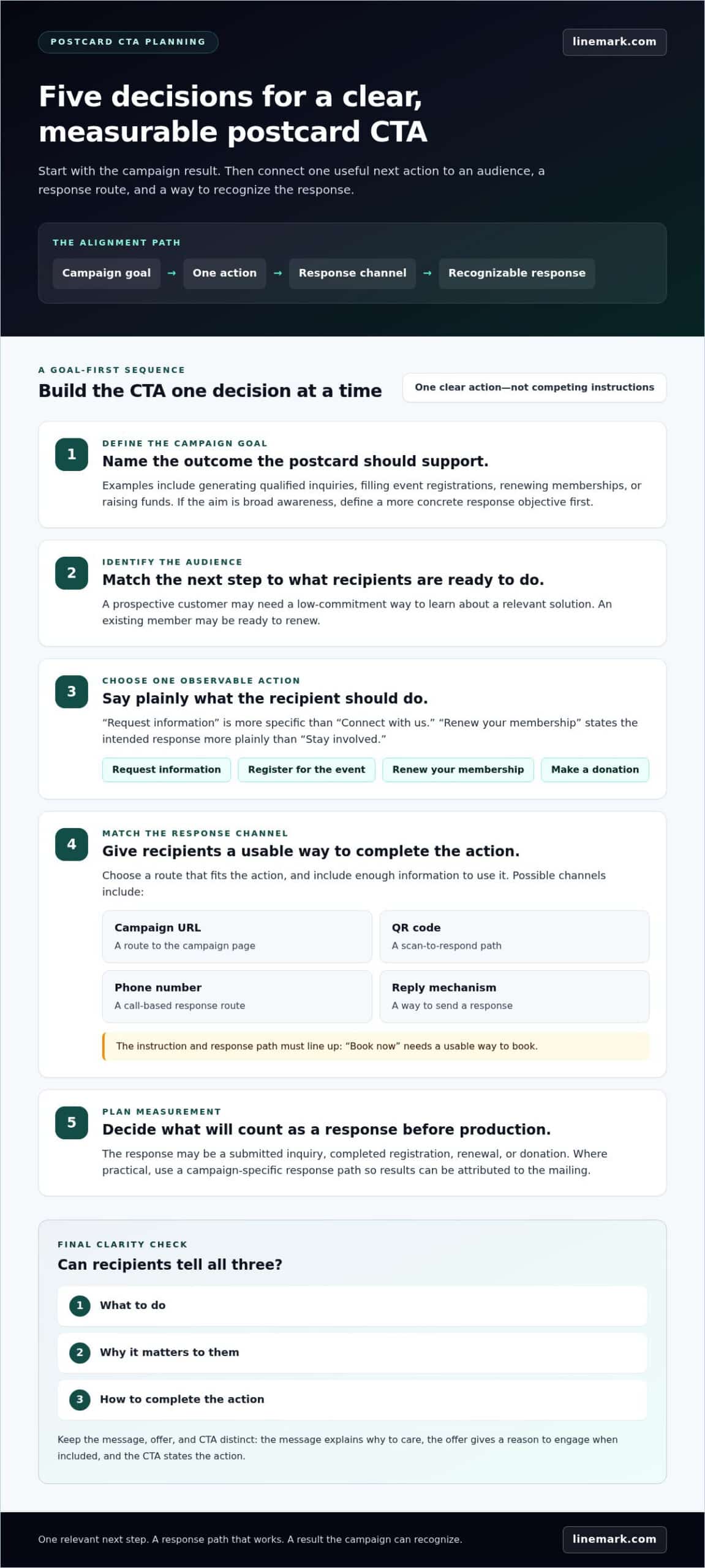
An effective postcard CTA gives a recipient one clear action that connects the message to a campaign goal. Use this as a practical test: can recipients tell what to do, why it matters to them, and how to do it? If not, refine the instruction or the information around it.
What job should a postcard call to action do?
A CTA should guide the reader toward one specific, relevant next step. Start with the audience’s immediate interest, then choose an action that responds to it. Someone interested in attending an event may need to register; a supporter who cares about a cause may be invited to contribute. The step also has to be possible through the response channel shown, such as scanning a QR code or entering a URL. If the card says “Book now” but gives no usable way to book, the instruction and response path don’t line up.
Specificity doesn’t require a long sentence. “Register online” is more actionable than “Learn more” when the campaign’s goal is event sign-ups. If the purpose is to introduce an organization, “Explore our programs” may fit better than asking for an immediate commitment. Choose wording based on what the audience is ready to do and what the campaign needs to measure.
How is a CTA different from the offer or main message?
Think of the message, offer, and CTA as related parts with distinct roles. The message explains why the recipient should care. The offer gives a tangible benefit or reason to engage, when one is part of the campaign. The CTA states the action. Keeping these roles clear prevents a headline or promotional detail from being mistaken for an instruction.
For example, a community organization might say, “Help local students build a daily reading habit” as its message, explain that donations support book kits as the supporting offer, then direct recipients to “Donate at [campaign URL].” The URL is illustrative, not a live address. A discount isn’t required: an invitation to register, request information, or support a cause can stand on its own when the action has meaning for the audience.
Design helps the CTA get noticed, but attention alone isn’t the goal. A decorative badge or oversized headline may draw the eye while leaving the next step vague. Keep the instruction distinct and make sure its wording matches both the campaign objective and the response channel. That alignment gives the postcard a coherent path from first impression to measurable action.
How to Choose the Right Postcard CTA for Your Campaign Goal
Start with the result you need, not with a catchy phrase. A goal-first process helps narrow the choices and keeps the CTA, response channel, and measurement plan working together. Use these five decisions to select the right action:
- Define the campaign goal. Name the outcome the postcard should support, such as generating qualified inquiries, filling event registrations, renewing memberships, or raising funds. A broad aim like “build awareness” may need a more concrete response objective before you can choose an action.
- Identify the audience. Consider what recipients already know and what they’re likely ready to do. A prospective customer may need a low-commitment way to learn about a relevant solution, while an existing member may be ready to renew.
- Choose the action. Pick one observable step that advances the goal. “Request information” is more specific than “Connect with us”; “Renew your membership” states the intended response more plainly than “Stay involved.”
- Match the channel. Choose a response route that supports the action and is easy for recipients to use, such as a campaign URL, QR code, phone number, or reply mechanism. Give recipients enough information to complete the step through that route.
- Plan measurement. Decide what will count as a response before the card is produced. Depending on the channel, that could be a submitted inquiry, completed registration, renewal, or donation. Use a campaign-specific response path where practical so results can be attributed to the mailing.
The campaign objective determines the CTA: choose the action that moves the intended audience toward that result. This is what makes a good postcard CTA practical, not just persuasive. The wording should lead to an action the campaign can recognize and evaluate.
Which CTA actions fit common direct-mail goals?
For customer acquisition, invite a relevant next step, such as “Request product information” or “Schedule a conversation,” and provide a response route that supports it. For an event, use “Register for the event” when sign-ups are the priority, or “View event details” when recipients need information first. For membership renewal, state the task directly: “Renew your membership.” For fundraising, “Make a donation” makes the response clear. Choose one primary action rather than asking recipients to take several steps at once.
How can you write a clear CTA in one pass?
Lead with an accurate action verb: register, renew, request, donate, or explore. Add a short benefit when it clarifies the value, such as “Register to reserve your place,” but don’t promise an outcome the campaign can’t support. Keep one primary instruction on the card and put details such as dates or eligibility in supporting copy. A CTA should set an accurate expectation, not merely sound compelling.
Once the goal and response path are defined, the wording can guide the postcard’s copy and production decisions. Linemark brings direct mail and postcard production together with data management and mail processing, helping connect campaign planning to execution.
Should a Postcard CTA Use Urgency, an Offer, or Personalization?
These approaches can make a CTA more compelling, but they serve different purposes. A direct CTA names the next step. A benefit-led CTA explains why that step may matter to the recipient. Urgency signals that timing matters, while personalization connects the message to a particular audience. The best choice depends on the campaign, not on a rule that every postcard needs a discount or deadline.
Use the comparison below to identify a suitable approach, then check that the wording supports the campaign goal and response path.
| Approach | Best-fit objective | Caution |
|---|---|---|
| Direct | Make a required step easy to understand, such as submitting an inquiry. | Keep the action specific, not vague. |
| Benefit-led | Explain the value of learning more or taking part. | Make sure the stated benefit is accurate. |
| Urgent | Prompt action around a real deadline or time-sensitive event. | Don’t manufacture pressure. |
| Personalized | Make the message more relevant to a recipient or audience segment. | Use accurate, purposeful details. |
When does an urgent or offer-led CTA make sense?
Urgency fits when the campaign has a real reason to act within a certain period, such as a registration deadline or a time-sensitive event. State the deadline plainly and make sure the response route supports the timing. If there’s no genuine deadline, a clear benefit-led or direct instruction is more trustworthy than “Act now” without explanation.
An offer is also optional. If one is part of the campaign, name it accurately and include any conditions recipients need to understand before responding. Avoid implying a saving, reward, or limited availability unless the campaign can substantiate it. The CTA should clarify the next step, not distract from it with pressure or vague promotional language.
How does personalization make a CTA more relevant?
Personalization can connect an action to a recipient’s interests, relationship with an organization, or relevant audience segment. For example, a message to previous event attendees might invite them to “Explore this year’s program,” while a general audience receives a straightforward invitation to view the event details. The wording should remain accurate and consistent with the campaign’s purpose.
Variable Data Printing supports personalized direct-mail pieces by allowing selected content to vary across a mailing. That can help align the CTA with the recipient’s message, but personalization is useful only when the information is correct and the action still makes sense. A recipient’s name alone doesn’t make an irrelevant instruction relevant.
In practice, what makes a good postcard CTA is the fit between the action and the reason for using a particular style. Choose direct wording when clarity is the priority, add a benefit when it helps explain the value, and use urgency only when timing genuinely matters. Personalize where it improves relevance. In every case, make the requested action clear and consistent with the campaign promise.
How to Make a Postcard CTA Easy to Notice, Use, and Measure
A CTA has to work across the full campaign journey: recipients need to spot it, understand how to respond, and follow a path that lets the campaign team evaluate results. Design and measurement are connected. The response method influences what you print, and the printed instruction needs to match what recipients encounter after they act.
Where should the main CTA appear on a postcard?
Place the primary instruction along the visual path from headline to supporting message, where it feels like the natural next step. Give it breathing room. Whitespace and contrast can distinguish the CTA from body copy without making it compete with the postcard’s main message. Use readable type, and review the design at final printed size so the action doesn’t shrink into fine print.
Check both sides of the card as a single experience. The front may introduce the benefit and direct attention, while the reverse can provide response details. Keep the CTA visually distinct wherever it appears, and make sure supporting information doesn’t introduce a competing action. Recipients should be able to identify the main instruction quickly.
How can you make the response measurable?
Choose a response path that fits both the action and the audience. A URL can lead to a campaign page, a QR code can provide a scannable route to that page, and a phone number or reply mechanism can suit recipients who prefer a direct response. Keep the destination relevant to the postcard’s promise. If you use a QR code, test that it scans reliably and opens a mobile-friendly page.
A visible CTA earns attention; a clear, campaign-specific response path makes that attention easier to measure. Before printing, decide what action will count as a response and how you’ll record it. A campaign-specific URL or QR code destination can help distinguish postcard responses from activity generated through other channels. For phone and reply responses, plan how staff will recognize and record campaign inquiries. Match the measurement method to the CTA instead of adding it as an afterthought.
- For a URL: Check the printed address for accuracy and make the destination relevant to the offer or message.
- For a QR code: Test it from a printed proof and confirm its destination works on a mobile device.
- For phone or reply responses: Define how responses will be captured and attributed to the campaign.
Set the baseline before launch: define the response metric, the period you’ll review, and where results will be recorded. Then compare responses with the campaign objective. This creates a useful learning loop for future mailings without assuming a particular response rate. A clear CTA and sound measurement plan support informed decisions, but neither guarantees a specific result.
For help connecting postcard production with campaign execution, plan your next direct mail campaign with Linemark.
How Linemark Can Support a Postcard CTA From Data to Delivery
A finalized CTA can shape more than a line of copy. It informs the postcard’s supporting message, response channel, audience-specific content, and the details needed to produce and distribute the mailing. Connecting these decisions early helps keep the printed instruction consistent with recipient data and the campaign’s intended next step.
Linemark brings direct mail and marketing postcard production together with in-house data management and mail processing. Variable Data Printing supports personalized pieces by allowing approved content to vary across a mailing. Personalization can make a CTA more relevant to its recipient, but it doesn’t guarantee a response. The message, data, and response path still need to align.
What needs to be ready before postcard production?
Before production, establish the campaign objective, intended audience, final CTA, and response channel. These decisions give the postcard team a clear foundation for copy and layout and help ensure the printed instruction matches what recipients will be asked to do. If the CTA directs people to a URL or QR code, confirm that the destination supports the action described on the card.
Prepare recipient data and review any fields that will be personalized. Names, audience details, and tailored messages should be accurate and fit the approved campaign copy. Then review the complete postcard, not just the CTA in isolation. Check that the action is legible at final size, the response instructions are consistent across both sides, and no variable message conflicts with the main campaign promise.
- Campaign plan: Objective, audience, final CTA, and response channel.
- Recipient data: Accurate fields that match the approved personalization.
- Final proof: Readable copy, consistent instructions, and one clear primary action.
How can print and fulfillment support campaign execution?
Once the content and data are aligned, production and mailing steps can work as one connected process. Linemark’s in-house data management and direct-mail processing support campaign execution, while postcard production brings the approved message and response path into the physical piece. This coordination matters: a correctly printed CTA can’t guide a recipient effectively if the destination or campaign details don’t match.
Campaign needs may also extend beyond printing and processing. Linemark provides storage, distribution, and fulfillment as connected services, supporting the movement of materials through the planned campaign workflow. Production can scale from one copy to millions of pieces, helping accommodate different project sizes while keeping the same planning priorities: align the audience, message, data, and intended action.
A strong postcard CTA is the result of coordinated decisions, from the first campaign objective to the final mailed piece. To explore how Linemark can support your mailing, explore Linemark’s direct mail services.
Turn Your Next Postcard Idea Into a Campaign
Put the principle into practice: choose one campaign objective, then shape a postcard that makes the desired response clear and relevant. What makes a good postcard CTA isn’t a formula to copy. It’s the alignment between your audience, the action you’re asking them to take, and the experience that follows.
That alignment can also guide production decisions. Linemark brings more than 30 years of industry experience to direct mail, with Variable Data Printing for personalized pieces and connected support for data management, processing, storage, distribution, and fulfillment. Each element can help carry a campaign plan from approved copy into execution, without promising a particular response.
Ready to move from CTA planning to your next mailing? Explore Linemark’s direct mail services and take the next step toward a postcard campaign built around a clear action.
Frequently Asked Questions
What is a good call to action for a postcard?
A good postcard CTA asks for one response that fits both the mailing’s purpose and the recipient’s situation. For example, a postcard introducing a service could invite a prospect to request details, while a follow-up to current customers could ask them to schedule a review. To judge what makes a good postcard CTA, check that its verb names a real action and the next step is evident from the card.
How many calls to action should a postcard have?
Give the postcard one primary CTA, then make any other instructions support that same response. A card might ask readers to sign up, with a URL and a phone number as two ways to complete that action. Those are response options, not competing campaign goals. If the postcard needs a secondary action, such as visiting an information page before registering, show clearly how it leads to the main action.
Should a postcard CTA include a QR code?
A QR code is useful when scanning gives recipients a straightforward route to the next step, such as viewing an event schedule or completing an inquiry form. Label it with a clear instruction so people know what they’ll get by scanning. Before printing, test the code from a proof and check that the destination loads properly on a phone. If some recipients may prefer not to scan, include another practical response option.
Where should the CTA go on a postcard?
Place the CTA near the message that gives the recipient a reason to act, so the instruction feels connected rather than detached. On a two-sided card, the front can introduce the main benefit and the reverse can carry response details, provided the action remains easy to locate. Review the full design at actual size, including the address and other required content, to catch crowding that may be less apparent on screen.
Should a postcard CTA create urgency?
Use urgency only when recipients have a genuine reason to act within a defined period, such as an upcoming registration deadline or a campaign that closes on a stated date. Explain the timing plainly rather than relying on generic phrases like “Hurry.” If there’s no real deadline, focus on why the action may be useful. Pressure without a factual reason can weaken trust instead of helping recipients decide.
How do you measure whether a postcard CTA works?
Measure the response that best reflects the campaign’s goal, such as completed registrations rather than page visits for an event sign-up campaign. Record the measurement method before mailing and keep it consistent across versions. A scan or visit shows engagement, but it may not equal a completed action. Review the audience, offer, timing, and execution alongside the CTA so you don’t attribute every campaign result to wording alone.
Can you personalize a postcard call to action?
Yes, personalization can make a CTA more relevant when the recipient information is accurate and the message fits the campaign. For instance, a renewal postcard can address an existing member with language specific to continuing their membership. Variable Data Printing supports personalized direct-mail pieces. Before production, proof the different versions and check that each data field appears as intended, that the CTA remains clear, and that no recipient receives a mismatched message.