


 10/16/2026
 Steve Bearden
What good is protected print stock if your team can’t find the right version when it’s time to fulfill an order? Secure warehousing for printed materials needs to do more than move inventory out of your office or production area. It should help keep stock organized, visible, and ready to use while reducing the risk of damage, unauthorized access, or outdated materials going unnoticed.
Printed pieces take up valuable space, stock levels can be hard to track, and fulfillment gets complicated when storage and distribution are managed separately. A coordinated workflow can bring these moving parts together.
In this article, you’ll find practical ways to protect printed inventory, maintain visibility into what’s available, and connect storage with picking, kitting, and distribution. Linemark brings in-house warehousing, inventory management, fulfillment, and nationwide distribution together with print production, helping simplify coordination from finished materials to delivery. With more than 30 years of industry experience, Linemark supports a connected approach to keeping print stock organized and ready to meet demand.
Key Takeaways
- Secure warehousing for printed materials works best as a coordinated process for protecting stock, handling it appropriately, and keeping inventory visible.
- Classify materials by sensitivity and intended use to guide handling and access procedures.
- Track each item’s identifier, version, quantity, storage status, and authorized use to make stock easier to manage.
- Use a consistent fulfillment sequence, from request and stock check to picking, kitting, packing, and distribution.
- Connecting print production, storage, inventory management, and fulfillment can simplify coordination from finished materials to delivery.
Why Secure Warehousing for Printed Materials Matters to Marketing Operations
Print inventory supports campaigns, sales conversations, events, and customer communications. When boxes are spread across offices, production areas, or multiple storage spots, teams can lose time locating the right piece and may not know how much usable stock remains. The result can be avoidable delays, duplicate orders, or uncertainty about whether materials are ready for the next campaign.
Secure warehousing for printed materials is a coordinated system for protecting usable stock, guiding how it is handled, and maintaining clear visibility into what is stored and available. It’s more than assigning materials a shelf or room. A warehouse supports organized storage and movement, as described in this overview of the Benefits of warehouses. For marketing operations, the value comes from connecting that space to the information and processes needed to retrieve the right materials for their intended use.
Not every printed piece needs the same treatment. General brochures may be appropriate for broad distribution, while personalized mailers or materials containing sensitive information may call for more defined handling and access procedures. Start by identifying what each item is, how it will be used, and who should handle it.
Which printed materials benefit from managed storage?
Brochures, catalogs, books, mailers, annual reports, and event materials can all occupy space between production and use. Campaigns often run in cycles, so printed stock may need to be stored until a scheduled mailing, sales push, conference, or other planned distribution. Managed storage helps teams treat that inventory as an operational resource rather than a collection of boxes to search through.
Separate reusable collateral from pieces tied to a specific date, offer, event, or campaign. A general company brochure may remain relevant across several campaigns, while an event program or dated mailer can lose usefulness after its intended use. Label these categories clearly so staff can distinguish them before selecting stock for distribution.
What risks does secure print storage help manage?
Dispersed or poorly identified stock can be harder to locate, count, and handle consistently. Materials may be misplaced or damaged, and unclear records can leave teams unsure whether inventory is available. If versions aren’t easy to distinguish, an older piece could be selected by mistake. These are operational risks that a well-defined process can help manage.
Useful safeguards begin with process clarity: identify each item and version, record quantities and status, define handling expectations, and make authorized use clear to the people involved. Plan a separate process for personalized or sensitive communications rather than treating them like general promotional collateral. When inventory information and physical stock stay aligned, marketing teams can make informed choices about what to fulfill, what needs replenishment, and what may no longer suit an upcoming campaign.
How to Protect Printed Materials Through Storage, Handling, and Access Controls
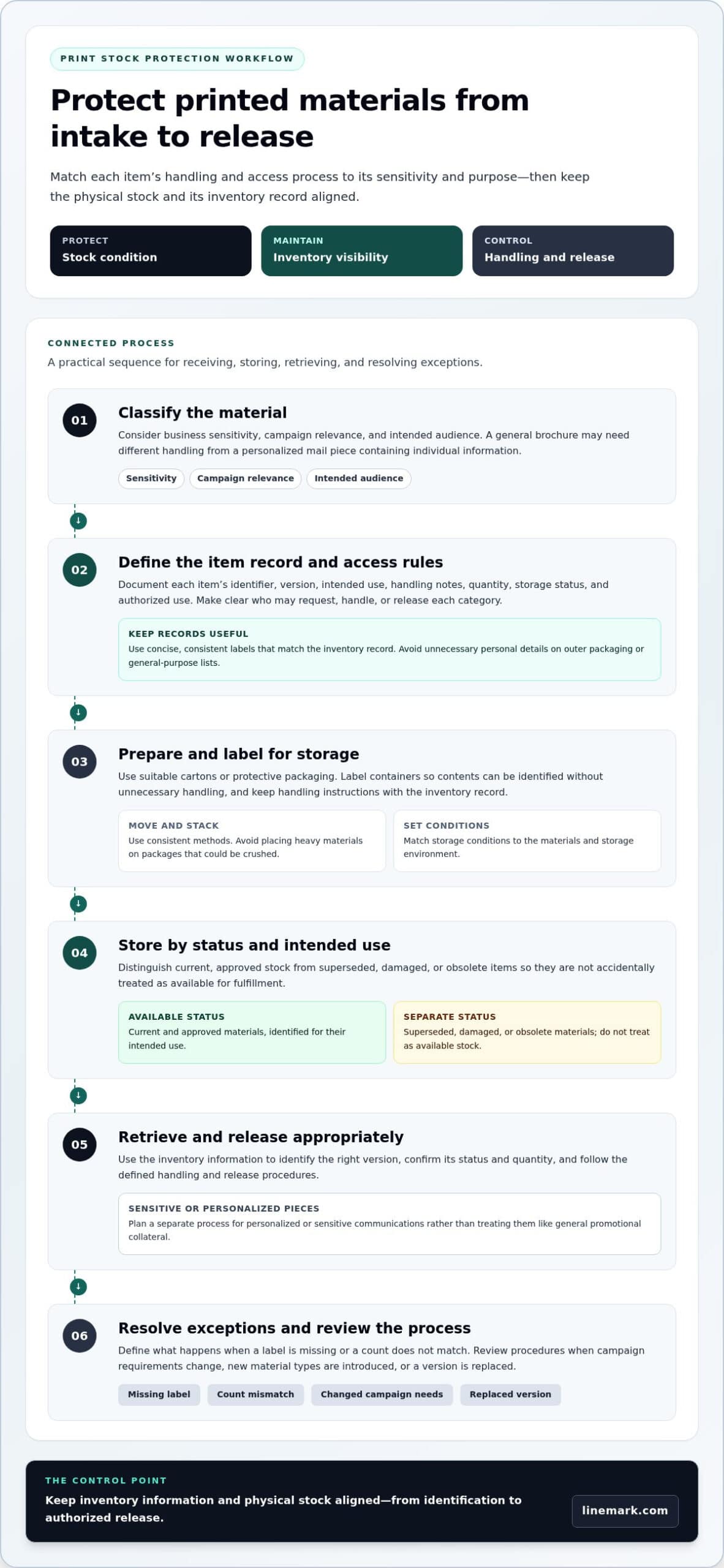
Protection starts with a clear plan for each type of printed stock. Before materials enter storage, decide how they should be identified, handled, and released. This turns secure warehousing for printed materials into a repeatable operating process rather than a general instruction to “keep it safe.” Match the process to the material’s sensitivity and purpose, and make it practical for the people who receive and fulfill requests.
Packaging and handling matter, too. Keep printed pieces in suitable cartons or protective packaging, label containers so contents can be identified without unnecessary handling, and use consistent methods for moving and stacking stock. Avoid placing heavy materials on packages that could be crushed, and keep handling instructions with the inventory record. Set storage conditions according to the materials and storage environment instead of assuming that every paper stock, coating, or binding has the same needs.
How should organizations classify printed stock?
Use a small set of categories that staff can apply consistently. Consider business sensitivity, campaign relevance, and intended audience. A general brochure may be handled differently from a personalized mail piece that contains individual information. Classification should also distinguish stock that is current and approved from items that have been superseded, damaged, or designated obsolete, so those categories aren’t accidentally treated as available for fulfillment.
For each item, document its identifier, version, intended use, and any handling notes. Keep the label concise and consistent with the inventory record. If a piece is personalized or confidential, make its handling requirements clear to the people authorized to process it. Avoid exposing personal details unnecessarily on outer packaging or general-purpose lists.
What should a print storage security process address?
Document responsibilities and the steps for receiving, storing, retrieving, and resolving exceptions. A useful procedure answers practical questions: who may request each category, who can handle or release it, how quantities and condition are recorded, and what happens if a label is missing or a count doesn’t match. Review the process when campaign requirements change, new material types are introduced, or a version is replaced.
- Receiving: Match incoming materials to their identifier and version, record the quantity, and note visible damage or discrepancies.
- Storage: Keep categories distinguishable, with handling notes available to staff who need them.
- Retrieval: Check the requested item and approved version before stock is released for an order.
- Exceptions: Set aside unclear, damaged, or superseded stock until its status is resolved.
Build security procedures around the controls your operation uses and document them clearly. Include responsibilities for handling and release, along with a process for recording exceptions. Linemark brings print production, warehousing, inventory management, and fulfillment together in one offering through Linemark’s print and fulfillment services.
How Print Inventory Tracking Keeps Stored Materials Visible and Usable
Stored print only supports a campaign if the team can identify it, confirm its status, and locate enough usable stock. Tracking can range from a basic list to a managed inventory process. The right approach depends on how many materials and versions need coordination, and how many teams request them. Unmanaged stock offers little visibility beyond what someone remembers or can find by searching. A spreadsheet can provide a shared record, but it depends on consistent updates and clear ownership. Managed inventory adds a defined process for keeping stock information connected to storage and fulfillment needs.
Accurate records make print inventory useful for decisions, not just counting. Reliable stock records help teams reduce avoidable reprints and stockouts by showing what’s available, which version is current, and what upcoming campaigns may require. They can’t guarantee that demand will match the plan, but they give teams a firmer basis for acting early.
What information belongs in a printed-material inventory record?
Build each record around fields staff can use to identify and manage stock without guesswork. Keep naming consistent across labels, requests, and inventory records. For example, distinguish a standard brochure from a revised brochure or a different format instead of relying on a broad label such as “marketing handout.”
- Item name or identifier: Use a distinct, consistent label for each material.
- Approved version: Record the revision or approval status so teams can distinguish current stock from superseded pieces.
- Quantity and status: Note available quantities and whether stock is ready for use, on hold, or otherwise unavailable.
- Ownership and intended use: Identify the responsible campaign or department, intended audience, and any restrictions on use.
These fields should reflect how teams request and distribute materials. If two brochures look similar, a clear identifier and version record can prevent the wrong one from being selected. For personalized or restricted communications, include handling and use notes appropriate to the material without placing unnecessary personal information in a general inventory description.
How can teams plan replenishment without overstocking?
Use current quantity as a starting point, then compare it with upcoming campaign schedules and past usage. A team preparing for an event can review planned distribution alongside remaining stock, while a department with recurring mailings can use prior usage as a planning reference. Treat history as guidance, not a promise of future demand.
Before replenishing, account for planned revisions, seasonal shifts, and changes in audience or campaign scope. A large quantity of an older piece may not meet the need if copy, contact details, or offers have changed. Review inventory before approving a reprint, and flag stock whose future use is uncertain so it isn’t mistaken for ready-to-use material.
For secure warehousing for printed materials, inventory visibility connects physical stock with campaign planning and fulfillment decisions. Linemark’s inventory management service supports that coordination as part of its broader storage and fulfillment offering. Teams can use clear item records, version details, and campaign plans to guide inventory decisions.
From Stored Print to Delivery: A Practical Fulfillment Workflow
A clear fulfillment sequence connects a campaign request to the correct printed materials and their destination. Each handoff should carry the item identifier, approved version, quantity, and any assembly or delivery instructions. That shared information helps teams move stock from storage into use without relying on memory or guesswork.
- Submit the request. Identify the material, quantity, destination, and intended campaign. Include any required components or special packing instructions.
- Check stock and version. Compare the request with available inventory and confirm the requested piece is current and approved.
- Resolve exceptions. If stock is insufficient or the requested version is superseded, pause preparation and determine whether to adjust the quantity, use an approved alternative, or arrange replenishment.
- Pick the materials. Retrieve the identified stock and verify its label and quantity against the request before it moves to fulfillment.
- Kit and pack. Assemble the required pieces in the intended combination, then pack them according to the campaign’s distribution needs.
- Distribute and update. Send the prepared materials to the stated destination and update inventory records to reflect the stock used and remaining.
This sequence works as a handoff map: the requester supplies campaign details, inventory staff validate stock, fulfillment prepares the order, and distribution moves it onward. Clear identifiers and approved versions keep those steps aligned. Print production can feed the same workflow when available stock no longer meets campaign needs, helping connect replenishment with storage and distribution planning.
What happens when a team requests stored materials?
Start with a complete request, not a vague instruction to send “the brochure.” A campaign or department should specify the exact item, quantity, destination, and intended use. Before picking begins, confirm that the requested version is approved and that the available quantity is suitable. If there’s a mismatch, document the issue and agree on the next step before releasing materials.
When do kitting and distribution belong in the workflow?
Kitting is useful when a campaign or event needs several printed pieces assembled as one coordinated set, such as a brochure, response card, and accompanying letter. Packing instructions should make the intended combination clear. For mail campaigns, teams can connect this workflow with planning guidance on direct mail marketing in 2026. When delivery spans multiple destinations, fulfillment can connect prepared materials with nationwide distribution.
Storage, inventory management, kitting, and distribution can operate as connected capabilities rather than separate coordination tasks. To align stored print with picking and delivery, coordinate print storage and fulfillment with Linemark.
How Linemark Connects Printed-Material Storage with Fulfillment
Printed materials move through several stages: production, storage, inventory management, picking, kitting, and distribution. Coordinating these activities within a connected print and communications offering can simplify planning, especially when campaigns draw on multiple items or require replenishment. Instead of treating each handoff as a separate task, teams can align the information needed to move stock from finished print to its intended use.
Linemark provides storage, distribution, fulfillment, and inventory management, connecting these capabilities with print production. Its more than 30 years of industry experience and nationwide distribution support this broad offering. A strong warehousing plan also defines how stock is identified, handled, tracked, and released, so the operational process matches the materials and their intended use.
What can a single-source print partner coordinate?
A single-source partner can coordinate production with stored inventory, then support requests that require picking, assembling multiple pieces, and distribution. For example, a campaign may combine a brochure with a mailer or event materials. Shared information about the items, versions, and intended use can reduce separate operational handoffs and make it easier to see how the work fits together. Explore how kitting and fulfillment can connect printed pieces with campaign execution.
- Production: Establish which printed materials are being produced and which approved versions enter inventory.
- Storage and inventory: Keep stock information aligned with campaign needs and planned use.
- Kitting: Assemble multiple items into a coordinated set when a request calls for it.
- Distribution: Connect prepared materials with their intended destinations, including nationwide distribution where required.
How can organizations prepare for a storage and fulfillment plan?
Start with a practical inventory of what the organization needs to store and use. A concise planning brief helps align production, storage, and fulfillment requirements. Include enough detail to distinguish current stock from pieces that may need revision, and outline how requests typically arise across departments or campaigns.
- List print items, approved versions, and approximate quantities.
- Map campaign dates and expected periods of use.
- Identify sensitivity, handling requirements, and any restrictions on use.
- Note likely destinations and expected request patterns.
With this information in hand, teams can plan how storage, inventory management, and fulfillment fit their workflow. Explore Linemark’s storage, distribution, and fulfillment services to see how these connected capabilities can support printed materials from production through delivery.
Make Your Print Inventory Work Harder
Use your next campaign as a starting point: identify the materials it will need, clarify how those pieces should be handled, and consider how storage and fulfillment can support the plan. That gives your team a practical foundation for secure warehousing for printed materials while keeping print inventory connected to future communication needs.
When production, storage, inventory management, kitting, fulfillment, and distribution work together, teams have a clearer path from planning to delivery. Linemark brings more than 30 years of industry experience to this connected print and communications offering, including nationwide distribution. A well-defined workflow can adapt to campaign needs and help turn stored materials into useful resources rather than idle stock.
Explore Linemark’s storage, distribution, and fulfillment services to take the next step toward a more coordinated approach to print inventory. Share your print and fulfillment needs with Linemark to plan how materials can move from production and storage to distribution.
Frequently Asked Questions
What does secure warehousing for printed materials mean?
Secure warehousing for printed materials combines suitable storage with clear procedures for handling, requesting, and tracking stock. It’s broader than selecting a room or warehouse: the process should reflect the material’s sensitivity, intended use, and fulfillment path. For example, a general product brochure and a personalized mail piece may need different request and handling practices. Define handling and access procedures in a way that matches each material category.
Do printed materials need climate-controlled storage?
Not all printed materials have the same storage requirements. Paper type, coatings, binding, packaging, intended use, and the length of storage can all affect what conditions are appropriate. A short-term supply of event flyers may have different needs from a finished book kept for later distribution. Set material-specific handling and storage requirements based on the stock and its planned use.
How should businesses handle confidential printed materials in storage?
Identify confidential pieces before they enter storage, then define who may request, handle, and release them. A personalized mail piece, for instance, may warrant a distinct process from a general brochure, including careful review of the request and item identification that avoids exposing personal details unnecessarily. Record receipt and release so teams can reconcile stock. Clear procedures support responsible operations and help limit unnecessary access to sensitive materials.
How often should a business review its printed-material inventory?
Choose a review cadence that reflects how quickly stock moves and how often campaigns or versions change. A frequently requested mailer may merit closer checks than an occasional-use annual report. During a review, compare recorded quantities with the stock on hand, identify superseded versions, and note items nearing a planned campaign or event. Adjust the schedule if usage patterns shift, a campaign changes, or stock becomes more time-sensitive.
How can a team decide how much printed material to store?
Estimate quantities using planned campaign demand, distribution plans, historical use, and current stock, then account for how often the material may be revised. For example, a piece with frequently changing offers may be better planned in smaller replenishment cycles than a stable reference booklet. Avoid basing the decision on one forecast alone or storing large volumes without an intended use. Revisit estimates when timing, audience, or content changes.
Can printed materials be stored and fulfilled through one provider?
Yes. A provider that handles both can coordinate inventory with picking, kitting, and distribution, so those activities follow a connected workflow. Linemark offers storage, inventory management, fulfillment, and distribution as part of its broader print and communications services. Shape the workflow around the organization’s materials, campaign schedule, and destinations. A clear plan helps teams define what needs to be stored and how requests will move toward delivery.