

 10/19/2026
 Steve Bearden
What if print on demand for corporate marketing were less about eliminating inventory and more about controlling how materials are replenished, personalized, and distributed? That distinction matters to marketing teams. Printed collateral can go unused when campaigns change, while distributed teams may order inconsistently or rely on outdated files.
These challenges are especially familiar when teams need small or personalized runs without adding complexity to production and fulfillment. A managed workflow can help employees order current materials, use approved brand assets, and coordinate the steps from printing through delivery.
This guide explains how corporate print on demand fits into a broader communications workflow. You’ll learn how managed ordering, digital and offset printing, variable data, inventory management, kitting, and fulfillment can work together across teams. The goal is a practical replenishment model that gives marketing leaders better control over materials without making every order a new operational project.
Key Takeaways
- Use print on demand for corporate marketing as a controlled replenishment workflow, not as an ecommerce merchandise store.
- Build a clear path from approved files and ordering through production, fulfillment, and delivery.
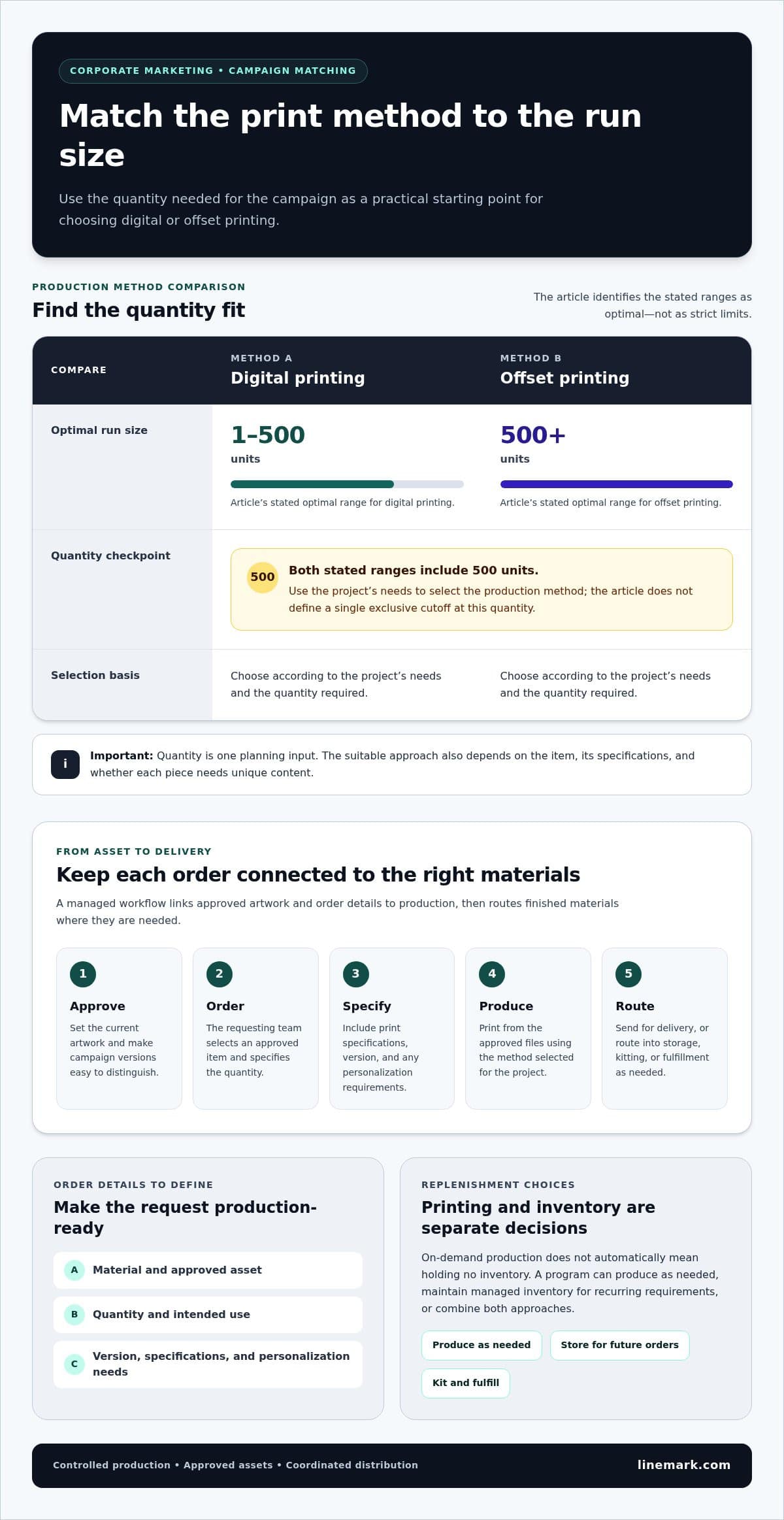
- Match production method to the campaign: digital printing is optimal for 1 to 500 units, while offset printing is optimal for runs of 500 or more.
- Set practical controls for assets, audiences, quantities, timing, and fulfillment to support consistent ordering across distributed teams.
- Connect printing with variable data, inventory management, kitting, and distribution to coordinate materials across the broader marketing workflow.
What Print on Demand for Corporate Marketing Actually Means
Corporate print on demand produces approved marketing materials in response to actual orders. Rather than committing every team to a large run upfront, an organization can replenish materials as campaigns and local needs arise. For print on demand for corporate marketing, the focus is less on selling products online and more on coordinating production, approved assets, and distribution as one communications workflow.
On-demand production can help limit excess printing when quantities or campaign versions change, but it does not automatically mean holding no inventory. Materials may still be stored for future orders, assembled into kits, or distributed through a fulfillment process. The broader concept is outlined in What is Print on Demand?; corporate use adds controls for who can order, which files they can use, and how materials reach their intended audiences.
The following video discusses print on demand from a seller’s perspective. Corporate teams can use it as a general introduction to the model before considering their own workflow.
How corporate print on demand differs from ecommerce POD
Ecommerce print on demand typically connects a consumer’s online purchase to production and fulfillment. A corporate program serves a different purpose: employees, departments, locations, or approved partners order materials for business use. A sales team might request brochures, an event organizer might order postcards, or a campaign team might replenish mailers. These materials support organizational needs rather than consumer merchandise sales.
That distinction makes permissions and file control central. A managed ordering process can present approved assets and defined options, helping teams request current materials without changing brand content or using outdated files. It also gives the organization a consistent route from order to production, instead of leaving each team to arrange printing independently.
Which marketing materials can be produced on demand?
General print solutions can include brochures, postcards, mailers, newsletters, catalogs, and other business collateral. Campaign materials may need versions for different audiences, personalization through variable data, or replenishment as teams use existing stock. The suitable approach depends on the item, its specifications, quantity, and whether each piece needs unique content.
Start by identifying the job each item needs to do. A reusable brochure may need a stable, approved version, while campaign mailers may require recipient-specific details. A practical program accounts for:
- Which assets are approved and available to order
- Who can access each item and request a version
- Whether materials need personalization, storage, or fulfillment
Print on demand is therefore not simply “print less.” It connects demand to controlled production while preserving the inventory and handling steps that support reliable marketing operations.
How the Corporate Print-on-Demand Workflow Moves from Asset to Delivery
A dependable workflow connects approved artwork to a clear order, then separates printing from decisions about storage and delivery. This structure makes print on demand for corporate marketing easier to manage across departments: teams work from current materials, and each order includes the information needed to produce and route it correctly.
From approved marketing asset to production-ready order
Begin with current, approved artwork and a defined ordering process. Linemark’s MarCom On-Demand provides custom online ordering platforms and management services for corporate marketing programs. Before an order moves into production, define the details teams need to provide, such as the material, quantity, version, and intended use. Linemark’s MarCom On-Demand strategic guide offers further context on managed ordering for distributed marketing.
- Approve the asset. Establish which artwork is current and ready to use. Make campaign versions easy to distinguish so each order can be tied to the right material.
- Place the order. The requesting team selects the approved item through the managed ordering process and specifies the quantity needed.
- Provide production details. Include relevant print specifications and identify any version or personalization requirements. Complete information helps align the order with the intended result.
- Produce the materials. Production follows the order and its approved files. Select digital or offset printing according to the project’s needs.
- Choose the next step. Send finished materials for delivery, or route them into storage, kitting, or fulfillment if the program requires those services.
This sequence keeps file control and production details connected. For broader context on providers and the ecommerce-oriented POD market, Forbes’ overview of print-on-demand companies discusses the category; corporate ordering also needs to account for approved assets and internal users.
Production, fulfillment, and replenishment are separate decisions
Printing after an order is one choice. Holding materials for future requests is another. A team can arrange production as needed, maintain managed inventory for recurring requirements, or combine the two approaches. Separating these decisions helps marketing plan replenishment without treating all printed stock as unnecessary.
For a campaign with several pieces, kitting can bring materials together as a coordinated package, while fulfillment supports preparation and delivery. Nationwide distribution can extend that workflow to recipients across the country. These services are separate from production, so teams can define handling and distribution needs alongside the print order instead of assuming they happen automatically.
When these steps are planned together, the process is easier to manage from approved file through delivery. Linemark connects printing with marketing production and fulfillment services as part of a coordinated communications workflow.
Digital, Offset & Variable Printing: Campaign Matching
Choosing a production method starts with the job the material needs to do. Run size matters, but so do color requirements, the number of versions, and whether each piece needs recipient-specific content. For print on demand for corporate marketing, consider these factors together rather than using quantity as the only decision rule.
Match the print method to run size and personalization needs, then account for the campaign’s color and format requirements.
| Approach | Run context | Personalization and campaign fit |
|---|---|---|
| Digital printing | Optimal for 1 to 500 units | Useful for shorter runs and campaign materials that need to be produced in limited quantities. |
| Offset printing | Optimal for 500 or more units | Suited to high-volume campaigns; custom-mixed PANTONE inks can support color fidelity. |
| Variable Data Printing (VDP) | Consider when pieces need individualized content | Enables personalization across print materials, such as segmented mailers or tailored campaign collateral. |
These are production guidelines, not universal guarantees about project economics or the right choice for every job. A run of 500 units falls within both stated ranges, so campaign requirements and specifications help determine the appropriate approach. Print format, color needs, personalization, and how the materials will be used all matter.
When digital printing fits short or personalized runs
Digital printing is optimal for runs of 1 to 500 units, making it a practical option for limited campaign quantities or targeted collateral. Linemark offers full personalization through Variable Data Printing. For example, a segmented mailer can carry different content for distinct audience groups, while tailored campaign pieces can include recipient-specific information. Plan the content and specifications together before production.
When offset printing fits high-volume corporate campaigns
Offset printing is optimal for runs of 500 or more units. It can support high-volume corporate campaigns, including materials where consistent color is a priority. Linemark also offers custom-mixed PANTONE inks for color fidelity. Quantity is one part of the decision; teams should also consider color requirements and whether pieces need personalization.
A campaign with broad-reach collateral and a tailored mailing may need different run contexts and levels of personalization. Define the requirements by asking:
- How many pieces are needed for each audience or version?
- Does the campaign require individualized text, images, or offers?
- Are specific color requirements central to the finished material?
Clear answers help align the production method with the campaign instead of forcing every item into the same approach.
How to Plan Corporate Print on Demand Without Losing Brand or Inventory Control
Distributed ordering does not have to mean distributed brand standards. Keep current artwork identifiable, define who maintains campaign information, and give teams a consistent way to request materials. Print on demand for corporate marketing works best when asset governance and replenishment planning are designed together, rather than treated as separate tasks.
Set controls for brand assets and distributed ordering
Start with a reliable source for approved artwork and clear version names. Labels such as campaign, audience, and revision date can help teams distinguish current files from outdated ones. Assign an owner to maintain assets, update campaign specifications, and communicate ordering rules. These responsibilities give distributed teams a shared reference point, even when they place orders at different times.
Use this planning checklist to establish a consistent ordering foundation:
- Assets: Identify approved artwork and a clear way to recognize current versions.
- Ownership: Name the people responsible for asset updates, campaign specifications, and ordering guidance.
- Audiences: Define who will use or receive each material, including distinct groups that need different versions.
- Quantities: Estimate the amount needed for each audience or campaign activity.
- Timing: Record when materials are needed and whether demand recurs or is tied to a single campaign.
- Fulfillment: Decide whether materials should be delivered directly, held for later orders, or assembled with other items.
Clear instructions help prevent teams from improvising their own artwork or ordering approach. A managed ordering process, including MarCom On-Demand, can give distributed teams access to approved assets and a consistent route for requests. The organization still needs to define asset owners and campaign rules. Clear responsibilities help keep local ordering aligned with central brand direction.
Plan quantities, personalization, and inventory together
Use campaign purpose and past ordering information, where available, to estimate likely demand. A one-time event may call for a limited production run, while frequently requested collateral could make managed inventory useful. The right approach depends on how often an item is needed, whether its content may change, and how it will be fulfilled.
Review these decisions as campaigns evolve. If artwork, offers, or audience details are likely to change, producing against current orders can help avoid holding outdated stock. If a material stays relevant and requests recur, stored inventory may support replenishment. Either approach still requires planning quantities and tracking what teams use.
Personalization is another planning input. Variable Data Printing can support tailored content when recipient or audience differences serve the campaign. Identify versions and their specifications before ordering so the print plan reflects intended use as well as quantity.
Linemark’s corporate print services connect production, inventory, and fulfillment for coordinated programs.
How Linemark Connects Corporate Print on Demand with Marketing Fulfillment
Corporate print programs often involve more than producing a finished piece. Campaigns may also require data preparation, storage, assembly, mailing, or delivery to multiple destinations. Linemark is a single-source partner for printing, kitting, inventory management, and nationwide distribution, connecting production with the operational steps that help marketing materials move through an organization.
Digital and offset printing support projects with different run needs, while Variable Data Printing can add personalized content where a campaign calls for it. Linemark can handle runs from one copy to millions of pieces. The right approach depends on the project’s specifications, quantity, and personalization requirements.
A connected production and fulfillment partner
Linemark’s in-house capabilities include data management, direct-mail processing, warehousing, and fulfillment. A campaign plan can account for what happens before and after printing: preparing data for a mailing, storing materials for future requests, assembling pieces into kits, and coordinating nationwide distribution. Each step can be planned around the campaign’s requirements.
For example, a marketing team may need printed materials prepared for a direct-mail campaign, with versions tailored to recipient groups and finished pieces routed for distribution. Connecting production and mailing considerations helps teams plan the work as one coordinated operation. Linemark’s Direct Mail Marketing strategic guide explores the planning considerations behind this channel.
Plan a print-on-demand program around your marketing operation
A useful starting point is to map the materials your teams use, who needs them, how orders should be placed, and what should happen after production. Linemark has more than 30 years of experience supporting print and communications projects, with capabilities that connect print to data, storage, kitting, fulfillment, and distribution.
Before planning a program, outline the essentials:
- Materials: Identify the collateral and campaign pieces teams need.
- Audiences: Note who will use or receive each item and whether versions or personalization are required.
- Ordering: Describe how teams request materials and what information belongs with each order.
- Fulfillment: Define whether pieces need storage, kitting, direct-mail processing, or distribution.
This information creates a practical foundation for aligning production choices with your marketing operation. Linemark’s corporate print project page provides a starting point for understanding how these requirements fit together.
Build a Print Program That Can Evolve With Your Campaigns
Use your next print initiative to improve how teams plan and request materials. Start with an upcoming campaign and map who needs to make decisions, what information teams need to place an order, and where handoffs could be clearer. A simple process review can reveal practical ways to coordinate future campaigns.
After each campaign, review what was ordered, what remained useful, and where requests or fulfillment required extra coordination. Use those observations to refine the next plan. This learning loop helps your print program respond to changing campaign needs while keeping brand stewardship in view.
With print on demand for corporate marketing, the goal is a workflow shaped around how your organization operates. Linemark can help turn campaign requirements into a coordinated production and fulfillment plan. Discuss your corporate print project.
Start with one campaign, learn from the process, and build a program your teams can grow with.
Frequently Asked Questions
Can print on demand work for corporate marketing materials?
Yes. Print on demand for corporate marketing can support materials such as brochures, postcards, mailers, and campaign collateral. For example, a team preparing for a trade show can order materials for the event instead of committing to a large quantity far in advance. The workflow should also define how artwork is approved, who can request each item, and whether pieces need personalization, storage, or delivery to multiple teams.
Does print on demand mean a company never has to hold printed inventory?
No. On-demand production can reduce the need to print large quantities before teams need them, but some materials may still make sense to store. A frequently used welcome packet, for instance, could be held for fulfillment while a short-lived campaign insert is printed in response to current orders. Review demand, campaign changes, and distribution needs together to decide which materials to replenish from inventory and which to produce as requests arise.
Can corporate print on demand include personalized mail pieces?
Yes. Variable Data Printing can personalize pieces by changing information across a print run, supporting communications tailored to recipients or audience segments. A direct-mail campaign might vary a recipient’s name, message, or offer. Before production, determine which elements change, organize the data for the intended versions, and align the content with the approved artwork. Clear data and version requirements help the finished pieces reflect the campaign plan.
How do digital and offset printing differ for corporate marketing?
Digital printing is optimal for runs of 1 to 500 units, while offset printing is optimal for 500 or more. Digital printing supports full personalization through Variable Data Printing; offset printing can use custom-mixed PANTONE inks for color fidelity. These are guidelines rather than guarantees about a project’s economics. At 500 units, both ranges apply, so campaign specifications, color needs, and personalization help determine the suitable method.
Can one print-on-demand partner handle printing and fulfillment?
Yes. A single-source partner can connect production with data management, storage, kitting, and distribution. For example, a campaign might require recipient data to be processed, several printed pieces assembled into kits, and materials sent to multiple destinations. Linemark provides digital and offset printing alongside these capabilities. Coordinating the requirements in one workflow helps teams plan handoffs between production and fulfillment without assuming a fixed delivery schedule.
What information should a marketing team prepare before planning a print-on-demand program?
Prepare a working brief that identifies the materials, intended audiences, approved artwork, expected order patterns, personalization needs, and fulfillment requirements. Also name the person responsible for keeping files current and documenting campaign specifications. For a recurring program, note which pieces remain consistent and which change between campaigns. This gives the production plan useful context and helps teams distinguish repeat orders from requests that need new versions or handling instructions.