

 07/16/2026
  Steve Bearden
A premium print project isn’t truly finished when the ink dries; it’s finished when it is engineered to survive the real world. Whether it’s a field manual subjected to moisture or a high-end catalog passed between multiple stakeholders, standard paper stocks frequently fail to maintain their integrity without professional print lamination services. It’s a common frustration to see a significant marketing investment lose its luster due to frayed edges, fingerprints, or accidental spills. You understand that in high-volume commercial environments, durability isn’t just a luxury. It’s a requirement for maintaining professional credibility.
Industrial-grade finishes transform vulnerable paper into resilient, high-impact assets that command attention. This article explores how these specialized coatings provide the necessary protection to survive high-touch usage while simultaneously elevating your brand’s tactile appeal. We’ll examine the technical nuances of various lamination types, their role in ensuring consistent quality across large orders, and how they integrate seamlessly into your downstream fulfillment and nationwide distribution workflows. You’ll learn how to choose the right finish to justify your investment and ensure your communications arrive in pristine condition, every time.
Key Takeaways
- Learn how industrial-grade film acts as “brand insurance” to protect high-value print assets from environmental damage and frequent handling.
- Identify the technical differences between gloss and matte finishes to ensure your materials achieve the desired balance of vibrancy and sophistication.
- Discover how professional print lamination services increase the ROI of menus, manuals, and retail displays by significantly extending their functional lifespan.
- Understand the efficiency gains of integrating lamination into centralized commercial workflows to streamline direct mail and nationwide distribution.
- Gain insights into how industrial-scale production facilities maintain precision and quality control across high-volume digital and offset print runs.
What are Print Lamination Services and Why Do They Matter?
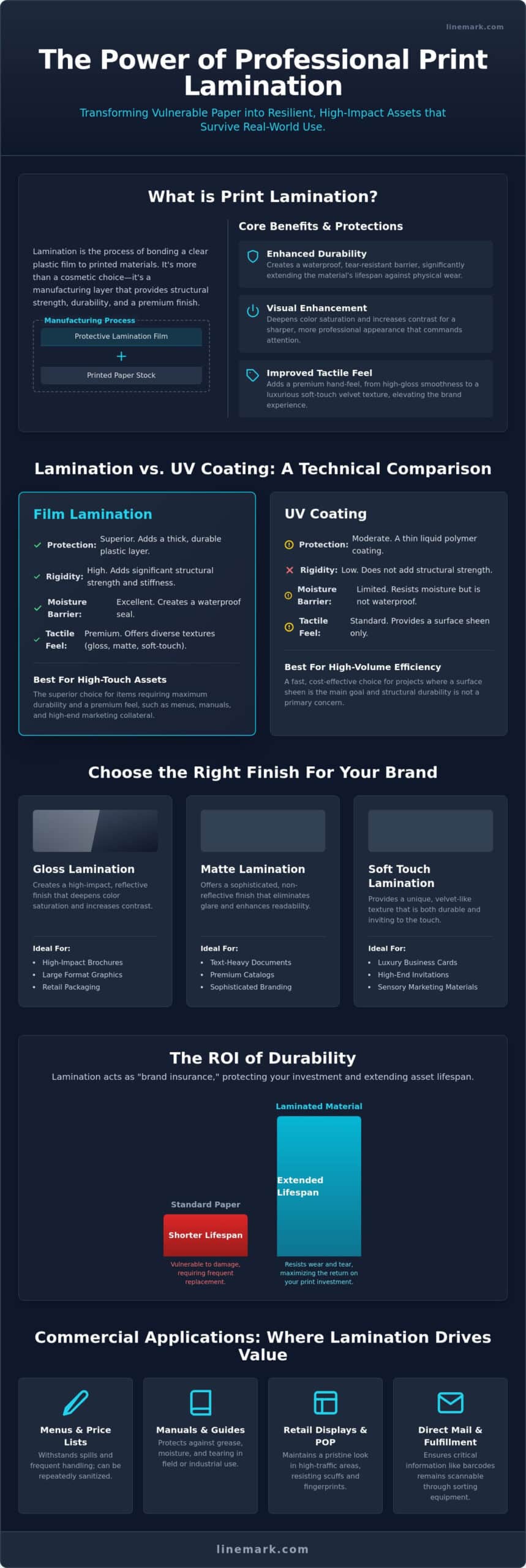
High-volume commercial printing represents a substantial capital investment. To protect that investment, many organizations turn to professional print lamination services. At its core, lamination is the process of bonding a clear plastic film to printed materials to enhance both their structural strength and visual appearance. Understanding What are Print Lamination Services involves viewing the finish as more than a cosmetic choice; it’s a manufacturing layer that provides stability and permanence to paper-based assets.
This finishing process serves as “brand insurance” against environmental degradation. While standard paper stock is vulnerable to humidity, spills, and physical wear, a laminated surface creates a barrier that is essentially waterproof and highly resistant to tearing. For outdoor signage or materials used in harsh industrial settings, UV-protective laminates prevent ink from fading under direct sunlight. This ensures that your brand’s visual identity remains sharp and professional long after the initial distribution.
To better understand this concept, watch this helpful video:
The Functional Role of Lamination in 2026
In 2026, the technical requirements for finishing have evolved. Digital prints, which use toners rather than traditional offset inks, require specific print lamination services to prevent edge peeling or “silvering.” High-capacity production facilities now utilize specialized adhesives that bond aggressively to digital toners. Beyond aesthetics, lamination plays a critical role in public health and hygiene. For shared materials like menus or training manuals, laminated surfaces allow for frequent sanitization with chemical cleaners without damaging the underlying print. This durability is also vital for variable data prints in complex direct mail campaigns, where unique barcodes and addresses must remain legible through high-speed sorting equipment.
Lamination vs. UV Coating: Making the Right Choice
Choosing between film lamination and UV coating depends on your project’s specific goals. UV coating involves applying a liquid polymer that is cured under ultraviolet light. It’s an excellent choice for speed and high-volume cost efficiency when you only need a surface sheen. However, it doesn’t provide the structural rigidity of film lamination. Lamination adds physical thickness and tensile strength, making it the superior option for items that require frequent handling or folding. While liquid coatings are faster to apply, film lamination offers a premium hand-feel and superior protection against moisture penetration. For high-volume commercial runs, a strategic partner helps you weigh the incremental cost of film against the significantly extended lifespan of the collateral.
Technical Specifications: Choosing the Right Laminate Type
Selecting the ideal finish for your project requires a balance between aesthetic goals and functional requirements. Gloss lamination remains the industry standard for creating immediate visual impact. It deepens color saturation and increases contrast, making it the preferred choice for high-impact brochures or large format graphics. Conversely, matte lamination offers a non-reflective finish that eliminates glare. This is often the sophisticated choice for text-heavy documents or premium catalogs where readability and an understated look are the primary objectives. High-quality print lamination services allow you to tailor these visual properties to match your brand’s specific communication goals.
The decision process involves more than just selecting a sheen. Modern lamination technology provides a variety of textures that influence how a customer perceives your brand. Soft touch lamination, for instance, has redefined the sensory experience of print. It provides a velvet-like texture that is both durable and inviting. When these technical specifications are aligned with the right paper stock, the result is a finished product that feels significantly more valuable than standard printed collateral.
Tactile Finishes and Scuff Resistance
The rise of tactile marketing has made soft touch laminates a staple in custom book printing. This finish provides a premium feel while offering a layer of protection that resists fingerprints. For projects with high-ink coverage, scuff-resistant matte films are essential. They ensure that dark, saturated colors remain pristine throughout the rigors of shipping and handling. Additionally, functional laminates can provide write-on and wipe-off capabilities. This is a practical solution for educational workbooks or industrial checklists that require frequent updates without the need for replacement.
Selecting the Proper Film Thickness
Durability is measured in “mils,” with one mil representing one-thousandth of an inch. Understanding these technical specifications for lamination is vital for determining the longevity of your assets.
- 1.5 to 3 mil: These thinner films offer flexible protection. They are ideal for book covers or folded brochures that need to remain lightweight.
- 5 mil: This is the “sweet spot” for high-traffic items like restaurant menus. It provides enough rigidity to stand upright while maintaining a manageable weight for users.
- 10 mil: This heavy-duty option is reserved for industrial signage and ID cards. It creates a rigid, credit-card-like feel that can withstand extreme environments.
Thickness also dictates how a piece will be handled in the final stages of production. Thicker films can complicate folding and may require specialized scoring or specific binding and finishing techniques to ensure the material doesn’t crack or spring back. Consulting with an expert in print lamination services early in the design phase prevents these technical hurdles during the production cycle.
Commercial Applications: Where Lamination Drives Value
The strategic application of print lamination services extends far beyond simple protection. In commercial environments, the finish on your printed collateral often serves as the first physical touchpoint for a customer or partner. High-volume sectors like hospitality and retail rely on lamination to create menus and point-of-purchase displays that maintain a “just-printed” look despite constant handling. In these high-traffic settings, durability directly correlates with brand perception. A frayed or stained menu suggests a lack of attention to detail, whereas a crisp, laminated piece reinforces a commitment to quality and operational excellence. To see an example of a business that prioritizes professional presentation in the Western Wisconsin region, you can check out Coulee Land Company.
In the education and training sectors, laminated manuals and workbooks are essential for materials that must survive daily classroom or field use. This is particularly true for technical documentation; for instance, field teams using online boring log software often laminate their printed logs to ensure they remain legible when exposed to mud and moisture on-site. These items are often subject to repeated page-turning and environmental exposure that would quickly degrade standard paper stocks. Corporate communications also benefit from this industrial treatment. Elevating annual reports or high-stakes presentation materials with a sophisticated matte or soft-touch finish transforms a standard document into a tangible brand asset. This tactile quality justifies the investment in high-end printing by ensuring the final product feels substantial and permanent in the hands of stakeholders.
Direct mail campaigns present a unique logistical challenge that requires a durable solution. Postcards and brochures must navigate the rigors of the postal system, which involves high-speed sorting machinery and varying weather conditions. Utilizing print lamination services ensures that your marketing message arrives in mint condition, free from the scuffs or moisture damage that can occur during transit. This resilience ensures your call to action remains legible and professional upon arrival.
Lamination for Large Format Graphics
Protecting large format graphics is a technical necessity for maintaining long-term visual impact. For outdoor banners, lamination adds the structural integrity required to withstand wind loads and temperature fluctuations while preventing UV fading. In retail environments, floor graphics require specialized, slip-resistant laminates. These finishes are engineered to meet rigorous safety standards while protecting the graphic from heavy foot traffic and industrial cleaning equipment, ensuring the display remains vibrant and safe for the duration of the campaign.
Enhancing Custom Book Manufacturing
Laminated covers are a critical component in professional book manufacturing, particularly for perfect bound and spiral bound projects. The lamination provides a hinge-effect that prevents the spine from cracking when the book is opened and closed repeatedly. For high-end coffee table books, lay-flat laminates ensure that the cover remains perfectly straight even in varying humidity levels. This level of precision is particularly important for technical manuals used in industrial workshops where grease, moisture, and heavy usage are constant factors.
The Industrial Advantage: Integrating Lamination into Fulfillment
Centralized production is a strategic asset for high-volume commercial projects. Most retail lamination involves shipping prints to a third-party vendor, which adds unnecessary days to your production timeline. By housing industrial print lamination services within a 90,000-square-foot production environment, the transition from press to finishing is instantaneous. This proximity eliminates the risks of transit damage and significantly reduces overall lead times. It allows for a unified quality control process where lamination is treated as a critical production stage rather than an afterthought.
Integrating finishing into direct mail workflows requires precise synchronization. Automation allows the flow to move from the digital or offset press directly to high-speed laminators and then onto the kitting line without manual intervention. This unified approach also solves a common industrial challenge: color consistency. Lamination naturally alters light refraction, which can make colors appear darker or more saturated. Professional facilities use advanced color management to calibrate the press specifically for the chosen film, ensuring a perfect match between laminated covers and non-laminated interior components.
Streamlining Kitting and Distribution
Lamination serves as a critical shield during high-speed kitting operations. When components are mechanically inserted into envelopes or boxes, the friction can cause ink scuffing on unprotected paper. For organizations managing inventory through marcom on-demand portals, laminated assets remain shelf-stable longer. They resist curling and environmental moisture while stored in the warehouse, ensuring that on-demand orders always meet brand standards. Additionally, using durable, laminated outer packaging can reduce the need for excess shipping filler, creating a more efficient and sustainable distribution model.
Scalability for National Campaigns
Executing national campaigns involving 10,000 or more units requires industrial-scale equipment capable of maintaining consistent edge-seal quality. Small-scale shops often struggle with heat fluctuations that lead to bubbling or delamination over long runs. A centralized provider manages the complex logistics of nationwide distribution while maintaining the integrity of each batch. This includes managing versioning and variable data within laminated batches, ensuring that personalized marketing remains protected and legible throughout the entire mailing process.
Consult with our finishing experts to streamline your next high-volume campaign.
Why Linemark is the Strategic Partner for Print Lamination
Linemark represents the intersection of industrial capacity and meticulous craftsmanship. Managing high-volume projects requires more than just machinery; it requires a deep understanding of how different substrates interact with various films. With over 30 years of industrial printing experience, we’ve refined our print lamination services to serve as a final quality gate in the production cycle. Our 90,000-square-foot facility is designed to handle complex, multi-stage projects under one roof, ensuring that your brand aesthetics remain consistent from the first sheet to the last. This centralized approach minimizes logistical friction and guarantees that every component meets our rigorous internal standards.
Our commitment to innovation means we constantly invest in the latest technical production capabilities. We don’t just apply a film; we engineer a solution that accounts for the nuances of modern marketing and logistics. Whether you are producing a single high-impact annual report or a nationwide retail rollout, our operation maintains the precision of a boutique shop at an industrial scale. This reliability is why leading organizations trust us as their strategic communications ally for their most critical print assets.
Precision Technology and Quality Control
Our facility utilizes advanced thermal lamination technology to achieve superior bond strength. This is particularly critical for digital prints where toner-heavy surfaces often resist standard adhesives. We employ rigorous inspection protocols to identify and prevent common industrial defects like silvering, bubbling, or edge-lifting. Every project undergoes a customized assessment to determine the ideal film and adhesive combination based on the final application. This technical precision ensures that your materials don’t just look professional when they leave our floor but remain durable throughout their entire lifecycle in the field.
A Partnership Built on Reliability
We position ourselves as a strategic communications ally rather than a transactional vendor. This shift in perspective means we consider how your laminated components will integrate into larger marketing and logistics goals. Our team provides dedicated project management for complex orders, overseeing everything from initial design considerations to nationwide distribution. We understand that your printed materials are a catalyst for growth, and we treat every project with the meticulous attention it deserves.
As you plan your 2026 marketing budget, consider lamination a strategic investment in brand longevity. Moving your production to a centralized, high-capacity partner reduces logistical overhead and ensures a unified brand presence across all channels. You’re invited to explore how our integrated binding and finishing capabilities can elevate your next campaign. Contact our team to begin a holistic journey that transforms your printed assets into lasting brand statements.
Scaling Your Brand Through Industrial-Grade Finishing
Professional finishing is the final quality gate that transforms standard paper into a resilient brand asset. By selecting the correct mil thickness and tactile finish, you ensure your materials survive high-traffic environments while projecting a premium image. Integrating print lamination services directly into a centralized production workflow eliminates the logistical gaps that often delay high-volume campaigns. This unified approach guarantees that your visual identity remains consistent across every touchpoint, from the first brochure to the last direct mail piece.
With 30+ years of commercial expertise and a 90,000-square-foot production facility, we provide the scale and precision necessary for complex projects. Our national fulfillment and kitting capabilities ensure your protected assets arrive in pristine condition, regardless of the destination. You don’t have to navigate the technical nuances of industrial finishing alone when you have a seasoned partner to guide the process. Request a custom quote for your industrial lamination and printing needs and discover how a strategic finishing strategy can catalyze your brand’s growth. Your next high-impact campaign starts with a durable foundation.
Frequently Asked Questions
What is the difference between thermal and cold lamination?
Thermal lamination uses heat-activated adhesives to bond the film to the paper. It’s the industry standard for high-volume commercial projects because it provides a superior, permanent bond. Cold lamination relies on pressure-sensitive adhesives. This method is typically reserved for heat-sensitive substrates, such as certain large-format vinyls or specific types of ink that might degrade under high temperatures.
Can you laminate both sides of a printed sheet?
Yes, double-sided lamination is a standard procedure for materials requiring maximum protection. This process encapsulates the paper between two layers of film, creating a moisture-proof seal. It’s the preferred method for items like restaurant menus, reference cards, and educational workbooks. This technique ensures the piece remains rigid and protected from environmental damage on every surface.
How does lamination affect the final color of my print project?
Lamination alters how light reflects off the surface, which impacts color perception. Gloss finishes tend to deepen blacks and increase color saturation, making graphics appear more vibrant. Matte finishes eliminate glare and can slightly mute colors, which often provides a more sophisticated look. Professional print lamination services include color calibration to ensure the final result aligns with your brand standards.
What is the most durable mil thickness for restaurant menus?
A 5-mil or 10-mil thickness offers the best balance of durability and handling for hospitality environments. A 5-mil laminate provides a sturdy, semi-rigid feel that allows menus to stand upright in displays. For heavy-duty applications where the menu must remain completely rigid, a 10-mil laminate is the ideal choice. This thickness effectively prevents bending, tearing, and dog-eared corners over months of daily use.
Can laminated materials be recycled in 2026?
Recycling laminated paper is difficult because the plastic film must be separated from the paper fibers. While some specialized industrial facilities can process these materials, most municipal programs still treat them as landfill waste. For organizations with strict sustainability goals, we recommend discussing aqueous coatings or bio-based films as alternatives for projects that don’t require the extreme physical protection of traditional lamination.
Does lamination work on all types of paper and cardstock?
Most standard paper stocks are compatible, but high-ink coverage and digital toners require specialized technical consideration. Digital prints often need “high-bond” laminates to ensure the film adheres to the toner rather than peeling at the edges. Extremely textured or porous stocks may also require specific adhesives to ensure a smooth, bubble-free finish. Our experts evaluate your substrate to ensure a perfect bond.
How long does it take to add lamination to a high-volume print run?
In a centralized 90,000-square-foot facility, adding lamination usually adds 24 to 48 hours to the total production timeline. Because the finishing equipment is located alongside the presses, there’s no delay for third-party transit. This integrated workflow allows for high-speed, automated finishing that keeps high-volume print lamination services on a streamlined schedule for nationwide distribution and kitting.
What is soft-touch lamination and when should I use it?
Soft-touch lamination is a premium finish that provides a velvet-like, matte texture. It’s an excellent choice for luxury brand materials, annual reports, and custom book covers where a sophisticated tactile experience is a priority. This finish is also naturally scuff-resistant. It’s particularly effective for dark-colored designs that might otherwise show fingerprints or scratches during the rigors of shipping and handling.